Depending on which reference you read, the dates of the Adena Culture vary by state. Kentucky archaeologists place them in the years between 400 BC and 200 AD.
Kentucky’s Adena People were contemporary with the Proto-Uchee Deptford and Cartersville Cultures in Georgia, plus Copena Culture in Alabama and western Georgia.
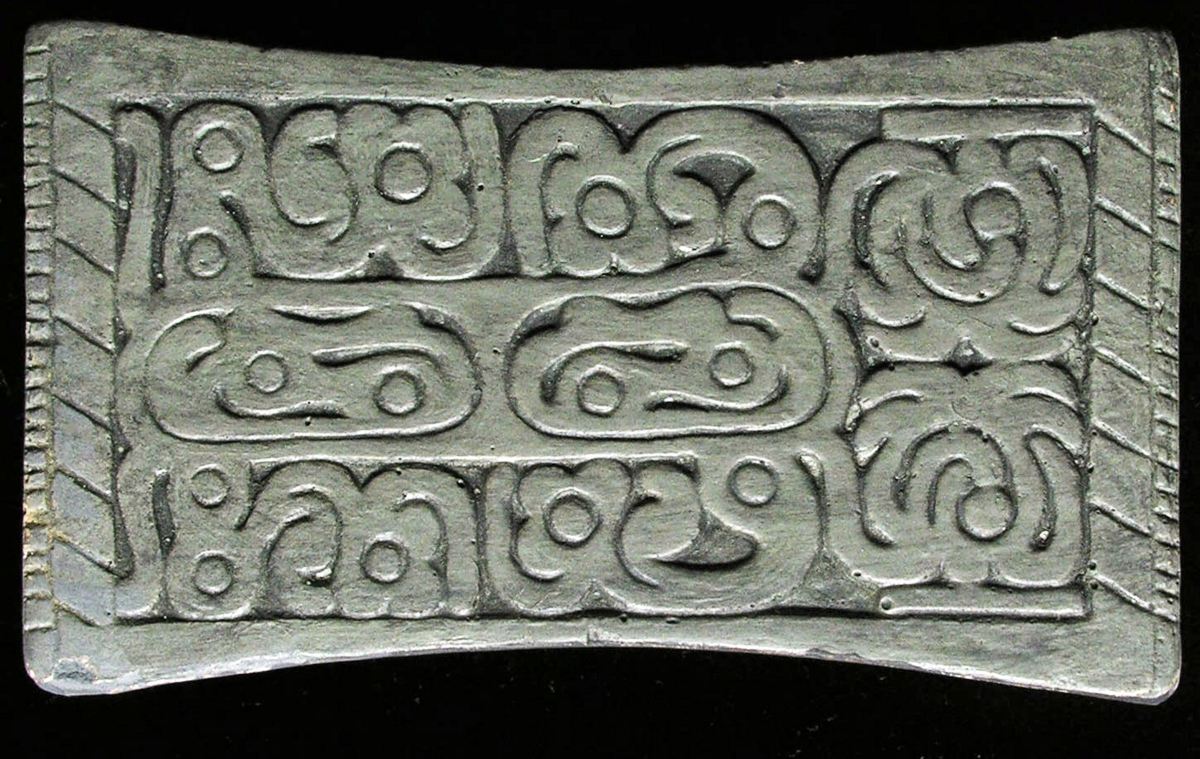
Image Above: This is the famous Cincinnati Tablet, found immediately across the Ohio River from the state of Kentucky. Measuring approximately 5 inches in length, 3 inches in width, and 0.5 inches thick, the Cincinnati Tablet is made from a very fine-grained sandstone and is considered the most sophisticated example of Adena Art. The tablet was probably used for applying tattoos or dying cloth. Adena art was quite similar to the wooden paddles carved by Austronesians and Polynesians for applying tattoos and dying cloth.
It was recovered during the fall of 1841 when a grading team was removing a complex of human-made burial mounds near Fifth and Mound Streets, which today is a large UPS facility just west of Interstate 75. While removing the mound complex in preparation for road construction, workers began to uncover numerous exotic artifacts, including thin copper cut-outs, well made lithic tools, galena ore, mica, shell, bone and copper beads, as well as perforated bear canine pendants, large marine shells, and two polished bone awls or perforators.
 The Americas Revealed