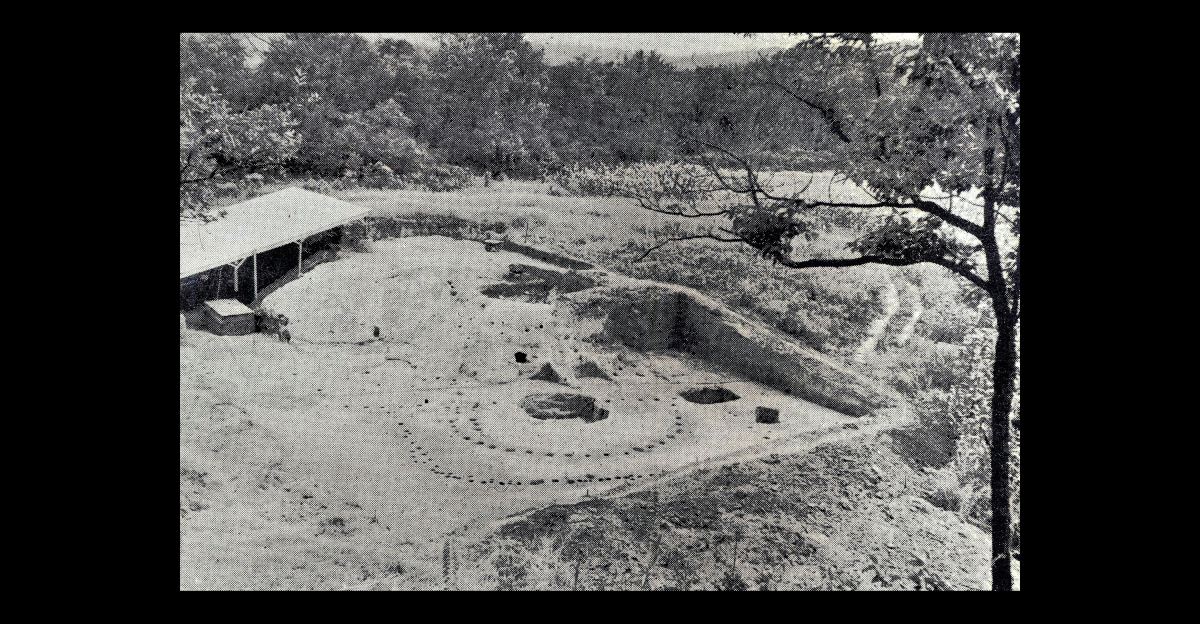
The photo above by Dr. Arthur Kelly, captures the moment when Dr. Lewis Larson’s crew unearthed the famous Etowah Marble Statues in a collapsed log mausoleum at the base of Mound C.
Note that a round temple was erected around the log mausoleum. At some future date, dirt was dumped on top of the collapsed temple. Descendants of the founding family of Etula (Etowah Mounds) continued to bury their deceased elite in the continually growing mound until the 1600s.
by Richard L. Thornton, Architect & City Planner

Bronze Age burial (c. 2500 BC) in the Steppes, where the Yamnaya Culture began.
The oldest known burial mounds in Europe are found in Ireland. They date from the Neolithic Period (around 3800 BC) or later.
The oldest known burial mounds in the world are found on the Louisiana State University campus in Baton Rouge and are about 11,000 years old. The tradition may have begun in North America and spread across the northern hemisphere.
Most of the major earthen pyramids and mounds in the Southeastern United States and Ohio River Basin began as the burial of an important person or group of important persons . . . whether or not the structure later was used as a platform for a temple or home of a ruler.
The archaeological reports from the famous digs of the 20th century in eastern North America contain fascinating details that are left out of museum exhibits. In 2007, the Muscogee Creek Nation ask me to investigate a complaint from secret source inside the National Park Service archaeological research center at Harpers Ferry. This person claimed that the museum exhibits at Ocmulgee Mounds conflicted with what was actually unearthed in what is still the largest archaeological project ever in the United States.
The National Park Service whistle-blower was correct. I was given access to Dr. Arthur Kelly’s original site plan for Ocmulgee, which was actually prepared by Georgia Tech graduate, Joe Tamplin*, plus a 1974 report from a team of National Park Service archaeologists, who obtained radiocarbon dates from key locations in the park. Human occupation at Ocmulgee and in Macon, Georigia long predated Cahokia Mounds in southern Illinois. The Mississippian Culture had begun at Ocmulgee, not Cahokia . . . so perhaps it should be called the Ocmulgian Culture?
Through the years, artists and exhibit designers had “dumbed down” the appearance of the Acropolis at Ocmulgee. For the first century, most of the buildings were round, not rectangular. However, throughout its existence, the Acropolis was densely occupied by a variety of specialized, sophisticated architecture, which included temples, the large houses of merchants, warehouses, community dining halls, and meeting facilities for “societies.”
The Lamar Village was not settled 200 years after the Acropolis was abandoned (c. 1150 AD) as stated in the museum, but around 1000 AD. The people, who founded this village, founded Etula (Etowah Mounds) a few years later. The town at the Lamar Site (Itzasi) remained occupied until the mid-1700s! Itzasi means Itza (Mayas) – descendants of!

The log-lined burials at Ocmulgee Mounds and Etowah Mounds were actually log mausoleums. The mausoleum at Etula (Etowah Mounds) was actually a small building within a larger round building for a generation or so. This may have been the case at Ocmulgee, also.
For the first time, in 1974 the NPS archaeologists obtained radiocarbon dates for the bases of several major mounds. The oldest date, c. 900 AD, was obtained for a log-lined tomb under Mound A. It was followed soon thereafter by an adjacent log-lined tomb of another important male. The archaeologists found that both men were American Indians and probably related. All the other mounds also began as log-lined tombs.
The NPS archaeologists found much older radiocarbon dates for houses in certain neighborhoods of Ocmulgee and for a large town across the river, which now is in the edge of Downtown Macon. Humans had been living almost continuously at Ocmulgee National Historical Park since the end of the Ice Age!
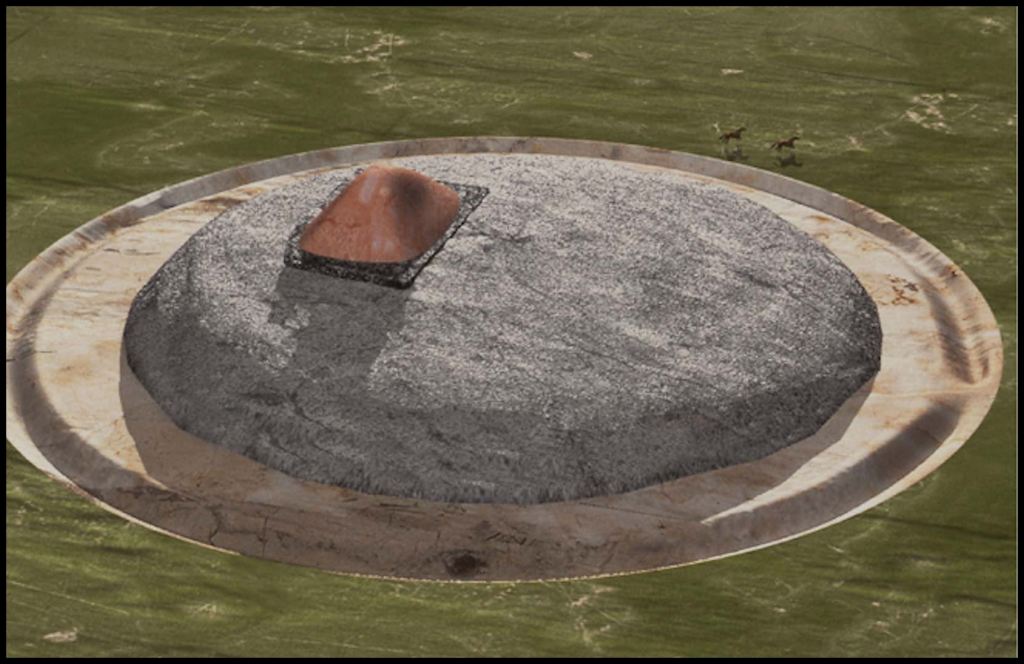
Virtual reality image of a log-lined tomb and burial mound over it during the Early Iron Age . . . on the Steppes of Ukraine. It dates from the same time period as Adena Mounds and shares several features. Note the single entrance from the south side, ditch and timber palisade.
A burial tradition spanning the Northern Hemisphere
Log-lined burials, covered with earthen mounds are found across the vast Steppe region, stretching from northern China through southern Siberia to the northern Black Sea. They are also found in southern Sweden, southern Norway, Ireland, Scotland, Wales and northern parts of England.
Did log-lined tombs began in North America then travel back to Siberia? Conversely, did American Indians bring the tradition with them when they traveled from Asia to the Americas many thousands of years earlier? It is an un-answered question.
However, the oldest burial tradition in Sweden, Finland and Karelia was to wrap the dead loved ones in fish netting and then pin the netting to the bottoms of shallow ponds. This tradition is associated with the ancestors of the Sami. It is also the 8,000 – 6,000 year-old burial practice at Windover Pond, Florida.
*The “dumbing down” of Joe Tamplin
The “dumbing down” process also extended to the history of Ocmulgee Mounds’ excavation. I first discovered this professional engineer’s name on the original site plan of 1930s excavation. A book by University of Georgia archaeological professors, Ocmulgee Archaeology, 1936–1986, had briefly mentioned him as “a laborer or foreman at the dig, who showed up at our 1986 conference.” I became curious and did some sleuthing. That sleuthing is now an article posted on LinkedIn.
Well . . . no Dr. Hally . . . Joe Tamplin was the supervising archaeologist at Ocmulgee and the only licensed professional, who ever worked on the dig. All engineers and architects must work as interns for several years and then pass a horrific national exam prior to using their professional titles. Archaeologists are not licensed by most states.
Dr. Arthur Kelly was based in Atlanta and responsible for all WPA and CCC – funded archaeological digs in Georgia. He was only able to be on-site in Macon, GA a few days a month. Joe Tamplin remained in Macon and became a respected civic leader there.
The Truth is out there somewhere!
 The Americas Revealed
The truth is way better than what they offer on the history channel
LikeLiked by 1 person
I try to share my past experiences so others will experience what I experienced. Those experiences are not necessarily the whole truth, but at least what we thought was the whole story at that time. LOL
LikeLike