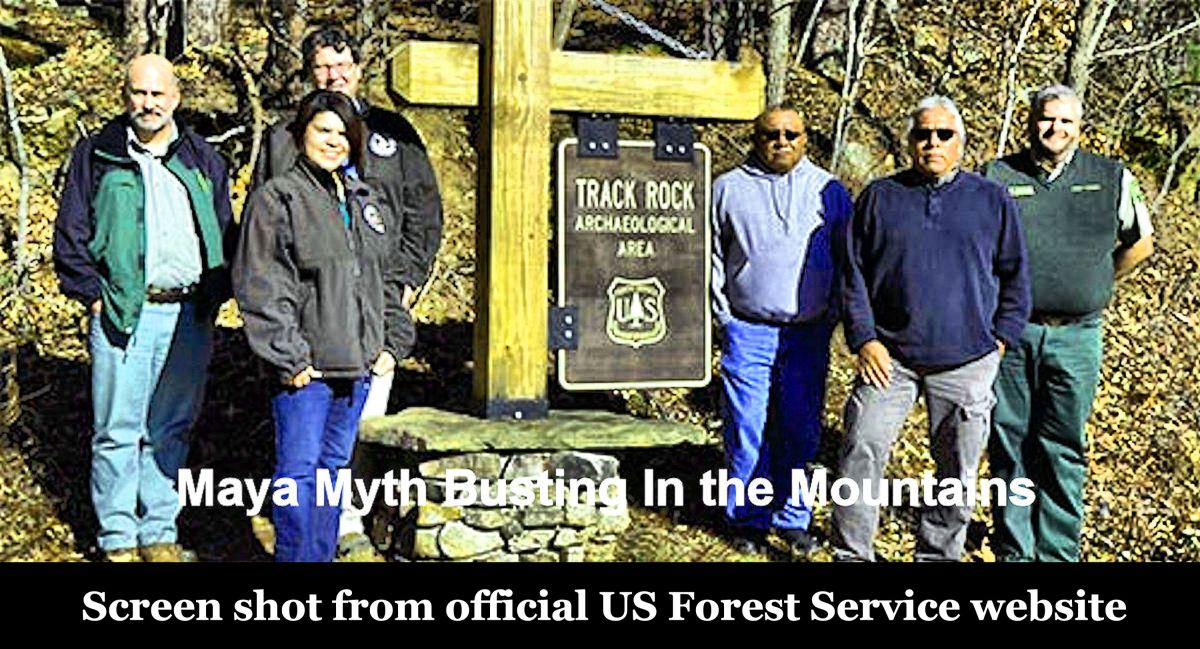
The Itza Mayas were dominant in the southern Appalachian Mountains, but bands of several other Mesoamerican peoples also settled in Eastern North America. The Upper Creeks were Toltecs from southern Veracruz.
Actually, Mesoamerican colonists also settled in Tennessee, western North Carolina, certain river basins in South Carolina and Alabama, southern Louisiana, the eastern edge of Oklahoma, central Arkansas, southern Florida, plus western Virginia . . . big time! Their words dot the landscape of the Southeastern United States.
IF Mesoamerican colonists settled in eastern North America was never a question for anyone, who knew anything about the subject, like the chief archaeologist at Chichen Itza, Alfonso Morales , , , However, when and why has been a continuing focus of my research over the past decade. I still don’t have a final answer.
by Richard L. Thornton, Architect & City Planner
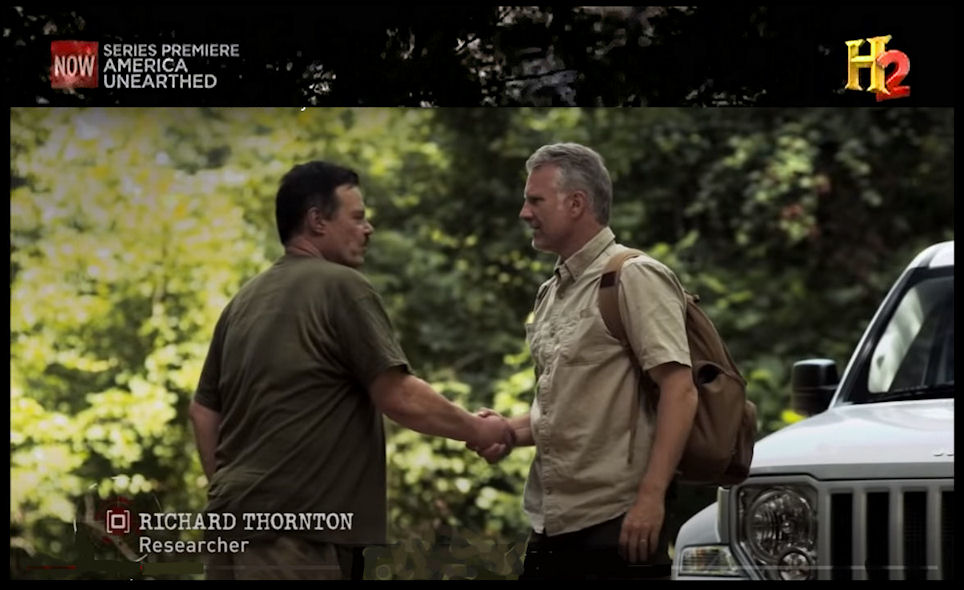
Two Images Above: Despite the deplorable condition of the roads in the Chattahoochee National Forest in northern Georgia . . . making many impassible . . . most of its staff in the main Gainesville, GA office were assigned to work on a political campaign throughout much of 2012 to discredit in advance the premier of the History Channel’s “America Unearthed.” Untold thousands of taxpayers’ dollars were wasted by USFS employees, who obviously knew nothing about the subject.
You see . . . Chattahoochee is the Anglicization of the Highland Maya words, Cha’ta Hawche, which mean: “Carved Stone (stela) – Shallow River.” The premier, now known as “America’s Mayan Secrets,” has become the most watched one hour documentary ever on the History Channel. Since 2017, it has been owned and broadcasted repeatedly by The Travel Channel and Amazon Prime.

It is made in Mexico . . . It is well made!
Continuing our 2024-2025 series on the Peopling of North America, we come to the question of contacts and immigration between Eastern North America and Mesoamerica. For decades that was a forbidden subject amongst Gringo archaeologists.
In December 1969, Dr. Arthur Kelly was driven out of the Department of Anthropology at the University of Georgia. Kelly had dared to show prominent Atlanta Journal-Constitution writer, John S. Pennington, artifacts that he had unearthed along the Chattahoochee River, which he thought were made in Mexico or were copies of artifacts, made in Mexico.
Dr. Kelly showed me those same artifacts in February 1969. He was right. In August 1970 I observed and photographed very similar figurines, platters, bowls and ceramic seals at the Tabasco State Museum in Villahermosa. That was just the beginning of a journey to determine the truth, which continues to this day.
On July 6, 1735 General James Edward Oglethorpe wrote a cover letter to King George II for the shipment of a wooden chest containing “the Creek Migration Legend” and several ethnological reports by Georgia’s Colonial Secretary, Thomas Christie. In the letter, he stated, “The Native Peoples of Georgia are unlike any encountered before by the British. They [Creek, Uchee, Chickasaw and Soque] are obviously the descendants of great civilizations and should be treated as equals in all matters.” Indeed, the readers will be shocked what surprising information is coming out of recent/current genetic, architectural and linguistic studies.
Right now, unfortunately, I am extremely busy with spring planting and doing professional work for an alliance of scientists scattered about the United States. My graphics work is in support for their research into the peopling of the Americas in the period when Indigenous Americans evolved from being hunter-gatherers to being master agriculturalists.
Therefore, the articles for awhile will be brief discussions of specific topics. You will have to read all of the articles to get the big picture.
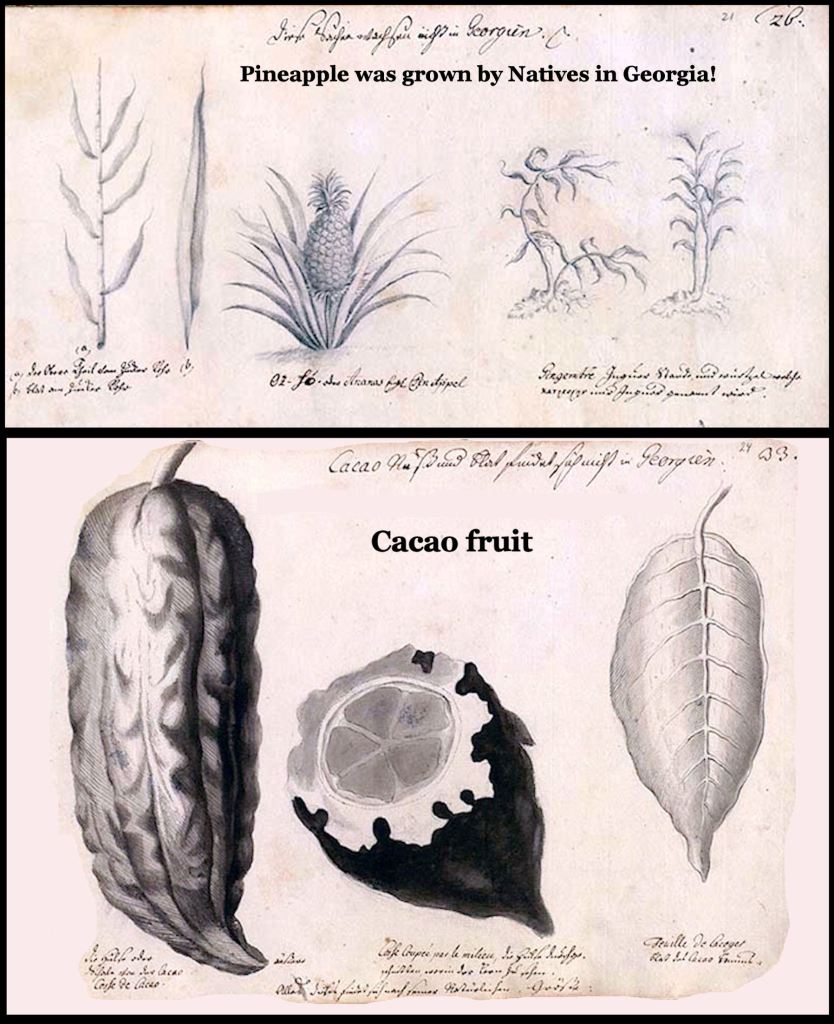
As proven by these sketches by Georg Von Reck, the Uchee near Savannah had selectively cultivated pineapple plants and cacao trees from southern Mexico to create crops, which were adapted to the Savannah Area’s climate. The temperatures do slightly and occasionally dip below freezing on the Georgia Coast. This would have killed the parent plants in southern Mexico.
Founding role of the Uchee
The largest province of the Uchee (Uchee, Euchee) was between the Ogeechee and Savannah Rivers when the British North American colonies were being founded. However, there were smaller Uchee provinces and individual trading towns throughout the Southeastern United States.
The Uchee were not ONE ethnic group, but an alliance of several Sea Peoples, who initially settled along the South Atlantic Coast then worked their way inland as traders. The Savannah-Ogeechee Province was composed of Austronesians, not people, whose ancestors came from northeastern Siberia. Other Uchee tribes had Pre-Gaelic Irish, Iberian, Pre-Germanic Nordic, Scottish Gaelic Basque and Sami names. Culturally, the Uchee were most similar to the Sami of northern Scandinavia and the pre-Gaelic Irish. This is particularly true of their religion.
The Uchee have a tradition that their traders once traveled long distances by land and water – even traded with the Gulf Coast peoples of Mexico. Right now, I believe that the Uchee traders introduced pottery-making and mound-building to the Gulf Coast and southern portion of Mexico. This would have been in the period between 1000 BC and 900 BC.
Over time, the Uchee Sea Peoples, who settled along the Gulf Coast of southern Mexico intermarried with local American Indians . . . eventually becoming known as Coastal Mayas, who unlike other Maya tribes were not afraid of the ocean and were skilled mariners.
Next time . . . the importance of attapulgite and mica
 The Americas Revealed