As a result, they stuck us with a bogus orthodoxy for the Native American history of Eastern North America.
From the Shenandoah Valley to southern Florida . . . Charleston, SC to southern Kansas and western Utah . . . the landscape of the United States is dotted with Mesoamerican and South American Indigenous place names!
Ironically . . . the words, Cha’ta Hawche, are easily recognized by the 300,000+ Highland Mayas, now living in the State of Georgia, but its archaeologists are generally unaware of the real meaning of this famous river’s name . . [ancient, carved stone – shallow river].
by Richard L. Thornton, Architect & City Planner
The Mayas in Georgia Series
Spoiler Alert! Chattahoochee, Miami, Tallahatchie, Mobile, Altamaha, Chehaw, Waxhaw, Etowah, Alabama, Tula, Tomahitan and Chickee are some of the many Anglicized versions of Highland Maya words that we see every day!
I have tried to reach out to the many thousands of Indigenous immigrants from Mexico and Central America near where I lived, during the time since I returned to Georgia. My next door neighbors in Jasper, GA were affluent Purapeche from Michoacan . . . my favorite state in Mexico. They were astounded, when I showed them color slides of Michoacan, taken when I was a young man on a fellowship in Mexico.
It is a difficult task because of their fear of Gringos . . . almost impossible in recent months. Sometimes, I do get to connect with the indigenous peoples in the communities around the Nacoochee Valley, where I shop.
There was Pedro from the Guatemalan Highlands at Cleveland (GA) Builders Supply. I rolled off several words in Itsate, the language spoken by my Creek ancestors. You should have seen the look on his face, when he understood every word. He exclaimed, “Richard, I live near the Chattahoochee River!”
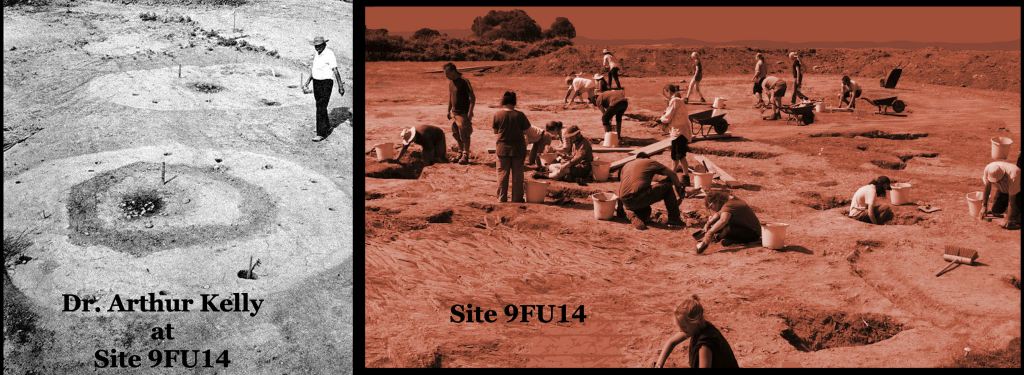
This highly publicized archaeological site is now an industrial park
I was just a wet-behind-the-ears Sophomore in Architecture at Georgia Tech, when I first met the famous archaeologist, Dr. Arthur Kelly. Like a sponge, I soaked up every word he spoke as pearls of wisdom. He was absolutely correct in his interpretation of Chontal Maya artifacts on the Chattahoochee River. However, during the past 25 years, the internet has enabled me to read many of the archaeological reports produced by Kelly and other prominent Southeastern archaeologists of his era.
There is something consistently odd about their professional work that one does not see in contemporary research done in the Late 20th century by Latin American and European archaeologists. The Gringos shared a belief that Native American place names could not be translated, plus were irrelevant to the town site that they were excavating.
If Kelly or even Southeastern archaeologists today, try to throw a bit of cultural awareness into their archaeological report, they will quote a translation of a Creek/Seminole word, first published by Smithsonian ethnologist, John W. Swanton, in the early 20th century. None seemed able to afford the very modest cost of a Muscogee-Creek or Seminole dictionary.
Swanton promoted himself as an expert on the Creeks and Creek languages. He didn’t know that actually, Muskogee, was a minority language until the late 1700s. I am not sure if he even ever had a conversation with a actual Creek or Seminole Indian. He did accumulate significant archival information on the Creeks during the mid-1700s to mid-1800s, but ignored descriptions of them in the 1500s and 1600s. Nevertheless, his translations are out in lala land . . . for the most part, grossly inaccurate. He obviously did not use a dictionary either. However, academicians and references always cite Swanton as the primary source of knowledge . . . even today.
Our next article in The Americas Revealed will provide readers a concise glossary of Pre-Columbian Maya/Mesoamerican place names around the United States. That will be followed in a couple of weeks by a glossary South American and Caribbean place names around the United States.
It’s a whole new world!
 The Americas Revealed