No Maya ever called him-or-herself, Maya, until the Spanish conquered Mexico!
Mayas In Georgia Series
by Richard L. Thornton, Architect & City Planner
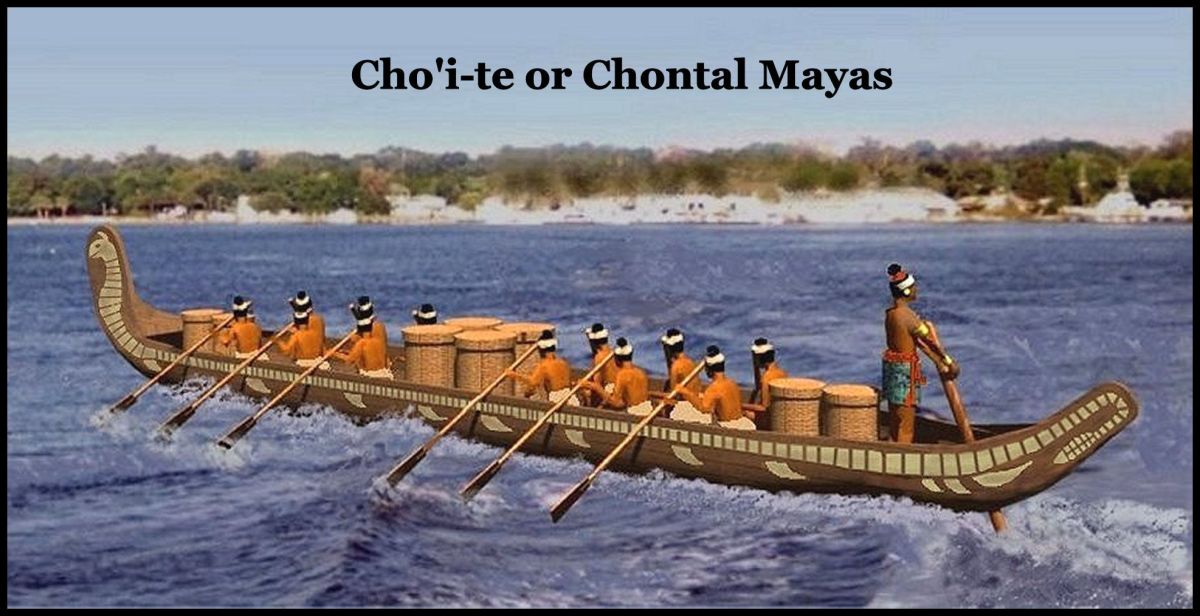
In 1502, Bartholomew Colon, brother of Christopher Colon (Columbus), encountered a large, trading canoe while scouting the island of Guanaja near present-day Honduras. Bartholomew boarded the canoe, finding it laden with Chontal Maya merchants and a rich cargo.
The Spaniards’ interpreter asked the Indigenous mariners, where were they from. They said, “Mia-am” . . . which Bartholomew wrote down as Mayam. In Spanish, the letter Y is pronounced as an English ē.
The word is Itza and means “Island-living place of” or we might say, “Island People.” It originally applied to the province around Lake Okeechobee, Florida, where the villages were located on islands in the swamps . . . but when some of those people immigrated to the northern tip of Yucatan, they continued to use the same tribal name, even though there are no lakes or islands in the northern Yucatan Peninsula. The people of the mother province called it, Mia-am-I, which means in Itza, “Island – living place of – principal” . . . Homeland of the Island People. That word became Miami to Anglo-American settlers in the 1800s.
The Colon brothers began labeling the natives on the tip of Yucatan as Mayas. Soon all of the indigenous peoples in the Yucatan Peninsula were called Mayas by the Spanish. Now people in Tabasco, Chiapas, Campeche, Yucatan, Quintana Roo, Guatemala, Belize and Honduras, whose Pre-Columbian ancestors never called themselves, assume that it is a Native American word, which has always been used.
When Spain finally subjugated all of the indigenous peoples in the Yucatan Peninsula and southern Mexico in the mid-1500s, for administrative expediency, all tribes speaking similar languages were labeled, “Maya.” However, up until the 20th century, most of these people thought of themselves being members of a distinct tribe, whose members spoke the same dialect or language. Not all “Maya” languages are mutually intelligible.
The correct pronunciation of Maya in English phonetics is Mă : ē : ă . . . not Mă : yă. However, no North American archaeologists or talking heads on TV and YouTube seem to know that!
Now you know!
 The Americas Revealed