The important role of Dr. Román Piña Chan in understanding the Southeastern USA’s true past
SLIDE SHOW
The moment when the famous Etowah marble statues were discovered . . . and then 14 years later, when I learned that the Mayas came to Georgia
The Mayas in Georgia Series
by Richard L. Thornton, Architect & City Planner
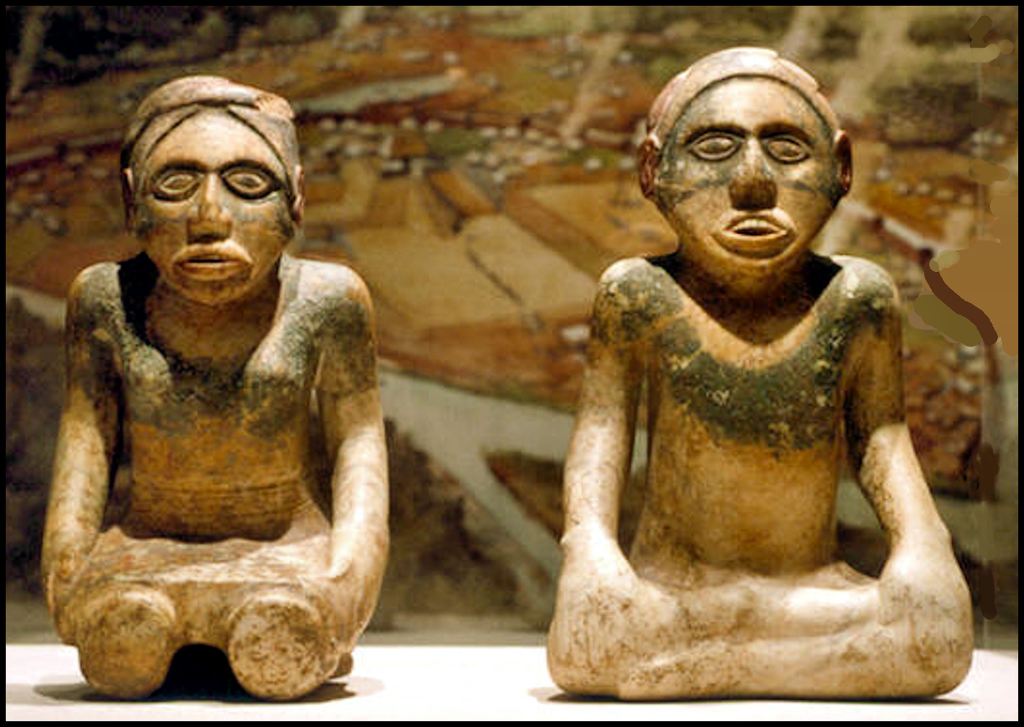
The clothing and face paint of these statues, unearthed underneath Mound C at Etowah, are identical to, even today, Maya Commoners in Campeche and Tabasco during dances and rituals. As traditional in Mexican academia, I gave the internationally famous archaeologists. Román Piña Chán and Ignacio Bernal, two books at the orientation meeting of my fellowship. Dr. Piña Chán was so astonished by the marble statues, pictured in one book, that he sent a graduate assistant to fetch me from the bus stop to have lunch with him. It was the beginning of a warm friendship, which radically changed my understanding of the past in the Americas.

The female, who inspired one of the Etowah statues, resembled these two young Itza Maya women
+
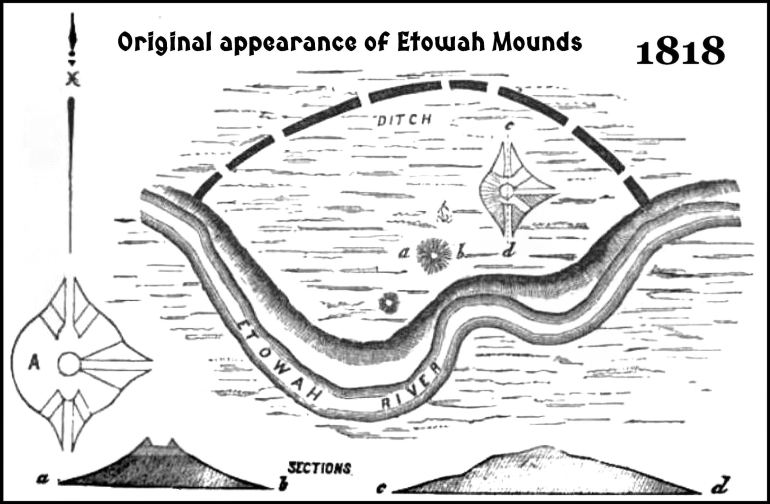
The mounds that you see today at Etowah Mounds National Historic Site bear little resemblance to the appearance of the ancient town site two centuries ago. This is a measured plan of the site in 1817, when there was a 20 year old Cherokee village located about one mile to the north, where the Roselawn Estate now exists in Cartersville. Elias Cornelius, a Natural Science professor Yale College measured and sketched the mounds.
As soon as the Tumlin Family obtained title to the archaeological zone in 1832, via the Georgia Land Lottery, amateur collectors began paying to dig for artifacts there. As mentioned in the previous article, Union soldiers from Ohio did considerable damage to the site, while stationed there in 1864. The soldiers dug for artifacts in the mounds and around the town site.
Between 1885 and 1956, archaeologists completely destroyed Mounds B and C. What you see today are inaccurate, fake mounds, constructed by Georgia Parks Department laborers in 1957. The work was done without any supervision by archaeologists.
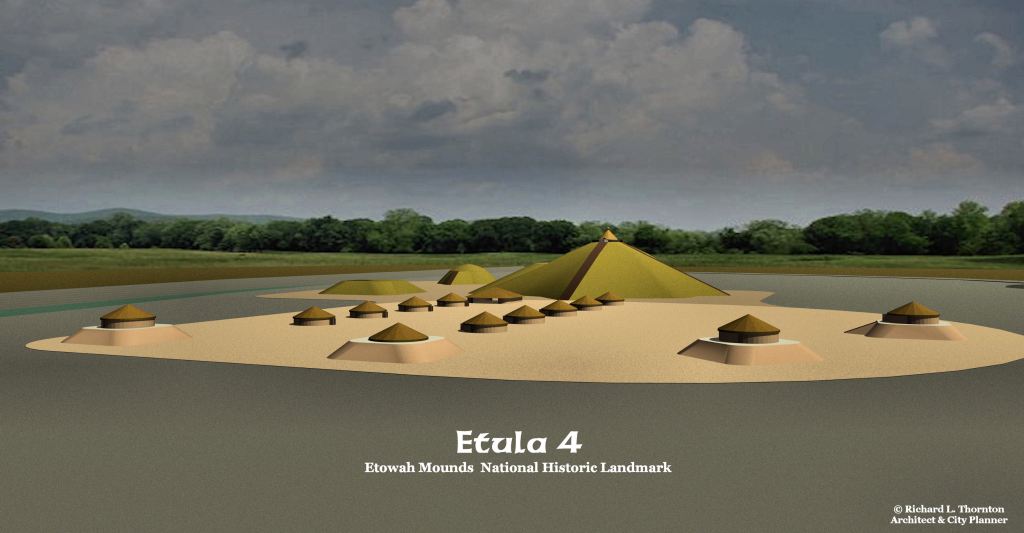
This is the appearance of Etowah Mounds in the 1600s.
Between the early 1980s and 2013, a small clique of archaeologists in North Carolina and Georgia intentionally obscured or altered knowledge of recent archaeological discoveries . . . concealed the presence of the Apalachete, Itsate, Chickasaw, Kansa, Uchee, Satile and Elate Peoples in northern Georgia . . . even erected many fictional state historical markers to make the public and young anthropology students think that the Cherokees had lived in Georgia since 1450 AD.
In 1995, they even created a very expensive and very fictional diorama in the Etowah Mounds Museum that showed the famous Etowah Marble Statues being hastily buried at the TOP of Mound C as Cherokees “captured and burned” Etowah around 1585 AD. Several members of this clique were definitely on the payroll of wannabe Cherokee gambling casino developers.
It is my great fear that two generations of archaeologists, Muscogee-Creek tribal officials and Georgia state cultural heritage officials are currently operating in a fog, created in the recent past, by this clique. This is a factual account of events in the latter half of the 20th century, which tell a very different history.
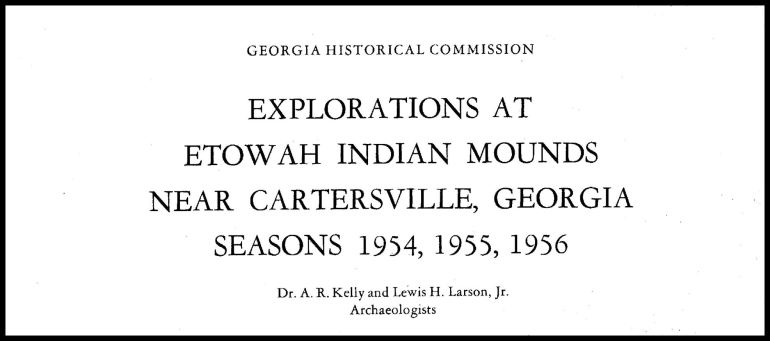
Contemporary Georgia archaeologists and Etowah Mounds staff claim that Dr. Arthur Kelly and Dr. Lewis Larson never wrote a report on their excavation. Dr. Kelly gave a copy of the report to every member of the Georgia Tech Pre-Columbian Architecture class that I was teaching, while we were visiting Etowah Mounds. This account comes directly from that report. The report was ignored, when the museum was “remodeled” in the mid-1990s.
Discovery of the Etowah Statues
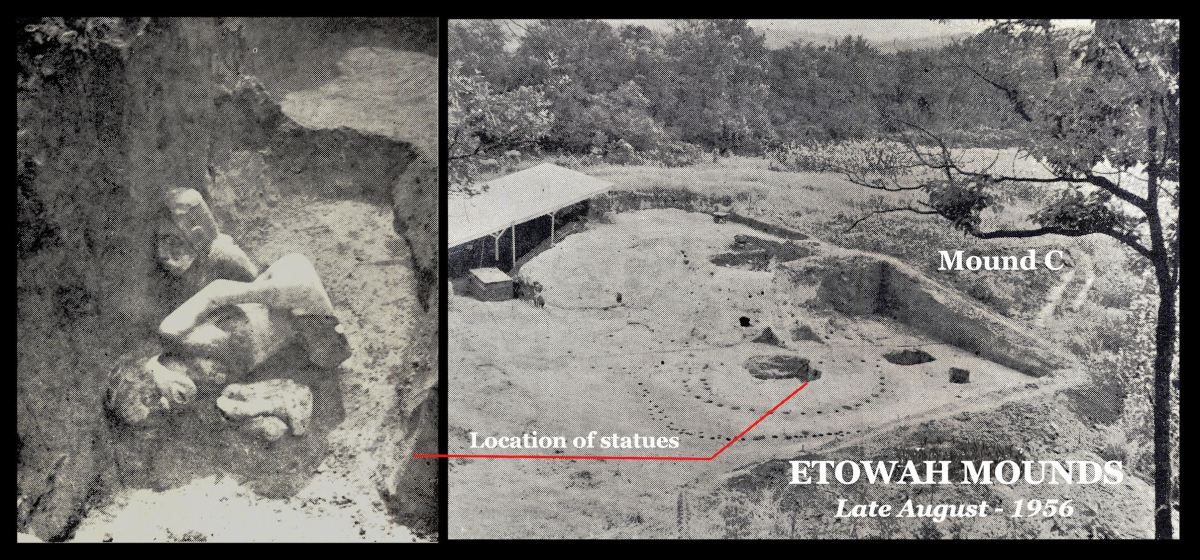
August 1956 – It was at the tail end of the last season of excavation at Etowah Mounds. The team was cleaning up the site. Then Lewis Larson noticed that the soil beneath a rectangular stone temple was “soft.” Its floor was not the surface of the land back around 1000 AD.
Drs. Kelly and Larson decided that it would be necessary to demolish the stone temple in order dig further. They quickly encountered a collapsed log structure within a circular temple, marked by post holes. It was either a tomb or a shrine. Larson eventually encountered the two disheveled statues that had stood atop a decomposed wooden platform. The roof of the log temple had collapsed on top of the altar, causing the male statue to break.
The Etowah Museum and many archaeological book/papers now state that the statues were accidently dropped into a shallow grave, as the enemy (Cherokees) were breaking through the walls of the town.
Arthur Kelly then climbed Mound A and took a photograph of the appearance of the excavation of Mound C, when the statues were found. It is the photograph at the upper right of this article.
At bottom of the collapsed log tomb or shrine, Larson found the scattered and mixed bones of three persons spread across the floor. He and Kelly had no clue, who these people were or why their bones had been intentionally disarticulated. All other log tombs within the mound were very formal burials, surrounded by grave offerings.
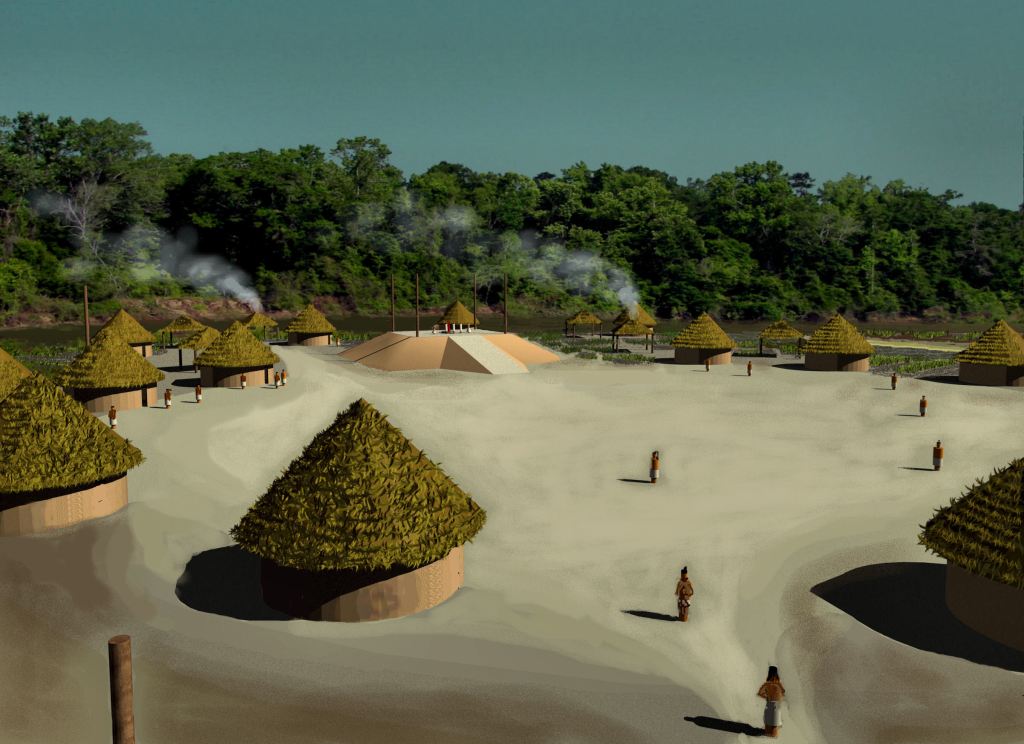
Site 9Fu14 at the Great Southwest Industrial Park – Atlanta, GA
Discovery of Mesoamerican artifacts on the Chattahoochee River
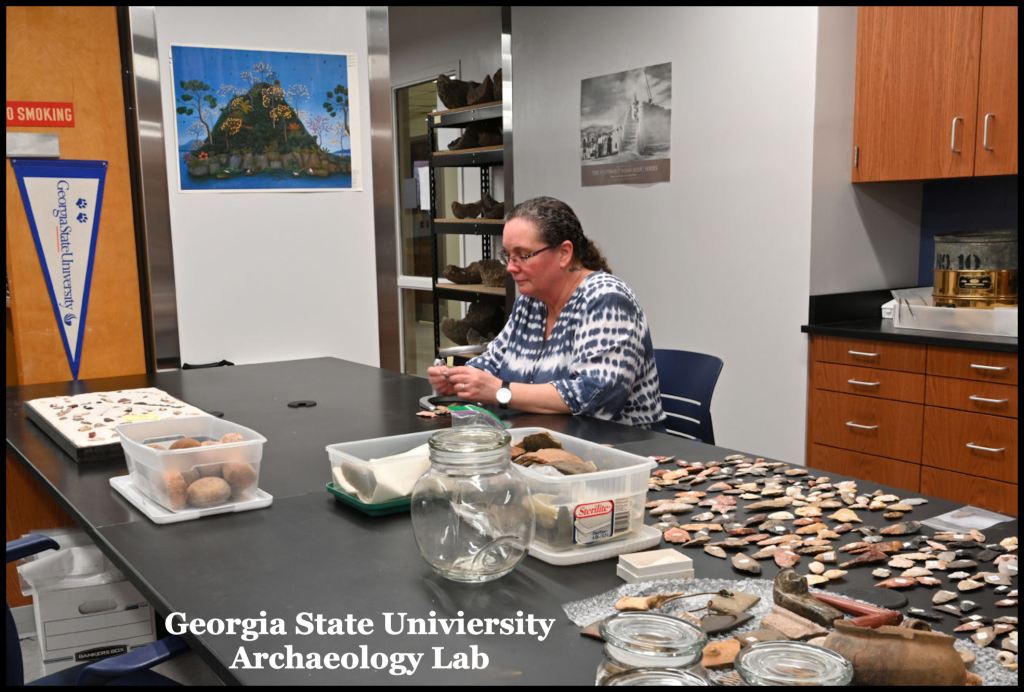
February 1969 – I answered a note on the bulletin board of the School of Architecture, seeking a volunteer to prepare an ink on mylar plastic site plan of Site 9FU14 on the Chattahoochee River. The excavation was being done by Georgia State University students, but was being supervised by Dr. Arthur Kelly from the University of Georgia. My main incentive was to meet Georgia State University coeds, since I did not have a car and there were only 124 female students at Georgia Tech. GSU was located near Tech in Downtown Atlanta and almost all its students owned cars.
My interview was at the GSU Department of Anthropology. Dr. Kelly was sitting at a table with two GSU professors. They were discussing a cluster of figurines, cylindrical tattoo stamps, bowls and small jars. Dr. Kelly explained to me that these were artifacts that he had unearthed through the years along the Chattahoochee River. He thought . . . and the other two professors agreed . . . that these artifacts were either made in Mexico or were copies of Mesoamerican artifacts.
I think it was in the early spring of 1969 that John S. Pennington of the Atlanta Journal-Constitution interviewed Kelly about these artifacts. All hell broke loose when the article came out. Many of his fellow Gringo archaeologists immediately demanded that Kelly be burned in the stake for heresy.
Barrett Fellowship in Mexico
December 1969 – I called Dr. Kelly to get input from him for a proposal I was writing in hope of receiving the first Barrett Fellowship from Georgia Tech. I planned to use the funds to study Mesoamerican architecture in Mexico. I was shocked to learn that Kelly had just been fired by the University of Georgia. No matter what was said to the public, the real reason was Kelly’s claim of finding Mesoamerican artifacts along the Chattahoochee River.
Kelly suggested that my research question be, “Architectural evidence of cultural connections between Mesoamerica and Georgia.” After reviewing my draft and making a few changes to insert nomenclature used by archaeologists, he endorsed the proposal.
I would come back from Mexico, knowing much more about Mesoamerican architecture and culture than probably any archaeologist in Georgia. Kelly was right. I saw artifacts, almost identical to those on the table at GSU’s Dept. of Anthropology in the Tabasco State Museum in Villahermosa. They were made by the Chontal Mayas, skilled mariners and traders on the coast of Tabasco. They transported most of the freight between the various Mesoamerican civilizations.
Román Piña Chan immediately recognizes the Mesoamerican connection
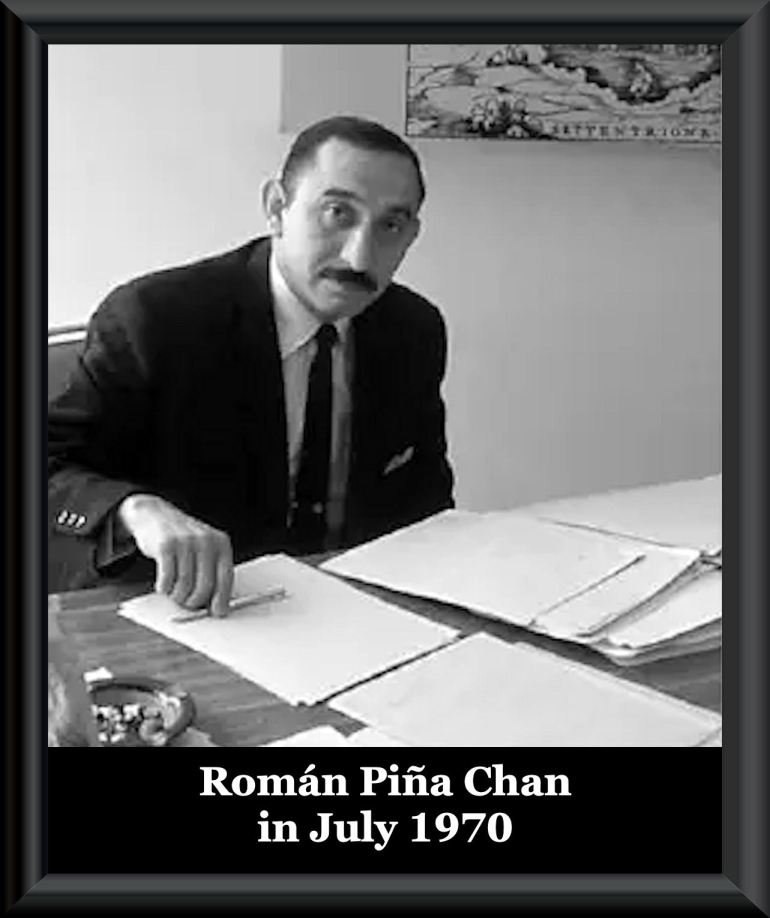
July 6, 1970 – Because of coming down with the most lethal strain of salmonella food poisoning my first night in Mexico, my orientation meeting with Román Piña Chan and Ignacio Bernal was delayed for about two weeks. In the meantime, after recovering I went ahead with my studies of Formative and Post-Classic city sites in Metropolitan Mexico City . . . then called the Distrito Federal.
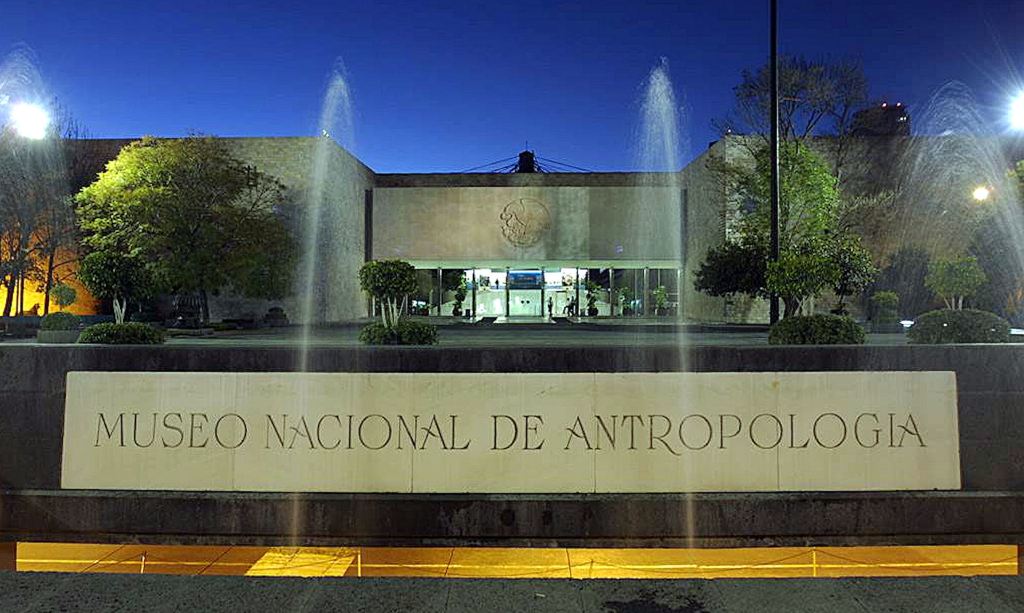
About five minutes into my guided tour of all six floors of the Museo Nacional de Antropologia, Ignacio Bernal glanced at his watch, uttered “¡Idiotas!” and excused himself. Dr. Piña Chan later told me that Bernal had realized that I was not from a rich Gringo family, who was going to donate fund to archaeological digs.
The Mexican Consul in Atlanta had told me that it was the custom in Mexico for college students to give books to their mentors at the beginning of any special program. At the end of the tour, I gave both books to Dr. Piña Chan. He ushered me into the outer office. In order to insure that the fellowship funds were spent at archaeological sites, the professors at Georgia Tech had assisted that I get reservations for a few package tours of major Mesoamerican cities.
+
After glancing at my fellowship syllabus, he asked me if I wanted to be a turistico or learn how Mesoamerican architecture developed and was constructed. I told him “The latter.” He tossed the Georgia Tech syllabus in the trash can and told me to come back the next day for the syllabus produced by his favorite graduate assistant, Alejandra. She had an undergraduate degree from the University of Texas and therefore was fluent in English.
As I was waiting at the bus stop in front of the museum. Alejandra raced out to me. Dr. Piña Chan had asked if I had time to join him for lunch in his private office. He wanted to discuss the two books on the American Indians in the Southeastern United States. I said, “Yes!” . . . but was thinking “I am not worthy! I am not worthy!”
Dr. Piña Chan initially made the statement at the top of the article, then went through the two books I had given them . . . comparing photos and drawings in those books with photos in books he had written on the Olmec, Maya, Totonac and Toltec Civilizations. My journal closes by quoting the archaeologist that the towns in Georgia were a continuing of the Olmec and Gulf Coast Civilizations, while those in Alabama, Mississippi and Louisiana seem to be more culturally linked to the Totonacs and Toltecs.
During the seven weeks that followed our initial meeting, Dr. Piña Chan’s speculations changed from that of a single migration of mostly males to that of an on-going process over many centuries, where various ethnic groups from various parts of southern Mexico migrated over a period of many centuries. After reading in one of the books I gave him, that Georgia had pottery for about 1,600 years before Mexico did, he decided that it was two-way pattern of communication, which began at the onset of the Olmec Civilization. My research in the 21st century has completed support the latter two speculations.

+
Román and Beatriz . . . the dynamic duo
At the end of August, Roman and Beatriz Piña Chan invited Alejandra and I to be their guests at a posh restaurant overlooking the Paseo de la Reforma for an entire afternoon. It was a profound gesture of Mexican hospitality, plus a match-making scheme. However, I was flying back in two days and seriously involved with Alicia Moreno. Nevertheless, it was the first time that Alejandra and I had carried on an extended conversation.
After all of us had several glasses of wine, Alejandra confessed that she created my second syllabus with the idea of it being her dream vacation. She secretly hoped that I would invite her to accompany me. Also, after several glasses of wine, I likewise confessed that I had fantasized about doing just that . . . but assumed that she would have been insulted.
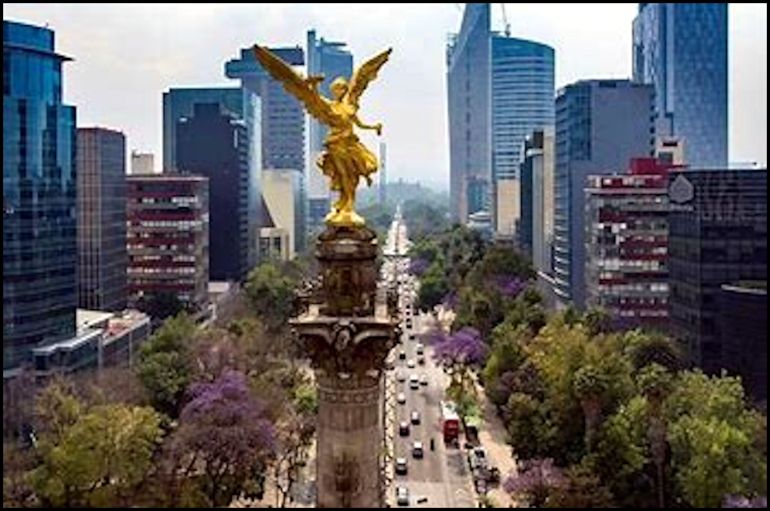
Paseo de la Reforma in Mexico City
At the end of our mutual, wine-lubricated confessions, Dr. Piña Chan confessed that he was puzzled why I didn’t invite her along also. He would have given Alejandra academic credit for a full quarter’s load of classes, if she had.
Among many other things discussed, Dr. Piña Chan urged me to become fluent in Spanish. If so, he could get me a full scholarship, including living expenses, for obtaining a PhD in Mesoamerican Architecture & Archaeology at the Universidad Nacional Autónoma de México. He added, “We need young people like you and Alejandra to create a cultural bridge between Mexico and the United States.”

Of all things, I ran into Alejandra, while staying at a hacienda in Tepoztlán, Morelos for two weeks in December 1980. She was related to the husband of one of the Soto daughters, who had hosted me in the summer of 1970. Alejandra was recently divorced and working at the Chalcatzingo site in Morelos, which had strong cultural ties with the Olmec Civilization.
Unexpectedly, we found that we had very compatible personalities and common interests. In the process of getting to know each other, we hiked up a canyon in the Copper Mountains and discovered boulders with petroglyphs identical to those on boulders in the Etowah River Valley in Georgia and County Kerry, Ireland. However, the two weeks ended and we were again 1370 miles (2205 km) apart. She ended up remarrying a French archaeologist and has spent the rest of her life in the Yucatan Peninsula or France.
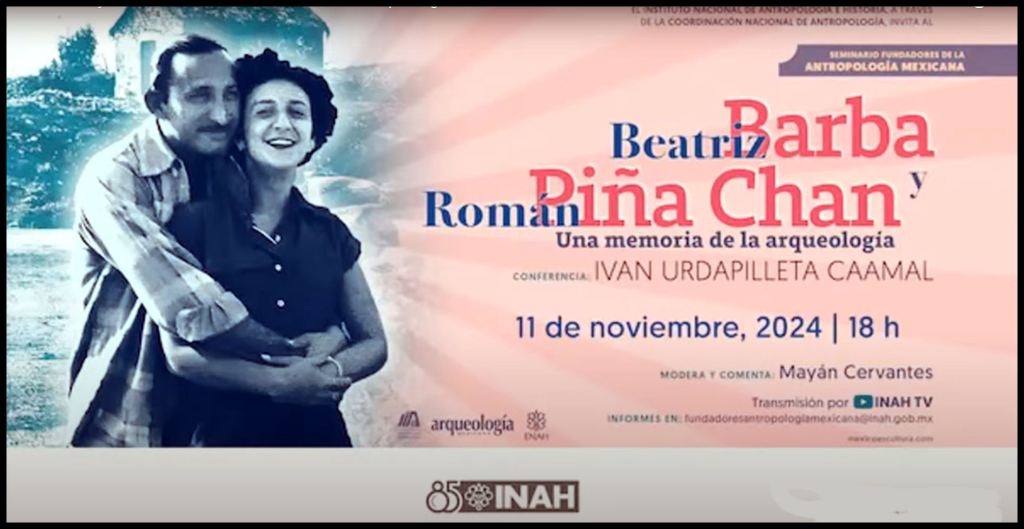
Until near the end of the 20th century, the archaeological profession in Mexico was dominated by snobby aristocrats, such as Ignacio Bernal. The award of a special gold medal by the government of Mexico in 1994 to Román Piña Chan marked the end of that era. He was of over half Maya ancestry and had grown up in a middle class family, living in at that time, one of Mexico’s poorest and most isolated states . . . Campeche.
In the more prosperous egalitarian environment of Mexico in the 21st century, there has been increasing appreciation in Mexico to Román and Beatriz Piña Chan’s extraordinary contributions to Mexico’s cultural vitality and the world’s knowledge of the past. When I first started doing research on Native American history around 2004, he was not even mentioned in the Mexican version of Wikipedia. Now he honored as one of the great minds of Mexico. Most recently (above) there was a conference and resulting TV docudrama on the 60 year-long love affair between Beatriz and Roman.
What I remember most about that extraordinary summer in my life is this. Dr. Piña Chan was already becoming internationally respected, when I walked into his office. However, he NEVER acted imperious with me. He never told me what to think. He very seldom even told me facts. He always asked me questions to answer my questions to him. LOL
Now you know why I am always questioning any assumed fact!
 The Americas Revealed
Richard,
A famiar story I have read before, but a wondeful story I enjoyed revisiting. Hope this finds you well. I am retired from Native American studies and back to my more familiar haunts- the early twentieth century, and more specifically 1920’s Georgia.
This journey began as a an inquiry into my grandfather’s banking career -and failure. Obsessed with the Lost Cause and reinterpreting the Civil War and Reconstruction, historians have ignored the remarkable story of the collapse of smalll town Georgia and the rise of corrupt business-government relations. No wonder the “official” histories” by state academicians have avoided covering this -and why few have attempted to undersatnd why the rural middle class arose and then collapsed in the years following World War I.
Erskin Caldwell’s accounts of a despondent and impoverished generation of sharecroppers and tenent farmers, while written in the 1930’s, were actually inspired by what he witnesses growing up in rural Georgia in the 1920’s. Governement power deployed by elected bad actors swept the Cherokee from Georgia. Sixty years later the same sort of governement by cliques of ambitious and unscrupulous men used banking, insurance, railroads and holding company schemes in ways that damaged Georgia in ways that have never been widely understood even by educated and professional citizens of the Empire State.” This in spite of the fact that its all there in the state’s newspapers and state and federal court records.
Joe
LikeLiked by 1 person
Hey Joe,
Yes, I have told most of these stories of recent history before. However, a friend of mine visited the work going on inside the museum. The Oklahoma Creeks and young archaeologists working there did not know that he was a friend of mine. So far, there is nothing amateurish about the art being created, BUT they are putting up a simplistic portrayal of the cultural history of the town and region, which includes the false theme that “Muskogee Creeks always lived there.”
Between around 1000 BC and 1700 AD, at least eight distinct ethnic groups lived there. The last occupants were “Creeks” but they spoke the Apalachicola language, which is a mixture of Chickasaw, Panoan from Peru and Itza from Mexico. There is no evidence that people, speaking the Muskogee language ever lived at Etowah Mounds or even in NW Georgia.
Archaeologists Arthur Kelly, Lewis Larson and Joseph Caldwell learned that all the major Creek towns in northern Georgia, as far south as the southern Fulton County were burned around 1700 AD and abandoned. This was probably due to the 1696 smallpox epidemic. Between 1700 and 1795, NW Georgia was thinly occupied by a scattered mixture of Apalachicola, Kansa, Uchee and Kaushe (Upper Creek) villages, plus some remnant tribes from the Georgia Coast. The gold-bearing region was Elate, who were of mixed Apalachete, Sephardic and European ancestry.
If the Etowah Museum is to be completely refurnished, it should be done accurately.
LikeLiked by 1 person