
. . . also in southern Florida, the Florida Panhandle and Alabama Gulf Coast
Both goddesses were associated with nature, springtime and romantic love. Both were worshipped at “Sunrise Services” on the Spring Equinox. Both had pet rabbits and were given decorated eggs as votive offerings.
Clearly, there is much more to the history of the Americas than students read in their history and anthropology books.
The Mayas In Georgia Series
by Richard L. Thornton, Architect & City Planner

This is the apartment building on Oestergaten, where I lived in Landskrona, Sweden
How I learned about the goddess, Easter
I learned about the Scandinavian goddess, Easter, the good ole fashion way. My apartment in Landskrona, Sweden’s international neighborhood was on Östergatan . . . Easter Street. I initially assumed that it was named after the Christian Holiday. However, as I rode my bicycle around the neighborhood, I noticed that other streets were named after Scandinavian pagan deities and the Christian holiday of Easter was called Påsk. That was almost the same as the Spanish word for Easter, Pascua. I was kornfuzed.
On Thursday, I was invited to have dinner with a member of the city council and to watch the living color, prime time premier of a new TV series, “Liv på USA” (Life in the USA). Of all things, it was about Georgia and at the end predicted that Jimmy Carter would one day be president. The City Council Member had not known that I was from Georgia.
The man evidently had connections beyond being on the City Council. The next day at lunchtime, a classic, statuesque Swedish blond walked up to me as I was eating the Swedish version of a hot dog and introduced herself as Britt, my official Swedish girlfriend. Britt was from the large city of Malmö, which was 47 km (29 miles) to the south. She was a law student at Lund University and President of the College Division of the Center Political Party. She was both beautiful and brainy. I thought that I had gone to heaven.
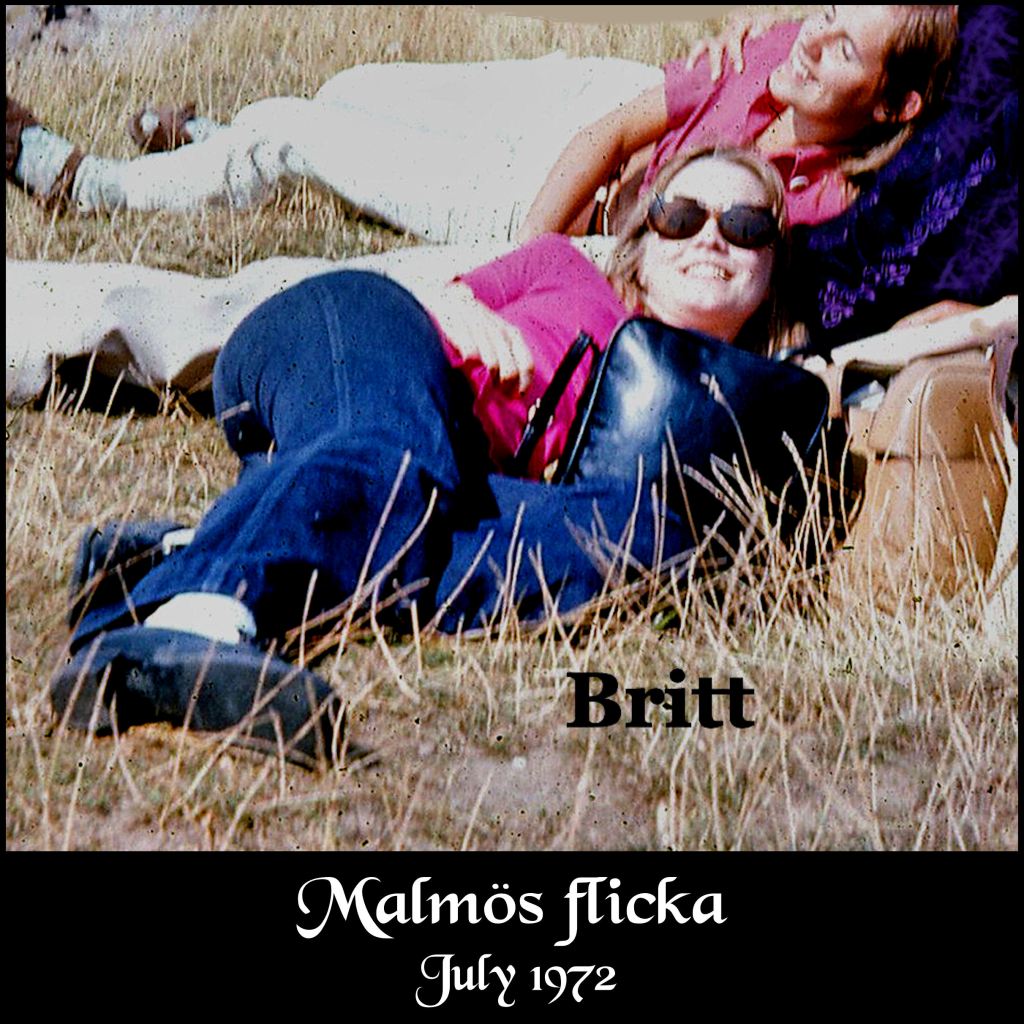
Britt-Louise Manson picnicking with me and friends on Ven Island, Sweden
Britt explained that there were many blond Soviet spies from the captive Baltic countries, hanging around southern Sweden and Copenhagen, Denmark. Since I was just learning Swedish, I would not know the difference between a bonified Swedish flicka and a fake Soviet flicka. She was going to be my tour guide and dating service so that my “extracurricular activities” would not be compromised by a Soviet Mata Hari.
Our first date that night was at the Tempo Supermarket, which was bigger than a Walmart. She taught me the pronunciation of all the major foods being sold there. I had never even bought food in a supermarket then two days after graduating from Georgia Tech, I was having to buy my own food and cook my own meals! The Tempo Supermarket also had a deli and cafeteria. Something I had never seen before. That’s where we ate. It would be at least 20 years before U.S. supermarkets began containing delis and cafeterias.
The next morning began my history lessons. As we were touring the Landksrona City Museum, I popped the question . . . “Why was my street named Östergatan?”
Britt explained that although Freya was the better-known goddess of fertility, she was really just old farm wife, mainly concerned with agriculture and birthing babies, calves, foals, kids or whatever. Öster (Easter) was the fun goddess. She was into nature, rebirth at springtime, the arts, learning, romantic love and frolicking with your significant other in the woods, just for the fun of it. Britt described herself as an Öster type flicka (gal).

Oster was a Moon Goddess, who appealed to adolescents & young women
She added that most of the customs now associated in Europe and the Americas with the Christian holiday that we called Easter, actually originated with the worship of the goddess, Öster. That included bunny rabbits, sun rise services and Easter eggs. She promised that she would start helping me find my own Öster. The Center Party was sponsoring a big Midsommarsfest dance at Lund University the next weekend.
Indeed, at the dance, Britt introduced me to one beautiful, intelligent flicka after another. There was a problem, though. It was summer and they were back at home, living with parents. None of them owned an auto or lived near public transit. All I had was a bicycle!

Sorry! Old Polaroid photos don’t age well, but this is the Midsommarsfest band.
The band was great. I had seen them on Sveriges TV Channel 1. They were modeled after the U.S. rock band, “Chicago” . . . with a wide range of brass, wind and guitar instruments. They had two female singers, one brunette and the other blond. Britt invited the band to join us for a traditional Midnight Sun dinner at a waterfront restaurant in Malmō. We moved to a table for two . . . sufficient distance from our friends, who could now chatter away entirely in Swedish.
At the communal restaurant table, the blond overheard that I was from the United States. She told me that her dream was to move to the United States and sing on Broadway. She asked if she could practice her English with me. In addition to having a beautiful voice, she was very sweet.
Unlike many of the Lund University coeds, she didn’t pretend to be a super sophisticated European woman. I liked her as a person, but about she could talk about was music. Like present-day star, Carrie Underwood, she had grown up on a farm. No danger of her being a Soviet spy! She didn’t know what NATO was, nor had she ever heard of Georgia or Atlanta.
Within a few minutes of discussing rock music, I realized that I recognized this flicka. I exclaimed, “You’re Mary Magdalene on the Swedish version of “Jesus Christ, Superstar” but you were wearing pig tails in the movie. I watched it last Friday night at the Landskrona Auditorium. I instantly fell in love with Mary Magdalene . . . I didn’t realize that that I would ever meet her! Mary Magdalene is a singer in a rock band? Hm-m-m.”
On the same night as the Midsommarsfest Dance, burglars broke into the Democratic Party’s Headquarters at the Watergate Complex in Washington, DC. Three days later, Landskrona’s newspaper, Sydsvenska Dagbladet, announced that President Richard Nixon and his Whitehouse Staff were behind the burglary. North Americans would not know that for two years.
The farm girl with a voice of an angel had a couple more opportunities to practice her English. The last time was a picnic on the beach in Landskrona. She had a beautiful voice, but a buck-toothed Swedish farm girl, who liked to go around in pigtails . . . and before the days of “American Idol” and its kindred shows in Europe . . . didn’t have a snowball’s chance in Hades of making the big time.
I don’t know if I ever remembered her last name and probably had forgotten her first name by the time I returned to the states. She merely entered the vague memory banks of my brain, filed under “nice” women, whom I had known briefly.
Meanwhile, Britt had decided a couple of weeks after the beach picnic that she actually wanted to get to know me better, rather than set me up with other flicker (plural of flicka). Big advantage! . . . Britt owned an automobile and lived on a public transit route.
In August 1972, the two singers at the Midsommarsfest dance left that band and joined two male singers to form the group, “Björn, Benny och de två svenska flickorna” . . . Bjorn, Benny and the two Swedish girls. The poor girl had talent, but obviously was killing her career with a switch to such a dumb name for a rock band, which they kept for two years.

Dr. Deborah Clifton, Creek-Choctaw anthropologist
Discovering that Ixchel had also been in North America
In 2006, while I was steadily discovering Mesoamerican words in the Creek languages, my research colleague, Dr. Deborah Clifton of LSU-Baton Rouge, made an incredible discovery on her own. Deborah is a Creek-Choctaw anthropologist. The Spanish recorded three geographical locations that they name Amichel. (1) the northern tip of the Yucatan Peninsula, (2) the Tampico Bay area of Tamaulipas State, and (3) the Gulf Coast between Mobile Bay and Apalachicola Bay. The three regions formed a perfect equilateral triangle. Deborah dug deeper.
Deborah discovered that the Amichel in Yucatan was associated with the worship of the Chontal Maya goddess Ixchel. It was obvious that the Spanish word Amichel was based on the Chontal Maya words, Am Ixchel . . . Living Place of Ixchel.
I knew very little about Ixchel, so Deborah explained that this goddess was relatively minor among most Maya tribes and city states, but along with Solar Sky Serpent, was one of the two principal deities of the Chontal Maya. Ixchel kept a pet rabbit and was the goddess of springtime rebirth, youthful fertility, romantic love and nature.
I instantly recognized the similarity to the goddess, Easter, but that made no sense. It would be another 12 years before I realized that most of the petroglyphs in Georgia were identical to the Bronze Age petroglyphs in either southern Sweden or County Kerry, Ireland . . . It depended on which Georgia river basin they were in.

Temple Complex of the Goddess Ixchel at the Ortona Site near Lake Okeechobee, Florida
During the summer of 2006, a member of the People of One Fire research alliance traveled to Lake Okeechobee, Florida to meet with archaeologist Bob Carr. The enormous Ortona town site had been featured in the Atlanta Journal-Constitution. The article claimed that the town had many features, which linked it to the Maya Civilization.
Carr provided us with a color photocopy of his site plan. The massive archaeological zone contained many ceremonial earthworks, including mounds, large effigies of traditional Maya ceremonial maces, canals and two large serpent mounds that were probably older than the Great Serpent Mound in Ohio. What really stunned me, though was the Goddess Ixchel Temple Complex. It was much larger and more sophisticated than any Ixchel shrine in southern Mexico, . . . but why here? We had many unanswered question to research.
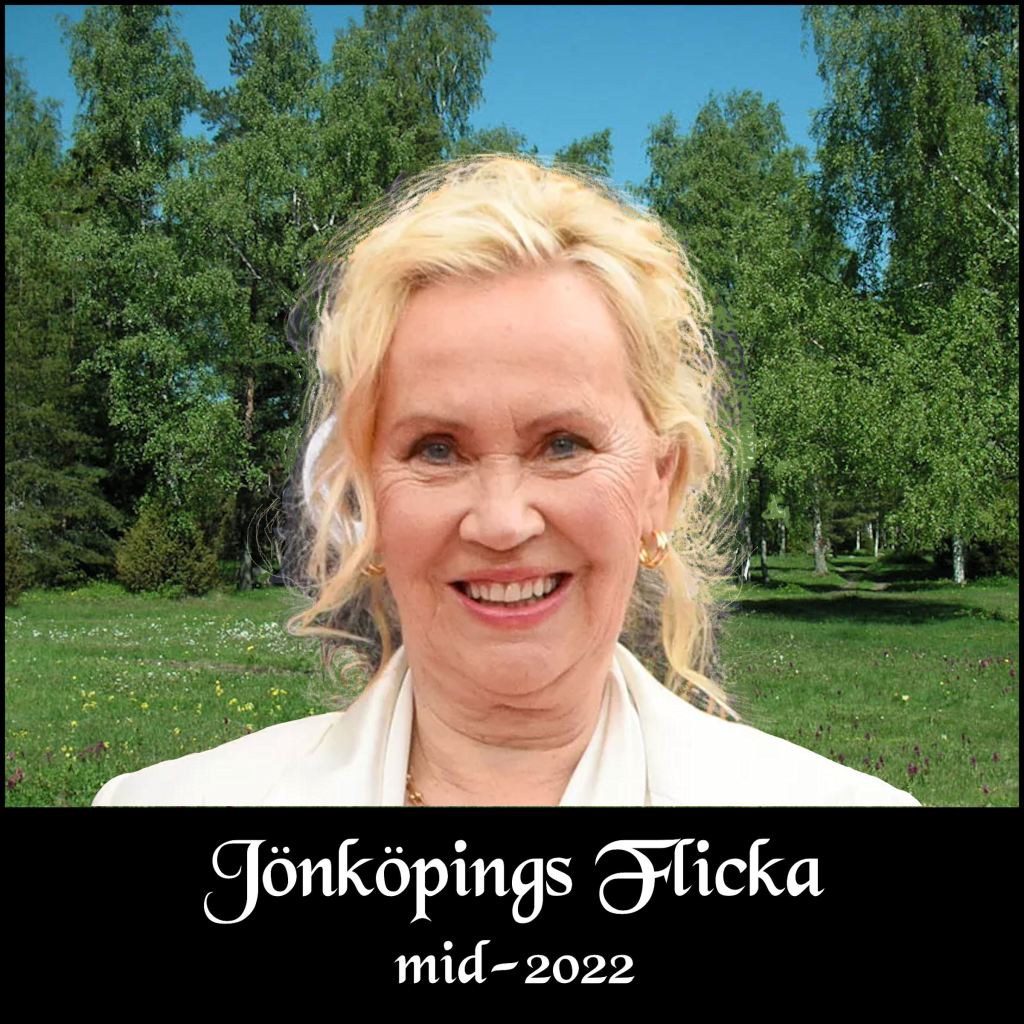
A modern-day Öster or Ixchel
Early in the morning July 17, 2022, I turned on my computer to see an intriguing email from YouTube. Someone named “Jönköping Flicka” (Jonkoping gal) had sent me a message through YouTube, which invited me to watch a private video. Was this some sort of porno scam? It was obviously someone from Jönköping, Sweden, a modest city in south-central Sweden, so at least it would be pleasant on the eyes.
I was puzzled, though. I occasionally exchanged messages on LinkedIn with a female professor from Upsala University, about 60 miles (97 km) north of Stockholm. Why would she send me a message on YouTube, when she could have easily attached a YouTube link to her LinkedIn Message?
I opened up the video. OMG! It was Agnetha. Of course, she grew up on a farm near Jönköping. BTW, Jönköping is pronounced, Yon : shopping. June 17th was the 50th anniversary of the Lund University Midsommarsfest Dance.
Apparently, Agnetha had stumbled upon my YouTube video about the extreme similarity between Swedish Bronze Age petroglyphs and those in the Georgia Gold Belt. YouTube was the only way she knew to contact me. It was a discrete way for a celebrity to contact a semi-stranger, without giving away her email address. After I watched the private video, it disappeared from YouTube.
The video was filmed on the farm, where Agnetha grew up. It was not a fancy production, but more like a video letter. In the background was the pasture, where I presume she had once tended cattle, sheep or horses . . . while singing Swedish folk songs.
She started out by saying that most people didn’t realize that she spent more years traveling from dance hall to dance hall in Sweden than she did in ABBA. In truth, she enjoyed singing at dances more than being an international star in ABBA.
She had met many nice people through those years, but had forgotten the names of most of them. That period was now a blur of memories.
No need to apologize, Agnetha. I forgot your name soon after being back in the States. I quickly learned it again, when ABBA appeared before the public for the first time in the United States on Saturday Nigh Live in 1975. I dropped and broke my ice tea glass in shock.
She stated that in the summer of 1972, she was just a country girl with big dreams. (That’s true) She explained that she dropped out of school at age 16 to focus on her love of music, so five years later knew nothing about the world outside of Sweden. Most of her jigs were in small towns or even rural villages, where the local dance hall was the only social life around.
The video went on to tell us some about the many decades of her life since ABBA. She has lived on a farm in the boonies of Sweden most of that time, because she has always loved being with nature. She said that it was really difficult for her to see herself as an international icon and role model for young Swedish women.
Let it suffice to say that Agnetha is very much a kind lady. I am very honored to have known her briefly. She is very worthy of still being one of the most admired people in Sweden. In a sense, she had become a modern-day Öster.
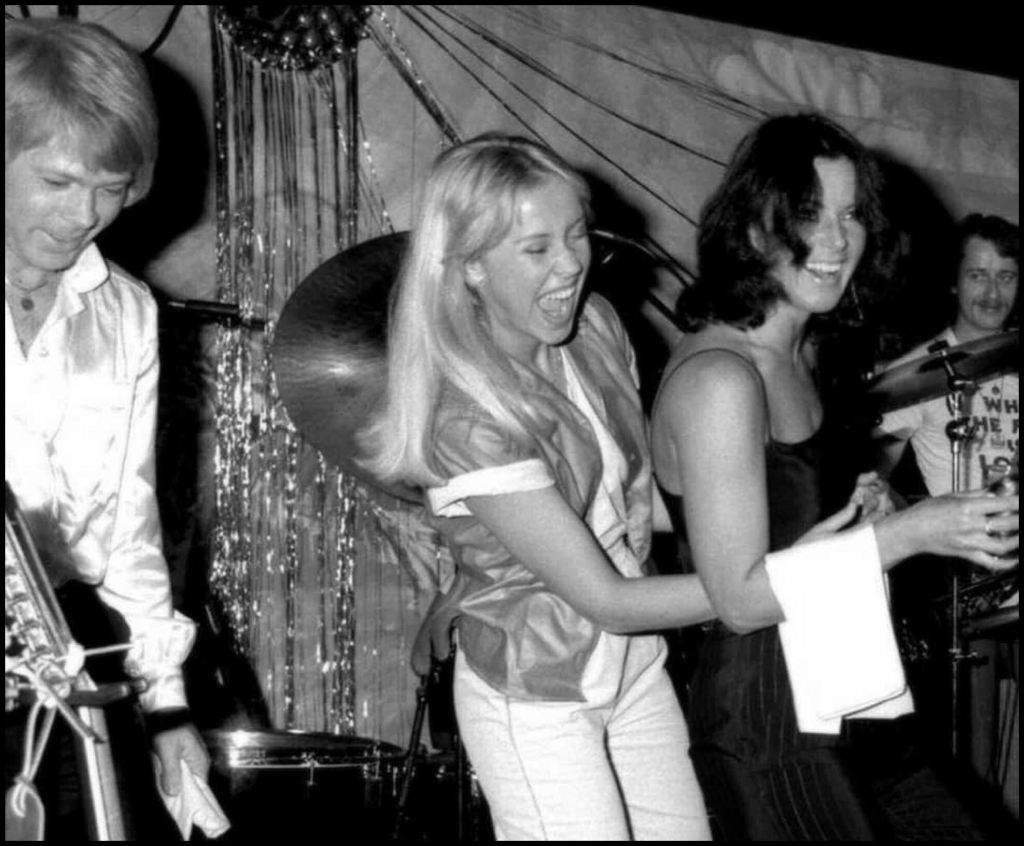
Agnetha and Ani-frid at their last public concert in Landskrona, Sweden
Ironically, the last live public performance of ABBA was May 23, 1979 at the Landskrona Strandpaviljoen (beach pavilion) very close to where she practiced English at a picnic, seven years earlier. The last song that they sang, was “Dancing Queen.” Here’s to you, Dancing Queen.
 The Americas Revealed
thrilling! Analysis: Examining the Long-Term Social and Economic Impact of [Global Pandemic] 2025 exceptional
LikeLiked by 1 person
I’ll be borrowing “kornfuzed” from you as it’s a gem. Also “Ishtar” to “Oster” to “Easter,” not neccesarily in that order, but amazing how so many things in the world, Georgia certainly not excluded, connect back to or nod to the decadent, Babylon. “Oster” also translates as a word of “East” as in things Eastern. Swedish Oster not unlike the word “oyster” which has all of the esthetical implications of sex and birth, making me think of “Venus” coming out of her shell. So is the Easter egg really her oyster egg? Notably, the Oster company, founded partly by an Swedish American, makes electric “massagers.” Enough said. It must be Spring rite time! Ishtar is in the air! My cheeky apologies.
LikeLiked by 1 person
I had forgotten about the Oster Company. Yes, it is the same word.
LikeLike
Wow! Great story. Loved Abba at that time – still do, Especially Fernando. I still believe a petroglyph here where I live was influenced by someone – Creek, Maya, etc. – with connectings back to Mexico.
LikeLiked by 1 person