
During its first century, the Ocmulgee Acropolis apparently only contained typical South American architecture.
Although the traditional architecture and typical layouts of Creek and Chickasaw towns were generally Mesoamerican in origin, most of their cultural traditions such as their colorful clothing, stamped pottery, drinking Yaupon Holly Tea, the Stomp Dance and Pre-late-1700s oval plazas originated in eastern Peru and Para’ Province in Brazil.
HOWEVER, even the oval houses and oval plazas of the Mayas in Campeche State, Mexico and the Chickasaws in the Southeast, plus the oval plazas of Upper Creeks and Apalachete in in northern Georgia seem to have originated in the Amazon Basin.
Place and tribal names in the Americas ending with kora, cora, cola, koa, coa, cua and coah are South American Carib words. Caribbean Island Carib is a somewhat different language.
South America and the Caribbean Basin Series
by Richard L. Thornton, Architect & City Planner
Virtual Reality Image above
WPA laborers, working under the supervision of archaeologist Arthur Kelly and Civil Engineer Joe Tamplin* encountered approximately 35 feet diameter round – center pole supported – houses at the lowest occupation level of the Ocmulgee Acropolis in the mid-1930s. Radiocarbon dating had not been invented, so Kelly speculated that these were oversized Caddo Indian houses from the Woodland Period, which predated any mound-building activities on the acropolis. The Caddos formerly lived in East Texas, where Kelly grew up.
*Joe Tamplin’s official title was Supervising Archaeologist. Kelly worked out of an office in Atlanta and was responsible for all WPA-funded archaeological work in Georgia. He and Kelly were the only college graduates, who worked on the Ocmulgee dig. Tamplin was the only licensed professional, however. Even today, very few states license archaeologists. In the 1986 book, “Ocmulgee Archaeology” Tamplin was briefly mentioned by some of the authors, Georgia archaeology professors. They labeled him a “foreman” or a “laborer.” They were amused that such a commoner would have the audacity to to attend the 50th anniversary celebration of the Ocmulgee Excavation.
In 2012, Dan Bigman carried out a remote sensing and radiocarbon dating study of the Ocmulgee Acropolis as part of this doctoral dissertation for the University of Georgia. He also encountered the round houses at the lowest level, but was surprised since they are not mentioned in the Ocmulgee Museum or in any book, published by Georgia archaeologists.
Bigman determined through radiocarbon dating that the earliest large round houses dated from the late 800s C.E. and that there were definitely associated with the founding of the Ocmulgee Acropolis. Only round, “South American-Caribbean” style houses were built on the acropolis until about 1000 C.E. Thereafter, an increasing percentage of the new homes were large rectangular structures that were typical of the Soque-Itza elite and wealthy Chontal Maya traders. By around 1100 C.E., all the houses were rectangular.

Carib village in Dominican Republic. Island Carib men and women lived in separate villages and spoke different languages. This might explain why there are two types of Island Carib housing – round and oval. The same style house was also utilized by some Panoan tribes in eastern Peru and the Tayrona People of Colombia. However, I personally do not know of any indigenous people in Mexico, who lived in round houses..

The Tallikora People lived in and around the town of Talli, which was obviously founded by South American Caribs. Its earliest houses are round, but Its last non-Cherokee occupation contained a house style typical of the earliest occupation phase of Etowah Mounds in Georgia. In the late 1600s, it was the first town seized by the Cherokees, when they entered the Great Smoky Mountains. They called it Tellicoa, then Tellico then Tahlequah. Yes, even Tahlequah, Oklahoma is derived from a South American Carib word!
Last weekend a genetics scientist in another part of the United States asked me to create a virtual reality 3D model of the village of Wasikura (Bird People) on the Nhamunda River in the Amazon River Basin, visited by explorer Eduardo Barros de Prado. De Prado provided a somewhat generic description of the village, but to create an accurate architectural model, I needed to know more about the occupants.
I eventually determined that the Nhamunda River Basin has been traditionally occupied by South American Caribs, who were also associated with the astonishing geometric earthworks that are being discovered in Upper Amazonia. The South American Caribs are culturally and linguistically different than the much better known, but much less numerous, Island Caribs of the Caribbean Basin.
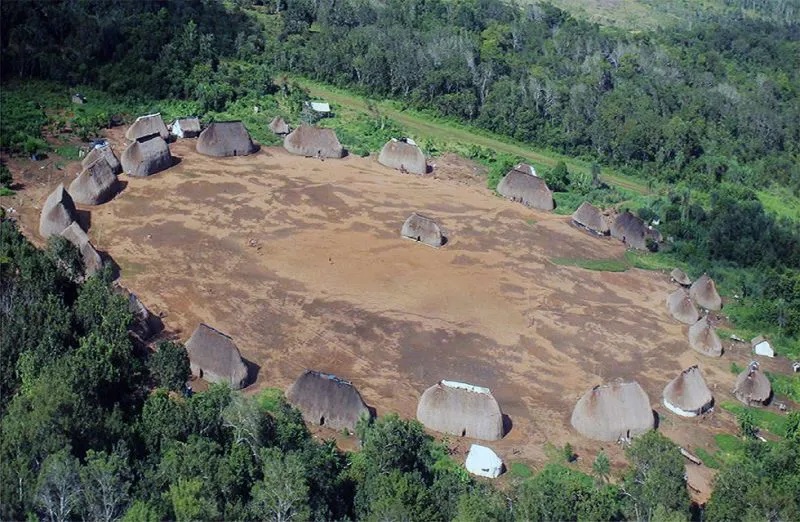
Traditional architecture and village plan of the Carib People.
While doing this research I came upon an aerial photograph of a remote South American Carib village on the Nhamunda River, which still contained traditional Carib architecture. The houses and village plan were identical to those maritime peoples on the Gulf Coast of Campeche and Yucatan, who were originally not ethnic Mayas. I also visited Pre-Columbian Itza villages in central Campeche, which consisted of oval houses in an oval site plan.
This village is also identical to the “Eastwood Village Site” in the Nacoochee Valley of NE Georgia . . . discovered and excavated by archaeologist Robert Wauchope in 1939. The appearance of this new style of house in Georgia coincided with the appearance of stamped Napier style pottery. Napier style pottery is quite similar to the stamped pottery made by the Shipibo People of Eastern Peru and the Caribs of northern Para Province, Brazil.
Wachope determined that the Eastwood Village was in the oldest known example of traditional Chickasaw architecture and village planning. Both villages adjoin a fast moving mountain river. Wauchope was unaware that the Caribs lived in identical houses and villages throughout what is now northern Para Province, Brazil and southern Venezuela.
Dates? Radiocarbon dating had not been invented in 1939. However, Wauchope did not write his archaeological report until the mid-1960s. By then, the Napier Pottery style had been dated. Wauchope estimated that the Eastwood Village was occupied continuously from around 600 C. E. to 1200 C.E. However, Chickasaw village continued to exist in the region until 1817, when their lands were ceded to the U. S. Government.

Eastwood Village Site in the Nacoochee Valley of Georgia
The Truth is out there, somewhere!
 The Americas Revealed
Great read, I love Ocmulgee. Beautiful place.
LikeLiked by 1 person
Thank you! Yes, there is something magical about Ocmulgee.
LikeLike