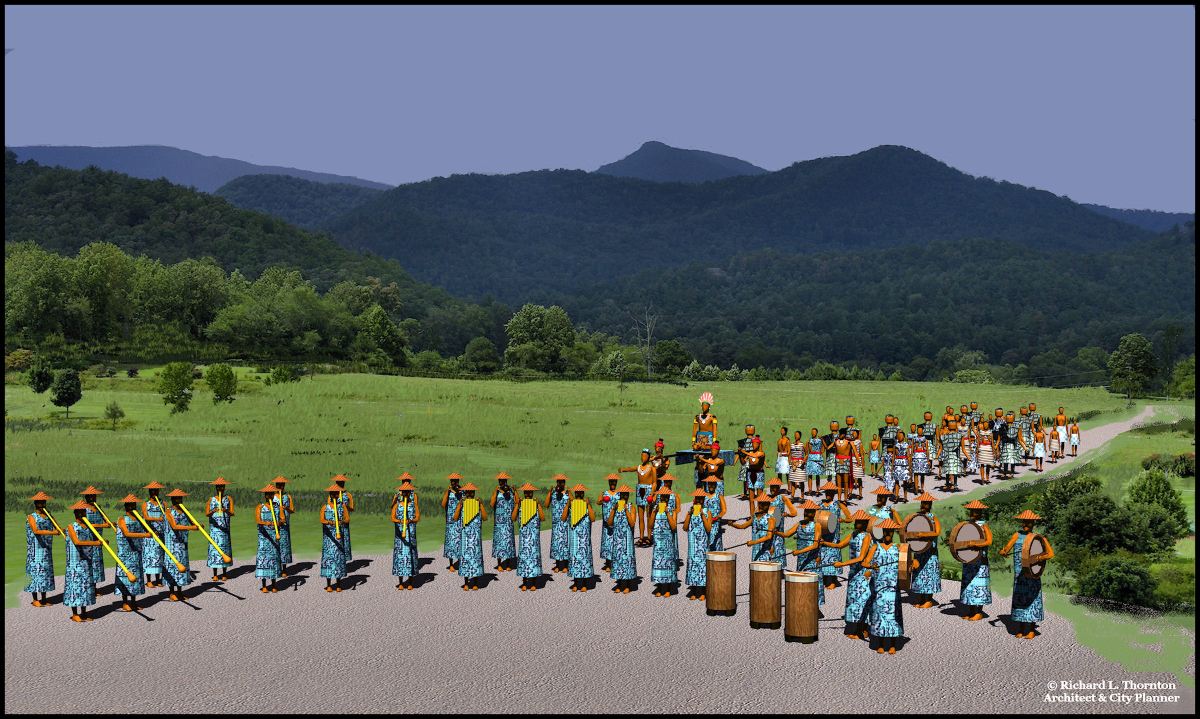
Spanish chroniclers stated that the musicians played 32 distinct wind and percussion instruments. The wind instruments could replicate all the sounds ranging from a piccolo to a bassoon.
Thus, we have eyewitness accounts that the Indigenous provinces that became the Creek Confederacy inherited all of the musical instruments of the Mayas, Upper Amazon Basin and Caribbean . . . making their music the most diverse and sophisticated in the Americas. The Spanish said that most songs had a rapid beat and were syncopated.* However, they also played some beautiful slow songs that reminded the Conquistadors of Iberian melodies.
The clothing of the musicians and Kaushe nobility behind them in this image is based on 16th and 17th century eyewitness accounts and sketches IN NORTHERN GEORGIA. Their appearance was very similar to that of the Panoan and Carib Peoples of eastern Peru and the Upper Amazon River Basin.
One of the most popular 20th century rock songs of all time, was actually a traditional syncopated Creek tune, dating back to Pre-Columbian times, The band that re-recorded it has never fully given credit, where credit is due.
The South America and Caribbean Basin Series
by Richard L. Thornton, Architect & City Planner

Syncopation is a variety of rhythms played together to make a piece of music, making part or all of a tune or piece of music off-beat. More simply, syncopation is “a disturbance or interruption of the regular flow of rhythm”: a “placement of rhythmic stresses or accents where they wouldn’t normally occur”. It is the correlation of at least two sets of time intervals.
This May Be the Last Time
“The Last Time” was a song released by the English rock band the Rolling Stones featuring the Andrew Oldham Orchestra. That song has made them millions of dollars. It was the band’s first supposedly original song released as an A-single in the UK. Mick Jagger and Keith Richards claimed to be the writers of the song, copyrighted it . . . then recorded it at RCA Studios in Hollywood, California in January 1965, “The Last Time” was the band’s third UK single to reach number one on the Singles Chart.
Only recently has Mick Jagger admitted that he did not create the tune and part of the lyrics for “The Last Time.” Their big hit was based on “This May Be The Last Time,” a gospel song recorded by The Staple Singers in 1955 . . . only 10 years before the Rolling Stones hit. The original song had been about an individual expressing remorse for past misdeeds. Jagger changed part of the lyrics to be about male-female relationships.
When an heir of the Staple Singers tried to sue the Rolling Stones for copyright infringement, an attorney in the UK discovered that the Staple Singers had actually stole the tune and most of the lyrics from a traditional Creek song that probably dated back before the arrival of European explorers. Neither the Staple Singers nor the Rolling Stones could have legally copyrighted it!
Now you know!
 The Americas Revealed
Amazing Richard! Thanks for sharing this!!BBSent from my iPhone
LikeLiked by 1 person