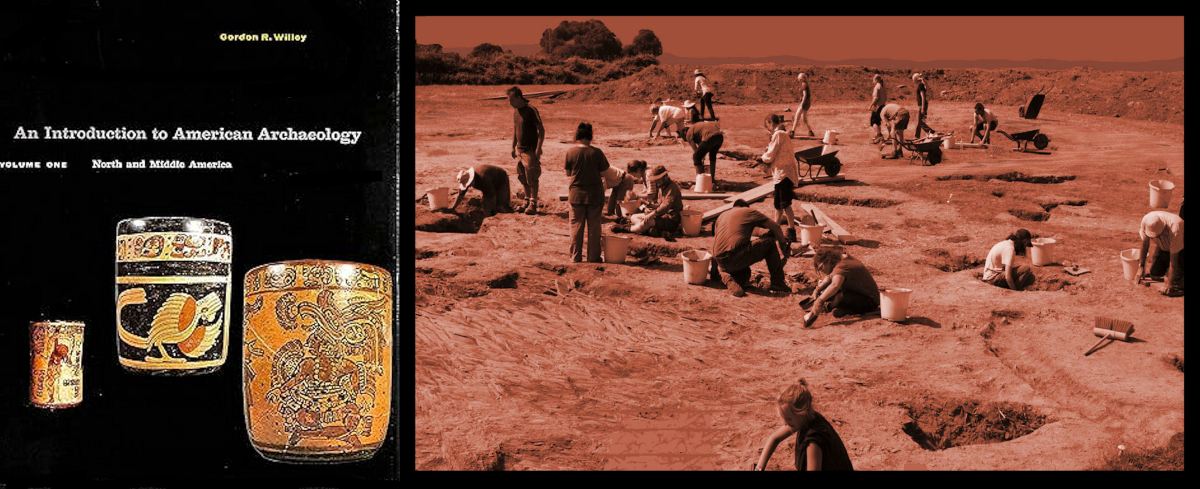
Last night I found the textbook that Dr. Lewis Larson used in our anthropology classes at Georgia Tech! It was in a box of memorabilia from those days long ago in Mexico. I took the text book with me to Mexico, but found the famous author’s knowledge of Mesoamerica to be quite obsolete and therefore never read it again. However, this book by archaeologist Gordon R. Wiley makes an excellent benchmark for explaining why the genetic, linguistic and architectural history of the South Atlantic Coast is so different from the orthodoxy maintained by academicians.
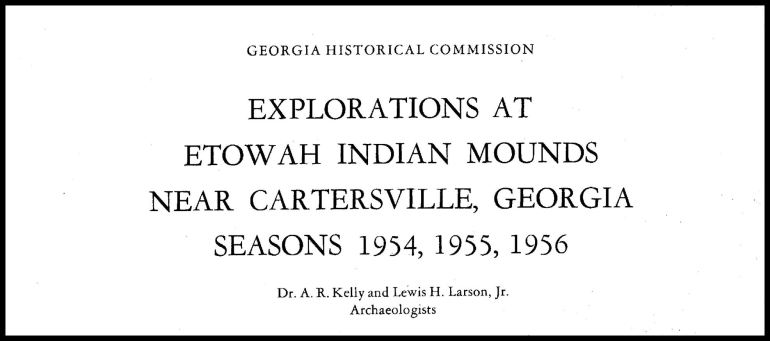
Dr. Lewis Larson was not just any archaeologist. He was nationally famous.
The Many Peoples of the South Atlantic Coast Series
by Richard L. Thornton, Architect & City Planner
Last night, I also discovered that just before I departed for home at the end of the fellowship in Mexico in early September 1970, “someone” had sneaked into my textbook and added now faded pencil writing . . . “LUVS Alicia Rozanes Moreno”. I can’t imagine, who would commit such a dastardly deed!
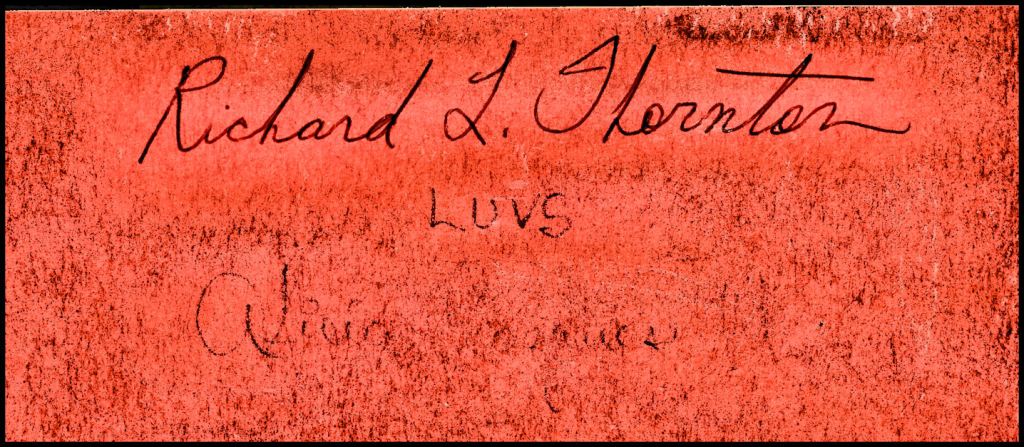
The penciled writing is now faded, but still sufficiently visible to convict this trespasser!
Gordon Randolph Wiley (2013-2002) was the emperor of archaeology in the United States throughout much of the latter half of the 20th century. He was born in Chariton, Iowa. His family moved to California when he was twelve years old. He completed his secondary education in Long Beach, California. Willey attended the University of Arizona where he earned Bachelors (1935) and Masters (1936) degrees in anthropology. In the autumn of 1939, he entered the doctoral program at Columbia University and earned a PhD.
After earning his Ph. D. Wiley was employed by the Smithsonian Institute until 1950, when he was hired by Harvard University. He was associated with Harvard for the remainder of his life.
After completing his studies at Arizona, Willey moved to Macon, Georgia to perform field work for Arthur R. Kelly. He was the first person, other than Dr. Kelly, with an anthropology degree to work at the massive Ocmulgee archaeological zone. The Supervising Archaeologist, Joe Tamplin, was a professional civil engineer and graduate of Georgia Tech.
Along with James A. Ford, Willey helped implement and refine ceramic stratigraphy, a concept new to Georgian archaeological sites. Unfortunately, although he accurately labeled one style of ceramics being older than another one, his dating was entirely wrong. That was a problem later on, when he had so much influence over the profession.
More than anyone else, he was responsible for the inaccurate dating and cultural interpretations of Ocmulgee which to this day deceive visitors to the museum. Wiley started the myth that Ocmulgee was founded by more advanced Indians from the Midwest . . . when in fact the mounds at Ocmulgee predate most of those at Cahokia, Illinois. Radiocarbon dating and later excavations by National Park Service archaeologists have produced accurate information, but the exhibits in the museum have not been changed.
For example, comprehensive biographies of Wiley state a quote from this book that the Lamar Village was inhabited from 1350 AD to 1600 AD. Actually, it was a favorite locale for humans, going back to the Ice Age and was continuously inhabited by ancestors of the Creek Indians from around 990 AD to 1805 AD.
Willey also worked at the historic site of Kasita, on the Georgia Piedmont near Fort Benning. In 1938, Willey published an article entitled “Time Studies: Pottery and Trees in Georgia.” In the early part of 1939, Willey worked at the Lamar Mounds and Village Site near Macon and identified relationships between Lamar and the Swift Creek (around 100–800 CE) and Late Woodland period Napier Phase (900–1000 CE) sites.
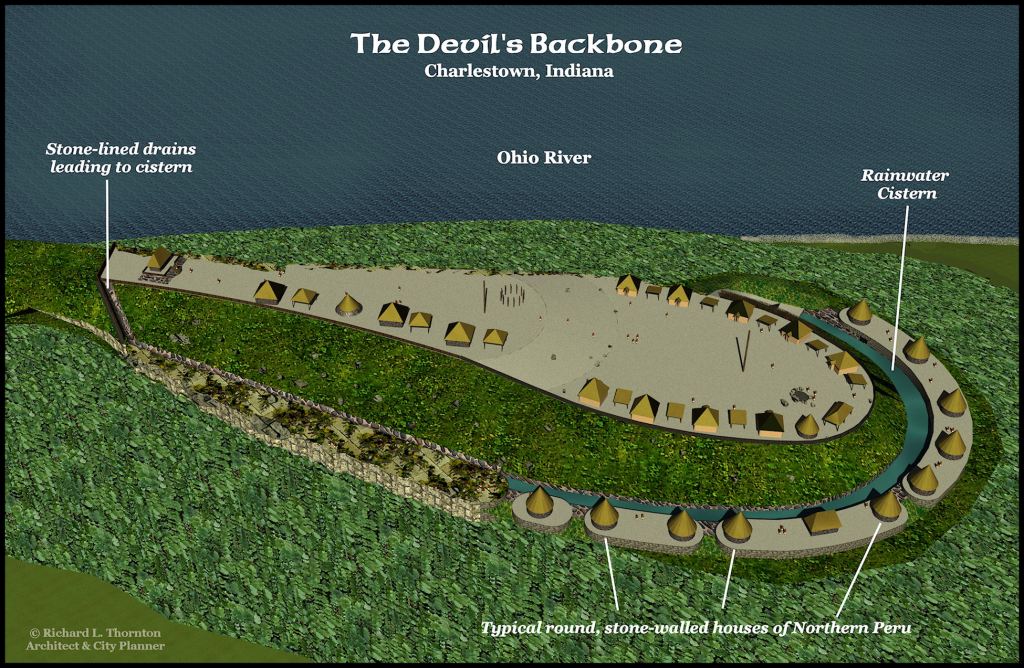
This site was obviously built by immigrants from South America. In fact, Moche style ceramics have been found in the Ohio River floodplain below. However, Wiley refused to admit that many peoples crisscrossed the Americas. Young archaeologists who challenged his beliefs saw their careers destroyed.
A narrow perspective of American cultures
In 1957, Louisiana archaeologist and geologist William Haag announced that he had obtained an astounding radiocarbon date of 3545 BC for the Bilbo Mound in Savannah, GA. The Wiley Clique in Archaeology quickly squashed the discovery, because “everybody knew that the first mounds were in Ohio.” They did the same thing when Haag began to identify many mounds in northern Louisiana that were much older than the mounds in Ohio.
Wiley’s interpretation of Native American community sites was clearly based on the prejudice that all advanced ideas came from either the North or the Southwest. In their mythological world, Clovis People were the first humans in the Americas, who crossed over the Bering Straight then immediately chose the High Deserts of New Mexico as the first place to live. The firsts of everything else began in the Midwest.
Actually the oldest Clovis points are found near Savannah, GA! No Clovis points have been found in either Alaska or Siberia. At any rate, they were NOT the first humans in the Americas.
Wiley’s first book in 1947 was on the Florida Gulf Coast Cultures. He believed that they were found by missionaries from Ohio and Illinois. His proof was that Hopewell pottery had been found in the Apalachicola River Basin of the Florida Panhandle. Apalachicola is what Floridians call the Chattahoochee River.
Guess what? The oldest know Hopewell style pottery is found in the Florida Panhandle! The designers of the Hopewell Mounds were probably from the Amazon River Basin and first landed at the mouth of Apalachicola River then worked their way northward.
Wiley believed that the first advanced culture, north of Mexico was the Hopewell Culture. Among he and his peers, they believed that the first pottery, the first mounds and the first gardens were in eastern Ohio. The first cultivation of corn and beans, plus construction of large mounds were at Cahokia, IL THAT is what I was taught in 1970.
In fact, the only memory I retain today of my first anthropology class was when Dr. Lawson was telling us about the importance of the first corn and beans cultivation at Cahokia. I interrupted his lecture by questioning the logic of saying that corn and bean seeds suddenly jumped 1800 miles from central Mexico to southern Illinois. They were tropical crops that first would have been necessarily adapted in stages to a temperate climate . . . but whatever the case would have required human hands, not migrating birds to be transported that distance.
Dr. Larson was from Michigan and received all his degrees in Michigan. He did not respond very positively to my suggestion that the Midwest was not the center of the Americas. Basically, he said that many years of education enable archaeologists to make interpretations of artifacts. Laymen and certainly students at an engineering school are not qualified to make such decisions.
Actually, the oldest known evidence of American corn being cultivated in North America has been found along the Gulf Coast of Alabama and the region around Lake Okeechobee, Florida. I strongly suspect that the wetlands of Ocmulgee Bottoms made an ideal location to develop tropical plants into varieties that would thrive in wet, temperate climate of Eastern North America.
An Introduction to American Archaeology was published in 1966 and continued to be a primary textbook for undergraduate classes in Anthropology throughout the United States. It is filled with lots of photos of pottery, stone tools and stone weapons, which make most students think that archaeologists know a whole lot about the humans, who occupied the Americas before 1600 AD. The truth is that being skilled at removing artifacts from the soil is not equivalent to having a broad understanding of how the makers of these artifacts lived or even who they were.
What makes the situation worse is that there has been very little genetic analysis of the thousands of skeletons removed from Southeastern Indigenous burials. An Archaic Sami skeleton could be identical to an Adena or Copena Culture skeleton. They were all Asiatic peoples . . . just came from different parts of Asia.
Guess what? The oldest DNA results from the Southeast are Proto-Sami . . . the Windover Pond burials near Cape Canaveral, Florida.
There is no discussion of linguistics, Colonial Era archives/maps, migration legends, architecture, town planning or genetics in the book. Humanity is defined by objects that one can hold in their hand. The South Atlantic Coastal Plain is barely mentioned in the book. It leaves one thinking that the region was either devoid of inhabitants or else that they were primitive savages.
In general, the book assumes that once a single Siberian ethnic group came over the Bering Strait, they migrated to a certain locale and stayed there, until European settlers arrived. The possibility of humans migrating from other parts of the world was unthinkable. The book introduced the concept of re-labeling “cultures” as being “phases” . . . to suggest that the same people merely evolved over time in each locale.

Shenandoah was derived from an Archaic Irish word . . . Shannon Toa
Today though, genetic scientists have absolute proof that peoples immigrated to the Americas before, during and after the Bering Land Bridge appeared. The reason that I was particularly excited to work with these scientists was that my linguistic studies had come up with the same conclusion. How else can you explain the abundance of Bronze Age European, Iron Age Nordic, Medieval Irish, Polynesian, Mesoamerican and South American words on the South Atlantic Coast?
It is a Whole New World.
 The Americas Revealed