
Photo above: Image published online, uncredited, by The Land Trust Alliance
There is a direct connection between several tribal names on the Georgia and South Carolina coasts with Nordic European tribes and architecture.
The Caribs and Panoans in the northern Amazon Basin also built massive A-frame timber apartment buildings that could hold up to 500 persons. The Panoan languages contain some words, which mean the same and are pronounced the same as modern Swedish.
The Many Peoples of the South Atlantic Coast Series
by Richard L. Thornton, Architect & City Planner
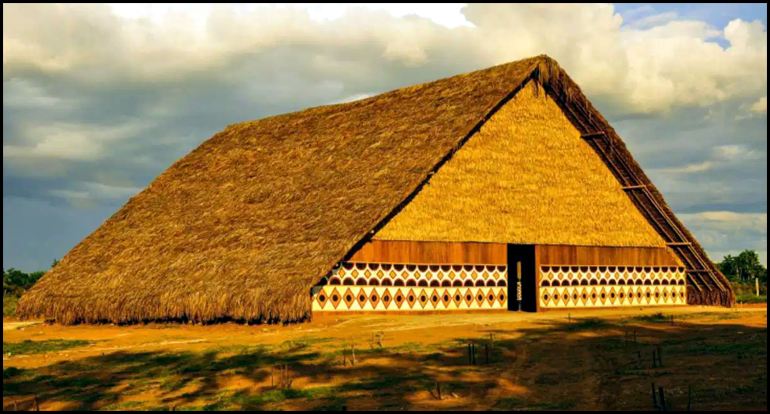
Shipibo Longhouse apartment building in the Amazon River Basin
Next week, The Americas Revealed readers will be treated with a slide show of many, very similar, massive timber apartment buildings in the Northern Amazon Basin, South Carolina, Georgia, eastern Scotland, Friesland, Denmark, southern Sweden and southern Norway. These structures held the entire populations of villages . . . up to at least 500 people! This is not the speculative stuff of such authors as Erich von Däniken and Graham Hancock.
In most cases, the original Nordic word was replaced by an entirely different Creek or Modern English word that meant the same! Sometimes the word remains today, virtually unchanged.
Winyah Bay, South Carolina, contains extensive tidal marshes. The Winyah People once lived there. These marshes are a mix of salt and brackish water environments, influenced by the influx of four major rivers. They look like a vast grassy prairie. Explanations of the word, Winyah, by South Carolina academicians and tribal elders, as usual for the Eastern United States, are purely speculative.

Most of the Gråen Vinja coastal grasslands near Landskrona, Sweden were destroyed over the past three centuries by dredging to build fortifications, a Swedish Royal Navy base and ship-building yards. However, the Swedish government is now restoring the wetlands, where possible, to provide habitats for waterfowl, such as the Mute Swan (Cygnus olor) and the Whooper Swan (Cygnus cygnus).
Winyah was one of the Native American words that I struggled with for years. It didn’t seem to be from any major Native American language . . . until I remembered that the Gråen Vinja was the Medieval Swedish name of a large tidal marsh near Landskrona, Sweden . . . where I worked after graduating from Georgia Tech. The word means “The Gray Coastal Marsh” In earlier times, Vinja would have been pronounced in English phonetics, Winyah!

A longhouse apartment building in Friesland or Northeast Georgia?
Commerce, Georgia – living proof of a Nordic connection
Thamacoggen was another Native American tribal name that I struggled with for over a decade. Captain René Goulaine de Laudonnière, commander of Fort Caroline (1564-1565) wrote in his memoirs that they were a powerful, wealthy tribe on the middle May River* (Altamaha) River. Their wealth had come from operating large freight canoes along the Altamaha, Ocmulgee and Oconee Rivers. As “middlemen” they interconnected the coastal provinces with those in the Piedmont and Mountains.
* All French, English, Dutch and early United State maps label the Altamaha River as the May River or else state that “May” was its original name. The Spanish called it the Secco River. Fort Caroline was definitely in Georgia, not Florida.
After the Spanish conquered the Georgia Coast, the Thamacoggen moved up the Altamaha and Oconee Rivers to a region that is now Jackson County and located in Northeast Metro Atlanta. The original name of the county seat of Jackson County was Thamacoggen, because it was located on the site of the Thamacoggen’s capital.
The Early History of Jackson County tells us that eventually, settlers decided that they wanted an English name for their county seat. They asked bilingual Creeks living in western Georgia, what Thamacoggen meant. It was a word, imported into the Creek languages, which roughly meant “commerce.” Bingo! We had the new name of Jackson County’s seat of government.
Finally, with the use of my new powerful A.I. computer, I was able to find the meaning of Thama and cog . . . the root words of Thamacoggen. Tama was the Totonac, Itza Maya and Itsate Creek for trade. It is seen on place names throughout the lower Southeast. The Frisians, Angliska (Archaic English) Jutes and Norse could not pronounce a hard “T” sound, so converted Tama to Thama.
“Kog” was originally the pan-Nordic word for a tooth, but became the Archaic Frisian name for the wooden purlins or tendons that inter-connected the planks on their first sea-going boats during the Roman Period. These Kogboats later evolved into the famous Viking Longboat. In fact, the Frisians were the first Vikings and later often participated with Norse Vikings on raids. Among Nordic peoples, the Frisians and their neighbors, the Angliska (English) were the only mariners during the Iron Age, who built boats, capable of long ocean voyages.
By the Early Medieval Period “kog” came to mean in Frisian anything that connected two things or geographic areas together. No other Nordic language had that meaning. By the Late Medieval Period, “kog” came to mean the teeth on a gear wheels. Its earlier meaning of being a connector was forgotten in the Frisian language.
Thus, Thamacoggen is a hybrid word from two languages, Itza Maya and Frisian, which together mean “Trade Connectors.” That is mighty similar to the modern city named Commerce! By the way, it was quite common for the indigenous peoples of Georgia to combine words from two or more languages to create a tribal name or political title.
Factual History is far stranger than Fiction!
 The Americas Revealed
Hi Richard, Can you show the reference for the entry photo if it’s not you? Thanks
LikeLiked by 1 person
Photo by the Land Trust Alliance (2016) I will add that to the article. My photos of Winyah Bay all had a girlfriend in them.
LikeLiked by 2 people
Just wondered. Want to give proper reference if I paint it. Cheers
LikeLiked by 1 person