Human genes cannot be carried by migrating birds!
Haplogroup U5 . . . a maternal haplogroup that was typical of hunter-gatherers in Northern Europe and typical today, primarily of the Sami in northern Scandinavia, was found in abundance where it shouldn’t have been.
Readers should remember that virtually none of the hundreds of thousands of indigenous skeletons unearthed in the Southeastern United States have been analyzed for DNA. When this was done at Windover Pond, Florida, the original burials were Haplogroup U5. The last burials consisted of hybrids who were a mixture of Haplogroup U5 and those haplogroups, typical of American Indians from Siberia. Our family carries substantial U5.
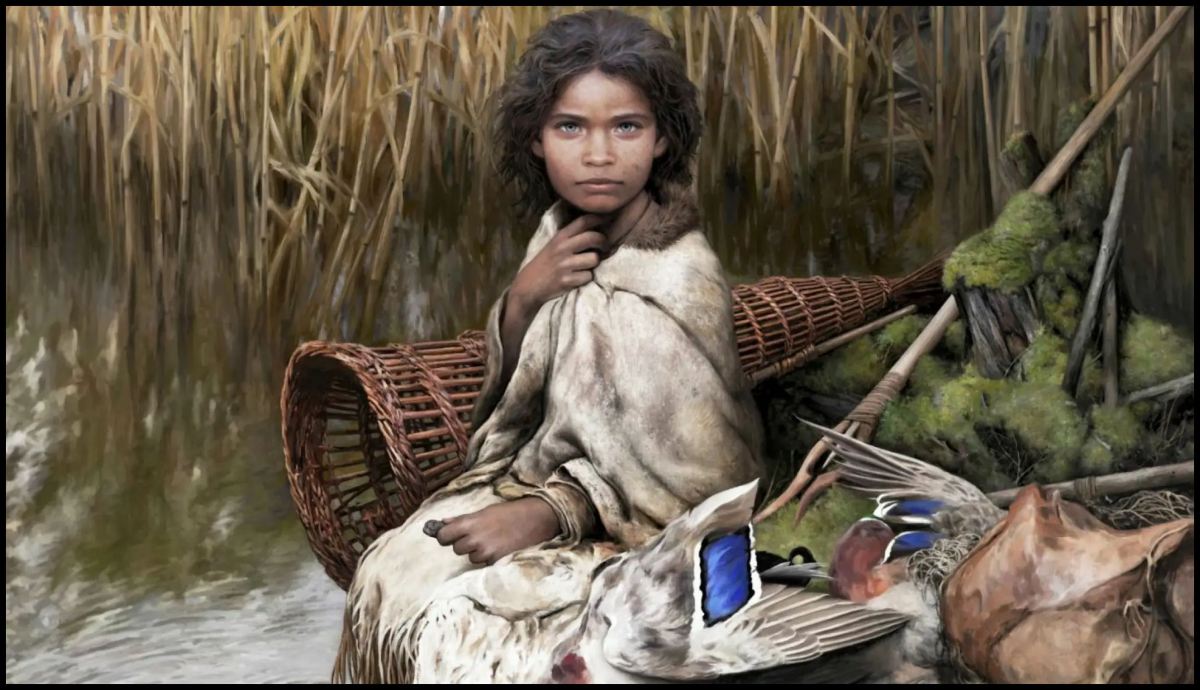
Image Above: Northern European Hunter-Gatherers had dark hair, tan skin and pronounced cheek bones. They looked little different than a Northern Sami, mixed-blood Native American or a Latin American mestizo. Painting by Tom Björklund at the Museum Lolland-Falster
The Many Peoples of the South Atlantic Coast Series
by Richard L. Thornton, Architect & City Planner

When we first began working together, Dr. Yates asked me to produce a global map of locations where there were Pre-Columbian concentrations of the Odin Gene. Initially, the map seemed totally implausible to me. However., the Windover Pond “bog bodies” in Florida did carry substantial Haplogroups U5 and X.
When research began in the project that became the recently published book, The Countercurrents of Pre-History* by Dr. Don N. Yates, all DNA labs assumed that all non-Siberian DNA in humans in the Americas came from admixtures after the voyages of Christopher Columbus. Thus, the Sami and Polynesian DNA in my family’s bodies was explained by saying that unknown ancestors from northern Scandinavia and Polynesia had been sailors on ships that docked in Savannah then decided to head inland and intermarry with the British colonists.
When out-of-the-box thinkers like Smithsonian archaeologist Dennis Stanford, suggested that some of the immigrants into the Americas came from places other than eastern Siberia, they were pounced upon viciously by the Old Guard. The Old Guard would chant repeatedly, ‘No non-AmerIndian DNA has been found in Pre-Columbian burials.” That is totally untrue, but if the mantra was repeated enough times, journalists believed them.

* The Countercurrents of Prehistory by Dr. Don N. Yates is available from Panther’s Lodge Publishers and Amazon.com
Three strategies were used to conceal America’s past.
(1) The “inconvenient” genes were not mentioned individually in a published report, but grouped in an “Other misc. haplogroups” category.
(2) Alternatively, the “inconvenient” genes were mentioned, but explained as being the result of post-extraction contamination.
(3) In recent years, progressive geneticists and archaeologists have gotten wise to the concealment of “inconvenient” genes. They typically will publish the results of their studies by reputable labs in national press releases, respected scientific journals and in bound books. Nevertheless, the cliques within the professions of genetics and anthropology will refuse to include the new discoveries in their classroom lectures or their own professional papers . . . thinking that these threats to orthodoxy will just go way if they were not mentioned.
Future articles in this series will discuss other Old World genes that were not supposed to be in the bodies of indigenous peoples of the Americas. I will also be showing readers my astonishing archaeological discoveries in the Northeast Georgia Mountains, which can only be explained by the movement of peoples across the Atlantic Ocean, before the voyages of Columbus.
What about Dennis Stanford’s Theory of North Atlantic migration?
There is insufficient direct evidence to definitively state that the Solutrean people carried the U5 mitochondrial haplogroup. Too few DNA samples have been obtained from Solutrean Culture skeletons. While haplogroup U5 was a dominant mitochondrial DNA (mtDNA) haplogroup among European hunter-gatherers, including those present in Europe during the time of the Solutrean culture, direct genetic data from Solutrean individuals is limited.
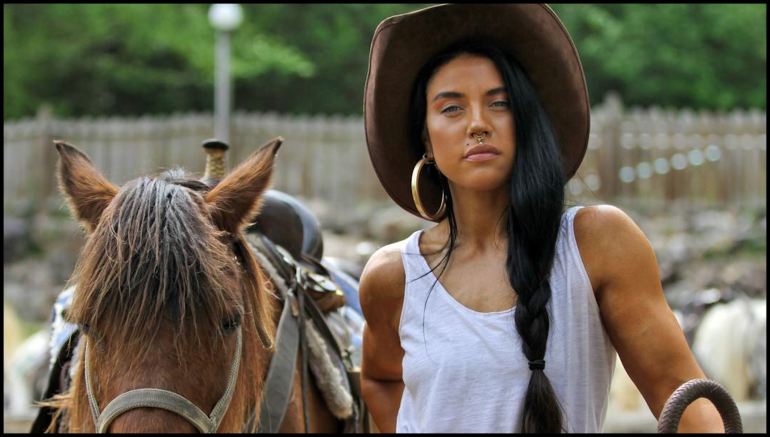
Maxida Mirak is a full-blood Northern Sami singer and political activist from Sweden. The Northern Hunter-Gatherers and Windover Pond People of Florida would have strongly resembled her.
Until next time!
 The Americas Revealed
I just ordered Dr. Yates’ book. I can’t believe I just paid that price for it, but I have other works of his, and his research has helped me immensely in understanding my own ancestry. I referenced him (and you, by the way) in a paper I wrote about a year and a half ago for the Center for Exploring Judaism at Central Synagogue in New York City.
LikeLiked by 1 person
Yes, the reason that I no longer write full size books is that the retailers charge outrageous prices for them and pay me almost nothing. At least with YouTube Video, the information that I am offering gets wide exposure . . . with a lot less work. My videos are classified as Educational so I don’t get advertising income, but receiving $1.12 for a book that Amazon sells for $112 makes that effort, not worth the time expended.
LikeLiked by 1 person
Yes, that’s crazy. Amazon is making a killing.
LikeLiked by 1 person