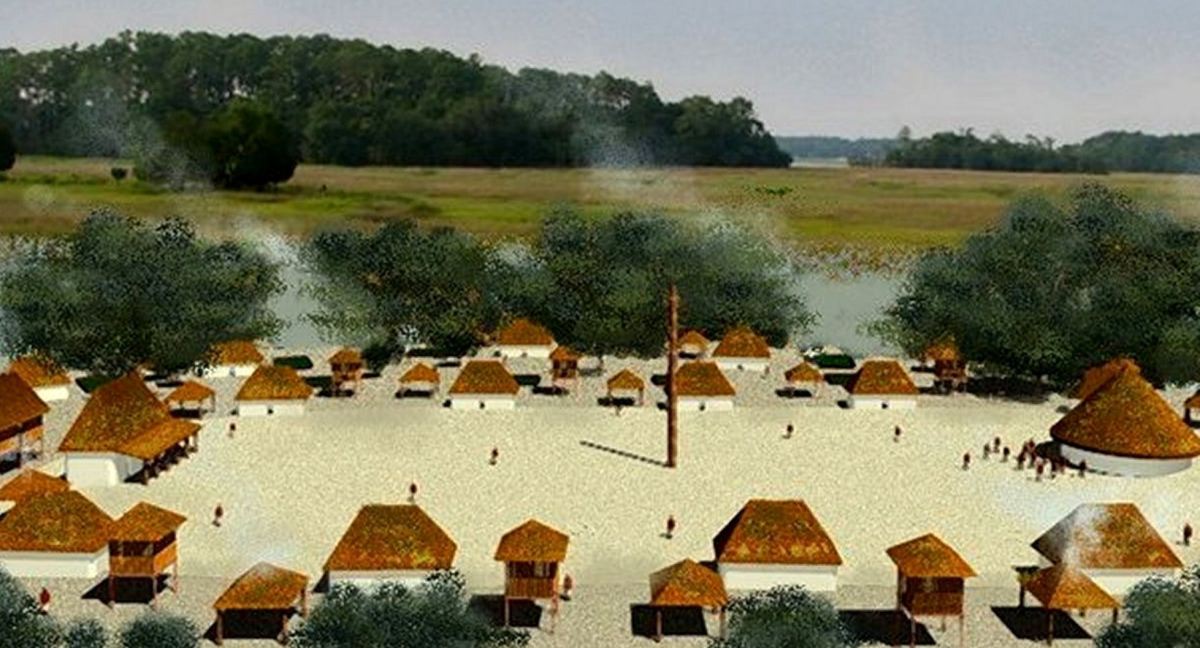
They introduced “Tabby” architecture from their homeland in Southern Mexico, long before the Spanish arrived.
The recent publication (finally!) of a Chontal Maya dictionary, plus examination of the South Carolina Colonial Archives provide a very different explanation of these words than the version memorized by archaeologists, while they were in college.
At some point in the late 20th century, a small clique of Southeastern academicians issued a Royal Edict on the matter, without knowing diddlysquat about these peoples Giving English names to potsherds that you dig up does not equate to understanding the cultural history of an indigenous people. Several distinct ethnic groups on the South Atlantic Coast made similar styles of pottery. These academicians created the myth that all tribes north of the Altamaha River were “Guale” and all tribes south of the Altamaha were “Timucua” . . . both words being Spanish labels for administrative districts of their mission system.
The work I did for a geneticist in Colorado and his associated scientists around the world in the first half of 2025 was a remarkable learning experience for me. It opened my eyes to the important role of Austronesian mariners in the cultural development of the Pacific Basin, northern South America, southern Mexico and the Southeastern United States. Ethnically-mixed descendants of early Austronesian colonists not only introduced the basis of Mesoamerican art, but also provided the mariners and merchants to interlink emerging civilizations.
Indeed, these scientists have discovered that the Savannah River Basin Uchees were Austronesians, not descendants of Siberian immigrants to the Americas. Subsequently, I found that even today, both Chontal and Itza Maya contain many Austronesian words, not found in other Mayan languages. These peoples were also originally, Austronesian mariners . . . who intermarried with the locals.

A Wahale (Guale) farmstead on St. Catherines Island, Georgia
The Many Peoples of the South Atlantic Coast series
by Richard L. Thornton, Architect & City Planner
Etymologies
(1) Wallie (SC English) – Wahalee/Wahachee (GA English) – Guale (Spanish)
Original words – Waha-re (Hybrid Chontal Maya & Archaic Irish) = Southerners
Wahashi (Hybrid Chontal Maya & Muskogean) = Descendants or colonists of Southerners
Notes : These are English and Spanish names for a tribe near the mouth of Savannah River, which was the dominant member of the Yamasee Alliance. Like their relatives on the coast of Campeche, Tabasco and southern Veracruz states in Mexico, they coated all of their buildings with a stucco, composed of hydrated lime, crushed sea shells, sand and white kaolin clay. A Spanish Army architect, who viewed their structures on St. Catherines Island (GA) said that these buildings “glistened like pearls.” He stated his intention to utilize this stucco on the buildings of St. Augustine. Thus, was the real origin of “tabby” architecture.
(a) Some migrated up the Savannah River to its confluence with the Broad River during Pre-Columbian times. Known as the Wahachee, after December 1715, they were allies of the Cherokees and Province of South Carolina during the Yamasee War. So, after this bloody war, they were initially labeled “Cherokees” in South Carolina governmental documents. Probably, those Lower Savannah “Wallies” who survived the war and fled northward to their kin, were quite happy to not be identified as “hostiles.”
This misconception is the basis for the many inaccurate maps floating around that show the Cherokees traditionally living in NE Georgia, when in fact, they never did. The region was always Muskogean, Uchee and Mesoamerican until 1818, when those lands were ceded.
In reality, the Wahachee always viewed themselves as being more kin to the Creeks and apparently joined the Creek Confederacy after Georgia was founded in 1733. They furnished scouts to the British Army during the Anglo-Cherokee War (1757-1763) and to the Georgia Rangers, which was formed after this war. They sided with the Patriots in the American Revolution and furnished scouts to United States in the 1776 Cherokee War and the Chickamauga Cherokee War, which followed the Revolution.
There was considerable intermarriage between the Wahachee, Uchee and White settlers in the Upper Savannah Basin . . . so much so, that the Wahachee fought on the side of their White neighbors, when Upper Creeks from present-day Alabama attacked the NE Georgia frontier in the late 1780s and early 1790s. Their offspring settled into mixed-blood Creek communities in Greenwood & Anderson Counties, SC and Elbert and Hart Counties, GA. Very few went to Oklahoma.
(b) Around 1500 AD, one band of Wallie migrated to St. Catherines Island, GA. At the time of first contact with the Spanish in 1566, their population was probably around 4,000 persons. However, under Spanish domination, their population plummeted to the point in 1684, it was only 52! By the early 1700s, they were essentially extinct
(c) Those in the Savannah Basin were allies of the Yamasee in the Yamasee War, thus were either killed, enslaved or driven out of the region in 1717.
(2) Yama (EN & Maya), Jama (SP-pronounced Yama)
Original word – Yama (Chontal Maya) = Gulf Coastal Plain of Veracruz & Tabasco; a grassy coastal plain; a cultivated field, cleared by slash-and-burn in the Coastal Plain; Name of province around the Jamapo River Basin in Veracruz State, Mexico.
Note: This is probably the original name of the “Olmec Civilization.”
(3) Yamacraw Bluff (EN) – Physical feature in Downtown Savannah, GA
Origina word – Yamakora (hybrid Chontal Maya & Amazonian Carib) = Yama People or Tribe
(4) Yamasee (EN), Yemansee (EN), Yamasé (FR), Jamiscaron (SP)
Original word – Yamasi (Chontal Maya & Itzate Creek) = Descendants of the Province of Yama. This may have applied to the original Mexican province or to the one in Georgia.
(5) Tybee Island (originally Taubee) (EN) – This popular resort island is located at the mouth of the Savannah River.
Original word – Taube (Chontal & Itza Maya) = salt
Note: Tybee Island had a long history of brine salt production. The Chontal and Itza Mayas refined sea water into salt. The Uchees distributed it around Southeastern North America.

Wahale-Creek brine refining facility on Tybee Island, GA in 1735. Note the large pile of salt on the left. Movies in the United States never portray Native Americans utilizing this scale of technology. Creeks and Uchees continued to operate the plant at an even larger scale until malaria and smallpox epidemics struck Savannah in the early 1750s. Sketch by Georg Friedrich Von Reck – Von Reck’s art is now on display at the Danish Royal Library in Copenhagen, Denmark.
(6) Pocotaligo (English) – The principal town of the Wahalee living north of the Savannah River.
Original word – Pocotaulico (Chontal Maya) = large town
Note: The root word within this town name, Talico, also was the name of a town an province on the Little Tennessee River near the present-day border between Tennessee and North Carolina. Talico became the name of the Tellico River. That was modified by the Cherokees to Tahlequah, the capital of the Cherokee Nation in Oklahoma. Talico was founded long before the arrival of the Cherokees.
Now You Know!

House in a Wahale village on the west side of an island
 The Americas Revealed
Great! However, the Guale and Yamassee still exist.
LikeLike