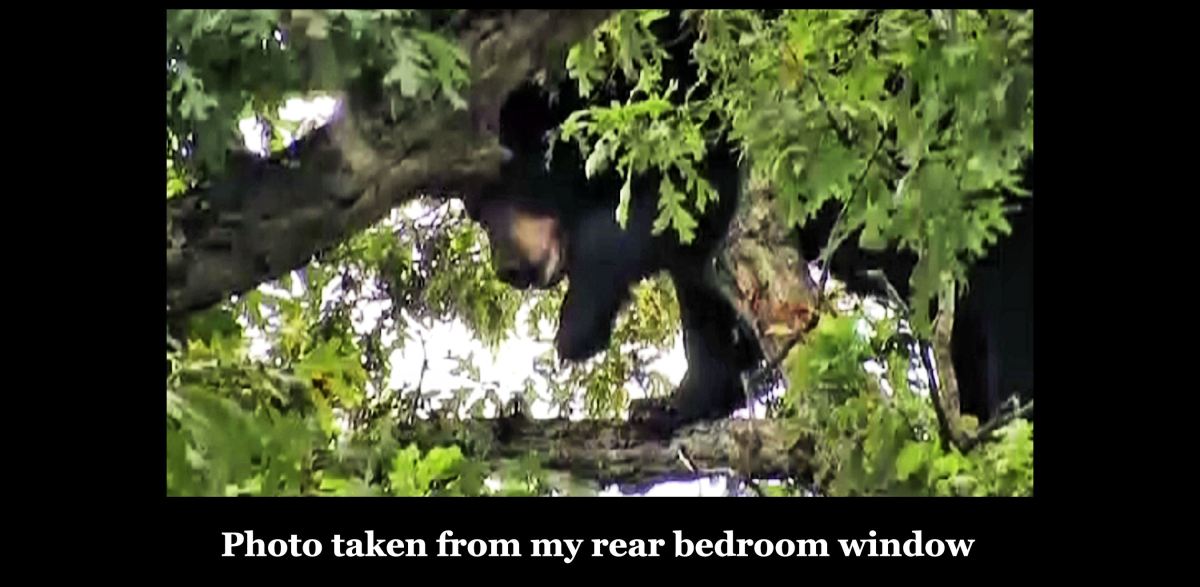
Look who was peaking through my window!
Yonah Mountain, the extinct volcano which dominates Northeast Georgia, was always named Nocoshe Mountain, the Creek and Chickasaw word for “bear,” until the mid-1830s, when settlers from North Carolina changed the name to “Yonah,” which is now the Cherokee word for a Grizzly Bear.
The Spanish-speaking gold miners from Galicia, Asturias and Navarre called the mountain, Yeona, which was their word for a mountain lion. Perhaps the North Carolinians looked up that word in their Cherokee dictionaries and thought the Spaniards were trying to say the word for a large bear.
Although between 1794 and 1821, the Nacoochee Valley was the southern edge of the Cherokee tribal territory, there is no evidence that ethnic Cherokees ever lived here. Several archaeological expeditions have only found typical Creek, Chickasaw, Kansa or Uchee artifacts and villages here. When local Spaniards and Indigenous peoples sold the land to a North Carolina real estate speculator in 1821, they pocketed the money . . . either remaining nearby or moving to the lands of the Creek Confederacy.
by Richard L. Thornton, Architect and City Planner
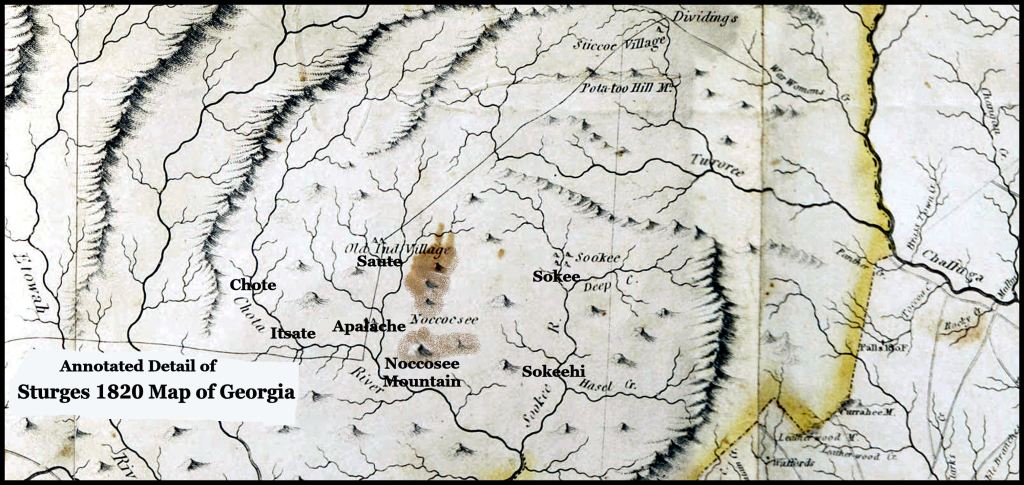
The official 1820 map of Georgia clearly named the mountain Noccosee, the Anglicized Creek and Chickasaw word for bear . . . plus only showed Native villages with either Creek or Chickasaw names.
In 2023, I received a grant from the California Arts Council and the People of Coulterville, California to research the connections between the Georgia Gold Rush and California Gold Rush. One of the stories, Californians were curious about was that “in 1849, over 240 skilled Cherokee gold miners departed their homes in the Nacoochee Valley and journeyed to California. “
All the Cherokee-owned lands in the upper Chattahoochee River were ceded either in 1818 or 1822. All Cherokees, except those whose husbands were White, were removed from the rest of Georgia in 1838. This story seemed impossible. Indeed it was.
I eventually figured out that the “skilled gold miners” were descendants of the Spanish-and-Portuguese-speaking colonists, who settled in the valley in the late 1500s and 1600s. They were of mixed Jewish, Iberian and some Creek descent. Undoubtedly, they labeled themselves Cherokees in order to avoid the hostility in California against Mexicans and Jews. In that era, Cherokees were considered to be submissive, while Creeks and Seminoles were often viewed as being arrogant and non-submissive. (See the video below.)

The official map of the Georgia Gold Belt, printed by Congress, used the Spanish name for the mountain, Yeona.
Bears, who are no bother
Black Bears frequently visit the deep ravine, which composes about 2/3 of my property. When I first moved here in the spring of 2018, I quickly noticed that their appearance and behavior was quite different than the many bears that I encountered in the mountains of North Carolina and Tennessee, while living in a tent there for six months in 2010.
The bears here look healthier . . . downright fat and satisfied . . . and much calmer. They are neither hostile nor skittish around me. During the late spring, a mother bear and three young cubs camped out in back of my house for a couple of weeks, until a pack of coyotes moved on. It is quite common for the younger males to behave like pet farm dogs, who belong here. I speak to them in a friendly manner. They turn their heads to me, grin, then go back to feeding.
After the experience with the young bear peaking through my second story bedroom window, I contacted the Georgia Department of Resources to find out why the Black Bears are so different here. I was afraid that they would laugh at me, but actually I was right on target. Here is what they said:

The mother with cubs slept at the edge of my flood lights at night during the period when a coyote pack was nearby. In the daytime, she parked the cubs at the base of the ravine then when foraging for food.
According to the Georgia Department of Natural Resources Wildlife Resources Division, there have been no recorded fatal bear attacks on humans in the 300 year history of the State of Georgia. Black bear attacks, in general, are considered extremely rare in Georgia, but occur annually in neighboring states, even though Georgia is rapidly developing the region’s largest bear population.
There is also evidence that the Georgia Black Bear population is evolving to a different sub-species. The bear family clans of the Georgia Mountains rarely mate with those in the North Carolina and Tennessee Mountains and generally drive out any bears, who originated from those states.
Also, they are exhibiting social patterns more like wolves. This is puzzling to wildlife biologists. They are not nearly as inclined to eat human garbage . . . instead they prefer to dine on deer fawns, rodents, insect grubs within fallen trees, plus seasonal wild fruit. Some sections of the Georgia Mountains are covered in wild blueberries, which large groups of bears will graze like cattle. They have also been increasingly seen to hunt deer and coyotes in packs. .This never seen before “pack behavior” is also seen when North Carolina and Tennessee male bears attempt to wander past the state line.
Very interesting . . .
 The Americas Revealed
I walk about 2-3 miles every day, and many days I just walk laps on my front porch, which runs almost the full length of the house. About 3 weeks ago, I was walking on the porch, listening to music, and singing, and looked up to see a large black bear just sitting there at the edge of the garage, looking at me, as if it were listening to me sing. One of my cats was sitting there staring at the bear, and I was more concerned about the cat than anything else. When I began calling the cat, the bear lumbered off.
LikeLiked by 2 people
Yep, must be the same Bear Clan that occupies this end of the Valley. You observed him showing the intelligence of primates. That’s the way that state wildlife biologist described the new behavior of the bears around here. They obviously can think, observe and remember,
LikeLiked by 2 people
How do the bears know where the state line is? Is there some kind of environmental pressure causing a divergence in their behavior? I was in TN about this time last year and I walked within 5 feet of a bear in the dark that was headed for my trash. I didn’t even realize it until I was past it and saw it in the light from the house. It appears to have hidden behind a tree as I walked by.
LikeLiked by 1 person
Yes there is more or less a natural boundary. There is a fault line and valley on the northern edge of the mountains in Georgia which allows east-wet roadways in NC and TN but they are extremely expensive to build in the Georgia Mountains,. Also, the vegetation and rock chemistry are quite different between those mountain ranges, since many of the peaks in Georgia are former volcanoes or are the remnants of a mountain range much older than the mountains visible today.
LikeLike
Very interesting. I wonder if any environmental differences would also work on other animals, or even people.
LikeLiked by 1 person
I remembered something after writing the original article. One of the reasons that we moved our goat dairy and cheese creamery to the Shenandoah Valley was that the soil in Western North Carolina contains toxic levels of aluminum and has virtually no potassium. After we moved our operation to the Shenandoah Valley of Virginia, our goats born there were about 30% larger and gave twice as much milk. The milk and the cheeses were also much “sweeter,”
LikeLiked by 1 person