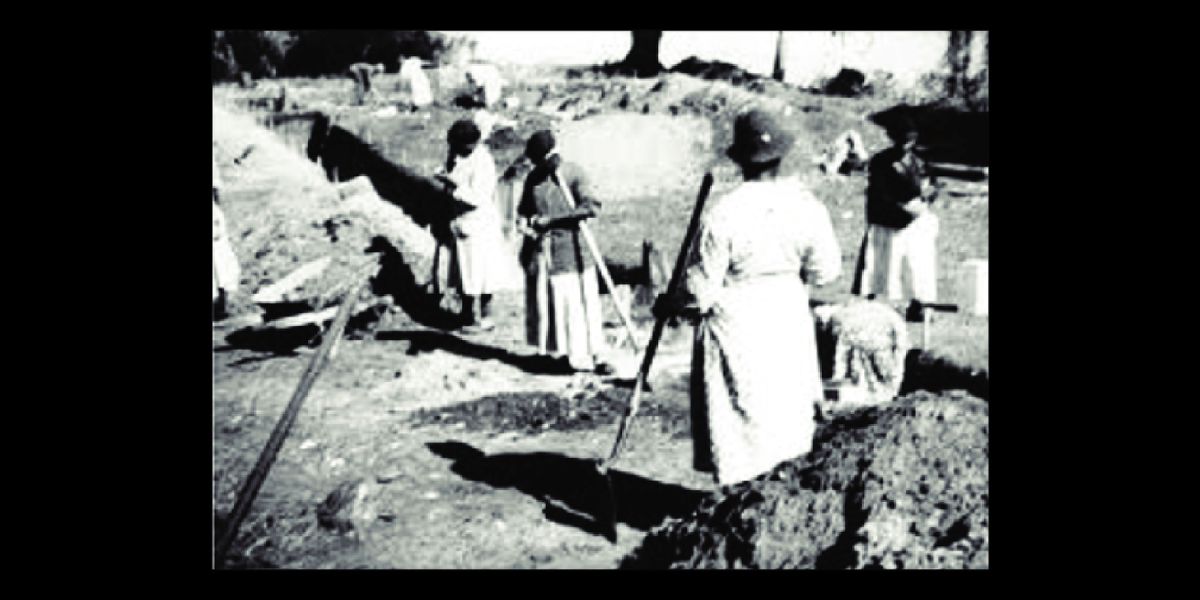
President Roosevelt ordered the White archaeologists, employed by the Works Progress Administration in Georgia, to hire women and African-Americans.
The archaeologists, all of whom were from Northern universities, responded that White women didn’t have the stamina to do archaeological excavation work and Colored folks in general, did not have the mental capacity to discern potsherds from dirt.
President Franklin Delano Roosevelt was not amused then responded . . . “Do it! If you want to get another paycheck from the WPA!”
The Many Peoples of the South Atlantic Coast Series
by Richard L. Thornton, Architect & City Planner
The story is that Roosevelt was not aware that WPA administrators in the South were only hiring White men until tipped off by his African-American and female neighbors around the Little White House in Warm Springs, Georgia. They complained that even when they listed him as a character or employer reference, they still couldn’t get work from the WPA.
The chief archaeologist in Savannah was Dr. Joseph Ralston Caldwell. He decided to experiment with the use of White and Black female workers together at the Irene Island site, which was about two miles from the downtown area of Savannah.
The Savannah WPA office hired 32 White women and probably double that number of African-American women. We say. “Probably” because although the WPA kept precise records of the White Women, none exist for the Black Women. Apparently, they were only known as Colored Woman 1, Colored Woman 2, etc. to the payroll clerks.
We only know the names of two of the Black women, because their sons became prominent. Savannah’s first African-American police officer, John White’s mother, Gussie, attended the Tuskeegee Normal School for Women and had training as an educator and clerical worker before the excavation. She was paid less than half of what the White women were paid.
What Joseph Caldwell and his team of ladies discovered

Birdseye view of Irene Island as it appeared around 1250 AD
© Richard L. Thornton, Architect
Caldwell was very pleased with his team of lady archaeological technicians. Irene Island was a fortified island compound for the royal family and elite of a powerful province, which dominated the South Atlantic Coast. It was abandoned in the 1600s then chosen as the location for a church and school for the Creek Indians by General James Edward Oglethorpe in 1734.
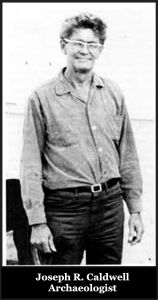
He went on to excavate many other mounds in the area around Downtown Savannah until World War II broke out. All Native American earthworks on Irene Island were destroyed by the construction of the new port facilities for Savannah during World War II.
After World War II, Caldwell worked on a series of sites that were to be covered by US Army Corps of Engineers reservoirs. From 1954 through 1956, he was part of the team at the excavation of Etowah Mounds then returned for the next ten years doing archaeological investigations for the US Army Corps of Engineers.
In 1967, Caldwell was hired as a professor at the University of Georgia and an archaeological professor. This was the Golden Age of archaeology at the University. He died of a heart attack at age 57 in 1973 without realizing that he had discovered the capital of the fabled Kingdom of Chicora. We will talk about that in our next article.
 The Americas Revealed