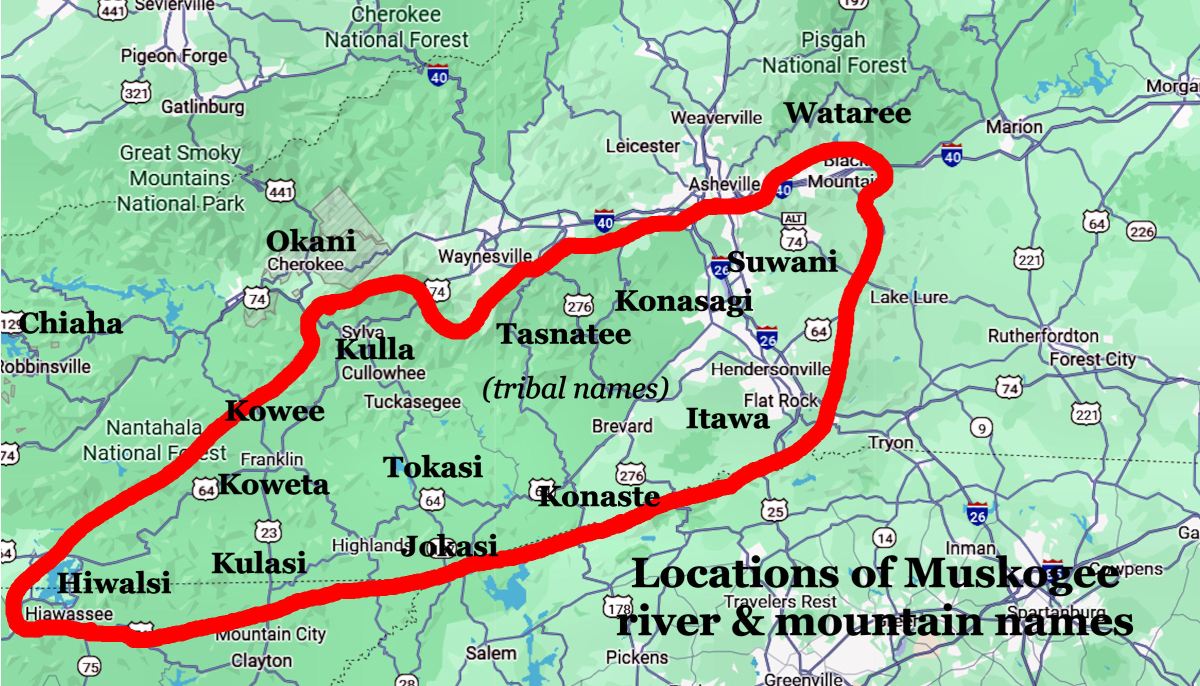
Only in a region stretching from Hiawassee, GA to Franklin, NC to Asheville, NC and Hendersonville, NC does one find all of the “Native American” place names originating from the Muskogee Language.
Most Creeks in Georgia spoke dialects of the Itsate Creek language until the late 1800s. Muskogee was the language spoken by the most militarily powerful tribes in 1717, when the Creek Confederacy was formed. Muskogee was adopted as its parliamentary language, but the hybrid word, Maskoki (Muskogee) was not coined until around 1748.
Muskogee is an extremely complex, hybrid language that is a mixture of several archaic Indo-European languages with Chickasaw, Panoan from Peru and Itza Maya from southern Mexico. Its grammar is more like Archaic Anglisk and Frisian than anything else. In fact, Muskogee contains a few Archaic Anglisk words and forms plural nouns in the same way as Anglisk.
by Richard L. Thornton , Architect & City Planner
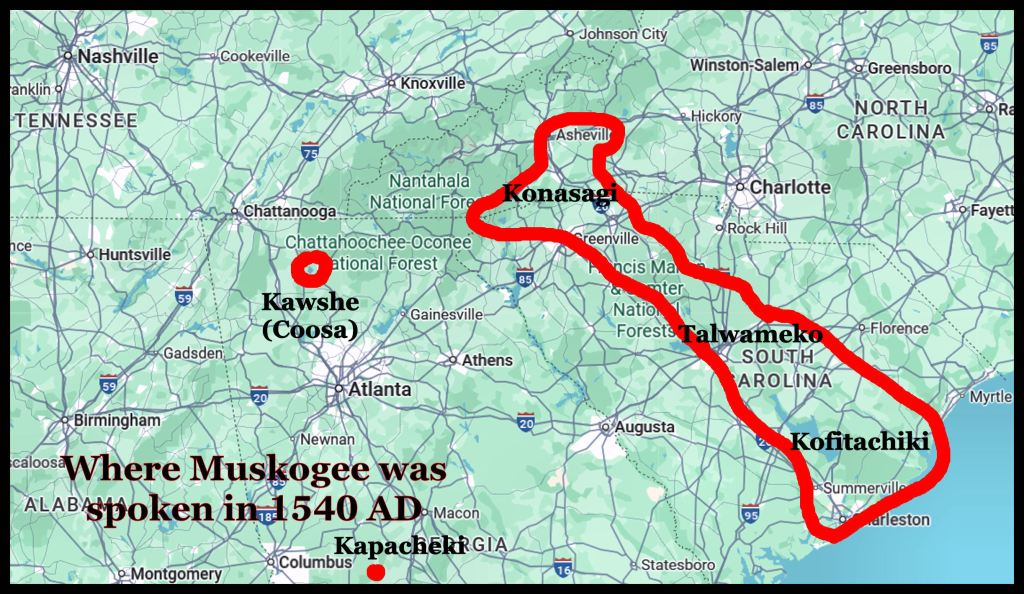
These are the only regions where the Hernando de Soto Expedition utilized Muskogee-Creek guides or else recorded Muskogee language political titles.
The original October Surprise
Shocked by the initial successes of French and Indian forces on the frontier of Virginia, South Carolina and Georgia colonial officials hastily bribed leaders of the Cherokee and Creek tribes to end their 40-year-long-war so that French might use it as an excuse to join the Creeks. The Creeks had refused to participate in a war against the French with whom they had friendly terms, but received very few trade goods.
Both tribes were actually confederacies, composed of semi-autonomous tribal towns. All of the Cherokee chiefs signed the peace treaty, because they had been on the defensive for about 15 years. Every Creek tribe except Coweta and the Bohurons in present-day White, Banks and Hall Counties, Georgia signed the treaty. The British Crown thought it a done deal since Coweta obviously would not start a war against the entire Cherokee Nation.
Only trouble was that the new Principal Chief of the Creeks, Malachi Bemarin was a Coweta and mean S.O.B. He was of mixed Sephardic Jewish and Coweta heritage. Hence the new name for the Creek Indians that he created, Masko-ki. was the Sephardic word for “Mixed ethnic groups” and the Creek/Irish Gaelic word for “tribe or people.”
Just after the Cherokees had harvested their corn in September 1754, Malachi launched a blitz krieg, spearheaded by the skilled Bohuron cavalrymen. The Cherokees didn’t not expect any attacks and were totally unprepared for fighting joint cavalry-infantry assaults. Within a few days, Malachi had reconquered all lands lost during the opening weeks of the Creek-Cherokee War in 1716.
Interestingly enough. the Bohurons brutally massacred the people in Chote, where Helen,. GA is now located, but didn’t molest the town Itsate (now Sautee-Nacoochee) two miles away. The Cowetas didn’t bother the Soque farther west either. Both tribes were Itsate-Creeks, but apparently had secretly remained on good terms with the Muskogees.
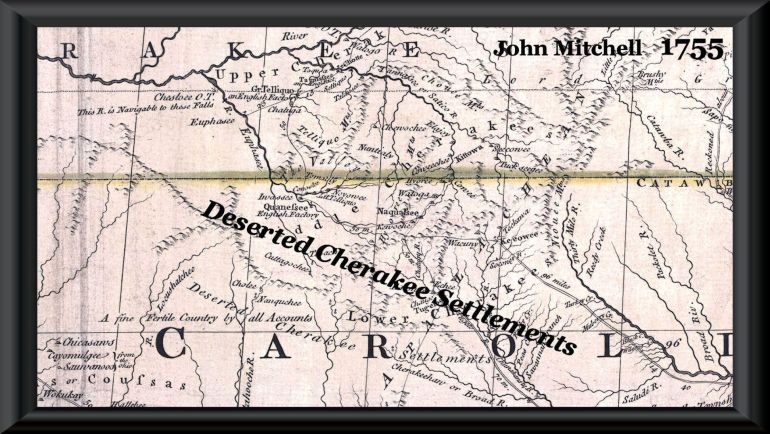
This famous map of North America denotes all Cherokee villages burned by the Cowetas.
Malachi then announced that he was going to reconquer all territory that had belonged to Coweta in the 1600s. This comment was highly significant. The Cowetas burned all Cherokee villages south of the Snowbird Mountains then those in he Nantahala Mountains. Nantahala is a Peruvian Arawak word, by the way.
Seeing that Cherokee warriors continued to flee from their cavalry attacks, Malachi then announced that he was going to seize the rest of the Cherokee Nation. South Carolina officials panicked and apparently bribed Malachi in some way to persuade him to halt the invasion. The Cherokees signed a peace treaty in December 1754, granting the Creek Confederacy all lands south of the Hiwassee River and present-day Franklin, NC.
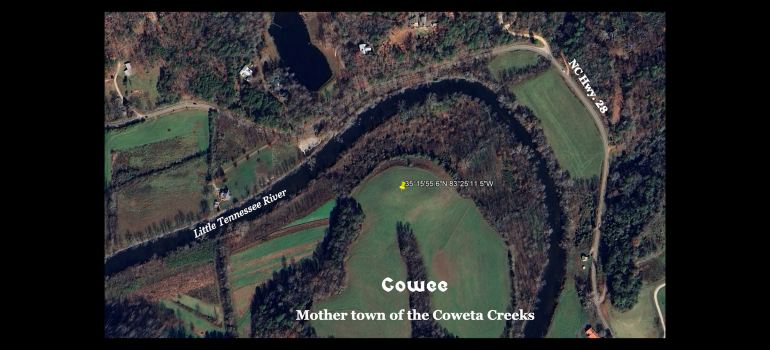
I took a closer look at the John Mitchell Map above and realized that all rivers and mountains with Native American names in the region reconquered by the Cowetas were English or Cherokee pronunciations of Muskogee Creek words! Indeed, the Coweta mother towns of Cowee and Coweeta were both near Franklin, NC. Of course, this is not what Oklahoma Creek children are taught, but the original Muskogee-speaking tribes of the Creek Confederacy were from the North Carolina Mountains.
NOW you know!
 The Americas Revealed