
A funny story on our quest to unravel the ancient history of North America
Over the past 20 years, archeology professors and archaeology students have repeatedly sent me photos of artifacts . . . trying to trick me and thus prove that they are omniscient wizards. Thirteen years ago yesterday, a professor sent me a photo that won first place in such efforts. You have to understand that this generation of archaeologists is obsessed with artifacts that have English names, but don’t have a clue what the Indigenous American names of rivers, mountains and former town sites mean.
by Richard L. Thornton, Architect & City Planner
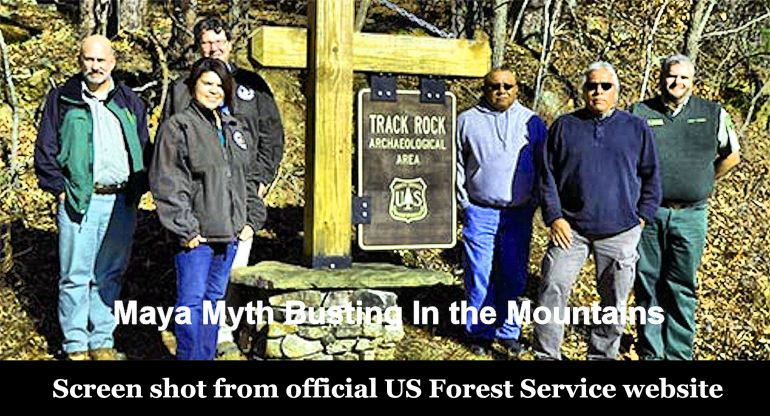
The USFS rangers and Native Americans in the photo didn’t have the physical strength to climb up through the half square mile ruins of the Track Rock Terrace Complex, so they had their photo made at the entrance sign. LOL
Perhaps the funniest irony of the past 20 years was the profound ignorance of the three main proponents of the “The Maya-Myth-Busting-In-The-Mountains” program in 2012, but they are not fireside stories like the one below. This multi-faceted propaganda effort was funded by you, the taxpayers.
- The U. S. Forest Service staff of the Chattahoochee National Forest didn’t know that Chattahoochee is an Itza Maya word, meaning “carved stone (stela) – shallow river.” It has the same meaning in Guatemalan Highland Maya languages.
- The archaeologists of the Eastern Band of Cherokee Indians Cultural Resource Preservation Office in North Carolina adopted a new logo in 2012. It was actually a shell gorget, excavated from Mound C at Etowah Mounds in NW Georgia, during 1925. The figure on the gorget is a priestess of the Maya god Kukulkan. LOL EBCI brochures tell tourists that the symbol is from an artifact found on the North Carolina reservation, portraying a young Cherokee woman, dancing.
- In September 2012, the Georgia Council of Professional Archaeologists and the staff archaeologist for the Chattahoochee National Forest issued a joint national press release telling the public among other things that no example of Maya writing has been found in the United States. This royal decree was accompanied by a photo of the Maya glyph “Henemako” (Great Sun) on a boulder at Track Rock Gap. Henemako was the first Maya symbol translated by archaeologist David Stuart, son of my dear friends, archaeologists George and Gene Stuart of National Geographic Magazine fame.
- David’s research partner in “cracking the Maya Code” was Linda Schele. In August 1970, Linda, her husband David and I toured Palenque together for the first time. That is also where we first met George Stuart. Our guide was the famous Maya expert, Moisés Morales. His son Alfonso, was the Director of Archaeology at Chichen Itza, who appeared in the premier of the History Channel’s “America Unearthed” on December 21, 2012. Life is INDEED, stranger than fiction.
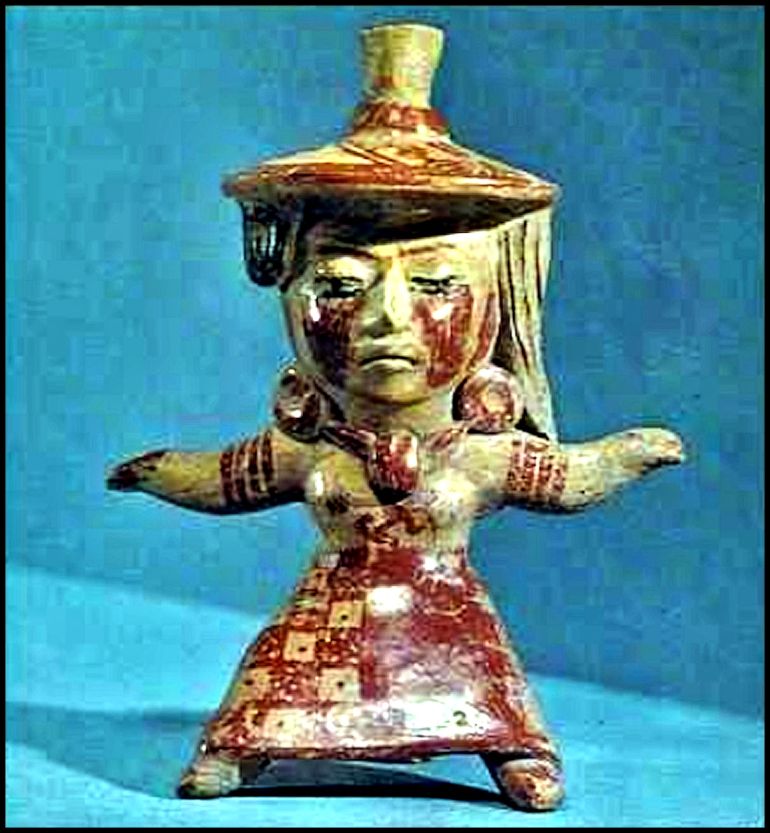
A Magic Garden near Track Rock Gap, Georgia
Thirteen years ago, I received an intriguing email accompanied by the photo above from man, who introduced himself as a traveling salesmen living in Athens, GA. He said that this figurine had been unearthed by friends of his from their vegetable garden near the Track Rock Terrace Complex Ruins. He said that it was proof that the Mayas* had lived at Track Rock Gap. He offered to help me get publicity for this discovery.
*Back in 2012, I quickly realized that the archaeologists in Georgia were grossly unaware that there were originally about 140 Maya tribes . . . often speaking mutually unintelligible languages. Maya tribes in Tabasco and Belize only built earthen mounds, very similar to those in the Southeastern United States.
I instantly recognized the figurine, but played dumb . . . since I also had quickly realized that the archaeologists in Georgia assumed that I was dumb . . . despite having eight years of very rigorous university education. I decided to play along with the man, to see if I could discern his true identity.
The initial email came through the campus email server computer at Florida State University in Tallahassee, Florida. However, the email address belonged to a woman, living in the Athens, GA area. The later emails came from a laptop computer connected by WiFi to BellSouth internet lines.
She emailed me several more times. The last time, she said that he had contacted the Atlanta Journal-Constitution and TV stations. She had set up a press conference at the vegetable garden near Track Rock Gap. She gave me the date and time for the press conference, where she (still using a man’s name) would get to meet me in person.
By then, I knew that University of Minnesota scientists had found a 100% match between attapulgite mined in Georgia to the “Maya Blue” stucco used in the great Maya city of Palenque. I did not attend the press conference . . . but probably something else was planned that would have been rather detrimental to me. Palenque is the only area outside the United State, where feral Yaupon Holly (Sacred Black Drink) grows.
You see . . . back in 1970 I had to postpone my orientation session with my fellowship coordinators, Dr. Ignacio Bernal (Director of the Instituto Nacional de Antropologia E Historia de Mexico and Dr. Román Piña Chan (Curator of the Museo Nacional de Antropologia) because of contracting the most lethal strain of salmonella food poisoning. When I did get to meet with the famous archaeologists on July 6, Dr. Piña Chan took a personal liking to me. He invited me to join him and his favorite graduate assistant in his private office for lunch.
Alejandra had received a Bachelor’s and Master’s degree in Anthropology from the University of Texas, so could help Dr. Piña Chan, when he couldn’t think of the proper English word or words to use in a sentence. At this point, I was just learning Spanish.
One of my most vivid memories of that first visit to Dr. Piña Chan’s office was glancing to the right as I entered his office and seeing internationally famous Mesoamerican artifacts on casual display. The figurine above was on an oak shelf, near the door frame. It was from the Formative-Early Classical city of Copilco . . . now in Mexico City. It was definitely NOT Maya.
At the top of this article, in one of the last photos made of Dr. Piña Chan, you can see that same figurine. Apparently, he excavated the figurine as a young man and it had special meaning to him.
In keeping with a long academic tradition in Latin America, I gave Dr. Piña Chan two books on the Southeastern Indians during the orientation session. He was shocked at the cultural similarities in the two regions. In my notes from this first of several lunchtime “talking sessions,” I wrote that Dr. Piña Chan thought that Georgia’s Indians were the direct descendants of the Olmec Civilization. In contrast, he theorized that the advanced indigenous peoples of Alabama and the Mississippi Valley had cultural ties with the Toltec and Totonac Civilizations.
On July 6, 1735 General James Edward Oglethorpe wrote a letter to HRH King George II: “The Creek Indians are unlike any native people met by the British in North America. It is obvious that they are the descendants of a great civilization. Their intelligence is equal to or perhaps, greater than Englishmen. They should be treated as equals in matters.”
It is a shame that Dr. Piña Chan and General Oglethorpe can’t be reincarnated to teach anthropology in the universities of the United States.
 The Americas Revealed
I enjoy reading your newsletter and discovering the real true history of the area I live in here in the foothills of the Appalachians.My late father was from the white county area, as well as my Dorsey ancestors in his line, and he was also a historian of sorts who penned a few genealogical books, including the History of Hall County, James Dorsey. I have kept up with a good bit of your blog emails over the last year or so, and even bought a couple of your books. Thanks for doing what you do to help keep the official record of history true.I also wanted to share a comment response I just put on a local helen advertisement that popped up on my Facebook scroll this am. I share for no other reason than to let you know there are people who also care to keep the record straight, even if it might seem to go against my own family history that began here well after the original natives may have been interrupted, regardless of what might feel about their way of life.I wonder how long it might last on thereâ¦?ð¤ð³ð¥´ Anyway, just wanted to reach out and share. Iâve found your story and blogs fascinating for sure.David Dorsey770.519.3363This e-mail and any files transmitted with it are confidential and intended solely for the use of the individual or entity to which they are addressed. If you have received this e-mail in error please notify the system manager. Please note that any views or opinions presented in this e- mail are solely those of the author and do not necessarily represent those of the Company. Finally, the recipient should check this e-mail and any attachments for the presence of viruses. The Company accepts no liability for any damage caused by any virus transmitted by this e-mail. Please disregard any typos or errors.
LikeLike