
“Earthen/Sand Pyramid (or terrace) – in marshes”
It is NOT a Timucua Indian word, “whose meaning has been lost” as stated in Florida university anthropology textbooks, Wikipedia and tourist brochures. The Timucuan language did not have a “TL” sound.
Also . . . the Native Peoples in the Okefenokee, St. Marys River and Satilla River Basins were NOT Timucuans as now stated by National Park Service websites and Florida textbooks. They called themselves the Sarakora or Sara (Damp Ground) People. The Okefenokee Swamp, then a large, shallow lake, was called Sarape. There was also a Sara province at the foot of the Blue Ridge Mountains in South Carolina, which was visited by the Hernando de Soto Expedition.
I have translated all of the surviving Sarakora village names. The words reflect a mixture of Peruvian Arawak and Peruvian Panonan colonists . . . with the exception of the town at St. Marys. Their architecture was identical to that of the people in the Florida Panhandle, whom the Spanish called Apalachee. Sarakoa survivors of European diseases and Spanish attacks moved to NW Georgia and eventually joined the Creek Confederacy.
Using a statistical technique known as “multiple regression analysis” and the AI features on my new computer, I was able to convert an incomprehensible word, recorded in 1564 by Captain Rene’ Goulaine de Laudonnière into a straightforward translation from a standard Mexica-Nahua dictionary. There are dozens of Nahuatl languages, I was quite surprised that these colonists on the Georgia Coast literally spoke the same tongue as the Aztecs.
The Many Peoples of the South Atlantic Coast Series
by Richard L. Thornton, Architect and City Planner
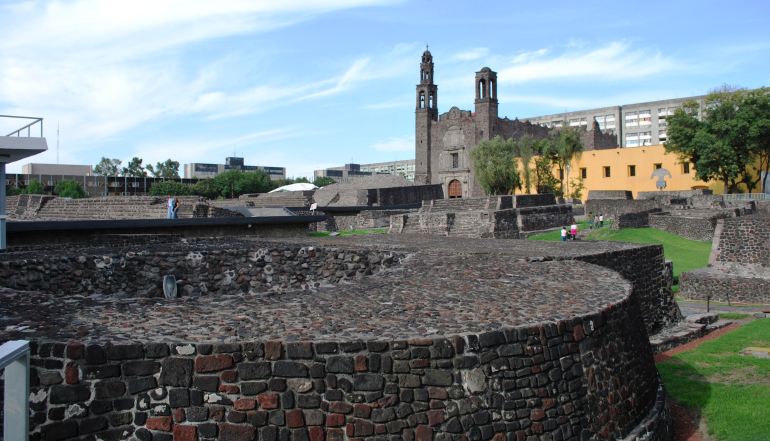
Base of the former “Silent God” temple
Earlier evidence of Nahua speakers in Eastern North America
Readers may recall that the year 2024 at The Americas Revealed was devoted to studying the Early Colonial Period in the Southern Highlands. While looking for locations of 17th century Spanish-speaking Sephardic settlements, I came across French and Dutch maps, which placed a prominent Nahuatl tribe . . . first in southern Quebec and then in the late 1600s in southern West Virginia.
They were the Teononecatecas or “Silent God Tribe.” Some had settled in the city of Tlatelolco – now within Mexico City – where they built a temple to their Silent god. The Cherokee were vassals of the Teononetatecas in New France and West Virginia, but at some point created an alliance in which the Teo’s became one of the clans. Samuel Champlain wrote that the Teononetatrca had crossed the continent from northern Mexico, whereas the Cherokee originally came across the Atlantic by boat and settled in Newfoundland.
I also telephoned Dr. Don Yates of DNA Consulting Service, Inc. For several years, his lab has been working with Cherokee clients, who want to now who they really were. He did identify a Northern Mesoamerican (Nahuatl) genome in several Cherokee families. They tended to be the ones with more Native American ancestry. He was puzzled as to where the Nahuatl ancestry came from, but did not pursue the matter.
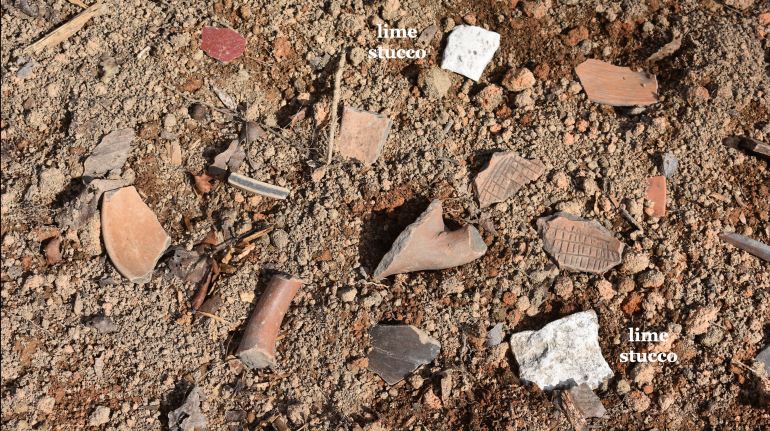
The view at my feet in the suburbs of Tenayuca – June 30, 1970
Since the late 1800s, artifact collectors and later, archaeologists have noticed that very similar styles of pottery were made along the South Atlantic Coast at any given time. For this reason, they assumed that the region was composed of perhaps two or three ethnic groups, living in the region for thousands of years. The archaeologists couldn’t imagine these indigenous Americans having the mental capacity to make long voyages or walking long distances to start their lives anew.
One the most important lessons that I learned from my first “talking lunch” with Dr. Román Piña Chan at the Museo Nacional de Antropologia de Mexico on July 6, 1970 was that utilitarian pottery was NOT an accurate measure of ethnicity.
My initial orientation session at the museum was delayed over two weeks, because I came down with the most lethal strain of salmonella food poisoning my first night in Mexico. Before meeting with Dr.Piña Chan, I had already noticed that there was little difference in the potsherds within the middle class suburbs of the ancient ruins of Cholula, Teotihuacan, Tula, Tenayuca, Cuicuilco and Texcoco . . . even though many women from many distinct ethnic groups made these ceramics over a 2,000 year period.

Dr. Piña Chan agreed with me that the pottery made by commoners changed little over time. Chemical analysis is about the only way to discern shell-tempered redware from Central Mexico from shell-tempered redware 800 miles away in Chichen Itza. At best, utilitarian pottery was an indicator of the females’ ethnicity.
However . . . he chuckled and added . . . militaristic societies tended to kill most of the men in a defeated nation, but keep the women. Thus, individual villages or towns might contain female pottery makers from several different ethnic backgrounds. Over time, the multi-ethnic influences would result in a hybrid style of pottery.
From their profession’s birth in the late 19th century, North American archaeologists believed that each tribe made its own distinct pottery. Similar pottery found in two village sites meant that the same ethnic group lived in both villages. However, what I am finding is that at least 14 distinct ethnic groups colonized the South Atlantic Coast and that their villages were in close proximity with each other.
That being said . . . never in a million years would I have expected to find a Mexica (Aztec) town on the Georgia Coast. All the anthropology books said that the Aztecs were land-lubbers. BTW . . . yes, long, long ago, the U.S. Navy gave me training in code-breaking methodology.
The analytical process
(1) The original word in De Laudonnière’s memoir was Tlathlothlaguphta . The “TL” at the front is typical of Mesoamerican languages, but extremely rare in the Southeastern United States, South America and the Caribbean Basin.
(2) I set up a multiple regression analysis of all the languages in place names that I have encountered between the Savannah River in Georgia and the St. Johns River in Florida. The list included Itsate Creek, Apalachicola Creek, Itza Maya, Chontal Maya, Samoan, Irish Gaelic, Panoan (eastern Peru), Carib, Tupi-Guarani, Archaic Anglisk, Archaic Frisian, Taino. Peruvian Arawak and Timucua. None of the languages showed significant probability, when analyzed by the computer.
(3) I asked the computer to convert the 16th century French spelling De Laudonnière’s memoir into modern French spelling. The word today in France would be Tlathilthe – acuafa.
(4) Knowing that De Laudonnière was listening to people from South America trying to pronounce Mesoamerican words . . . I substituted “t” for “th” and “p” for “f,” plus “k” for a 16th century French c. The final word was Tlatelliti – akuapa (or acuapa in Mexican dictionaries).
(4) I looked up the words in an online Mexica (Aztec) dictionary . . . hoping the words, recorded by De Laudonnière might be a little similar to the actual language of the people in St. Marys. By golly, they were Mexica words. Obviously, some Mexica speakers were skilled mariners. Whether some day, some artifact will be found in St. Marys that seems to belong in Central Mexico . . . I have not a clue.
Tlatellite means “Earthen/sand pyramid (or terrace) people.: Akuapa literally means “water place” in English, but came to mean a swamp, marsh or shallow lake in Mexica. Akuapa could also be spelled Aquapa or Acuapa. Yep, that is the same word for water as used by the Romans! My AI computer is finding many Indo-European words in the Muskogee-Creek, Shawnee and Siouan tongues, but was surprised to also find them in Aztec.

+
Until the early 1800s, the Okefenokee Swamp, St. Mary’s River, Satilla River and Altamaha River flooded dramatically in the springtime, like the Amazon Basin. Most of extreme Southeast Georgia would have been covered by the flood waters. As a result most Sara villages along the St. Marys river would have been very small. Their potential locations were limited to the sand dunes of ancient islands, now a considerable distance inland.
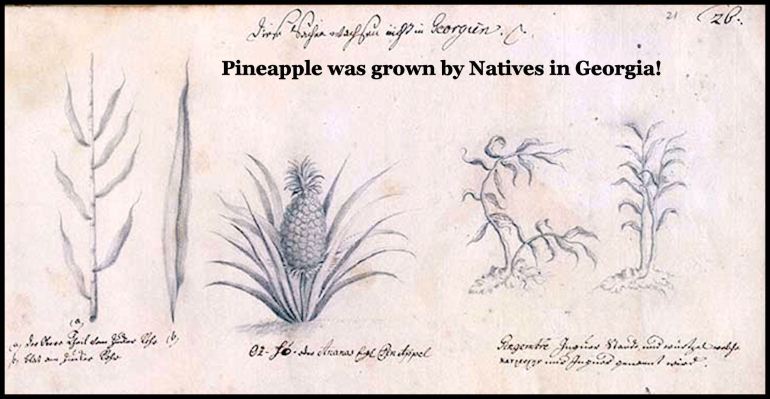
And now for the rest of the story!
In reading De Laudonnière’s memoir, I found something else surprising. General James Edward Oglethorpe reported to King George II and the colony’s Board of Trustees that the Creek and Uchee Indians near Savannah grew pineapples . . . and that they were delicious. For unknown reason, the colonists never grew pineapples commercially. I assumed that the pineapples had been introduced by Spanish missionaries.
Nope! Rene’ de Laudonnière observed large scale cultivation of pineapples in what is now Camden and Glynn Counties in Georgia. This was several years before the first Spanish missions were established on Cumberland and St. Catherines Islands. Obviously, there are varieties of pineapples, being cultivated in Venezuela, Peru or Brazil, which will thrive on the Georgia Coast. So . . . y’all, when are we starting the first Golden Isles Pineapple Festival?
 The Americas Revealed
I love pineapple. Don’t see much here. Georgia coasts are now covered in real estate developments and highways. I guess rice was also grown here.
LikeLiked by 1 person
Rice was a major export for Georgia until technical advances in ships brought down the price of rice, imported from other parts of the world. Having local pineapple would be kind of cool, however.
LikeLiked by 2 people
I wonder who has thought of it. I’m reading of cultivating hemp here. It’s a traditional source for making ropes, and paper, I’m told.
LikeLiked by 1 person
Glad you got that new computer! Looking forward to many new discoveries about our ancient Southeastern heritage!
LikeLiked by 1 person
https://www.ancient-origins.net/news-history-archaeology/teotihuacan-writing-00102195
Hi Richard
This article said a couple of Danish scientists has decided the language of Teotihuacan. It is related to Nahuatl the Aztec language. This may help you to decode more words here in North America. Keep up the good work!!!
LikeLiked by 1 person