
Homeless Veterans in a National Forest
Where have the years gone? This article, which I wrote in 2010 for my Architecture column in the National Examiner, while myself homeless, directly resulted in President Obama’s 2010 “Opening Doors for Veterans” Strategic Plan and Congress’s Helping Homeless Veterans Act. At the time, my three dogs and I were camped out near Brasstown Bald Mountain, so the article was written on a computer in the Union County, GA Library!
All articles for the national edition of the Examiner went out to the world on an RSS feed. It was quickly picked up by many newspapers, but generally only credited to the Examiner, not me. By the time it was presented to Congress, the article was being credited to whichever newspaper, the member of Congress read.
This era was the middle of the Great Recession, which had started in the George W. Bush Administration. In December 2008, Congress had quickly bailed out the executives on Wall Street, who caused the economic catastrophe, but did nothing to help the 35 million unemployed members of the construction-real estate-architecture-engineering industries, who were unemployed. We were left to fend for ourselves. Many of my friends in architecture and civil engineering either committed suicide or died of a heart attack during this era. I chose to live in the wilderness.
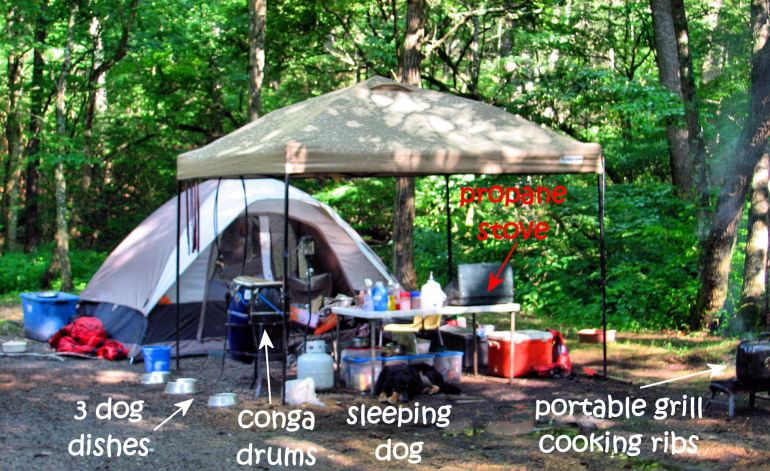
This was my last campsite before moving into an abandoned chicken house!
by Richard L. Thornton, Architect & City Planner
God certainly works in mysterious ways . . . and also has a sense of humor. You see, all my troubles began in 2000, when a mentally-deranged investigator for the Pickens County, GA District Attorney’s Office saw in my resume that I had worked three months for a city in Sweden. He was a former Marine and Vietnam War veteran so decided that I was a librul Marxist draft evader, who must be destroyed.
Never mind that my resume also said that I was an NROTC midshipman at Georgia Tech and no one was being drafted, when I graduated from Tech. Most of our troops had been pulled out of Vietnam by then. Never mind that six months later, I was working for a prestigious AEP firm near Washington, DC and my boss was a Captain in Army Intelligence. That’s how covert overseas assets are rewarded. I don’t think the crazy ex-Marine ever realized that all those gals, who came to visit me from the dating websites was the same flicka, Susan Karlson, a covert Federal counter-intelligence officer.
Well, anyway . . . throughout my nine years in Jasper, GA I was harassed by state law enforcement and physically attacked by gangs of vets, who got whipped . . . then their sons . . . then their grandsons. You see . . . I never went to a Navy officers version of boot camp for training in guerilla warfare and survival in the wilderness. Before going to Mexico, I was personally trained at the Navy’s Lake Allatoona Recreation Area by a Marine Colonel and Navy SEAL lieutenant . . . both of whom had won the Congressional Medal of Honor in Vietnam!

The evil powers-that-be in Pickens County, GA assumed that I would commit suicide a few days after being evicted on Christmas Eve. Better still, maybe I would commit some crime to get food and they could ARREST me . . . proving that their side won. God had other plans. Exactly three years later I would be on the History Channel . . . prime time. Actually, the foreclosure was illegal too. The out-of-state Dixie Mafia company that filed the foreclosure didn’t even own my mortgage.
The Hidden World of Homeless Veterans
by Richard L. Thornton, Examiner National Architecture Columnist
Part 1 . . . June 16, 2010
The retired vets with vehicles take care of the younger vets
Chattahoochee National Forest – Georgia: The startling statistics of homelessness in America, and among veterans in particular, were known when I intentionally sought out these vets. According to several veterans organizations, roughly 1/3 of the +/- 3 million homeless Americans are veterans. Initially, I assumed that the finger of blame would be pointed at a duplicitous Veterans Administration or an indifferent Congress.
Local TV news teams, if they cover homelessness at all, will often go to a convenient inner city location, infer that the veterans are homeless due to alcoholism or addictive drugs then meet the other members of their staff for drinks and dinner. The actual events which caused the veterans, interviewed, to be homeless had nothing to do with the federal government, alcoholism or illegal drugs. The real villains will surprise most readers.
I had learned from a restaurant owner that many homeless vets were camping near Blairsville, GA . . . on both sides of the GA-NC state line . . . because there is a Veterans Administration Clinic in Blairsville. Furthermore, the doctors, nurses and dentists there had chosen to break the law by concealing patients, who were wanted by law enforcement. They would open the clinic at night or allow veterans to be dropped off at the back door, so any law enforcement officer watching the clinic wouldn’t see them.
It is difficult to make generalized statements about homeless veterans, because their current living locations are so dispersed. National forests are attractive sites for homeless camps, because the water is generally pure and the locations are hidden. However, in most national forests, camp sites must be moved every two weeks. In some states, the camp sites must be moved as far as ten miles.
This distance completely eliminates homeless people, who are also carless – IF they abide by the two week rule. There is no way for them to move their belongings ten miles. Thus, the homeless without personal transportation are faced with the options that include violating U. S. Forest Service rules (i.e. breaking the law,) living in abandoned structures in violation of local zoning ordinances, or moving to inner city areas where tent cities for the homeless are concentrated.
I set up a tent camping site in a remote area of the Chattahoochee National Forest, then hiked or drove around the backwoods areas looking for homeless people. Because of the increasingly hostile attitude of the U.S. Forest Service toward the homeless, their compounds are difficult to locate without inside information. Homeless Vietnam War veterans are often of retirement age these days and therefore more visible. They tend to live in small recreation trailers.
I found several retired vets living in recreation trailers. After convincing a vet named Jim, of my trustworthiness, he arranged a meeting with some younger veterans. Jim, one of the retired Viet Nam vets, said that he acted as a mother hen for the younger guys, since he had a truck. The majority of homeless vet camps are not visible from either roads or trails frequented by hikers.
Contact was made with some Desert Storm and Iraqi Occupation veterans near Suches, Georgia. Only three agreed to show their faces and talk at all. They were in the process of moving to another camp site.
Most of the Vietnam vets are not hiding from the law, so with their vehicles go into town to buy groceries or pick up food donations from local churches and veterans organizations, who knowingly help feed the vets, who have arrest warrants hanging over their heads.
There was one Winnebago trailer pulled by an older model Ford pickup. I suspected that the older vet, who owned the truck, bought food and supplies for the others, but no one stated this. The remainder of the men (and possibly women) . . . I saw some women’s clothes . . . evidently lived in tents of varying sizes and condition, but did not own cars or trucks. There were a couple of antiquated motorbikes.
I saw absolutely no evidence in the Chattahoochee National Forest of the excessive consumption of alcoholic beverages or illegal drugs. There were a few beer cans in the garbage bags. The men actually looked much healthier than the typical group of aging warriors.
Apparently, all the younger men were there because they were either unemployed and could not afford conventional housing or they were in arrears with their child support payments. Like most states, Georgia severely penalizes fathers, who are tardy with their child support payments. This will be discussed in more detail later. Only one homeless vet in the camp, whom we shall call Jack, was willing to discuss his personal life at all.
Jack was a Marine Lance Corporal in Desert Storm. After leaving the military in 2000, he had risen to being manager of a very successful sporting goods store franchise. He formerly owned a house in the affluent Atlanta suburb of Alpharetta. Then in 2005 disaster struck.
Jack severely cut his left thigh while sawing wood in the backyard. His job required considerable floor walking. After his medical leave expired, he was fired by his employer. While his wound was healing, his family sold their stock and used up most of their savings to maintain the same lifestyle as when he was the store manager. He eventually found a job as a retail salesman at less than half of his former salary. His wife had to go back to work.
In 2008 the economy began collapsing in the Atlanta Area. Jack was laid off again. Between his wife’s salary and his unemployment, they were unable to simultaneously make payments on their two cars, house note and car insurance. First, his car was repossessed because of no insurance (not being in default on the loan.)
The mortgage payments were falling behind, when he found another job, making even less money. He thought that his family had just gotten “over the hump,” when his wife announced that she had fallen in love with a man at her office. She had already pulled their remaining savings out to hire a lawyer. He could not afford a lawyer.
Jack was saddled with a child support payment based on his income as a store manager the previous three years. The courts use “standard formulas” for every thing. Unless one has a good lawyer, court bureaucrats dictate judgments. He quickly defaulted on the payments and went to jail several times. After his ex-wife’s lover got a divorce and married her, the new husband hired a lawyer to get Jack’s child support payments reduced to zero. However, Jack has been unable to find another job and has been living in the woods since spring of 2009.
It was obvious to the interviewer, that emotionally, Jack was a broken man. His self-esteem is so crushed that it is unlikely that he will ever have a significant job again. He has spent several months in the Fulton County Jail as if he was a real criminal. His “crime” was not being able to afford an attorney in a divorce and child custody case. One must also question the credentials of a judge, who would order $3000 a month child support from a man, who was only receiving $600 a month in State Unemployment benefits – AND who did not own a car.
In the next part of this article, we will interview a vet, who was able to say more about his personal life.
 The Americas Revealed
The VA is a drug-pedaling racket, or at least it was when I worked temporary assignments in VA facilities. First, few VAs provide housing for the thousands of vets, who live longer than expected or wanted. Where are they supposed to live, unless they have skills and employment? The VA system doesn’t provide housing or employment. It seems the Native American systems of community support and self-help worked better, but the US of A has not adapted to the traditional values the European descendants have used to divide and partition land for individuals. How to blend the best of both? Never mind that there is still a cultural division between these groups, but everyone suffers from sustained animosity against our fellow human beings.
LikeLiked by 1 person