
After the construction of unique “keyhole” houses ceased at Kolomoki around 600 AD, their construction can be seen moving progressively up the Mississippi River to southern Illinois in around 800 AD.
A woodhenge is a ring of timber posts that was used as a sun dial and for astronomical observations. Although Midwestern archaeologists think that “woodhenges” and keyhole houses are unique to Cahokia Mounds, the first woodhenge and keyhole houses at Kolomoki were constructed at least 600 years earlier.
National Native American Heritage Month
by Richard L. Thornton, Architect & City Planner

Artist’s conception of a Key Hole House in Southern Illinois. It has a major error. Earthlodge houses, constructed east of the arid Western Prairies had thatched roofs with a pitched roof over the entrance tunnel. There were no Native grasses in the Mississippi Basin, which formed sod. Furthermore, sod would rot and decompose quickly in the heavy rainfall and high humidity of the Mississippi Basin.
From Midwestern Archaeologists . . .
The appearance of Key Holes Houses in Southern Illinois around 800 CE were associated with growth of a hamlet into a large village at the site of Cahokia Mounds, and of the construction of mounds, showing some Mississippian traits. These newcomers also constructed the first “woodhinge” at Cahokia around 900 CE. However, development of a large town and the major mounds that are seen today did not begin until after 1050 CE.
While Cahokia had large ceremonial buildings atop mounds and smaller domestic homes, the term “keyhole houses” typically refers to distinctive, often larger, post-built structures with unique entrances (like keyholes or benches) found at Cahokia and Southern Illinois, distinct from standard rectangular houses. They probably served as elite residences or important community buildings used for rituals, as evidenced by artifacts found inside.
It is believed that after abandoning Cahokia, the residents migrated northwestward and became the Earthlodge tribes of the Great Plains. Thus, these founders of what was to become a large town at the Cahokia site probably were Proto-Earthlodge Siouans from the Upper Ohio River Basin. However, since neither keyhole houses nor woodhinges have to date, been found upstream from Cahokia, they must be considered for now to be unique to Southern Illinois.
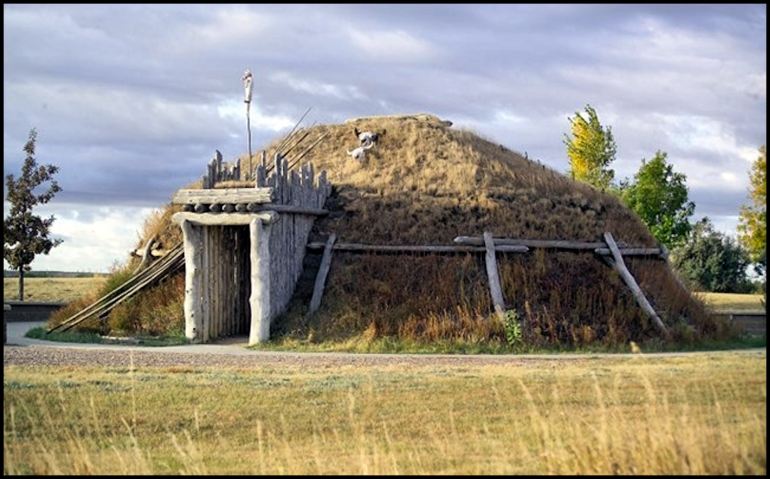
Like the earth lodges in Georgia and Cahokia, most Western Plains tribes built earth lodges that were squares with rounded edges . . . not octagons with rounded edges like those of the Mandan, Arikara and Hidatsu Peoples. The Pre-Columbian earth lodges also tended to have longer tunnel entrances, giving them the appearance of keyholes.
Cahokia’s unique Keyhole Houses
- Unique Features: These were not typical small homes; they had distinctive features like interior benches, central roof posts, and sometimes elaborate entranceways or partitions.
- Purpose: Their size, location near important mounds (like Monk’s Mound), and the presence of ritualistic artifacts (shells, tools, ceremonial pots) suggest they were used by community leaders or for important public/ceremonial events, not just everyday living.
- Construction: Built with log posts, some even featuring planed logs, they were substantial structures.
From Arkansas Archaeologists . . .
Keyhole houses appeared in the Plum Bayou complex settlement around 700 AD and were associated with the first construction of mounds. Plum Bayou is the new name for Toltec Mounds. They are believed to be related to elite residences or specific ritual spaces, highlighting unique architecture within the broader Mississippian context.
It is now presumed that these mound-builder elites, who lived in keyhole shaped houses, originated from farther south along the Mississippi River. They appear to have been the progenitors of the Southeastern Ceremonial Mound societies, which because of their origin are commonly known today as the Mississippian Culture.
From Georgia and Florida archaeologists . . .
The oldest radiocarbon date for a mound base at Kolomoki in Southwest Georgia is 80 CE. However, lower strata suggests that there was a small village here somewhat earlier, probably associated with nearby Mandeville Mounds on the Chattahoochee River, which dates from c. 400 BCE. The population of the original village began to grow around 200 CE, while major mound construction began around 250 CE. The town contained its largest populations between 350 CE and 600 CE. It was largely abandoned after 750 CE then reoccupied by a Proto-Creek people around 1300 CE.
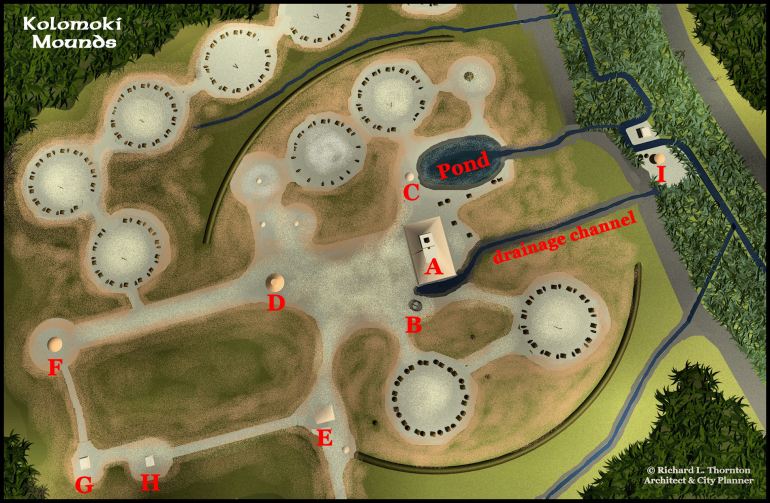
Birdseye View of Kolomoki Mounds after work by Dr. Thomas Pluckhahn
Recent discoveries at Kolomoki by archaeologist Dr. Thomas Pluckhanh
While obtaining a PhD in Anthropology from the University of Georgia in the early 2000’s, Dr. Thomas Pluckhahn contributed significantly to the understanding of Kolomoki Mounds. He currently is Chair of the Department of Anthropology at the University of South Florida. He proved that its Woodland Period structures were features of a large, permanent town with distinct neighborhoods, not a ceremonial center with few permanent residents, as generally assumed by his profession. He also discovered that Mound B at Kolomoki was actually a circle of vertical timber posts used for astronomical and time measurement purposes, which was repeatedly reconstructed from around 200 CE to 600 CE. This is now commonly known as a “woodhinge.”
In his book, derived from his doctoral dissertation, Kolomoki: Settlement, Ceremony, and Status in the Deep South, A.D. 350 to 750, Pluckhahn expressed particular surprise in his discovery of numerous structures, which he called “keyhole houses.” They were recessed somewhat underground and had tunnel-like entrances. They are most commonly located in Kolomoki, but have been found at other sites in Georgia, primarily within a 150 mile radius of Kolomiki. He did not find evidence of them being built at Kolomoki after around 600 AD.
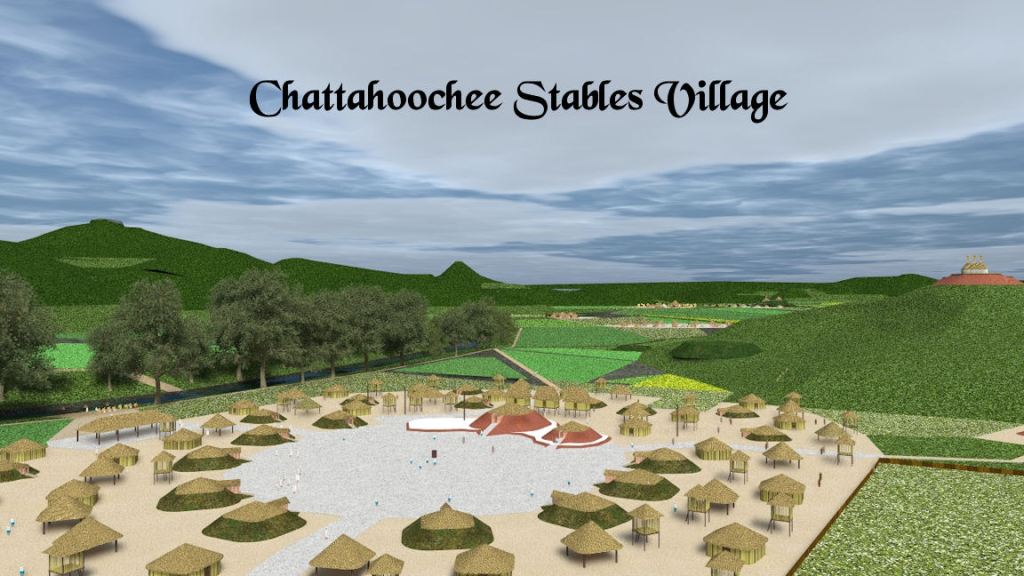
This village near the Kenimer Mound in the Nacoochee Valley of Georgia was founded a few years after Kolomoki was partially depopulated (600 AD). It remained occupied until around 1350 AD, when it was replaced by Southern Mesoamerican style houses.
Georgia Keyhole buildings contemporary with Cahokia
Despite their vague description in several books on Cahokia, the archaeologists working their have not published online any drawings or precise dimensions of the keyhole houses and communal buildings there. The one artist’s sketch I found may have been speculation. I have noticed that most artists, who paint renderings of Native American towns and buildings rely more on their imagination than precise measurements.
In contrast, archaeologist Robert Wauchope was a skilled architectural draftsman, plus having a doctorate in anthropology from Harvard in his resume., I carried his book on Maya houses in my back pack, while on the fellowship in Mexico. It was based on his doctoral dissertation. Even though he turned 30 shortly after arriving in North Georgia in 1939, he was already considered an expert on Indigenous Architecture in Mesoamerica and North America. Wauchope was hired by the WPA to survey all of northern Georgia, but spent much of his time in the Nacoochee Valley, where I now live.
Wauchope was surprised that much of his findings totally flew in the face of archaeological orthodoxy. The Nacoochee Valley was a 12-mile (19 km)-long, multi-ethnic megapolis in which villages (actually neighborhoods) with entirely different architecture co-existed as close as 200 feet apart for centuries. The distinct ethnic groups even had their own capitals and temple complexes. However, one of the major ethnic groups built houses and communal buildings that seemed to have been almost identical to those in Cahokia . . . the keyhole houses.
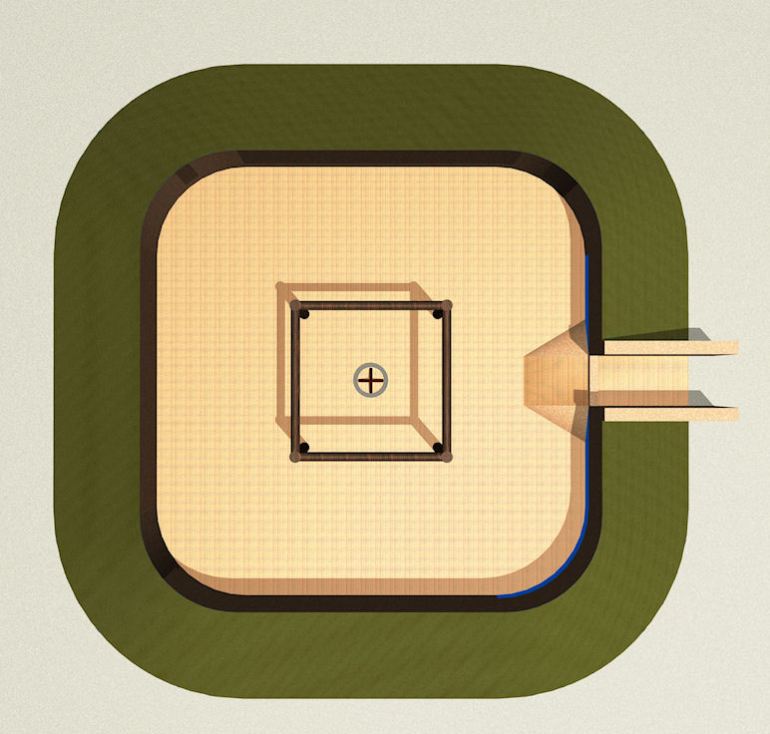
Like the keyhole houses and communal buildings in Cahokia, the keyhole houses in the Nacoochee Valley had a semi-rectangular floor plan, four supporting posts and sloping, earth berm walls. The communal buildings contained log benches like their counterparts in Southern Illinois.
In our next article, we will show readers, where the “Western Plains Earth Lodge Peoples” originally lived!
Now do readers see why I began publishing The Americas Revealed in 2011?
 The Americas Revealed
Thank you!!!
LikeLiked by 1 person