
In fact, their name is derived from the French word for a two-wheeled cart , , , chariot . . . pronounced Chă : rē : ō
This is yet another example of academicians ignoring recorded, eyewitness history, when creating official history. Someone in the past made the poorly researched statement that no American Indian tribe knew how to make a wheeled vehicle, then everyone parroted his speculation afterword.
NATIONAL NATIVE AMERICAN HERITAGE MONTH
by Richard L. Thornton, Architect and City Planner
In 1614, French explorer, Étienne Brûlé, encountered a mysterious tribe living near the Great Rapids of the St. Lawrence River, east of Lake Ontario. They were vassals of the Tiononeteca, who were vassals of the Huron (Wendat). This small tribe earned trade income by portaging heavy freight canoes around the rapids. They used two-wheeled wooden carts to haul the canoes.
Brûlé stated that the Huron, Algonquin and Iroquoian tribes did not understand the strange languages spoken by the Tiononeteca and Portage tribes. We can certainly understand why they didn’t understand the Tiononeteca! They were a Nahua-speaking tribe from Mexico! The word means, “Silent God People.” Brûlé couldn’t even understand the name of the Portage tribe,
The famous founder of Canada (Nouvelle-France), Samuel de Champlain, published Voyages de la Nouvelle-France in 1632. His book mentions the Cherokee numerous times because of their knowledge of wheel-making and being one of the tribes targeted for missionary work by the Jesuits.
Champlain claimed that he had given the Cherokee their name, since no one knew their real name. He combined the French word for a two wheeled cart with the Huron word for a tribe, “ke”. Thus, from then on, the French Colonial Archives called them the Charioqui.
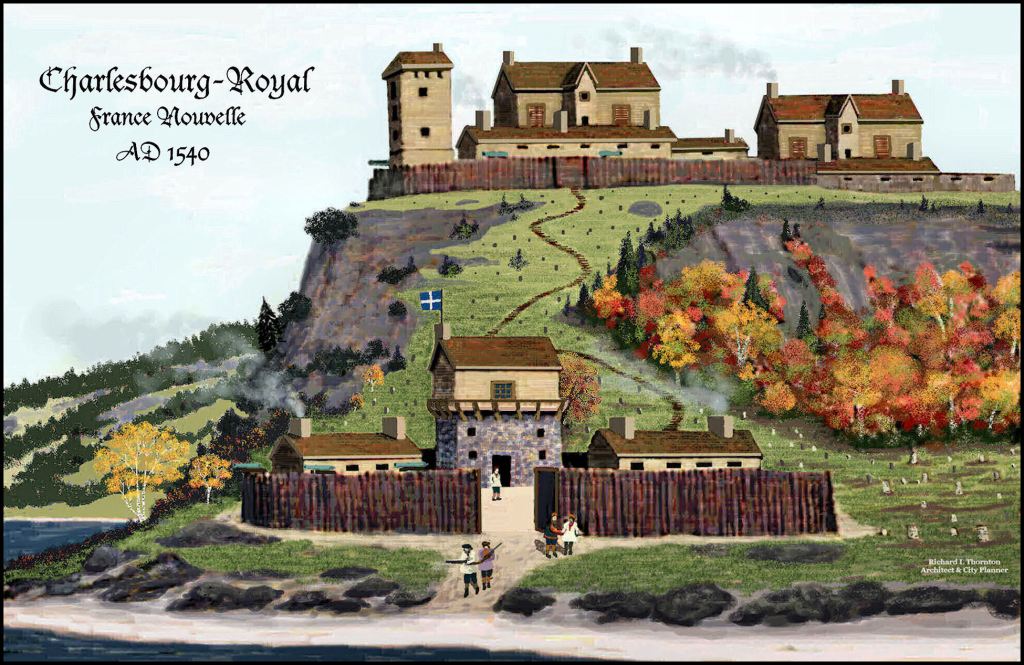
This sketch by the author of the first attempt by French Protestants to colonize Canada appears in the official History of Canada textbook!
There is no information in Champlain’s books as to how long the Cherokee had been building wheeled carts. It is possible that they learned how to build carts from the colonists at Charlesbourg-Royale. Champlain said that they originally lived on the Atlantic Coast of Canada. Perhaps they were originally not American Indians, but rather colonists from across the Atlantic, who intermarried with the locals.
A later book by Champlain stated that a massive invasion by the Iroquois Confederacy decimated the Hurons and forced the Tiononeteca and Charioqui to flee southward to the rugged mountains of western Virginia (now the state of West Virginia) in 1650.
The Charioke soon became major players in the Native American slave trade. They became so powerful from the wealth gained that they formed an alliance in 1684, which included as member tribes, the Chiska, Tiononeteca and Rickohocken.
The alliance began invaded western North Carolina after the 1696 smallpox epidemic decimated the Creek and Shawnee populations in the Little Tennessee River Valley. By 1715, when they were now living in NE Tennessee and Western North Carolina (north of the Hiwassee River), the first English map to mention them, called them, “Charoqui.”
Now you know!
 The Americas Revealed
Another fascinating look into the greater depths, layers and chapters of the human story, the complexities and connections! Reading your blog is like an ongoing historical novel being written for the first time and right before our very eyes in real time! Thank you, Richard!
LikeLiked by 1 person