He also founded the Tama Creek Tribal Town in southwest Georgia before the Muscogee Creek Nation ever existed
It was also the first electric guitar, but about a decade later, George Beauchamp obtained a patent in 1934 for a electric guitar that looked like a conventional guitar.
PBS got it wrong. Both Hank Williams and Neil McCormick were CREEK Indians, not Cherokee.
Also . . . I could have been a citizen of the Seminole Nation years ago . . . if I had just known I was eligible!
NATIONAL NATIVE AMERICAN HERITAGE MONTH
by Richard L. Thornton, Architect & City Planner
Once Upon a Time There Was a Dream
In 1970, there were three tiny federally-recognized Creek tribes in Oklahoma that had about 200 members each. There were two federally-recognized Seminole tribes in Florida.* The Seminole Tribe had about 500 members, while the Miccosukee Tribe had about 100 members. The Creeks and Seminoles in Oklahoma were pressuring the Bureau of Indian Affairs to reconstitute their governments, but it had not happened yet.
This was all that was left of the Creek Confederacy (earlier called the Apalachen Confederacy) which Spain, France and Great Britain considered the most numerous and culturally advanced indigenous tribe in North America. So, how could such a large and culturally-advanced tribe almost disappear in 170 years?
The law would be passed by Congress in 1974 at the urging of President Richard Nixon that would enable Oklahoma Creeks and Seminoles to start enrolling members. Richard Nixon was the first President to admit being of partial Native American descent. It would one of the last acts that he signed into law before resigning.
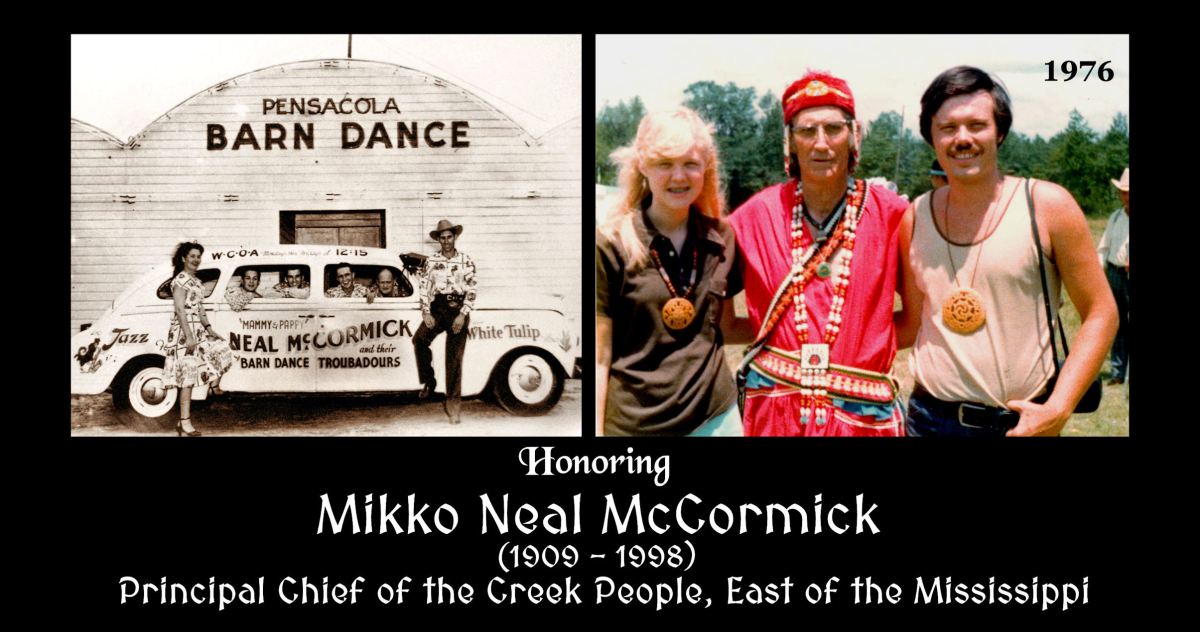
A talented musician, who grew up dirt-poor in the southern edge of Alabama, played a key role in the renaissance of the Creek People. Throughout much of his career, he feared so much being labeled an “Injun” that he and his band members pretended to be Hawaiians! His chosen career in country-western music would have seemed to be unlikely jumping platform for him to help bring the Creek Indian People out of hiding. However, that is what happened. His stage name was Pappy Neal McCormick.
Historical background
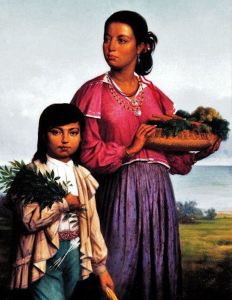
In the late 18th century, the Creek Confederacy adopted a national flag and maintained a gunboat navy to patrol the Gulf Coast and navigable rivers. They had no concept of race. The commanding general of the Confederacy was a full-blooded Frenchman. Although Spain technically owned Florida again, most of the land was ruled by Creeks, who increasingly called themselves Seminoles.
In the 1790s, the Creeks & Seminoles constructed a chain of lighthouses, docks and warehouses to facilitate trade with Cuba and Yucatan. Master Creek/Seminole farmers in South Georgia and North Florida were becoming wealthy from selling produce and livestock to townsfolk in the State of Georgia and Cuba. White farmers in Georgia and South Carolina were becoming increasingly jealous of the Seminoles because they were so much skilled in agriculture.
Then in the early 1800s, began a series of forced land cessions, wars, internal schisms and intentional U. S. policies to divide and subjugate the Creeks. By 1836, the Creeks had been scattered to the winds. The Seminoles were fighting a desperate guerilla war to stay on the lands in Georgia and Florida that they had cleared and cultivated. The U.S. Army was never able to completely defeat the Seminoles and so declared the war over and went home.
A third of the Oklahoma Creeks died in the American Civil War . . . mostly in concentration camps that the United States set up for pro-Union Creeks in Kansas. They were intentionally starved to death in order to steal their lands after the war.
Then suddenly in the early 20th century, when Neal McCormick and my grandmother Mahala were children, persecution by whites became the rule. My grandmother’s older sister was raped and lynched by white hooligans at the edge of their community.
My grandmother frequently stated, “We were treated worse than the Coloreds.” After the “troubled times” started, she could no longer go into Elberton, because white kids would throw mud and manure at her and her siblings. The State of Georgia did not allow American Indians to attend public schools, so she and her siblings were taught by a minister at an Indian school within a Ruckersville Methodist church. Her family lived in Ruckers Bottom, a major archaeological zone.
*The core of the Seminole towns were bands of Itsate (Hitchiti)-speaking Creeks, who left Tennessee, Georgia, North Carolina and South Carolina to settle in Florida. The Christian Itsate speakers in Georgia, who preferred to live in villages near the Europeans, became known as the Eastern Creeks. Many had become Christians in the 1560s, when French Protestant survivors of Fort Caroline, who settled in northeast Georgia, “witnessed” to the Apalachete elite. If you carry a mixture of Maya and Panoan DNA from Peru, you are descended from the Apalachete elite.
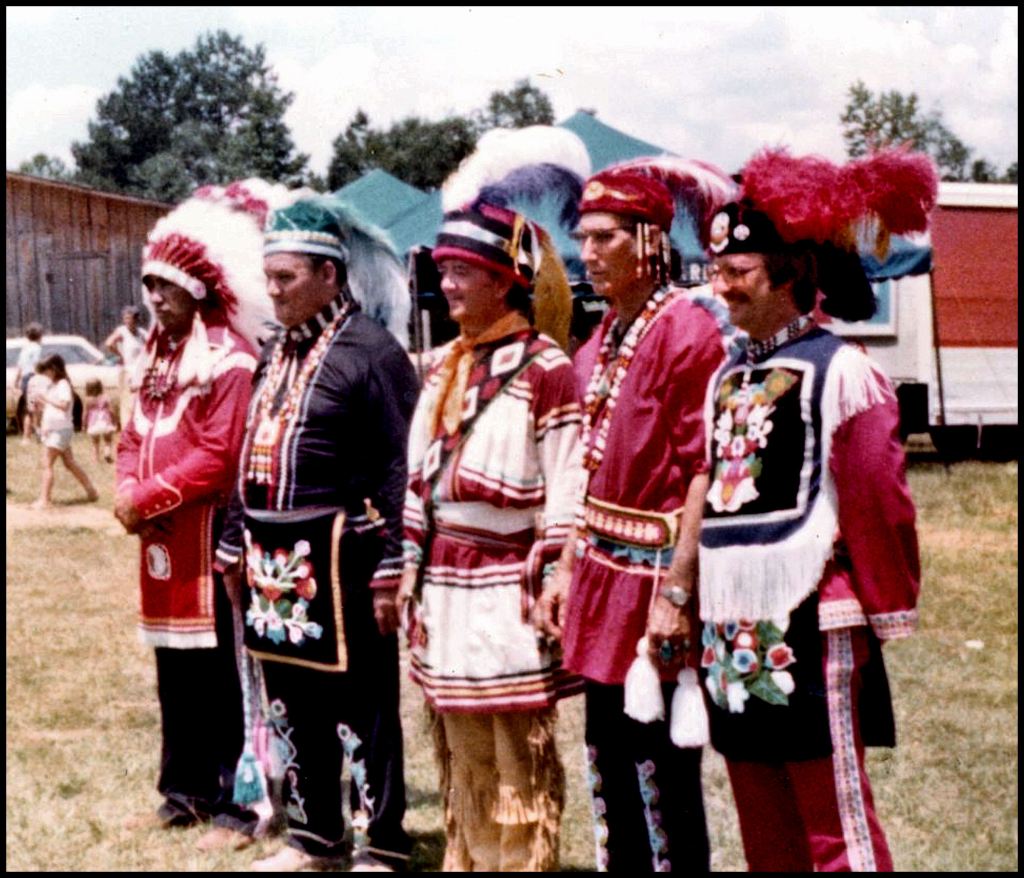
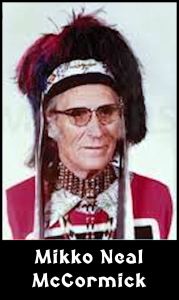
Mikko Neal McCormick with three mikkos from Florida and a Lakota chief
Sudden changes for the better
In 1924, Georgia began to allow Creek kids (from “good” families) to attend public schools. As a result, later on my mother became the first person in her family to graduate from a public high school. At age 16, she became her graduating class’s Valedictorian!

She was awarded a full scholarship to pay for the tuition, room and board at any state-owned college in Georgia. Her parents owned a large farm, which kept the family well fed with a variety of nutritious foods, but they kept virtually no cash. Their only transportation was a mule wagon.
She had the advantage though, of coming from hard-working farmer parents, who encouraged their children to have as much education as possible.
Then one day, some men from the federal government stopped by to talk with grandmother. They said that the old Bone Reserve down on the Savannah River was one of three places, where the government might like to develop a small Indian reservation. Furthermore, they saw in the courthouse where a lot of land from their original reserve back in the 1800s by state judges. All the heirs can receive some compensation for that legal chicanery.
My mother used the money that she received from a modest Bureau of Indian Affairs reparations payment to buy a sewing machine and cloth to make dresses for the wealthy white girls. With that money, she was able to pay the costs of college, not covered by the scholarship.
My mother graduated Summa Cum Laude from the University of Georgia. I am fairly certain that she was the first Native American female to attend the University of Georgia. The federal government never built the Creek Tribal Town. Instead they scooped up all the farms in Rucker’s Bottom and built Lake Russell!
Neal McCormick came along when no American Indians could attend public schools. His parents were not nearly as productive in farming as my grandparents. After a marginal education, he taught himself how to play a guitar and used those musical talents to escape poverty.
Neal went on to become a pioneer in the American Country Music. He invented the electric guitar, but only gets credit for inventing the electric steel guitar. You will learn about his career in music in the video below, which is an excerpt from a PBS documentary.
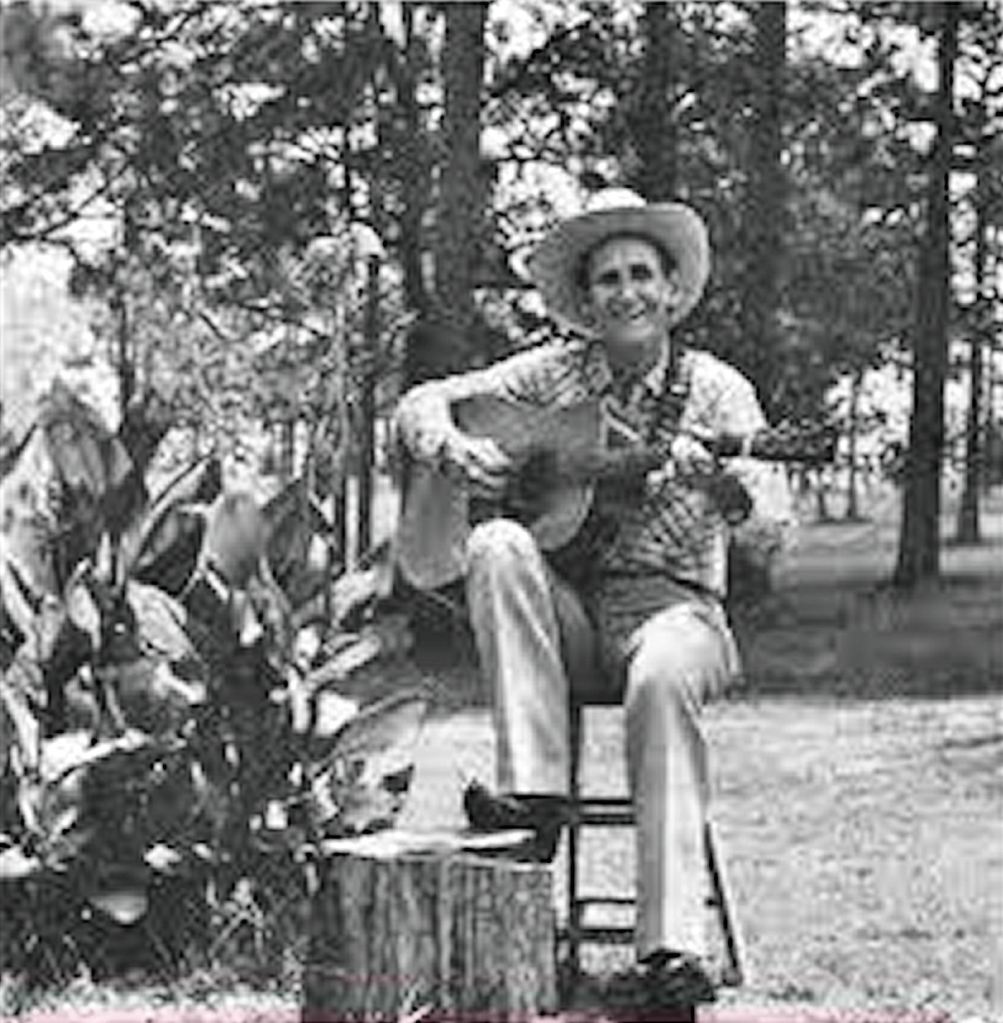
Neal McCormick’s role in the Creek Renaissance
As early as the 1930’s Calvin McGhee in southwestern Alabama was dreaming of reuniting the Creek People. NO impetus came from the Muskogee Creeks in Oklahoma. They seemed to be in a state of malaise in which they had submitted to their fate to go on the road to disappearance. He created on paper the Creek Nation, East of the Mississippi in the 1940s. He then began speaking to rural communities in his region, which contained Creek descendants.
The process of reviving cultural awareness was a slow one. Many Creek descendants in Alabama, such as the family of Corretta Scott (King), were tri-racial. Alabama White Citizens Councils were hostile to the concept of giving American Indian status to families, who also carried African genes.
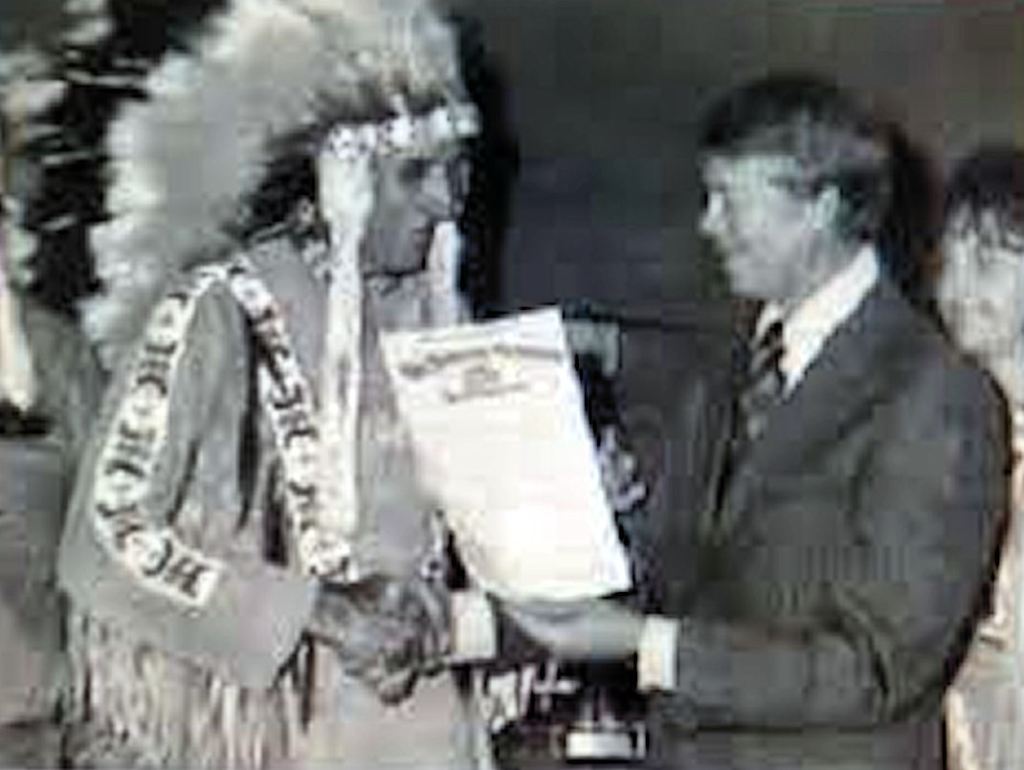
Neal McCormick with Jimmy Carter
Then along came Jimmy Carter. He was highly influenced by his close friend, Creek journalist John S. Pennington at the Atlanta Journal-Constitution. Shortly after being sworn in as governor in 1971, he pressured the Georgia General Assembly to abolish all laws that reduced American Indians to non-citizen status. Among other things, these archaic laws prohibited American Indians from voting, attending public schools, testifying in court in their own defense, practicing a licensed profession, hiring white men, owning a business or owning a large farm.
Carter then sponsored a series of acts, which were targeted at Georgia’s hidden Native American descendants. Among other things, it encouraged the creation of state-recognized tribes in the state and the creation of Native American reserves throughout the state. Carter dreamed, but didn’t talk in public much about it, of a new capital of the Creek People near Ocmulgee National Park in Macon, GA.
Creek leaders from the Southeast traveled to Oklahoma in efforts to persuade emerging Muskogee leaders to help create a national Creek tribe. They were rebuffed because many Oklahoma Creeks considered Southeastern Creeks to be traitors, since their ancestors didn’t suffer on the Trail of Tears like theirs did.
That wasn’t factual history. Most of the Eastern Creeks broke away from the Creek Confederacy during and after the American Revolution, because their villages and farms were being raided by Upper Creeks in present-day Alabama, who were on the payroll of the British. The Principal Chief at that time, Alexander McGillivray, was a mostly white Tory. He had moved the Creek capital from Coweta, where Columbus, GA now sits, to Pensacola, so the British Redcoats could protect him.
Eventually, Neal McCormick (Georgia), Wesley Thombley (Florida), and Houston McGee (Alabama) signed a pact of unity in February 1973. This would give an opportunity for each state to work with the legislature to amend the laws of their state and work towards federalization as one tribe (Creek Nation East of the Mississippi). Neal was eventually elected Principal Chief of the Creek Nation East of the Mississippi . . . minus the Creeks in southwest Alabama, who wanted to build gambling casinos. Georgia and Florida Creeks did not want to sponsor gambling.
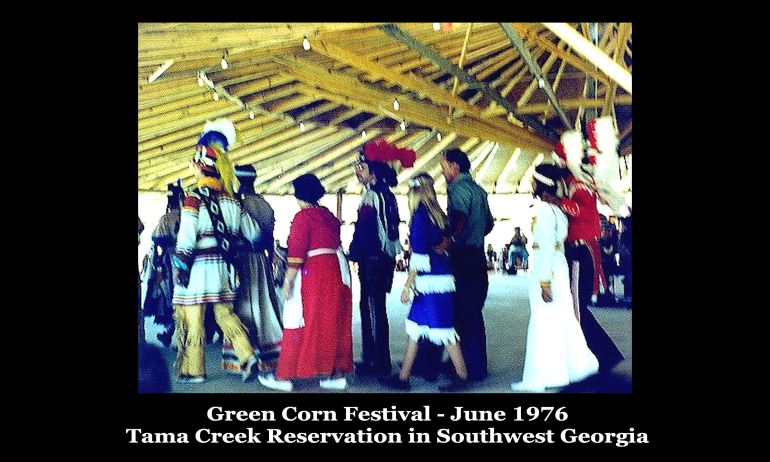
Neal McCormick’s Tama Tribal Town in southwest Georgia, now known as the Lower Muskogee Creek Tribe (East of the Mississippi) became a showplace for what could be accomplished. Its 1976 Green Corn Festival drew thousands of non-Native American visitors from Georgia, Alabama and Florida. It was a glorious weekend in which we celebrated what seemed to be a miracle.
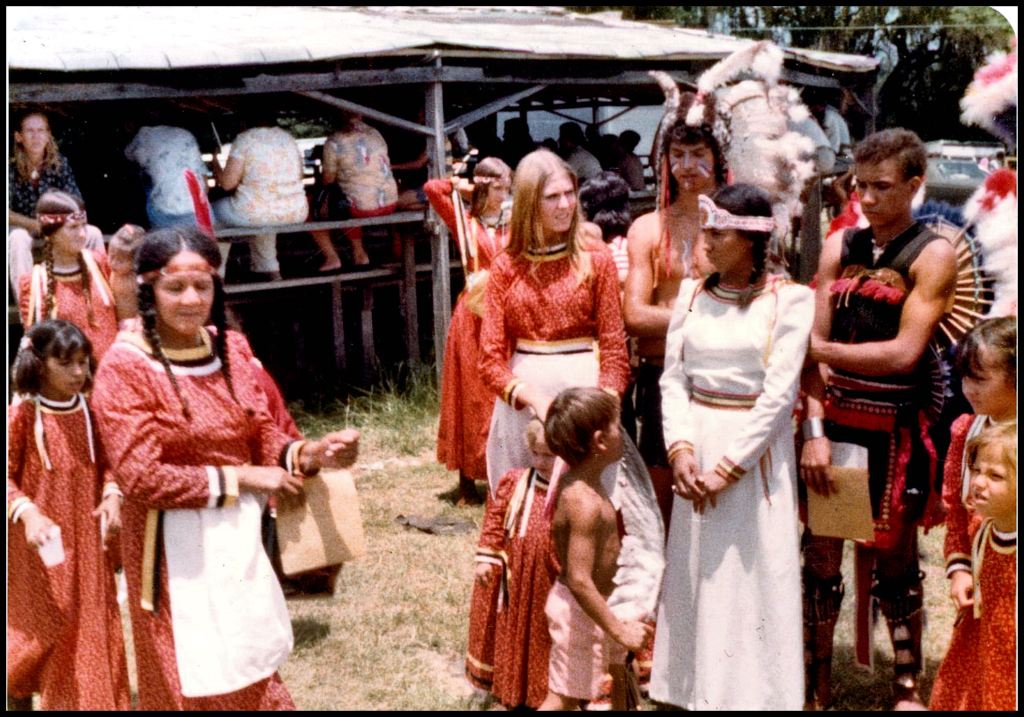
And now an explanation of the photos
When we arrived at the Tama Tribal Town for the 1976 Green Corn Festival, my mother and I immediately noticed that our body proportions and facial features were very different than the McCormick Family . . . really, most of the local members of the Tama Tribe. Unlike most of the people there, we knew the names of all of our Creek ancestors back to the mid-1700s, but didn’t know diddlysquat about our cultural heritage. We initially assumed that the McCormicks were what real Creeks looked like and we didn’t have much Native ancestry.
Also, even then, I knew that the real Creek town of Tama was in Middle Georgia on the Altamaha River – not near the Florida Line in deep, southwest Georgia. The people of the real Tama were Itsate Creeks, not Lower Muskogee Creeks, as the Tama tribe called themselves.
When the delegation of federally-recognized Seminoles arrived from Florida, several looked around then made a beeline to my mother. They were very impressed by the Turkey gorget that I had made for her. My mother had a grand time chatting with them and even commented that it was like going to a family reunion.

A former “Seminole Princess” and university beauty queen starred at me like she was looking for someone then quickly walked up. She introduced herself as Connie Osceola. She was no longer a teenage princess and now all grown up. She said that she was a professional Interior Designer, plus an artist.
After chatting warmly with me for a while, she smiled seductively and blurted, “I always thought it would be fun to be with an architect. You’re the first Native American architect I ever met.”
Miss Osceola then invited me to come visit her in Tampa. I unfortunately had to explain to her that I was married. As she slowly started to move on, Connie turned around and laughingly told me that after I divorced my icy cold Anglo wife, to come see her. Never been hit on like that before. LOL
My mother and I thought at that point that we were Seminoles, not Creeks. I later realized that Neal McCormick was an Upper Creek, who look very different than other branches of the Creeks. However, Eastern Creeks and Seminoles also looked different than their Muskogee counterparts.
Neal McCormick’s second wife was from the North Carolina Mountains. She didn’t look like she had any Native American ancestry, but dyed her hair black and presented herself to be the expert on the subject. Things like that can get one in trouble, when full-blood Native Americans from Florida come around.
You couldn’t help from liking Neal. I had been working with him on the phone in planning a large Creek Reservation on Carters Lake in the Northwest Georgia Mountains. It was the site of the great town of Kusa, which had over 3,000 houses. We really got along well. He was someone, people enjoyed being around. Where he got the energy at his age to accomplish what he accomplished, I don’t know.
Six months later, I found myself temporarily living in a cabin near Asheville, NC and the man, hired to revitalize Downtown Asheville. I was too busy to work on the reservation plans, and would be living as far as 700 miles from Tama for the next 18 years. I instantly was no longer in contact with Neal and Georgia State officials so the Carters Lake Reserve never happened.
When I found myself trapped at my parents’ house 17 years later, due to an contrivances by a wife I should have divorced in 1976, I soon thought of renewing friendship with my Creek brothers and sisters in Georgia. Maybe this time, I would find me a loving Creek or Seminole wife. Was Miss Osceola available?
To my shock, no other Creek tribe had formed in Georgia, since I left the state. I then thought of calling Tama and offering to start a branch of the tribe in the Georgia Piedmont and Upper Coastal Plain, where most of the Creeks lived.
I was stunned. The lady, who answered the phone, quickly told me that all of my mother’s extended family had been expunged from the tribal rolls, because we were not Native Americans. Pappy McCormick’s white wife from North Carolina had made the decision and tossed all of our files into the garbage. All of my grandparents’ generation had died off. It would be impossible to recreate the applications.
I told her that the State of Oklahoma had come to me to be the Architect for the Trail of Tears Memorial in Tulsa. My Uncle Hal had paid a Creek genealogist to get more information on our Creek ancestors. We were Creek Wind Clan. Three of my direct ancestors were Creek mikkos, who had signed the 1774 Treaty of Augusta.
My Uncle Hal’s last position in the US Air Force had been as the Welfare Officer for Native American USAF personnel in the Southeast and Latin America! Both he and I had been unilaterally reclassified as American Indians by our particular branch of the military, after a mysterious blood test and physical.
My mother had a certificate from the Bureau of Indian Affairs stating that she was a federally-recognized Creek Indian. She had been able to go to college because of a BIA check. Probably, nobody else in the tribe had such a certificate. Nothing I said, mattered.
A Quixotic quest for federal money
I tracked down some people in the Atlanta Area, who had been members of the Tama Tribe in 1976. They were all legitimate Creek descendants from North Georgia. They also had been expunged. What they all said was that it was a five-or-six-hour drive down to Tama through an increasingly monotonous landscape. The family had a good time at the first Green Corn Festival. The second festival they attended had the same activities, so after then the family didn’t want to go again. They assumed that they had been dumped because of lack of attendance or donations.
Then a Georgia Parks and Historic Sites Division official returned my call. He was the former Site Manager of Kolomoki Mounds State Historic Site in Southwest Georgia. His family had also nixed any more trips to Tama after two festivals.
He began, “You know, the fact is that Neal and his family have developed the only attractive reservation among of the many small tribes that popped up in the Seventies. Most of these tribes never got beyond meeting in libraries or community centers. That is an amazing achievement in itself.”
“Everyone adored Chief Neal McCormick, but some of the people in the tribe were telling the visitors inaccurate history. Tama was located in traditional Florida Apalachee territory, yet they said that the site had been occupied by the Muskogee Creeks for 10,000 years. In fact, what few Creeks, who might ever have lived in the general vicinity for a while were Hitchiti-speaking Seminoles.” We know that Kolomoki was occupied by Hitchiti Creeks at that time.”
He continued . . . “From a marketing standpoint, they could have not put the reservation in a worse location for Georgia residents. The reservation is located in spitting distance of the Florida line in the poorest, least populated part of Georgia, many hours drive from the main concentration of Creek descendants. The nearest city of any size is Tallahassee, the state capital of Florida. We could have helped them more, if it had been closer to Kolomoki, Columbus or to Macon.”
“They really didn’t have a plan for making the reservation self-sustaining year-round. I suggested that since Chief McCormick had a prominent place in American music history, they make the reservation a music performance venue.”
“Instead, they looked for grants from the state’s taxpayers. The tribe’s leaders presented themselves as representing all of the Creek descendants in Georgia, hence they recruited people like you and I as members to give them statewide credibility.”
“They received grants to construct the buildings and pay the family’s bills, as long as Governor Carter was in office. He looked upon the reservation as an economic development project for Southwest Georgia, where he grew up. That dried up, as soon as he started running for President. Our auditors determined that the tribe’s activities had little impact on the region and were essentially a family business, living off of government grants. They increasingly marketed to the Tallahassee and Pensacola Metro markets, but they were so close to Florida that visitors spent most of their money in Florida.”
“The tribe’s leaders then focused on getting federal grants and federal recognition. They never had a snowball’s chance in H-L of that latter proposition. The number one requirement for federal recognition is that members have lived in the same location for many generations.”
“Heck, the two leaders of a tribe were a country music performer from near the Florida line in Alabama, whose ancestors came from northeast Alabama and a his wife from the North Carolina Mountains. The folks at the BIA would joke about it when visiting Kolomoki.”
He continued . . . “Neal McCormick was liked by everyone, but getting right old. His wife became the real boss. His family spent over a decade or more in litigation trying to get recognition. They finally got a review by the BIA and were turned down because none of the tribe’s members were born in the vicinity of the proposed reservation and that the land had no historical connection to the Muskogee Creeks.”
“The BIA’s ruling also said that they did not have procedures to confirm Native American ancestry. That’s not true. We had to submit a lot of paperwork. Bet y’all did too,”
“Your relatives should have applied to be a federally-recognized tribe instead of joining the Tama Tribe. They just might have been approved the site in Elbert, since the elders of your family were born where there are lots of Creek village sites. However, that period of time is probably when all of us in North Georgia were removed from the Tama rolls. “
“The Tama people thought if all of the members lived in southwest Georgia, the BIA would approved the second application. They missed the point again. Nobody in the tribe was born on the land that they wanted to make a reservation. Their much smaller tribe was still turned down a second time.”
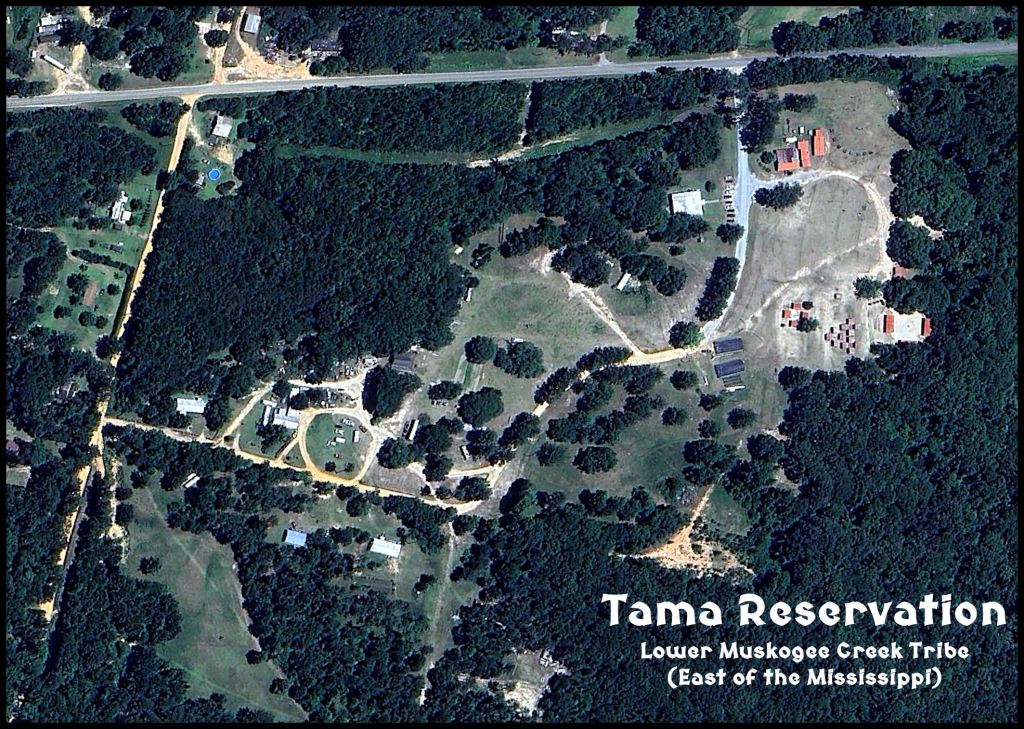
Of all the dozens of small tribes that popped up in the Southeast in the 1970s and 1980s, the Lower Muskogee Creek Tribe – East of the Mississippi was the only one who developed a real reservation.
Looking back five decades
Dozens of small Cherokee, Creek, Uchee, Siouan, Natchez, Yamasee and make-believe tribes were formed in Tennessee, Alabama, Georgia, South Carolina and Florida during the 1970s and 1980s. Several, with only a few dozen members, called themselves nations. Most had charismatic leaders like Neal McCormick, who were willing to spend most of their time to recruit and hold together their “tribe.” Most now are gone with the wind or only exist on paper.
When the charismatic leader got too old to work full time or passed away, his or her offsprings would typically assume his or her title . . . but soon got tired of working for no income. Members drifted away out of disinterest or left over spats with fellow members. Eventually, the make-believe tribe was just one or two nuclear families.
My mother’s extended family was far more a legitimate “Creek tribe” than any of these late 20th century upstarts. It was composed of at least six mixed-blood Creek and Uchee families, who had been intermarrying since the mid-1700s and living near each other in the Savannah River Valley. They grew up on farms that were underlain by multiple strata of Native American communities.
The mega-family reunions were scheduled each year by the elders to be as close as possible to the Creek New Year on June 21. Relatives came as far as Oklahoma and Florida to enjoy vast spreads of traditional Creek and Southern foods. We chatted, sang, played musical instruments then the young folks went to go swimming at the Sliding Rocks of King Hall Mill Creek. It was some of the happiest times of my life.
Alas, though, the annual Bone reunion went the same way as the make-believe Native American tribes. When my grandmother’s generation died off, 2 ½ centuries of family reunions came to an end. The new generations were too busy to have time to get together.
Maybe it’s just that the times have changed. Perhaps the Smart phone and text message generation is just not interested in silly things like reunions and Native American tribes.
PS – Last year, I was shocked to learn that my mother had first and second cousins coming to those reunions, who were citizens of either the Seminole Tribe of Florida or Seminole Nation of Oklahoma. All she had to do back in the 1970s was send a letter saying that she was the niece of Sam Bone and we would have been instantly enrolled in either tribe. That’s why the Florida Seminoles treated her as a Seminole sister and the beautiful Miss Osceola wanted me to paddle off into the sunset with her. All of my grandmother’s and mother’s generations are gone. It is not so simple now.
Hope you enjoyed this series of articles for Native American Heritage Month
 The Americas Revealed