
Translations of Tribes, Villages, Rivers and Titles
from the soon-to-be-published book
The Sea Peoples of the South Atlantic Coast
Richard L. Thornton, Architect & City Planner
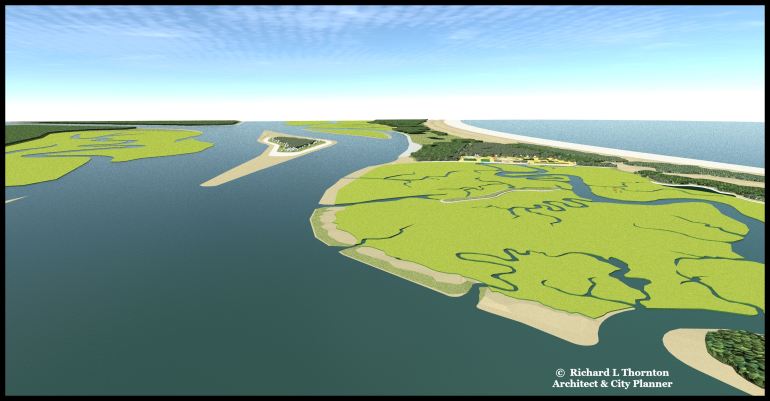
From Winyah Bay, SC to Amelia Island, FL there was once a dense population of peoples from many places, interconnected by a maritime expressway that we now call the Intercoastal Waterway. There was also another dense concentration of peoples in the southern tip of Florida, interconnected by man-made canals and raised earthen causeways. These coastal towns and villages were quickly decimated by European diseases and slave raids. They are barely mentioned in official state history textbooks. It is time that their story be told.
VERSION OF WORD
Native AmericanNA FrenchFR SpanishSP EnglishEN IrishIR
Austronesian Austro DutchDU ScandinaviaSK
Panoan is the language family of the most advanced indigenous tribes of the eastern Andes Mountain Foothills . . . Satipo Province. They grow crops in a climate with heavy rainfall, similar to that of the Southern Appalachian Mountains and Piedmont. It is quite likely that it was their seeds, which were adapted by Native Americans to a Temperate climate. The Lima bean originated in Satipo Province.
South Carolina
1. AtoyaNA – René de Laudonnière described Atoya as the Sun God and principal deity of the peoples living around Port Royal Sound. At that time in Peru, Atoya was considered an “old god” and lived up in the higher elevations of the Andes.
2. AjoSP` (AhoNA) – Sweet Potato in Southern Arawak, all Creek languages – the chronicler of the Juan Pardo Expedition stated that this village specialized in growing sweet potatoes.
3. AshepooEN Tribe < AseboNA = “Yaupon Holly – Place of “ in Panoan. “S” is pronounced “sh”. The Panoans cultivate a holly which is closely related to the Yaupon Holly in the Southeast, but genetically not exactly the same.
4, Catawba EN Tribe < Catapa SP < Kataapá NA – means “Crown – Place of the” in the Itsate Creek language. The Kataapa were a Mesoamerican-Muskogean People, who were the elite of an alliance of small Siouan tribes along the Pee Dee/Catawba River in present-day South Carolina. Their principal province was in present-day Georgia from North Metro Atlanta to the edge of the Blue Ridge Mountains. After the American Revolution they migrated downstream on the Chattahoochee River. The Siouan Catawba call themselves: yeh is-WAH h’reh (People of the River.)
5. Caushee EN < KausheNA – “Strong, Elite” in Panoan
6. Cheraw EN Tribe – (Sara, Saraw, Saura) NA – Means “soggy ground” in Panoan. There was also a large Sara province in extreme southeast Georgia in the vicinity of the Okefenokee Swamp and St. Marys River.
7. Cofitachequi SP) – Kofitvsiki NA – means “Mixed peoples-descendants of-7ribe” in Muskogee-Creek. This is the name of a town and province visited both by Hernando de Soto and Juan Pardo.
8. Combahee EN Tribe < Kvnepahi NA – means “Low Land – Living Place” – Sokee-Creek (Soque, Zoque, Miccosukee). The capital of the Sokee was on the headwaters of the Soque River in mountainous northeast Georgia, but they had strong trading ties with the Cusabo. Later they merged, with most moving to Florida.
9. Cusabo EN – Kaushabo NA – means “strong, elite – living place of” in Panoan. There is still a Kaushabo Tribe in eastern Peru today.
10. Datha Island IR – [chief of Duhare Tribe] (Medieval Irish Gaelic) = “Painted”
Note: The Spanish account of the Province of Duhare mentioned that Datha’s body was completely covered in brightly colored tattoos. See Duhare.
11. Daufuskie Island EN – Tvl-fuske NA – means principal town of the Creek Bird Clan in Muskogee-Creek. There is no D in the Muskogee Alphabet. The T is pronounced half way between an English T and an English D. All South Carolina references state that Daufuskie means “spear” in Muskogee, but that word is “tag̱anís.”
12. Duhare SP, Duhale FR & EN – Du h’aire – Early Medieval Irish Gaelic = “of Ireland” or “Irish” – While National Architecture Columnist for the Examiner, the author worked with the Irish Consul in Atlanta, the Irish Cultural Attache’ in New York City and the Linguistics Department at Trinity College in Dublin to find proof that Early Medieval Irish and Norse DID settle in South Carolina. Our report made international headlines.
Notes: Within Peter Martyr d’Anghiera’s book, De Orbe Novo (1530 AD) is a description of the voyage of Francisco Gordillo and Pedro de Quejo to the South Atlantic coast in 1521. The two men mentioned a visit to a province called Duhare, somewhere near the Savannah River. Its occupants were of tan complexion with red to black hair. The men wore beards. They lived in houses similar to those of the Indians nearby. Their pottery was similar to that of the Natives. The Spaniards did not see any iron tools. The Duahare grew crops and livestock, indigenous to the Americas, plus some typical of northwestern Europe.
William Bacon Stevens’ Early History of Georgia (1847) stated that there was a tribe of light-complexioned Indians living north of Savannah, who spoke an Archaic form of Gaelic. Irish and Scottish immigrants to Savannah could carry on conversations with them. Within a few years, the Gaelic “Indians” moved to Georgia and assimilated into the many immigrants coming to colony . . . rebranding themselves as “Irish Only.”
13. Echaw or Itshaw EN People < Itsaw NA – means Itza (Maya) in Muskogee-Creek. Muskogee S’s are pronounced like an English “sh.”
14. Edisto EN or Audusto FR Island – In its recorded form, the root word “Edis” or “Audus” is not recognizable in any indigenous American language, but is a common name among Christians in Ethiopia, Egypt and eastern Turkey. “To” is probably an abbreviation of “toa” – the Archaic Irish word for tribe, “Toa” or “doah” are suffixes in several “Native American” place names in the Southeast.
15. Escamacu SP or Euscamacu SP Tribe – This word literally means “Basque” with the pan-Arawak suffix of “maku,” meaning “unintelligible language.” It is definitely not Muskogean, as labeled in South Carolina references, nor is “eska” translatable in any other language, commonly used on the South Atlantic Coast. Never the less, the interpretation should be considered speculative.
16. Etiwa & Etiwan EN < Etalwa & Etalwan NA – means Principal Town & Principal Towns in Muskogee-Creek
17. Heneha SP/EN – Title of Native American officials, who met with Spanish explorer Juan Pardo in present day South Carolina. The actual Itza Maya word is Hene-Ahaw and means “Sun Lord.” Both in southern Mesoamerica in Creek provinces, the Sun Lords were the siblings of the High King, who served as itinerate judges in court cases.
17. Hillabee EN Creek Tribe < Ilape SP < Herape NA – With at least 32 mounds, Herape was probably the largest town on the Pee Dee River. It’s name cannot be translated by dictionaries of any known tribe in the Southeast – including immigrants from other parts of the Americas. The Herape People left South Carolina soon after it was founded, initially settling in present-day Northeast Georgia the West Central Georgia then East Central Alabama.
18. Hobcaw EN < Hobkaw NA – means “Sacred Red Hawk” in Chontal Maya.
19. Hoya EN – This is possibly a Muskogee pejorative for outcast villages. Otherwise, the word does not appear in any of the languages found along the South Atlantic Coast. South Carolina authors have confused it with the sun god, Atoya.
20. Kiawah EN Tribe < Kiaraw NA –This is a Muskogee-Creek version of Kiar-re IR , which means “Darked Skin Tribe or Kingdom.” The founders of this tribe were from County Kerry, Ireland. Native Americans rolled the “re” so hard, that it was typically written as “le” or “we.” The capital of this tribe was on the Oconee River in present-day Watkinsville, GA – a short distance south of Athens. Their descendants in Oklahoma are members of the Kialegi Tribal Town. Kiare-gi would be completely understandable to a Gaelic-speaking Irishman today. The suffix “gi” is also Gaelic.
21. Kussah EN People – Kaushe NA – “Strong, Elite” in Panoan – See Cusabo.
22. Kussoe EN – Kaushoe NA – “Principal town of Strong, Elite” in Panoan/Itza Maya
23, Mekko NA – A regional or town king in the Creek regions of the Southeastern USA, southern Veracruz State and in Tabasco State, Mexico. The word is Chontal Maya, but derived from mekke, the Scandinavian word for a regional or town king.
24. Ocate EN – Okate NA – means “Water People” in Itsate Creek.
25. Orata SP & Olata FR – title of most village chiefs in South Carolina, as recorded by Juan Pardo SP and Rene Goulaine de Laudonnière FR. The word means “speaker” in the Panoan language and is the title of a village chief in Peru and the Amazon Basin. It is derived from the from the Latin word, ōrāre (“to speak, pray, plead”). There was obviously contacts between the Americas and Europe in Pre-Columbian times.
26. Pee Dee River & Tribe EN – This important river’s name was derived from
27. Pocateligo EN < Pokateliko NA – means “Big Town Capital” in Chontal Maya. It was the capital of the Yamasee Alliance. It is interesting that there was a town on the Ohio River with the same name. This suggests that the Chontal Maya traders at least reached that far north.
28. Pon-Pon EN River – This possibly means Dance – Dance in Muskogee-Creek. It may instead be a Uchee word. To date, there is still no Uchee-Yuchi-Euchee dictionary.
29. Salkehatchie EN River < Sawaki-hachi NA – means Raccoon Clan River in Eastern Muskogee-Creek. The Creek men in this region formed the Raccoon Regiment, which fought for the Patriot Cause in the American Revolution.
30. Santee EN River & People – San-teNA– Chontal Maya word for colonists – equivalent to Panoan word, Sati.
31. Savannah EN River < Savanu or Savano NA < Savai–nuu Samoa – means Savai Villages in Proto-Polynesian and Samoan. The Savai were the occupants of the largest island in Samoa. Pioneer anthropologist and Mayor of Savannah, Charles C. Jones, Jr. provided absolute proof that the Savanu were not Shawnee and were a tribe that had long lived on the Savannah River. The reasons are described in the Georgia section.
32. Sewee EN – “Sewee” in recorded form is not recognizable as in any major language spoken along the South Atlantic Coast. A few recorded words such as the one for “friend” did not match any word for friend in my Indigenous American dictionaries Known as the “Island People,” they could have been pre-Arawak occupants of the Bahama Islands, Cuba or Florida Coast.
33. Stono EN People – “Stono” in its recorded form is not recognizable as in any major language spoken along the South Atlantic Coast.
34. Talimeco SP – Talimekko NA – means :”Town of the King” in Chontal Maya. It was located on the Santee River and was visited by the De Soto Expedition.
35. Uchee EN People – This tribal name is written as Yuchi in Tennessee and Euchee in Oklahoma. Recent genetic studies have determined that they were Austronesians, but as mentioned earlier in this book, in the Southeastern Highlands, most of the Uchee Tribes had Archaic Irish, Archaic Scottish or Modern Irish Gaelic names.
36. Vehedi SP Tribe – This word, which appears in the chronicles of the Juan Pardo expedition with was derived from the Itsate-Creek word, Vehite NA, which means, “Archer People.
37. Waccamaw EN People – Probably a Uchee tribe and derived from the Austronesian-Samoan words Waka-maw’nu Austro, which mean “Canoes or catamarans-drifting.” In the past, the Waccamaw were one of several coastal tribes that European-American academicians in South Carolina decided were “Siouans” without a shred of linguistic or cultural evidence. Neither “waka” nor “maw” are Siouan root words.
38. Wando EN People– “Wando” and its few recorded words are not recognizable as in any major language spoken along the South Atlantic Coast. Wikipedia and some South Carolina authors label the Wando as being Siouan. Wando and “wan” have no meaning in Catawba, a written Southern Siouan language. The Wando and Sewee Peoples were on good terms. It could be that these small coastal tribes were from the same unidentified origin.
39. Waxaw EN People < Guaxua SP < Wassaw Austro (Double S is pronounced with [jzh] sound.) This is the Austronesian Samoan and Fijian word for “ocean.” The Wassaw men were described as having flattened foreheads and some Mesoamerican traits. They may have first lived in southern Mesoamerica or South America, before immigrating to North America. These are the same people, who the De Soto Expedition labeled “Guaxule.”
40. Westo EN People = Woeste DU which means “scary” In Late Medieval Dutch (Duets). A Low Country Indian rushed to warn Dr. Henry Woodward that the Westos were about to attack. All he said was “Scary!” It is obvious that he was using the English translation of the raiders alternate name.
Their other name was Rickohocken. In 2014, Boston College linguist, Marilyn Rae, determined that this word was also Duets and meant “Nobility – Highlands.”
From my past research into the 17th century western Virginia history, while living in the Shenandoah Valley, it is known that Dutch traders and slave buyers were traveling the length of the Appalachians as far as northern Georgia in the early and mid-1600s.
There is even an ancient mud volcano in Northeast Metro Atlanta, named Nodoroc, which is proof that the Dutch made it that far south. Al references stated that Nodoroc was a Muskogee Creek, meaning “Gate of Hell.” That is absolutely not true. In 2013, Marilyn Rae determined that Nodoroc was Late Medieval Dutch and means “Swamp Smoking.”
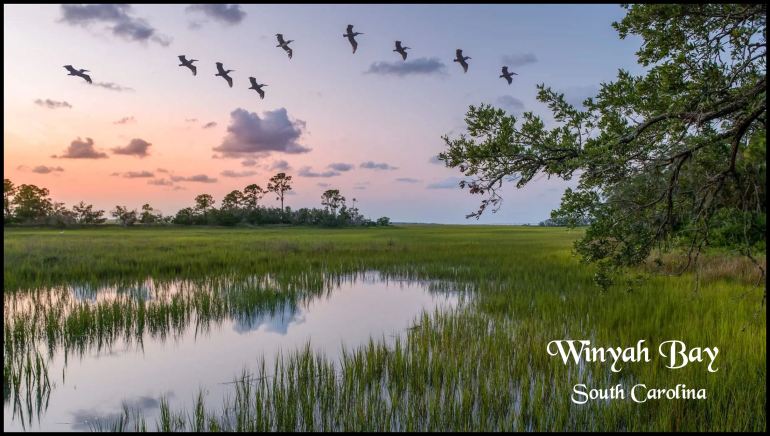
41. Winyah ENBay – VinjaSK or VenjaSK – (pronounced like Winyah) – Archaic Swedish-Danish word for a wide expanse of marsh grass, which is exactly the appearance of Winyah Bay. The location of Winyah Bay corresponds to what Anglo-Norman, Irish and French monastic journals describe as the Scandinavian portion of Witmannsland (White Man’s Land) . . . four centuries before the Columbus voyages. The descriptions of Vinland by Greenland Norse explorers (extensive grasslands, wild muscadines and Butternut trees) seems more appropriate for the South Carolina coast than Newfoundland. Despite what YouTube amateur historians tell you, the Scandinavian word for grape is “drupa,” not “vin.” Vin/ven means “grass” or “pasture.”
42. Yamasee EN Alliance < Yamasi NA – Chontal Maya word meaning “Descendants of the Province of Yama. Yama was the region in Mexico, where the “Olmec” Civilization developed and also was a name for the province around Savannah. See Yamacraw in the Savannah, GA Area.
 The Americas Revealed