
Passamaquoddy Bay, Maine
Ville St. Croix (1604-1605)
Merry Christmas to all my friends around the world.
Most members of this expedition would have died, had not their Native American neighbors felt compassion for them and around the time of Christmas Day, taught them how to make a potion that would treat and prevent scurvy.

Under Samuel Champlain’s leadership, the French colonies were much better planned and constructed than those in Virginia and Cape Cod. Note the vegetable gardens laid out among the buildings.
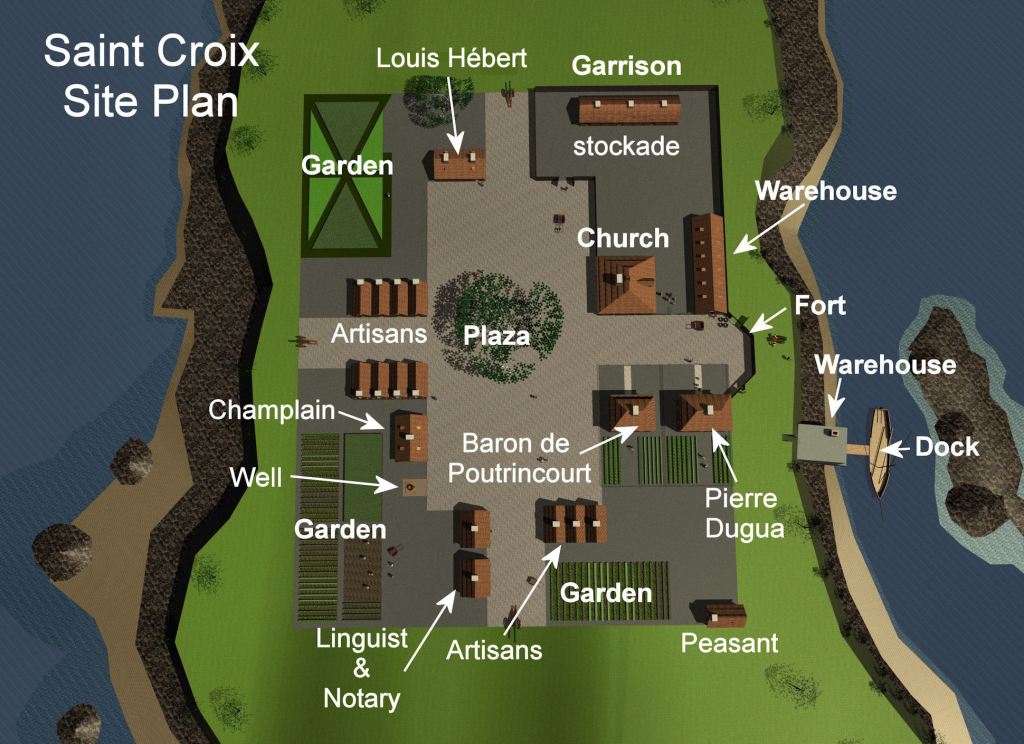
On November 8, 1603, Henry IV of France granted a Protestant nobleman, Pierre Dugua, Sieur de Mons, a monopoly for the conduct of the fur trade and the title of lieutenant governor of the territory between the 40th and 46th parallels known as La Cadie. In return, De Mons was expected to colonize the country and convert the First Peoples to Christianity.
Prominent members of the expedition included the explorer/geographer Samuel Champlain; the Sieur de Poutrincourt, who had a special interest in farming; and François Pontgravé, who, like Champlain, had been involved with an expedition up the St. Lawrence the year before. De Mons also brought along a surgeon, a miner, a Roman Catholic priest and a Protestant (Huguenot) minister to look after the spiritual needs of the colonists. The group included a sizeable contingent of Protestants.
The expedition sailed from Havre de Grâce (now Le Havre), France in March 1604. Arriving at Sable Island on May 1st, they divided-up; three ships headed up the St. Lawrence to trade, Pontgravé sailed for Canso, and De Mons, Champlain, and Poutrincourt explored the coast of Nova Scotia and the Bay of Fundy. Throughout the summer De Mons searched for an appropriate site for a settlement while Champlain carefully mapped the inlets and harbors of the rugged coastline.
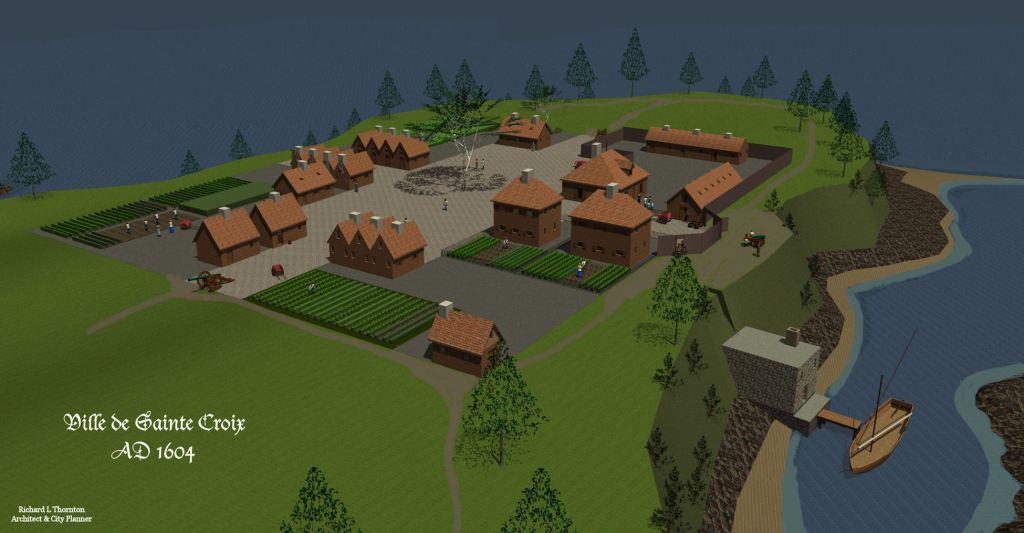
At the end of June, after exploring the mouth of the St. John River, the group arrived at Passamaquoddy Bay. Here they found an island situated inland near the confluence of three rivers. Blessed with an abundance of resources, especially herring and bass, and easily defended against possible attack, it seemed a promising site for a settlement. De Mons named the island Île-Sainte-Croix.
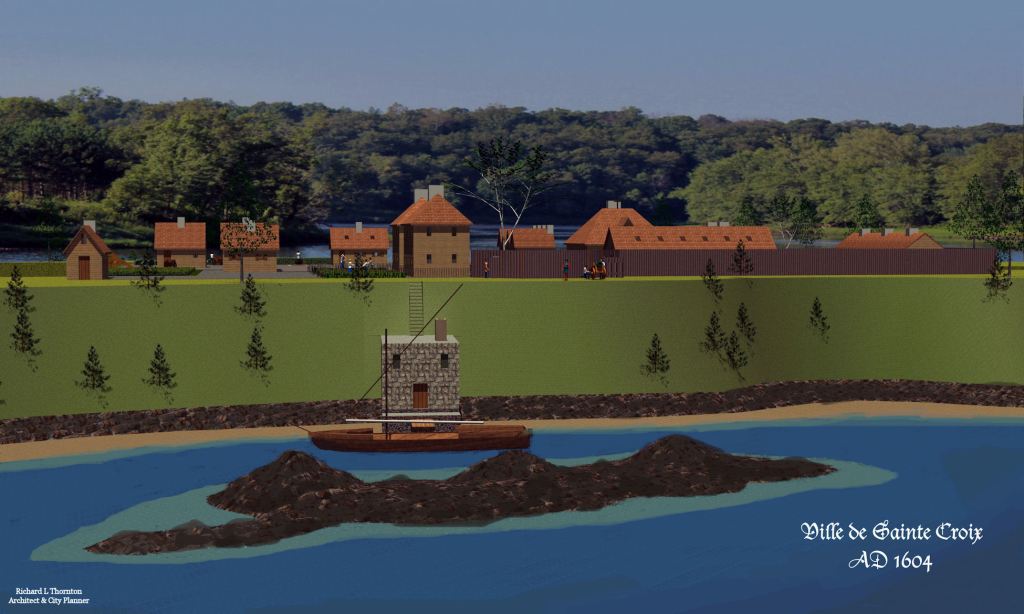
The snow came early that year. The situation of the colony quickly changed. During the first winter there more than half the settlers had perished due to a “land-sickness” believed to be scurvy. Most of the colonists would have probably died had not their “Good Neighbors,” the Passamaquoddy People noticed that the Frenchmen seemed too weak to even cut firewood.
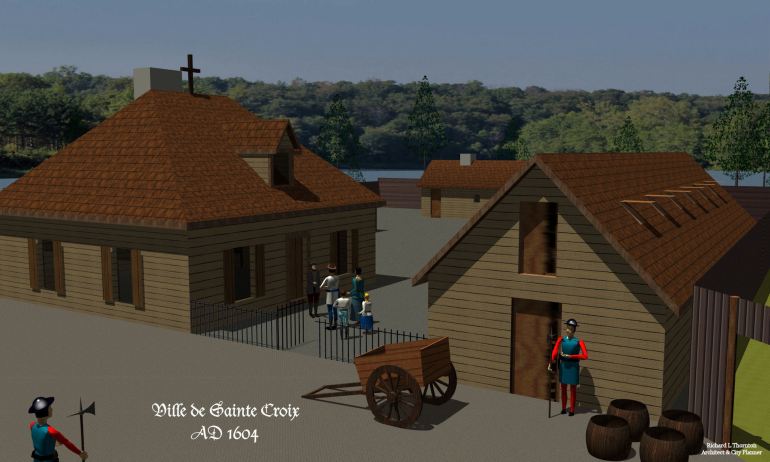
Several Passamaquoddy paddled over to the island with food then were shocked when they realized that almost of the French had died and the rest seemed to be headed there. They brought over some fire wood in their canoes then took the few men in the best shape to the forests along the bay, where a certain type of fir tree grew, whose needles were rich in Vitamin C and other nutrients. Soon he survivors were in sufficient health to cut firewood, fish and hunt.
The following spring, Champlain and François Gravé Du Pont moved the settlement to a new location on the southern shore of the Bay of Fundy. Champlain had found the site during a shoreline reconnaissance expedition. Called Port-Royal, it became the first permanent European settlement in New France . . . a year before English colonists founded Jamestown.

St. Croix Island International Historic Site is managed cooperatively by the U.S. National Park Service and Parks Canada under a formal agreement. Both countries have main-land interpretive trails and exhibits near the island. The island is within U.S. territorial boundaries, but the site is considered a historic shrine by French Canadians.
 The Americas Revealed
Merry Christmas, Richard! God bless!
LikeLiked by 1 person
Merry Christmas and God bless you too!
LikeLike
Even now, I drink pine needle tea for the Vitamin C and help with congestion, etc.
LikeLike