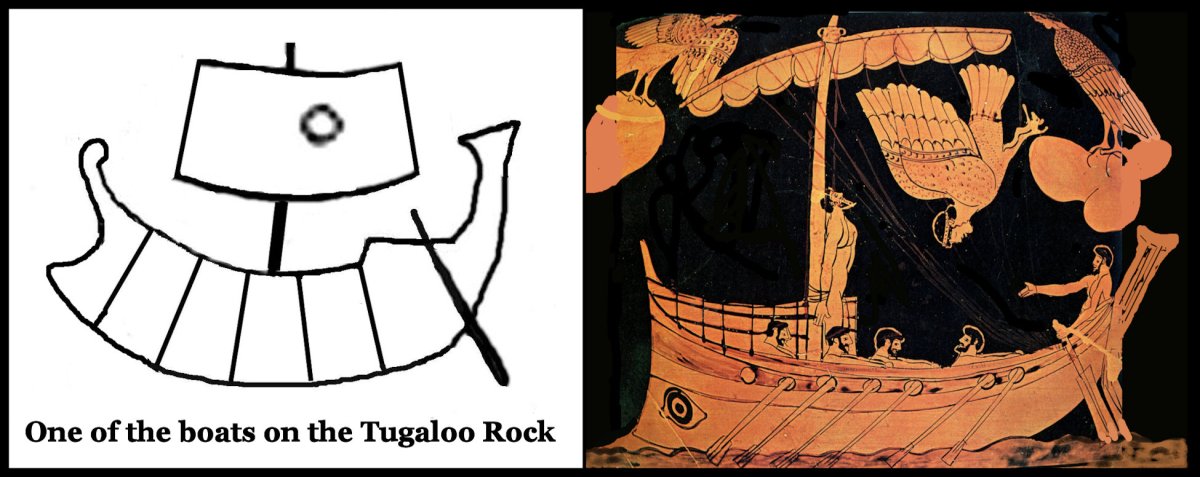
On the left above is one of several Bronze Age ships portrayed on petroglyphs in northeast Georgia near the headwaters of the Savannah and Chattahoochee River. On the right is a 2500-year-old Greek vase, portraying an early form of the Greek pentekonter ship, commanded by Odysseus.
by Richard L. Thornton, Architect & City Planner
The Sea Peoples of the South Atlantic Coast series
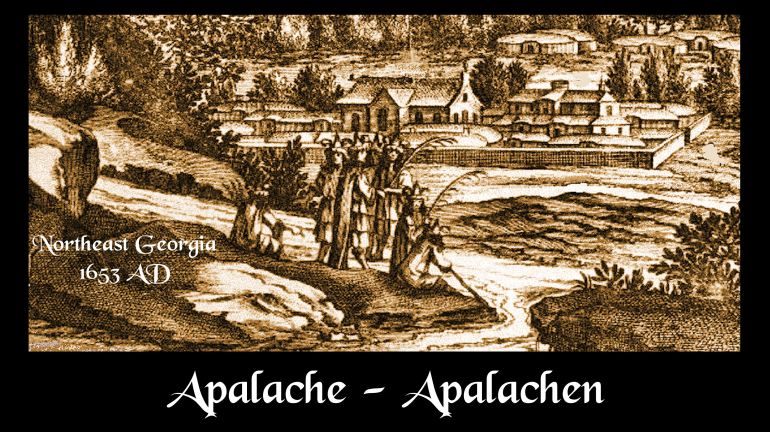
The Appalachian Mountains get their name from the plural of Apalache. This scene is a lithograph of a scene sketched by Richard Brigstock in 1653 about a mile north of Helen, GA at the confluence of the Chattahoochee River and Smith Creek.
The Countercurrents of Prehistory
Hey y’all. During much of 2025, I provided graphics and research support for Dr. Donald Yates in the creation of his latest book, The Countercurrents of Prehistory. It was a fascinating and very educational experience. The book follows the movement of certain “minority genes” and the Austronesians around the planet from the Neolithic Period to when the Pacific Basin was fully populated.
The two minority genes that interested me the most were the Helen Gene and the Odin Gene. The Helen Gene (named for Helen of Troy) was associated with Mediterranean Bronze Age Civilization, while the Odin Gene was associated with Nordic Scandinavian Civilization. Both genes were carried by peoples in the Americas, thousands of years before Columbus sailed the ocean blue. Look at the maps below that I prepared for the book.
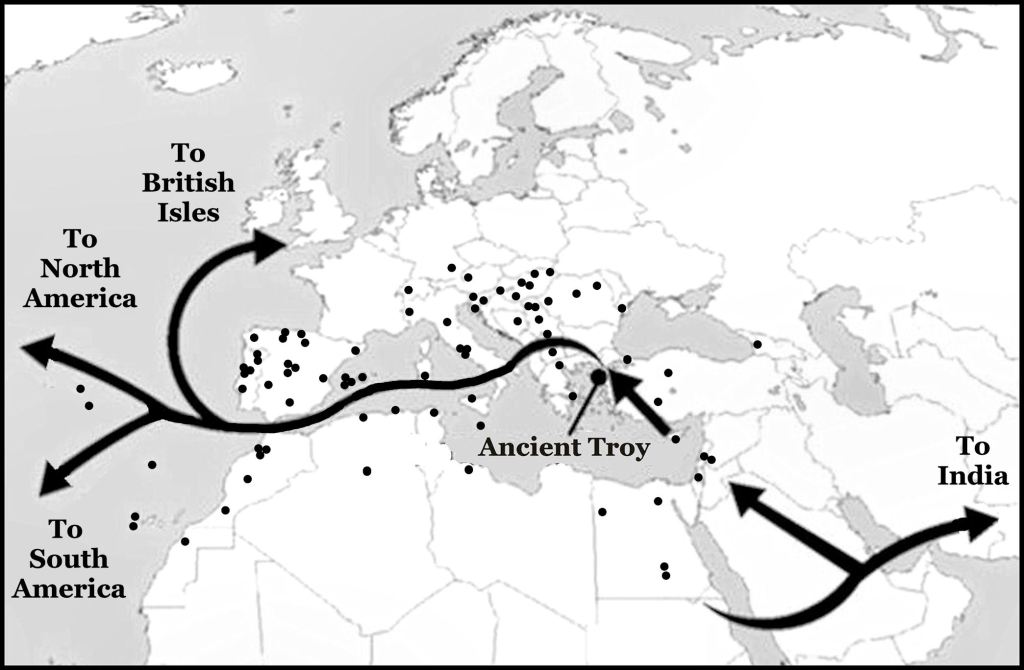
Migrations of the Helen Gene – from The Countercurrents of Prehistory by Dr. Donald Yates
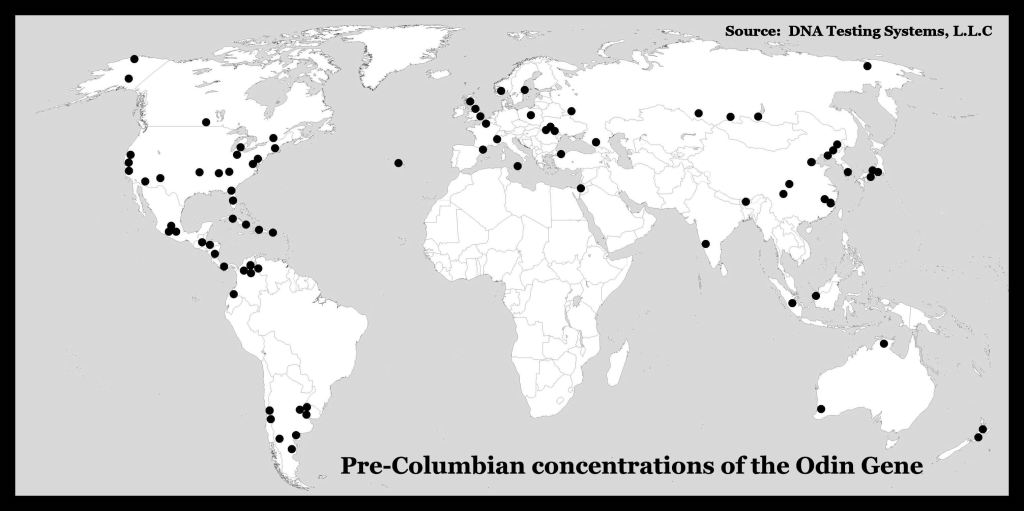
From The Countercurrents of Prehistory by Dr. Donald Yates
The Austronesian immigration into the Americas that originated from Taiwan is especially important to Americas Revealed readers, who have indigenous ancestors along the Gulf Coast of Mexico and in the Lower Southeast. The Uchee (Yuchi), Itza Mayas, Tamulte Mayas, Potun Mayas and Chontal Mayas, plus the Panoans of Peru are descendants of Austronesians, who intermarried with the locals in varying degrees. That’s why the famous Creek leader, Tamachichi, looked like someone from Malaysia or the mountainous regions of the Philippine Islands.
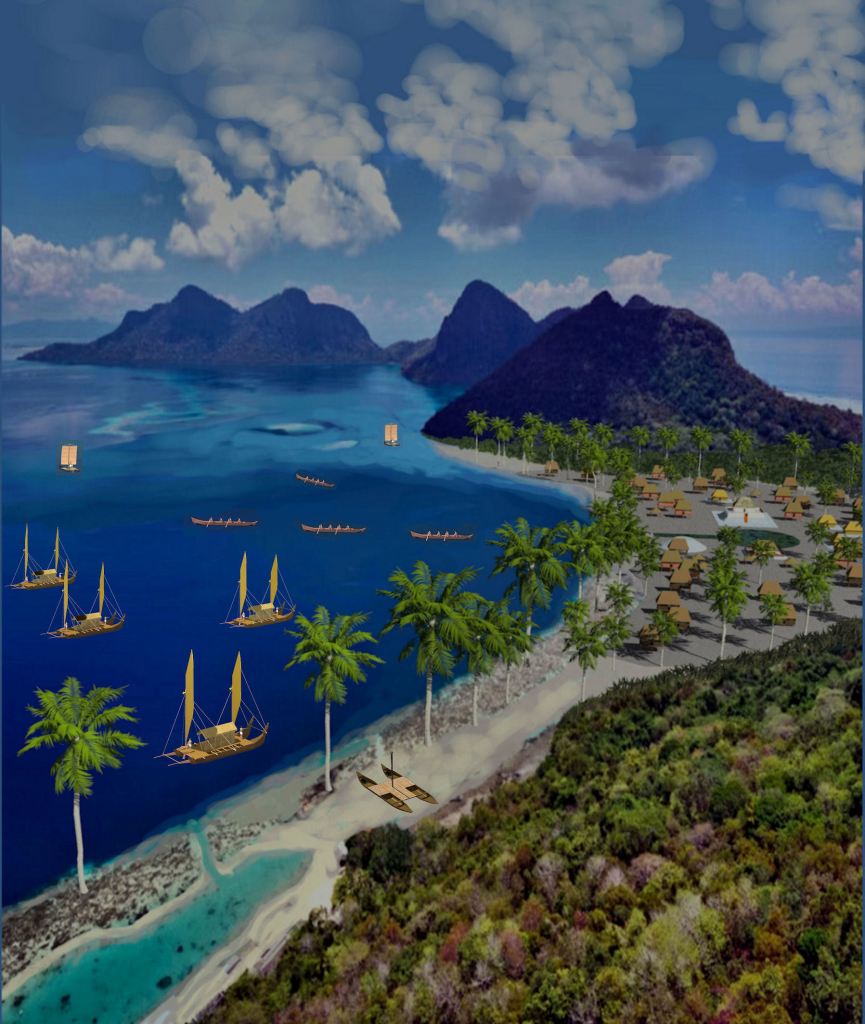
The Austronesians arrive in Sarawak Bay, Borneo by Richard L. Thornton, Architect
Smoke and Mirrors genetics
As stated several times on this website, there are NO Pre-Columbian DNA markers available to genetics labs around the world from the Southeastern United States. That’s a big problem because the Southeast and Lower Mississippi River Basin was where most of North America’s peoples lived in 1492.
Then we have the problem of many indigenous peoples on the Atlantic and Caribbean regions of the Americas carrying Pre-Columbian Helen and Odin genes. Both commercial and university labs have been “tossing” these genes out as being the result of Post-Columbian admixtures or sample contamination. However, they are also showing up in isolated indigenous peoples of the Amazon Basin.
Part of the reason for ignoring the Southeast is that the oldest DNA samples achieved so far in the Southeast were people, who were NOT from Siberia. They were either Proto-Sami from northwestern Eurasian or Austronesians. The scientists involved in the studies did not want to upset members of federally-recognized tribes by telling the world that Indigenous Americans were the result of many peoples mixing together, not a pure race, which marched or paddled across the Bering Strait.
Fact-checking a seemingly wacky theory
About two years ago, Dr. Yates told me that he believed the original ancestors of the “real” Apalache in Northeast Georgia were Bronze Age Greeks. They were the elite, when visited by Richard Brigstock in 1653 and were sketched going around wearing choir robes, cone shaped straw hats in the summer and Middle Eastern fezzes on formal occasions.
I admonished him for attending wacky weed parties in Aspen, Colorado, but thought I might fact check him quietly. I presumed that I would find nothing in Creek linguistic and cultural history to back him up, but was not going to destroy our friendship by telling him afterward that he was out in lala land. He sent me Latin, Classical Greek and Austronesian dictionaries. I already had Indo-European and Archaic Swedish dictionaries.
Actually, Don was right! Now, linguistically the Creek languages contain more loan words from the Nordic Indo-Europeans. In fact, grammatically, Muskogee-Creek is closer to Archaic Frisian and Saxon than any other languages in the world. Culturally? Wow!
Te cultural themes of Creek oral literature and art are almost identical to those of Bronze Age Scandinavia, but the traditional clothing that sets them apart from other tribes in North America is identical to what was worn by the Panoans in Peru and the Bronze Age peoples of Greece and Illyria, plus the Philistines. There are also some Archaic Greek and Classical Latin words in the Apalachicola, Muskogee and Itsate Creek languages.
- The words used for tribe on the South Atlantic Coast, plus in the Caribbean Basin and northern South America are kura, kuro, koro, kola, koa and kua. They are all derived from the Classical Greek word, kura.
- The Aztec word for a deity, teo (pronounced theo) was the Classical Greek word for deity, theo.
- Muskogee-Creek has two words for water . . . ue (Nordic) and akwa (Latin)
- The Muskogee-Creek for canoe is pilla. The Eastern Creek word is pirraw. Both words are derived from the Carib word pirau, which ultimately comes from the Classical Greek word for canoe . . . pirro.
- The Muskogee word for “Speaker of the Council” or a village/neighborhood leader [orata] is from the Latin word, orator (verb – orata) which means to speak before a council or assembly, but originally from the Classical Greek verb, oro, which means to publicly offer prayers. Some towns used the term oramekko (olameco in Spanish) to describe the king of a province. The word mekko is Scandinavian and derived from a word used by the Odin gene Indo-Europeans, when they arrived in Scandinavia.
These Latin-Greek based titles and words were in use when French and Spanish explorers made first contact with the Southeastern Indians. This is definite proof that America’s real history is different than what we were taught in our high school textbooks. When my two books are published, you will be reading many more surprises.
 The Americas Revealed
Hi Richard
I went to Travelers Rest State Historic site last weekend to see the Tugaloo Stone.
The Tour guide was a very nice gentleman that gave me a tour of the main house and told me about the history of the house. He knew very little about the “Indian Stone” other than the state approved history. I showed him your pictures of the stone and what what you thought the carvings meant. The stone is still upside down and under a small open sided shed. I took some pictures but you cant really see any of the carvings without good lighting, but I could just make out the boats and several of the smaller carvings. I plan to go back up to that area and check out the Batesville Store and the mound it sits on.
Thanks again for the interesting information!
LikeLiked by 1 person
Yes, I have a very powerful ultraviolet light and a special setting on my camera, which I use for photographing Indigenous pottery and petroglyphs. I went there on a Sunday, so no staff member would see me using special equipment. The Batesville General Store Restaurant is under new management and getting excellent reviews for its seafood and fried chicken!
LikeLike