They were following the path of a massive comet that passed over Central America in 536 AD then crashed into the Atlantic off the coast of Florida, creating Cape Canaveral then sending a wall of water from 125-500+ feet (38-153+ m) tall over southeast Georgia. The tsunami debris ridge is still 85 feet (26 m) tall near Darien, GA!
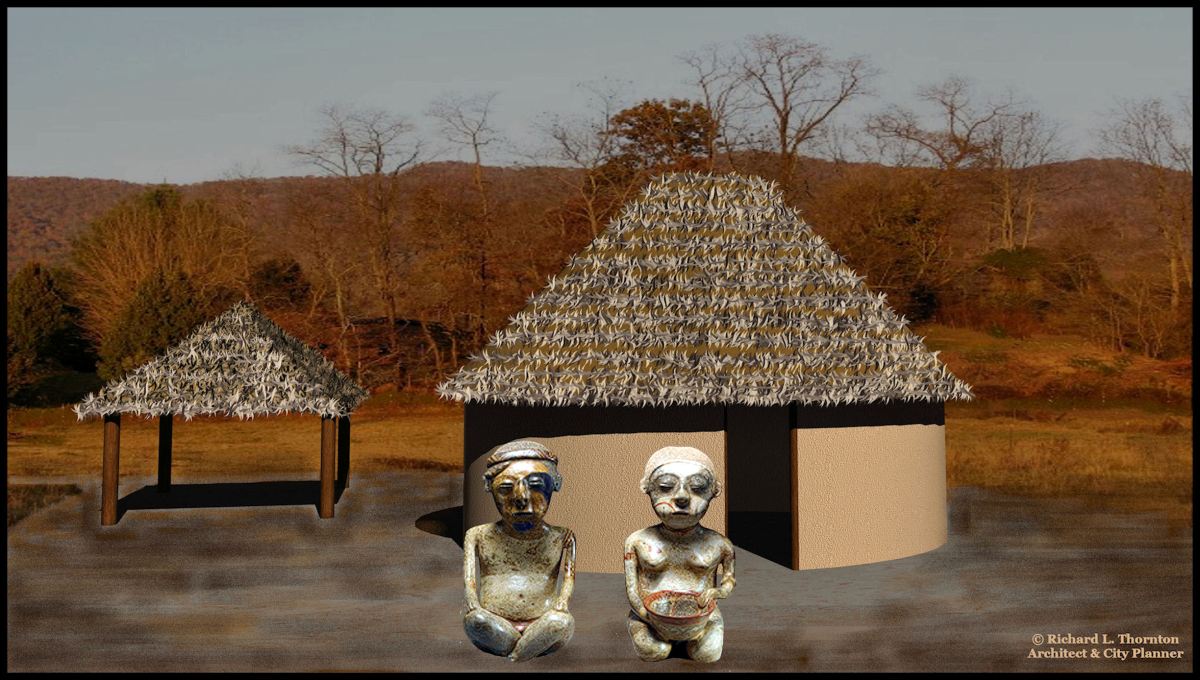
Their arrival was announced in Georgia and South Carolina by the sudden appearance of oval shaped houses, Mesoamerican style earthen “platform” pyramids and stamped pottery with “angular” geometric patterns.
My discoveries in 2025 and 2026 of the immense impact of Chontal Maya immigrants on the Southeast were made possible by the publication in Mexico of a Chontal Maya dictionary and my new AI computer being able to read and translate all relevant published archaeological reports in Mexico within a few seconds!
The Sea Peoples of the South Atlantic Coast series
by Richard L. Thornton, Architect & City Planner
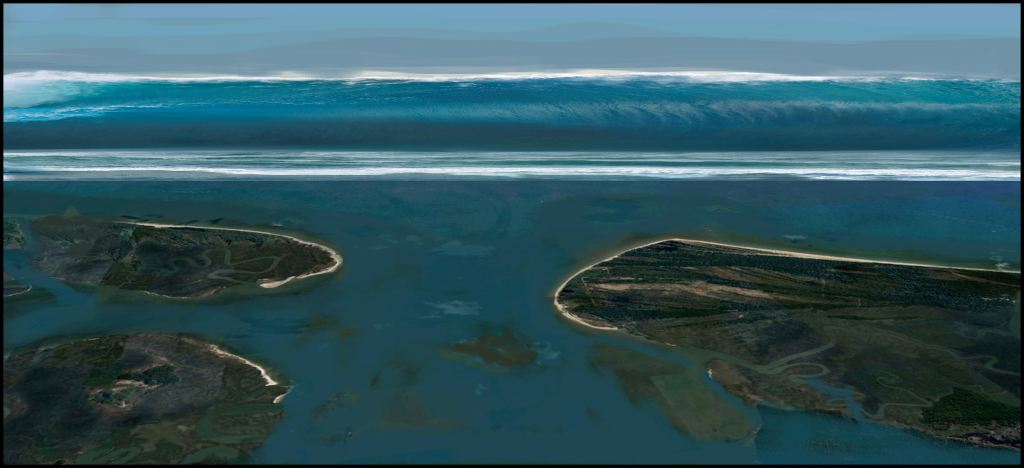
The 536 AD Tsunami about to sweep over Sapelo and St. Simons Island, Georgia
Solving a puzzle from the past
Since the 1960s, archaeologists have been aware that Swift Creek villages in Southeast Georgia were suddenly abandoned in the mid-500s AD Elsewhere in the Southeast, the Swift Creek culture went into decline. They moved to the Northeast Georgia Mountains and later into the Hiwassee River Valley of western North Carolina, where some villages survived until around 1000 AD.
When a large meteor, asteroid or comet strikes the ocean, intense heat and mechanical energy, plus several gases are released into the atmosphere. These gases are trapped in the Arctic and Antarctic ice caps. Volcanic eruptions also leave several chemical traces in the ice caps . . . but they are different, primarily sulfates. There were enormous ammonia spikes in 539 AD and 1014 AD trapped in the ice packs of Greenland, northern Canada, the Andes Mountains and Antarctica. Volcanoes do not emit ammonia.
In 2009, Dr. Dallas Abbot of Columbia University found nodules associated with a major asteroid or comet strike at the “500s AD level” of the Greenland Ice Shelf. She insisted that either a comet or asteroid played a role in the climatic catastrophe of the Sixth century, since volcanoes do not emit ammonia.
Abbot also found nodules in the Caribbean Basin. The concentration increased the closer one came to the Florida Coast. She eventually zeroed in on an impact location just off the coast of Cape Canaveral.
Very soon thereafter, archaeologists in Mexico, plus professors at the University of Texas-Austin and Tulane University accepted Abbott’s discovery as a major factor in the temporary collapse of the Maya Civilization in the Yucatan Peninsula between c. 536 AD and 600 AD. There were also major volcanic eruptions in Mexico and Central America at that time.
In 2010, a Greek archaeologist, Dr. Amand Laoupi, reinforced Abbot’s theories by revealing a second ammonia spike in the Arctic ice shelf in 536 AD. The spike was clearly unrelated to Icelandic volcanic activity. A comet or possibly an asteroid struck the Atlantic Ocean near Florida, which extinguished all life for hundreds of miles away.
The published academic papers of Dallas Abbott and her research associates from around the world, never mention the mass-disappearance of Native American towns in Southeast Georgia. Even though the greatest destruction from the comet impact would have been in northeast Florida and much of eastern Georgia, academicians in those states apparently either did not know about her discovery and else, didn’t “get the connection.”
Finally reading the little black book
Long-time subscribers may recall that in 2020, I read the daily journal that I kept in Mexico during the fellowship . . . for the first time! Two entries really caught my eye. My guide in Campeche, Ana Rojas, told me that the “real” Mayas never lived near the ocean. The region within about 25 miles of the Gulf Coast was occupied by sea peoples, who had apparently migrated from South America to Mexico. Over time, their original language borrowed some Maya words, but their cultural traditions stayed distinct and much of their living often came from transporting goods around Mesoamerica, not farming.
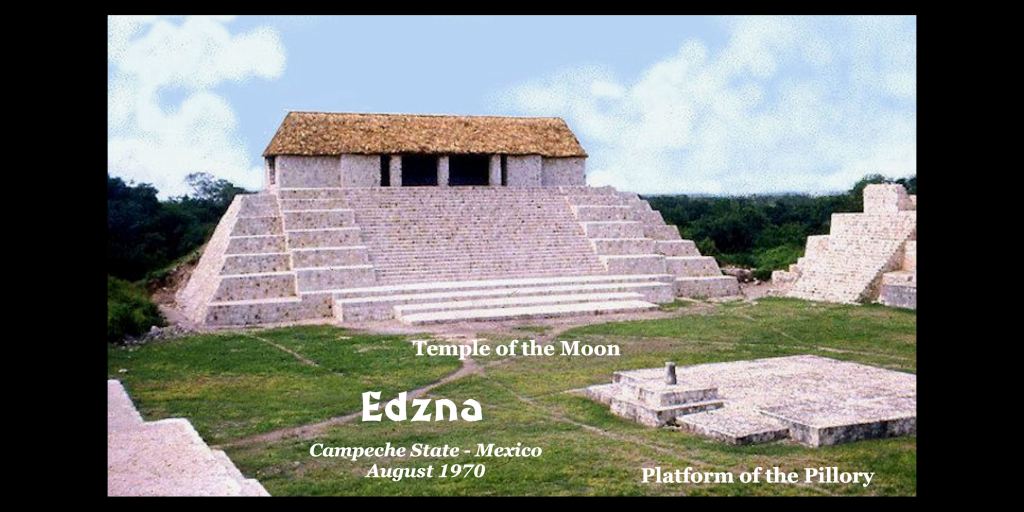
Then was the archaeologist at Edzna. That’s the Hispanic name of the town. Its real name was Itzanoa, which is also the real name of the large town in Kansas. Etzanoa. It astound me that North American archaeologists still refuse to admit that large numbers of Itza, Chontal and Tamali Mayas immigrated into North America.
At the very time that Ana and I were visiting Edza, the INAH had discovered that about 50% of the population of Campeche had disappeared around 550 AD. There was no sign of mass deaths or a war. Mexican archaeologists knew that they had not immigrated into other parts of Mesoamerica. They didn’t know where they went.
There was no mass migration out of Campeche during the period from 800 AD and 1000 AD when the Lowland Maya city-states collapsed. In fact, most of the Campeche Maya cities and villages remained occupied until a catastrophic smallpox epidemic struck that region in the early 1500s.

Important maritime skills of the Chontal Mayas
The Chontal Mayas were the only Pre-Columbian peoples, who built sea-going vessels from wooden planks. They also were probably the only peoples, who constructed large sea-going sail craft. In fact, their sailboats were very similar in design and construction to Scandinavian Longboats. Their sailboats and larger freight canoes were quite capable of crossing the Gulf of Mexico or reaching any island in the Caribbean Sea. I have found several Archaic Swedish words in the Chontal vocabulary/ The most significant of these loan words was “mekko,” who was the king of a town or small province. The word has the same meaning in Muskogee-Creek.

Eastwood Village Site in the Nacoochee Valley of Georgia – c. 600 AD – 1000 AD
Instant information from an AI computer
I have trained my new AI computer to look first for archaeological reports, references and books published online in Mexico when asked about a tribe or archaeological site in Mexico. It often provides very different information than what Gringo archaeologists have posted in the USA version of Wikipedia.
The computer was asked two questions: (1) What style houses did the Chontal Mayas build in Pre-Columbian times.?(2) What style temples did the Chontal Mayas build?
(1) Most Chontal Mayas lived in oval houses. Some houses of their leaders and temples had parallel front and rear sides with round ends.
(2) The Chontal Mayas only constructed earthen pyramids, Most were approximately square, low platforms for their modest temples. (In other words . . . identical to the Eastwood Village Site.
You go figure . . .

Dr. Robert Wauchope from Columbia, SC first became nationally known as a result of his dissertation on Maya houses for Harvard University, He spent considerable time in southern Mexico, dong the research for this subject, The book published from his dissertation is outstanding. In contains professional quality architectural drawings. I carried his book in my backpack when I was on the fellowship in Mexico.
The Eastwood Village on the Chattahoochee River in the Nacoochee Valley of Georgia was the first entire community site that Wauchope excavated after graduating from Harvard and publishing his book. He did not begin writing his book on his 1939 archaeological work in North Georgia until the early 1960s. By that time he had been working on Maya archaeological sites in Mexico and Guatemala for over 15 years.
Wauchope noted in An Archaeological Survey of Northern Georgia that the Eastwood Site’s architecture and site plan were starkly different than anything in the Southeast before it. Yet, it never dawned on hip that this village could have been occupied by Maya immigrations.
Now you know!
 The Americas Revealed
Hi Richard,
At the beginning of the article you say that the Chontal Maya were following the path of the 536 AD comet. Please elaborate on this.
Do you mean that they were trying to get to the impact site of the comet, perhaps to gather rare metals? Or did they want to settle there, like in the Natcoochee Valley where you found the meteor impact site at the Sky Serpant? But this impact site was in the water, how could they benefit from it?
Thanks,
Starfire
LikeLiked by 1 person
Hey Mary Starfire Kelly!
The Sky Serpent or Serpents were worshipped as a god or gods by the Chontal and Itza Mayas. So when an asteroid or comet struck Earth, they would believe that it was a place where their god or gods had come to Earth. The Nacoochee Sky Serpent aligns perfectly with the 536 AD comet impact off the coast of Florida. Very likely a piece of the comet broke off and exploded in the vicinity of the Nacoochee Valley. There was a fuge swarm of asteroids that struck eastern North America and the North Atlantic Ocean in 1014 AD, causing lethal tsunamis on both sides of the Atlantic. It was probably these impacts that attracted the Itza Mayas to migrate northward into what is now northern Georgia and western North Carolina. Large serpent effigy mounds were also built near Lake Okeechobee and eastern Ohio.
LikeLiked by 1 person
So the Natcoochi Sky Serpant aligns with the 536 AD comet. I’m unclear whether you mean that the Natcoochi Valley was settled soon after the 536 AD impact and the Sky Serpant was built by those settlers,
OR
That, later, the Itza Maya migrated following the 1014 AD impact and built the Sky Serpant with an alignment towards the earlier impact?
When did the Panoams migrate from Peru? Were they the ones who built the Sky Serpent soon after the 536 AD impact? If yes, it would place them in the right location to be the roots of the Kingdom of Apalache.
I live in Cleveland, Ohio, so I know about the Snake Mound. I have not been there to see it, though. I always thought that the mound had been constructed by the descendants of the Hopi tribes. Their origin myth states they were sheltered underground by Ant People, breathing through reed straws, during one of the destructions of the world. When it was safe for them to come up, they had an assignment to fulfill. The various clans that made up the tribes were told to split into four groups and travel to the farthest edges of the land and claim it. They were to go north, south, east and west, then return to Hopi Land to await the return of the Feathered Serpant.
I had always thought that effigy mounds such as the Ohio Snake Mound were the claim marks of each clan. That the Snake Clan had made the Snake Mound. That somewhere are marks of the other clans: Turtle, Mouse, etc. I read ‘The Book of the Hopi’ about 40 years ago, but can’t find my copy right now so forgive any mistakes.
But now I think you are correct that the snake/serpent mounds are marking meteor strikes. I’m going to elaborate in a new message because this is getting long.
Starfire
LikeLike
I am not sure about the Panoans. Most likely their arrival was associated with the appearance of Swift Creek pottery – since it is almost identical to the motifs of several Panoan tribes in Peru. The most likely candidate for the Spiral Serpent mound are the Chontal Mayas, because there was a large Chontal town at the foot of it. The problem I have is that I am now so far ahead of the academicians in the Southeast that they don’t have a clue what I am talking about. They don’t know who the Panoans/ Chontal and Itza Mayas are. . . . whereas I use published dictionaries for these peoples.
LikeLiked by 1 person
I just re-read the article and you did make it clear about the migrations. Chontal after the first impact and Itza after the second impact.
Last year I watched all the episodes the Discovery TV series of ‘Mystery At Blind Frog Ranch’. It ended up being an unexpected treasure trove of knowledge for Native researchers. A family of gold hunters have a piece of land in Utah and they have some pretty strong indicators that Montezuma’s Aztec treasure is hidden there. It may even be the location of the Aztec homeland Aztlan and the Place of the Seven Caves, where they lived before going south and conquering what is now Mexico.
The relevant part to this article is the idea of Natives building on meteor craters. A few seasons into the show, they are trying to understand some pockets of radiation on the Ranch. Testing reveals that the site is inside a meteor crater! Their geologist talks to an expert who takes him to the Ohio Snake Mound and shows him that it is also on a meteor crater!
LikeLike