It all started in 1970, when a foolish, young architecture student from Georgia Tech had a gun pointed at his head on top of the mountain overlooking Teotihuacan.
Pottery, large scale architecture and mounds were in Georgia and South Carolina long before they appeared in Mexico. The indigenous peoples of southern Mexico even have an oral tradition of colonists arriving in large flotillas from across the Gulf of Mexico to introduce “civilization,” around 1200-1000 BC.
However, the farmers of Tabasco State, Mexico . . . by that time . . . had become some of the most skilled agronomists in the world. The crops that they developed, along with those of the Andean region of South America now feed the world. The ability to produce an abundance of food year-round enabled Mesoamericans to quickly eclipse most of the accomplishments of those in southeastern North America.
by Richard L. Thornton, Architect & City Planner
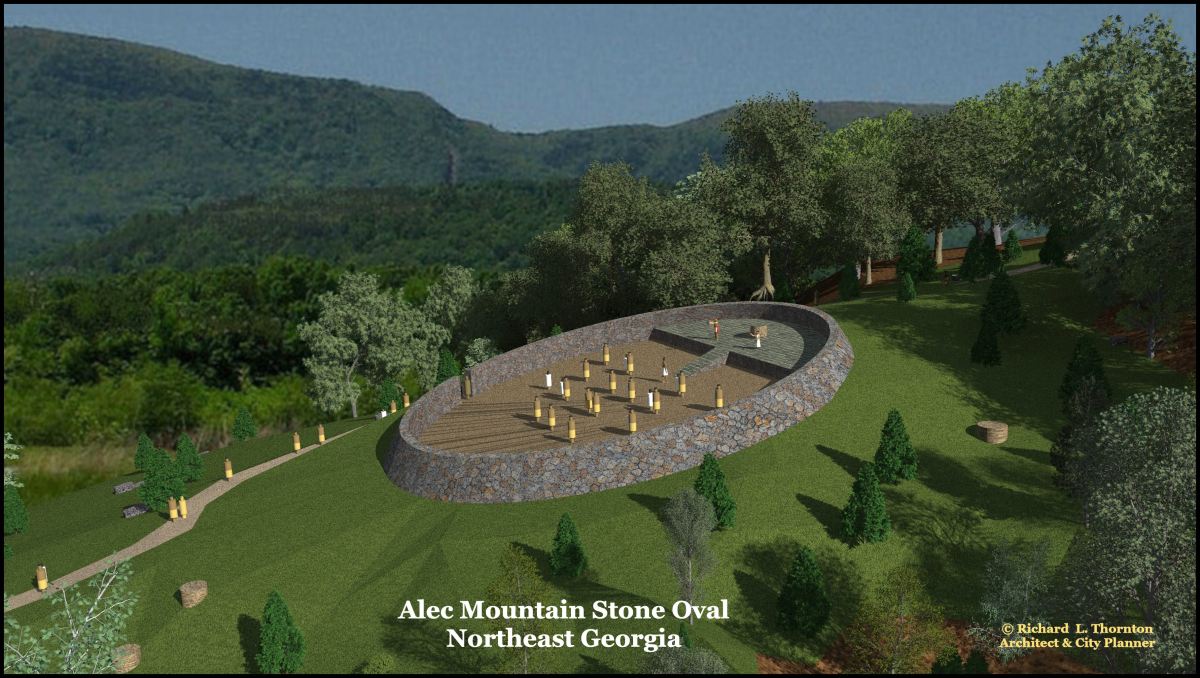
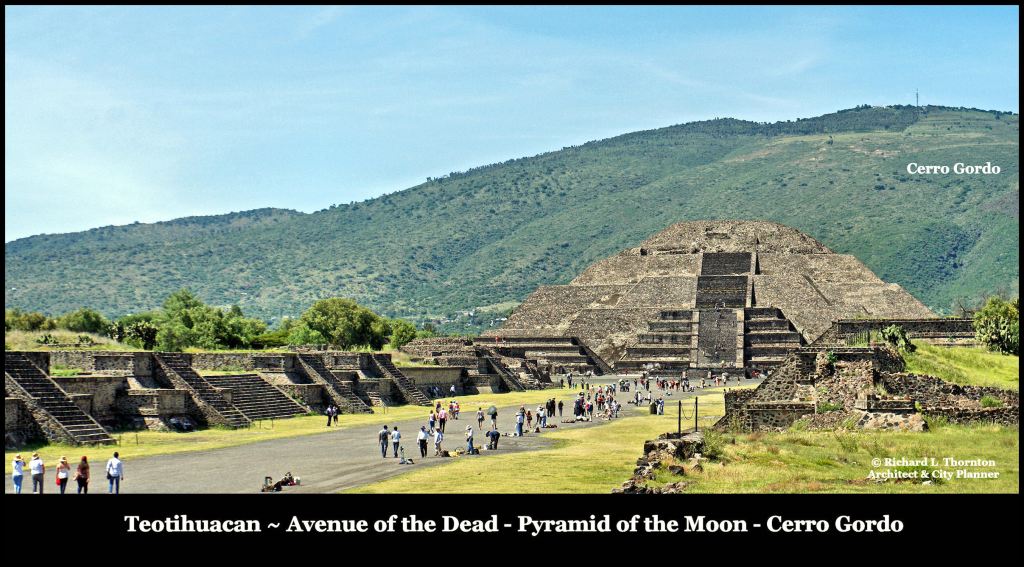
Image Above: This is the appearance of the Alec Mountain Stone Oval around 5,000 years ago. It is located one mile east of my house and at the same elevation. No significant stone structures would appear in Mesoamerica until around 200 BC. Immediately east of Alec Mountain is a mountaintop stone fortress stretching about 1200 feet from northwest to to southeast. Some of the boulders dwarf the stones at Stonehenge. This site is completely unknown to Georgia archaeologists, but I found it with LIDAR. The only thing that I have found in Mexico that compares to it is on southern cress of 10,000 feet tall Cerro Gordo, over-looking and seemingly predating Teotihuacan.
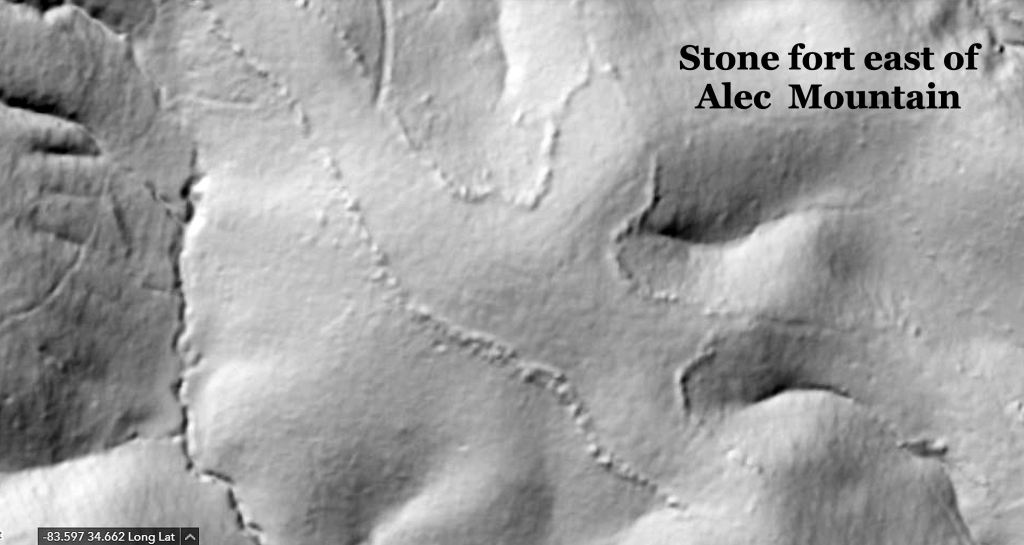
LIDAR image of a massive stone fortification in NW Habersham County, GA
When was first contact made between Mexico and the Southeast?
The videos on my People of One Fire YouTube Channel frequently receive interesting comments and questions from people around the world. One of the most interesting was posted in 2025 by an electronics engineer, who as a student of the Politecnico Nacional (Mexico’s equivalent of Georgia Tech) had interned one summer at a Mexican Air Force radar facility on top of Cerro Gordo.
He had just watched my videos on Teotihuacan and was astonished. He said that there was what we call an “urban legend” that at sometime back in the 20th century a Gringo architecture student had appeared out of nowhere at the door of the main building, begging for water. He claimed that he had discovered ancient stone ruins on the mountain, older than Teotihuacan. He also claimed to have climbed up the mountain. which no one had done before. He would have been arrested by the Mexican Army for espionage and trespassing on government facilities, had not he been wearing a Instituto Nacional de Antropologia E Historia (INAH) photo ID tag.
While the architecture student was gulping down an entire pot of grape Koolaid, the manager called the National Museum and eventually reached Dr. Piña Chan, who never stopped laughing on the phone. Dr. Piña Chan told them that no Mexican archaeologist had ever thought of climbing Cerro Gordo. “Despite being young, this intruder was a very important person in the Estados Unidos, a friend of the Mexican Consul in Atlanta and an official guest of Relaciones Culturales. Don’t arrest him! ”
The viewer on Youtube quickly realized that this fairytale from the 55 years ago really happened. However, he still couldn’t believe that I climbed up the mountain on foot.
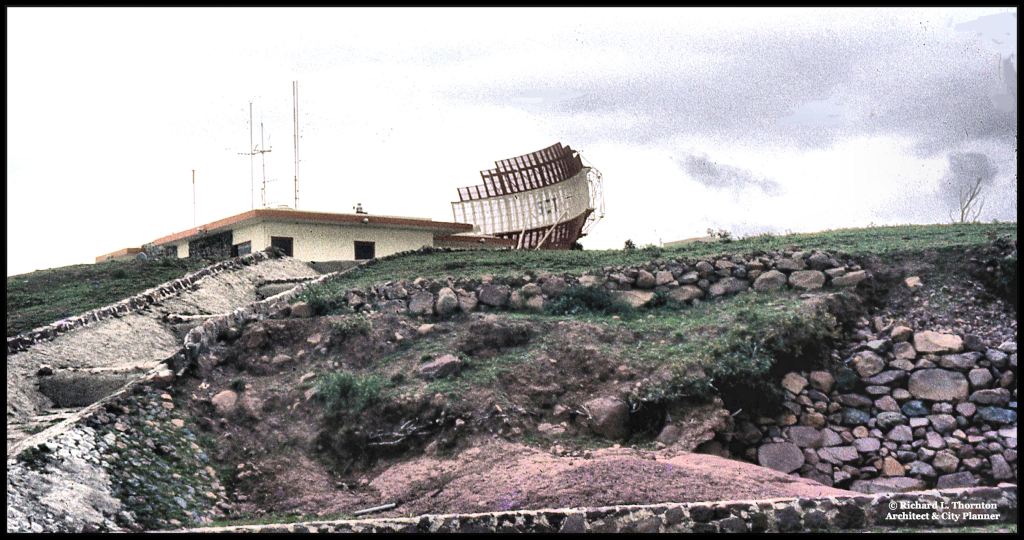
The radar station was built on the ruins of an ancient city, which is unknown to the general public.
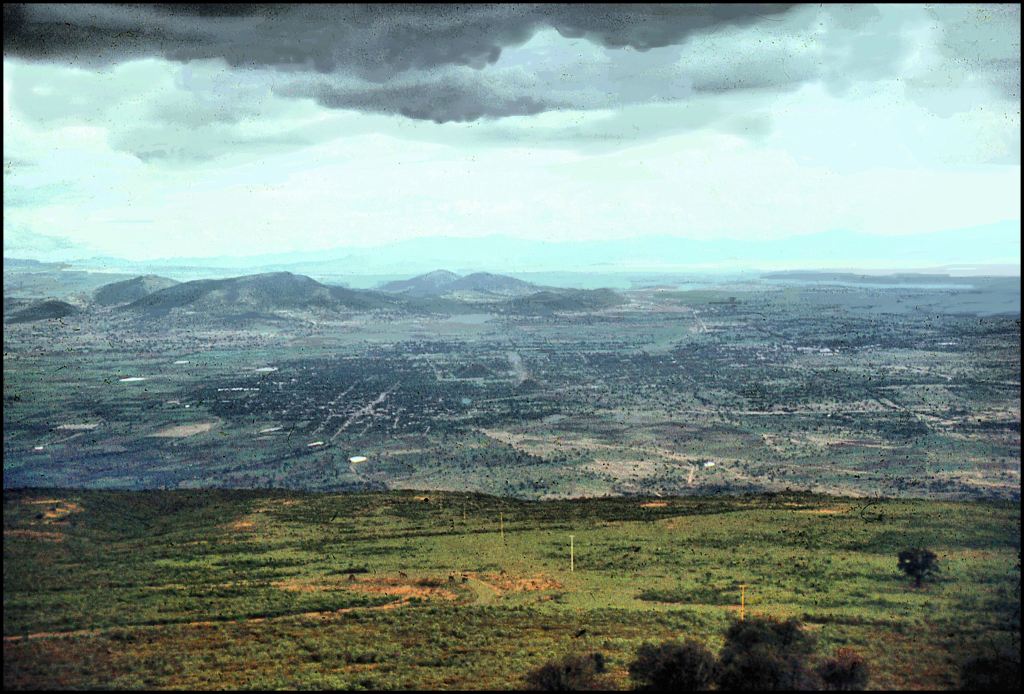
View of Teotihuacan (center of image) from the edge of the Mexican government radar station. A few seconds after this color slide was made, a lightning bolt came down from the storm clouds at the top of the image. I ignored the “Prohibido el paso” signs and raced to the door of the main building to seek shelter and water.
I wrote back . . . yes, it is a true story . . . but I was just a wet-behind-the-ear mixed-blood Creek student from a middle class family. Georgia Tech awarded me a huge fellowship for the first time, but no one at the architecture school was quite sure how to manage it. In the mean time, the Mexican Consul was an architecture graduate from Georgia Tech. He took control of setting up the details and arrangements. The beginning of my fellowship coincided with the first direct flights between Atlanta and Mexico City. The Consul was able to “open many doors” for me in Mexico, because of that. .
It must be said that both Mexican government officials and the Mexican People showed me extraordinary hospitality . . . especially in Mexico City, Tabasco, Campeche, Chiapas and Yucatan. The Soto family treated my the son, they never had. In many towns, families invited “El Gringo Simpatico{ into their home for dinner. That would never happen today in the Estados Unidos. I have been living in Habersham County, GA for almost eight years and never been invited by anyone to enter their home . . . much less dine with them.
Sra. Soto was very worried about me. I never got drunk or went to brothels like most young Mexican men of that era. She pulled a dirty trick on me for my 21st birthday party, however. While most of the Mexican guests drank hard liquor or strong cocktails, she made a special tropical fruit punch for my Mexico City girlfriend, Alicia, and I . . . plus the teenagers 16 and older. Alicia and I could barely taste the grain alcohol in the delicious beverage. Before we knew it, we were stone drunk and totally uninhibited. Both of us were terribly embarrassed, when we woke up on the couch together about 8:30 that evening. LOL
An affluent family in Campeche treated me like a son-in-law in every sense of the word. The Maya Site Manager at the Labna Archaeological Zone drew from her meager salary to put on a traditional Maya wedding feast for the Campeche family’s 21-year-old daughter and I because, she thought we were newlyweds on our honeymoon. We were staying in a Maya hut near the ruins. (We reimbursed her!)
A hotel maid in Merida, Yucatan repeatedly begged me to run off with her 16-year-old daughter (She was beautiful and looked 18, but even if I was foolish enough to get involved in such a thing, she couldn’t have entered the USA.)
Then there was the owner of a modest inn at the Tres Zapotes archaeological zone in the southern tip of Veracruz State. He thrust 400 pesos into my hands, trying to persuade me to rent his 18-year-old daughter at a local brothel ! (I freaked out and refused the offer.)
Well, let’s just say that if I was your president, we would be treating our neighbors to the south and north very differently. We need “real” middle class people running our government, not arrogant oligarchs, out of touch with humanity.
The urban legen left out the part about a pistol being pointed at my head, when the security officer first opened the door of the radar facility. However, when the manager came back from his office, the gun was holstered and all the staff members were very hospitable to me. They gave me a lunch of ham & cheese sandwiches, tortillas with sour cream, a banana and a tangerine. Yes, I was THAT hungry and thirsty. Despite being an Eagle Scout, I had foolishly climbed the mountain without a canteen or snacks.
From this comment, I finally learned why Dr. Piña Chan called the Soto Residence in Colonia Nueva Santa Maria (where I was based in Mexico City) to tell the Soto’s to tell me that the museum would pay for the development of my Teotihuacan slides in return for being allowed to utilize copies. I was on top of the mountain, when he made the call.
The Mexican engineer wrote back with a question . . . when was first contact made between Mexico and North America? It’s a good question and you will be surprised. My research over the past 23 years has taken me far beyond what Gringos are taught in university anthropology classes.
From Tortillaland to Dixieland
Primitive maize pollen – Evidence of limited cultivation of a primitive strain of maize has been found in lake near the Gulf Coast of Alabama (1200 BC) and near Lake Okeechobee (800 BC). They are explained as being brought back by traders from North America to the coastal regions of the Southeast. Being tropical seeds, they were of little use farther inland.
The corn grown my Native Americans in the Eastern United States has been genetically determined to have been from a much later strain, developed in more temperate climates of the Andean Foothills in South America. A claimed discovery of very primitive maize pollen near Fort Center, Florida, dating from 2400 BC, has recently been discredited as being the pollen of a wild grass, closely related to the wild ancestor of maize in Mexico.
Earliest Mesoamerican architecture (c. 550 AD – 600 AD)
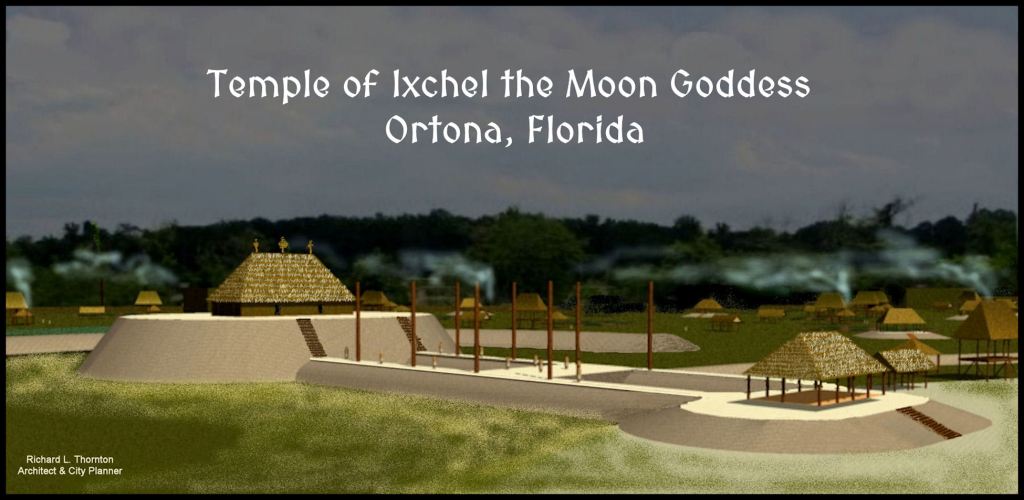
This temple complex was constructed within an earthen crescent – a typical feature of Chontal Maya architecture. Crescent-shaped earthworks or stoneworks have been found in several parts of Georgia and Alabama.
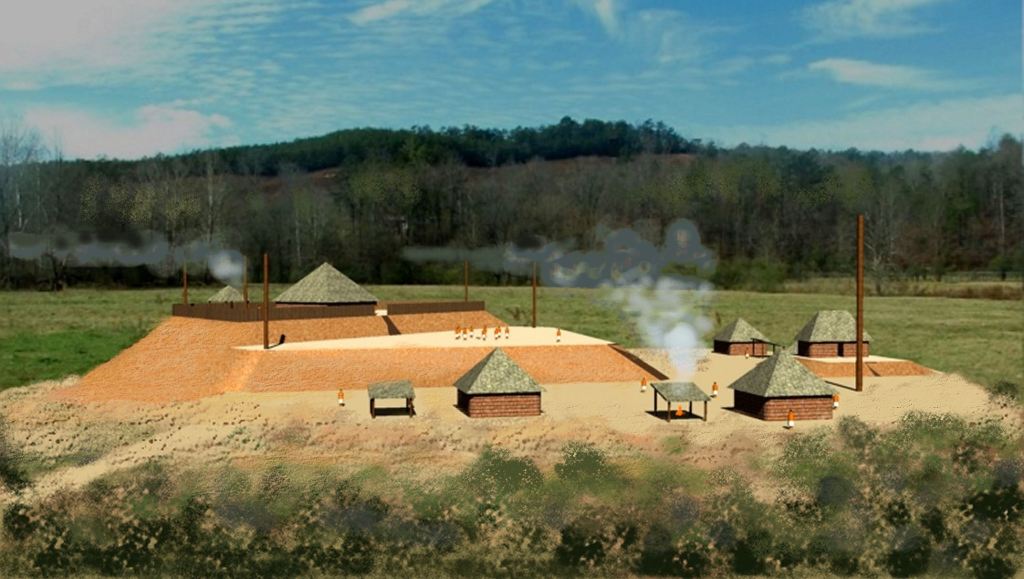
Five-sided pyramids were only built by the Creeks, Itza Mayas and Kekchi Mayas – with the exception of one of the last mounds built at Cahokia. This hilltop mound is about two miles from my house and on the surface contains potsherds dating from around 600-700 AD.
From Dixieland to Tortillaland
The Savannah River Uchee have a tradition that they were formerly the consummate traders of the Americas and that their boats covered the Caribbean Basin and the Gulf Coast of North America and Mexico, In 2025, Dr. Donald Yates of DNA Consultants, Inc, found genetic proof that the Savannah River Uchees were descended from Austronesian Mariners, not AmerIndians from Siberia. One Uchee tribe in Georgia, the Wassaw had a Samoan name and strongly resembled the famous Olmec heads in southern Mexico.
Mounds: Two of the oldest burial mounds in the world can be found on the LSU campus in Baton Rouge. They initial construction dates are around 11,000 BP. The Bilbo Mound in Savannah dates from 3545 BC, but it also includes a man-made harbor and canal . . . which makes it the oldest known civil engineering works in the Americas. Watsons Brake circular earthwork in northern Louisiana dates from around 3450 BC. Both Georgia and South Carolina contain many earthen or shell mounds that are over 4,000 years old.
The oldest known mounds in Mexico date from around 1000-900 BC and have been traditionally remembered as being built by colonists, who arrived via canoe.
Pottery: The oldest known pottery in the Americas (c. 2500 BC) , outside a certain section of the Amazon Basin, can be found in the Savannah, Altamaha, Ocmulgee and Oconee River Basins in Georgia, plus here in the Nacoochee Valley. The earliest pottery in southern Mexico dates from around 1000-900 BC)
Shell and Stone Rings: The oldest shell rings in the world are found on the southern islands of Japan and date from around 24,000 years BP. The oldest shell rings in the Americas are found on the Georgia and South Carolina Coasts and date from 3,000-1800 BC Florida has some shell rings that are slightly younger. Shell rings are rare along Mexico’s Gulf Coast, but seem to date from around 1000-800 BC.
Mountain top and hill top Stone Circles were formerly endemic in northern Georgia and still so in several counties within the Gold Belt. They appear to date from around 3,500 BC to 1000 AD. They are rare in Mexico, but I found one in the Teotihuacan Valley. Dr. Piña Chan told me that this particular stone circle was constructed by a people, who predated the builders of Teotihuacan. My daily journal does not mention the date of its construction.
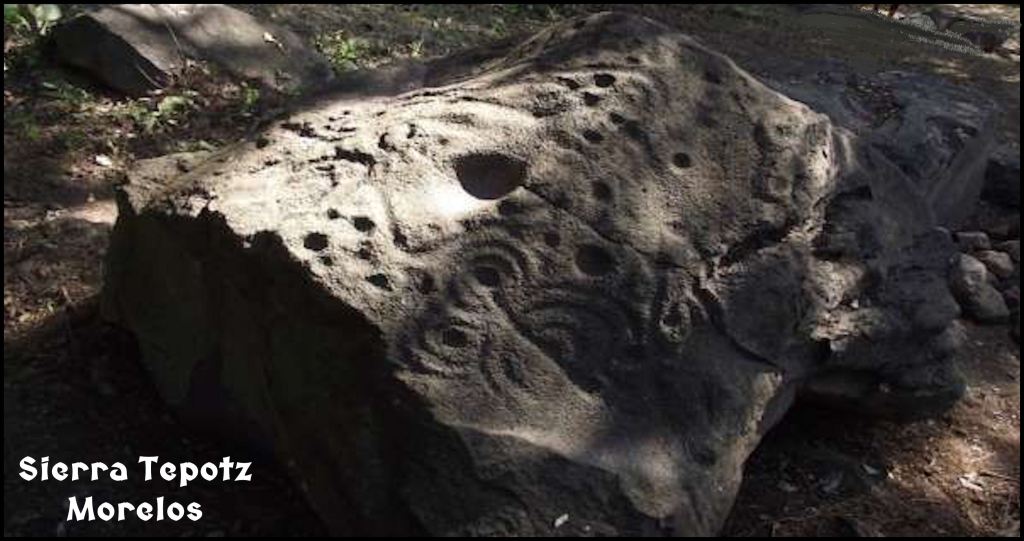
These are petroglyphic boulders in the Copper Mountains, east of Tepoztlán, Morelos, which are almost identical to boulders found in the Etowah River Valley in the North-Central Georgia Mountains.
 The Americas Revealed