
A violent volcanic explosion around 1700 in the Nacoochee Valley caused the relocation of the Creek Indian capital to near Ocmulgee Mounds, while most Creeks moved farther south . . leaving its large towns and mounds uninhabited, when Savannah was founded 33 years later. Mixed blood European-Jewish-Creek gold miners were more inclined to remain, but some also moved southward.
Chimney Mountain, seen above, continued to emit smoke until the 1886 Charleston Earthquake. During 2018 and 2019, hot gases killed most of the vegetation on the top of Chimney Mountain. The fumes were only visible when the air was still, cool and had high humidity.
During the period leading up to the Charleston Earthquake, Buzzard’s Roost Mountain in North Georgia belched flames, lightning and large boulders so violently that the display caught the attention of the New York Times. A new volcano also appeared on the slope of a peak in the Pisgah Mountains, west of Asheville, NC. In between the Nacoochee Valley and the Pisgah Mountains, massive cracks appeared on mountainsides. People were wondering if the End of Times had arrived.
by Richard L. Thornton, Architect and City Planner
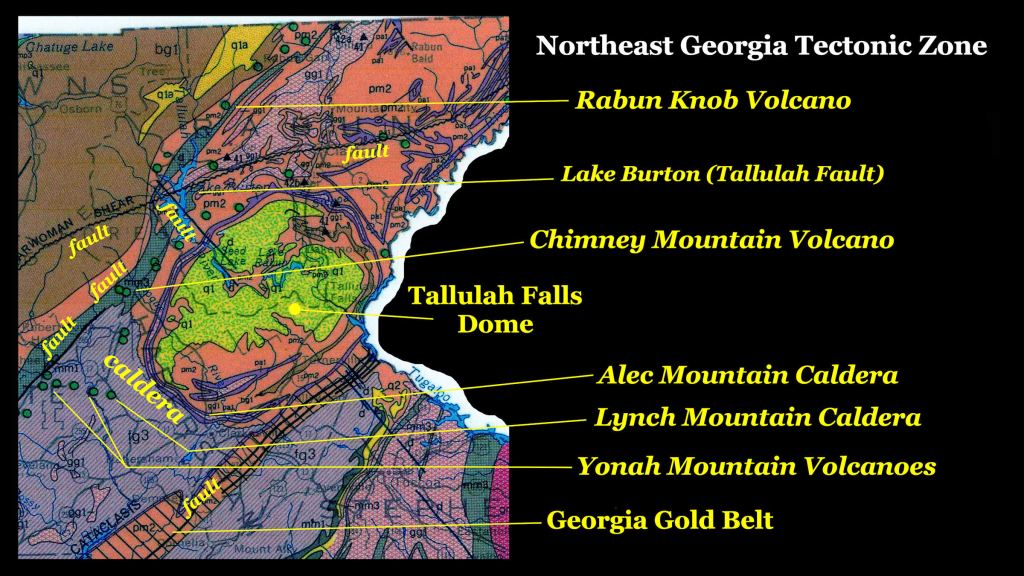
The 11-mile wide Tallulah Falls Dome is a giant caldera is the same sense as the Yellowstone Dome Caldera, but probably extinct. We really don’t know because no one has ever examined the magma chamber beneath the dome. Note that Chimney Mountain is one of 4 volcanoes clustered togeher.
Mention this information to almost all the geology professors in the Southeast today and they will either offer a blank face or an incredulous grin. The few that even know that Georgia contains a tectonic zone will laugh and say that yes, Georgia had volcanoes 230 million years ago, but Stone Mountains is about all that’s left of them.
Actually, there is a line of much younger volcanic cones crossing the state from Curahee Mountain on the east to Buzzard Roost near the Alabama line. There are dozens of these cones, but most have been extinct for a long time. The Nacoochee Valley was created by two lines of volcanic cones that look like volcanoes. At least three, maybe more, are active gas volcanoes, which have erupted super-heated gases and boulders in the past three hundred years.
At least one cone near me IS a full-fledged volcano. There are young lava bombs, consisting of either black scoria, brown scoria or white pumice in the topsoil of my property. Underneath the topsoil in many locations are beds of golden volcanic sand (ash). Such things can only be created by a real, recent and CLOSE lava volcano.
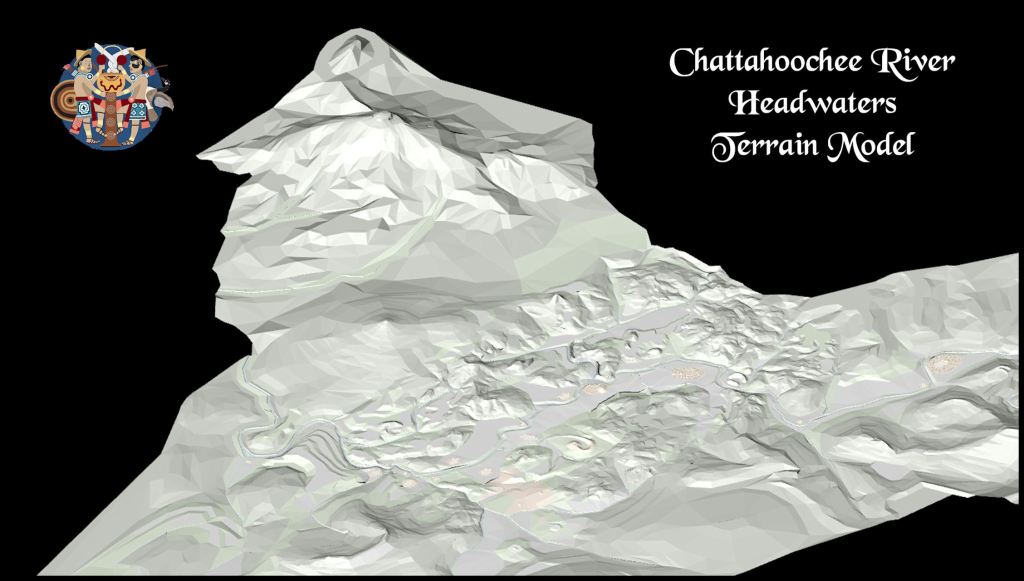
3D Lidar model of the Nacoochee Valley – Note the many cone or dome-shaped volcanoes
That I knew that there were volcanoes in them thar hills . . . in addition to gold . . . before I moved to this tectonic zone, you can thank Dr. Aure Lius Sydney Furcron. He was my geology professor at Georgia Tech and the state geologist. My anthropology professor was Dr. Lewis Larson, who unearthed Mound C and the famous marble statues. My favorite English professor was James Dickey, who wrote “Deliverance” while at Tech. I was fortunate enough to be at the tail end of era when the major universities in Georgia hired outstanding professionals in Georgia to teach their students.
Maybe that policy would have been fine for the geological and anthropological heritage for Iowa, New Hampshire and Delaware. Georgia contains about every geological formation that one could have in North America. Soon thereafter, the public universities began intentionally hiring professors from other parts of the nation and world.
When I first encountered lava bombs in my soil, I called geology professors at Georgia Tech, the University of Georgia and Georgia State University. All were from other parts of the United States. All three stated that they knew very little about the geology of Georgia and were unaware that Georgia had ever contained volcanoes. They were only vaguely aware that there was gold in Georgia, but didn’t know about its geological context. Say what?
A catastrophic event left out of the history books
The famous Archaeologist Robert Wauchope (1909-1979) described the Nacoochee Valley as the largest, longest occupied and most densely occupied archaeological zone in North America. He worked there throughout most of 1939. After being discharged from the US Army at the end of World War II, he was a professor at Tulane University for the rest of his life.
I met Dr. Wauchope at a Chontal Maya site on the coast of Campeche, when he was 61 and at the peak of his career. I joined his team for lunch. Neither he nor any of the other archaeologists mentioned that his first archaeological digs were in Georgia and that he was the first person to teach anthropology at the University of Georgia . . . even though he knew that was a Georgia Tech student and from Atlanta.
Wauchope remained puzzled for the rest of his career by one strange discovery in the Nacoochee Valley. The same strata were found wherever he dug in the flood plains of the Chattahoochee River and Dukes Creek.
- The upper level of the top soil contained the typical manufactured detritus of farm lands everywhere in the eastern United States.
- The next level contained the American-manufactured detritus, associated with gold mining in the early 1800s.
- The next level contained the scattered detritus of artifacts typical of thinly populated regions of the Southeastern frontier in the 1700s. The oldest artifact seemed to date from the first decade of the 18th century. He found no Cherokee artifacts, no Native American artifacts . . . even though historians then claimed that the Cherokees lived their until 1822. In fact, Wauchope never found a single Cherokee village or Cherokee artifact anywhere in Northeast Georgia.
- The next level was from five to fifteen feet of “sterile sand,” which had been deposited by a single catastrophic natural event. He described the sand as being sterile, because there was no evidence of human occupation. He did find a total of 35 Clovis points and numerous mastodon teeth, which had been washed downstream by floodwaters.
- Wauchope never developed a solid explanation for the massive flood. He learned that until the early 1800s the Georgia Mountains had deep snow accumulations in the wintertime. He theorized that “something” created an enormous heat wave that instantly melted the snow. One possibility was a comet or asteroid, but the Colony of South Carolina had no record of a heavenly object striking the earth around the year 1700.
- Beneath the sand strata was a very dense occupation of people utilizing Creek, Spanish and French artifacts. The deeper he dug, the higher percentage of Native American artifacts. The European objects ended at the level of the late 1500s. All Native American artifacts from 1700 AD down to the Ice Age were very similar to those unearthed a few years earlier at Ocmulgee Mounds.Wauchope concluded that Creek civilization developed concurrently at Ocmulgee and in the Nacoochee Valley.
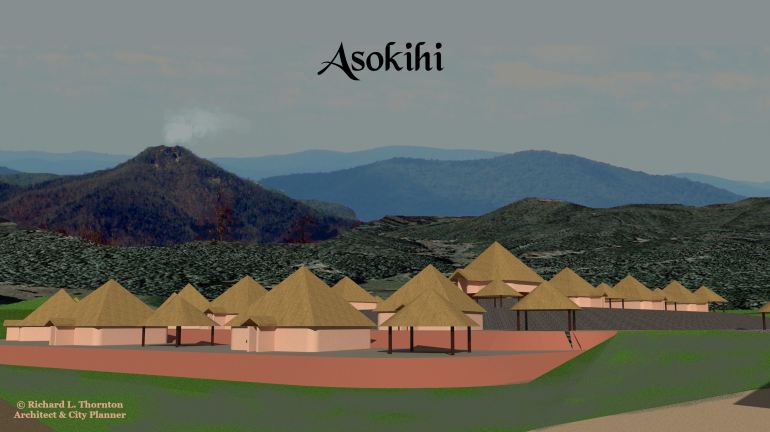
Even though the capital of the Sokee Nation was built near Chimney Mountain, it is shown on the maps until after the American Revolution when most of the Sokee moved to either East Central Alabama or Florida. This would not seem probable, if Chimney Mountain had erupted in 1700. Nevertheless, the official state geological maps show three more volcanoes north of Chimney Moundtain.
During the past few years, I have occasionally come across very vague references to a mountaintop that overlooking the Nacoochee Valley. In 1800, it exploded then sending a fireball rolling down the slopes, which burned many thatch-roofed houses. The firestorm was then followed by a catastrophic flood, which killed many people. This suggests that the secret volcano is probably in the vicinity of Helen, GA or even farther upstream near Robertstown.
Supposedly, survivors fled the valley with only the possessions that they could carry in their hands. The resettled in central /Georgia and the Chattahoochee River Valley.
The mountains are tall and very rugged in that section overlooking Helen, but there is no peak that resembles a volcano today. The question of what caused the burning and flooding in the Upper Chattahoochee River Valley around 1700 AD must remain an unsolved mystery.
 The Americas Revealed