The 539 AD Comet Impact off the coast of Florida was a regional extinction event that aligned perfectly with the Sky Serpent Effigy in the Nacoochee Valley of Georgia and the Hopewell Culture Earthworks in Ohio.
Since the Late Triassic Period, the South Atlantic Coast has been in a constant state of flux. It has probably changed more rapidly and dramatically than any other part of the Americas. These changes can be seen on the USGS LIDAR maps.
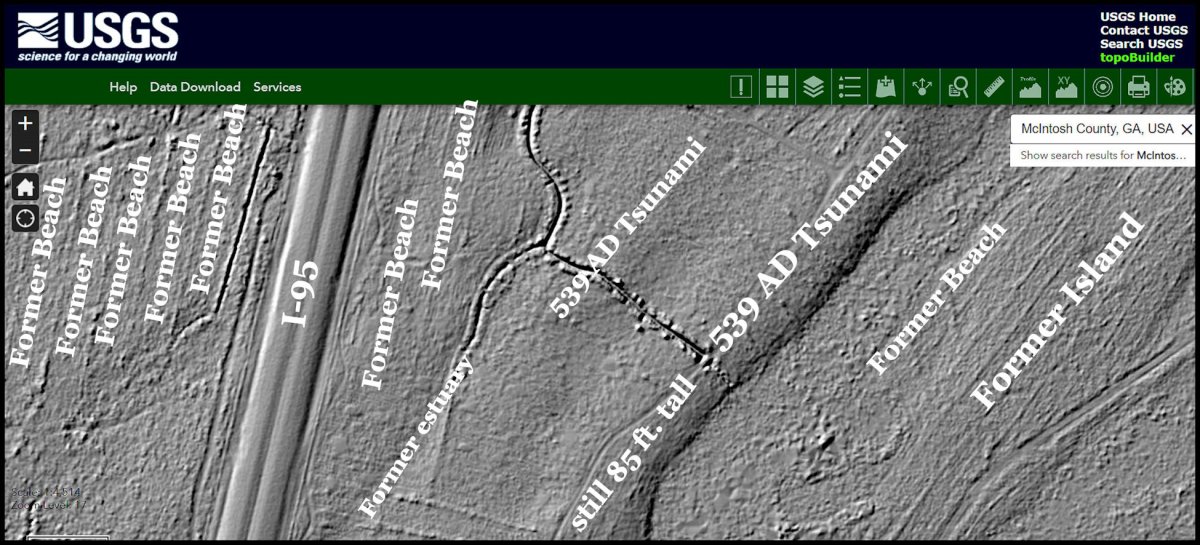
While South Florida and the Carolinas show the scars of repeated strikes by mega-hurricanes, the LIDAR scan reveals that Georgia is particularly vulnerable to tsunamis. The c. 539 AD tsunami obviously killed most humans and mammals in southeastern Georgia and possibly many people farther north. A recalculation of its height makes it worthy of people’s nightmares.
The eastern part of the Southeastern United States has been repeatedly struck by large meteorites, asteroids and comets. The impact points today are tsunami residue ridges, ponds, swamps and peat bogs.
The barrier islands of Florida, Georgia and South Carolina are constantly evolving. Cape Hatteras, North Carolina is probably what’s left of a chain of islands that were repeatedly battered by hurricanes then rolled over by a tsunami from the North Atlantic in 1014 AD.
The Sea Peoples of the South Atlantic Coast series
by Richard L. Thornton, Architect and City Planner
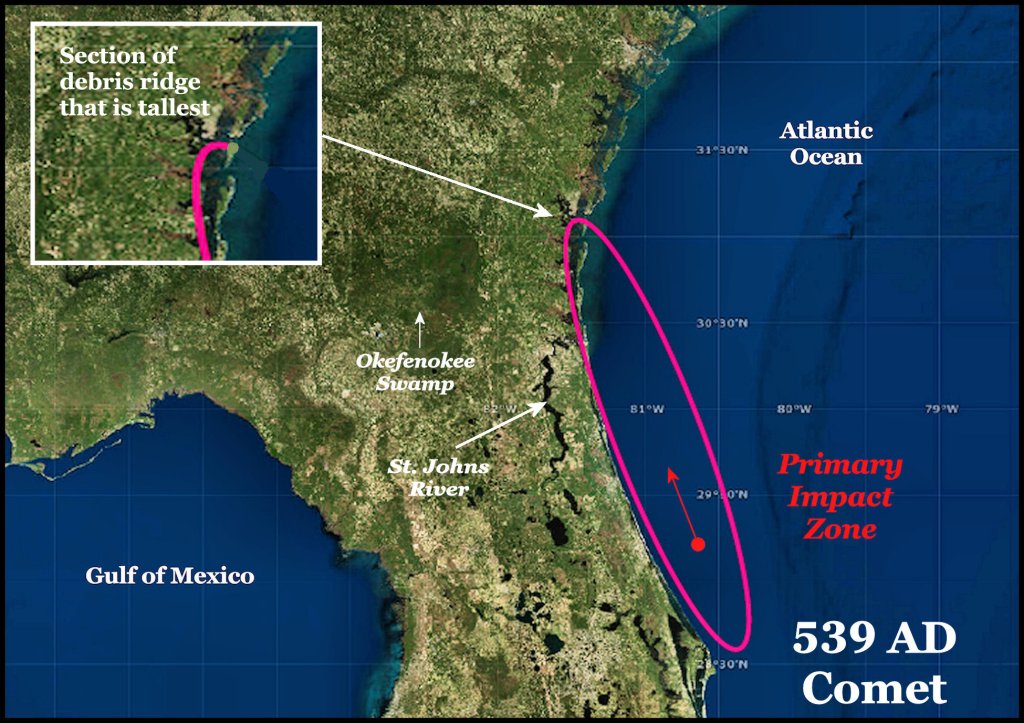
The southward shock waves from the comet’s impact obviously created Cape Canaveral.
A recalculation of the tsunami’s height
In several past articles, I have mentioned a massive comet strike off the coast of Florida, which was first discovered by Dr. Dallas Abbott in 2005. She is a geophysicist and adjunct research scientist at the Lamont–Doherty Earth Observatory of Columbia University. She made this discovery while her team was studying a tsunami that caused great loss of life in both Northwestern Europe and the Atlantic Coast of North America in 1014 AD.
At the time that she and her colleagues published their report, they were not aware that there had been a mysterious, instantaneous abandonment of all Native American villages in south-central and southeast Georgia, below the Fall Line about that time, followed by a rapid decline of the Hopewell Culture in Ohio. My new calculations make it certain that this was a regional extermination event that probably also flooded the coastal villages in South Carolina, but did not include the lethal shock and infrared waves that devastated northern Florida and eastern Georgia.
The mega-tsunamis would have been extinction events that radically altered the Pre-Columbian history of the region. Their past damage is remembered by the debris ridges that can be found on many islands and near the edge of the mainlaind. This subject is worthy of more detailed discussion.
For example, portions of the March 11, 2007 mega-tsunami on the Pacific Coast of Japan struck coastal areas almost identical to Georgia’s coast between Darien and St. Marys. The tsunami produced run-up heights up to 39.7 meters (130 feet) in Miyako, Iwate Prefecture. The debris ridge was over 33 feet (10 m) tall. That is a 1:5.9 ratio!
In my earlier articles, I utilized global averages for the relationship between the height of the debris ridge and the height of the tsunami, They were at least a 1:1 ratio, but averaged about 1: 1.5. Thus, an 85 feet tall ridge today was at least 100 feet tall in 839 AD. The wave was therefore somewhere between 100 and 150 feet tall. Well, no.
In doing research for my book on the South Atlantic Coast, I read more of the research reports from Dr. Abbott and her colleagues. A tsunami, caused by a comet or asteroid is a whole different level of monster than a tsunami created by an earthquake or landslide. Also, a comet entering the atmosphere at an obtuse angle, like the one in 539 AD, tends to behave more like the blast from an atomic cannon than a bomb dropped into the ocean.
The speed of a comet entering the Earth’s atmosphere varies depending on its type: Short-period comets typically hit at an average speed of 30 km/s (approximately 118,000 mph). Long-period comets average around 53 km/s (about 185,000 mph). In either case, the energy released into the ocean is lethal a long distance away from impact because it converts water into superheated plasma. Image plasma molecules going almost 100,000 an hour like miniature bullets.
Also, the topography of the ocean floor and the coastal area affects the height of the tsunami. Shallow water, channeled in to a river’s mouth, like that around Miyako, Japan and the coast of Georgia creates monstrous tsunamis. The wall of water that slammed into present-day Darien, GA was somewhere between 600 and 1000 feet high! Macon, GA is 164 miles from Darien, GA but is only 380 feet above sea level. No wonder the archeological site there, which gave the Swift Creek Culture its name, also was abandoned around 540 AD.
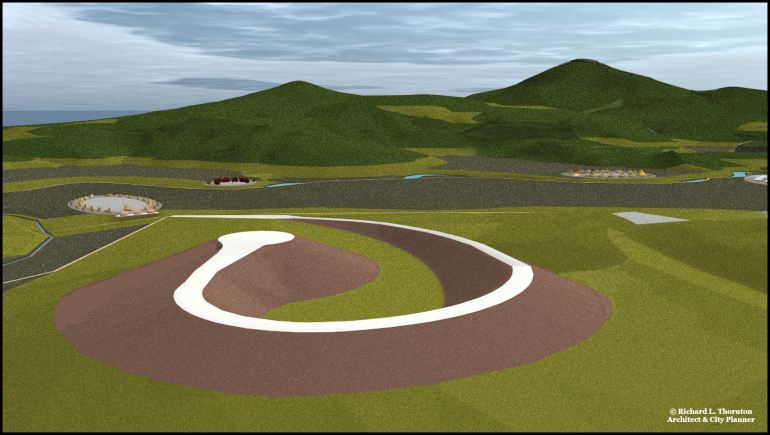
Meteors, asteroids and comets begin fragmenting as soon as they enter the atmosphere. It is quite possible that some fragments and certainly the plasma struck the Nacoochee Valley and eastern Ohio. It is very likely that the Sky Serpent (which is approximately 2000 feet by 1200 feet) was constructed to commemorate the event.
The plasma would have started massive forest fires in Florida and Georgia. The smoke would have contributed to the elevated level of volcanic smoke in the air during that time period . . . causing a Little Ice Age in the Northern Hemisphere. This set the stage for the first outbreak of the Bubonic Plagues in Europe and the Byzantine Empire, plus crop failures in Mesoamerica and unusually cold weather in North America.
Now you know!
 The Americas Revealed