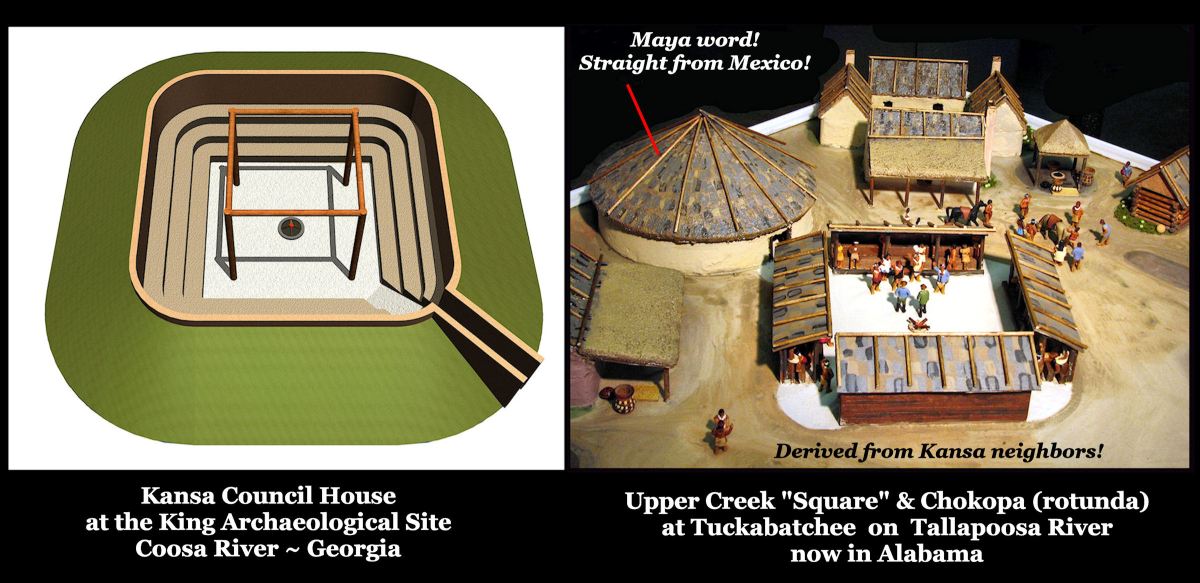
But the Creek Rotunda is from Mexico!
by Richard L. Thornton, Architect and City Planner
One of the principal messages that I try to get across to readers of “The Americas Revealed” is that at the time that European explorers began to penetrate North America, Eastern North America was a patchwork quilt of peoples, speaking many languages and maintaining many differing traditions. The Native American tribal area maps produced by the U. S. Department of Interior and Canadian Department of Indian and Northern Affairs are at best “snapshots” of the situation in the early 1800s.
The architectural traditions of these diverse peoples mixed and evolved. Because many things were lost when the majority of Southeastern Indigenous Peoples were enslaved, died in epidemics or forced westward, folk traditions in Louisiana, Oklahoma, Texas and Kansas are not necessarily accurate descriptions of the ancient past.

A Tequista village in Southwestern Veracruz State, the region where the Upper Creeks once lived, shortly after the Mexican Revolution (c. 1924). Note that it has a rectangular plaza with a Dance Circle in the center. The chokopa on the right was both a “bad weather” dance hall and a meeting place for villagers. Chokopa is an Itza Maya word meaning “Warm Place.” It is pronounced “chukofa” by Oklahoma Creeks.
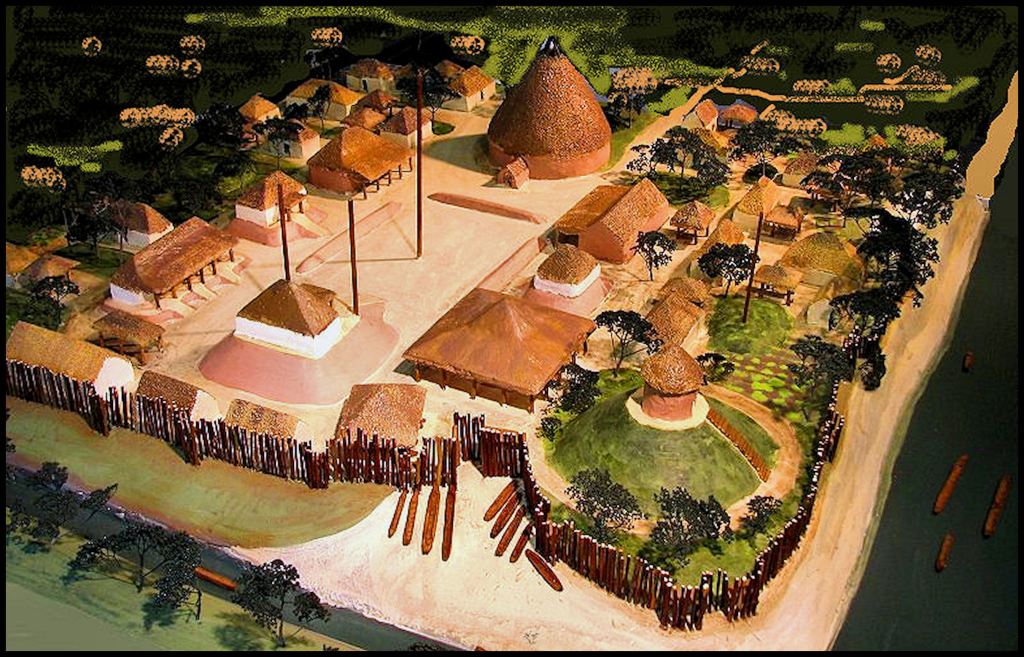
This model of a Creek town on the Lower Ocmulgee River was constructed for the Muscogee-Creek Nation in 2008. The town’s appearance was based on architectural sketches by botanist-explorer William Bartram in 1776. It is interesting that even at that late date, some Georgia Creek towns had a distinct Mesoamerican feel to them. The town chokopa is massive. Bartram speculated that it could hold 500 people. It is cone shaped like the folk temples to Kukulkan (Quetzalcoatl) in central and southern Mexico.
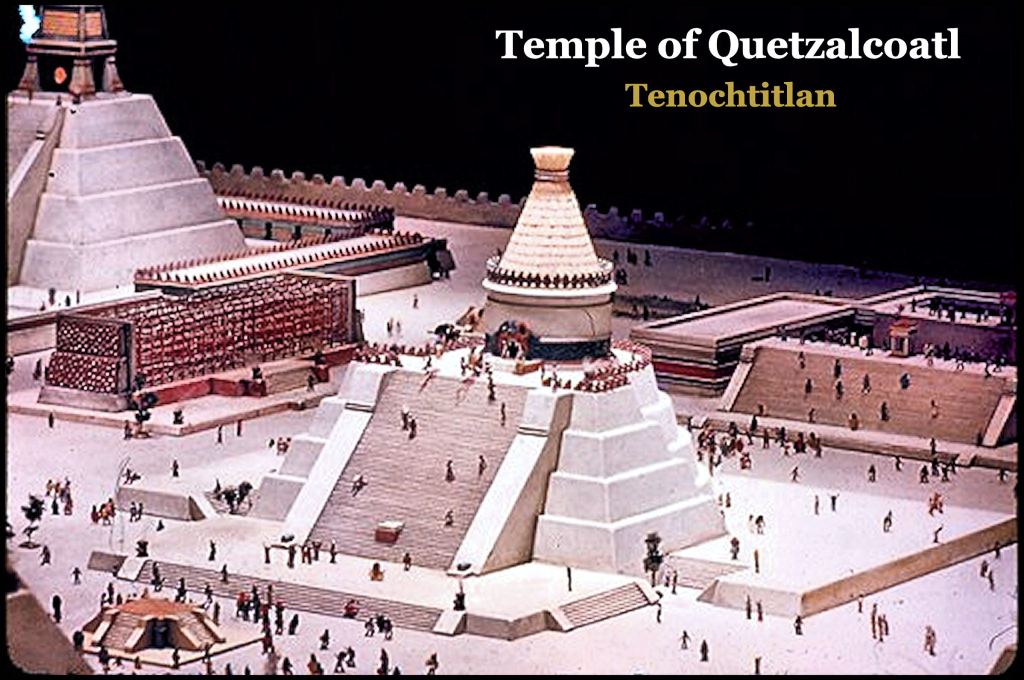
This is a color slide that I took in the Museo Nacional de Antropologia in Mexico City of the model of the Pyramid of Quetzalcoatl in the Mexica (Aztec) Capital of Tenochtitlan. Note that the temple on top of the pyramid is quite similar to the Chokopas, built by the Creeks in Central Georgia.
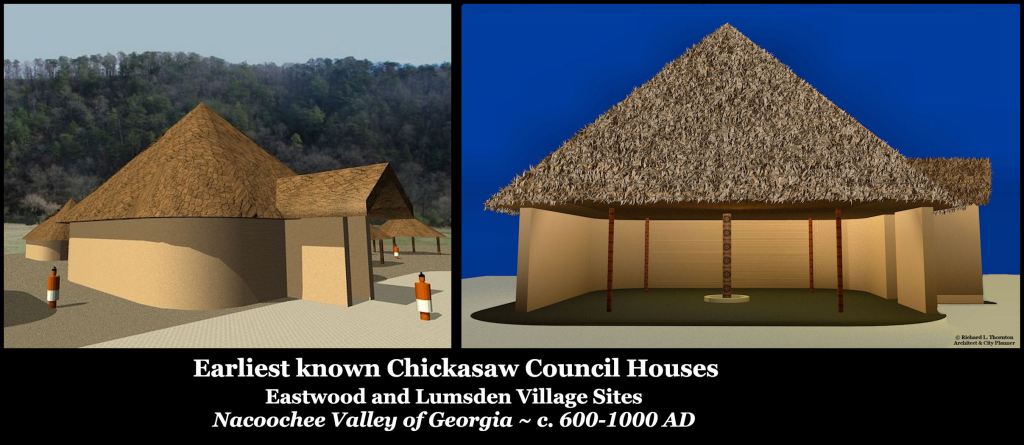
Chickasaw council houses have always had a unique feature that was also typical of Itza Maya temples. Four internal posts carried most of the roof load, but in the center was a large, ornate carved “world tree” column, which rose out of the circular hearth. Maya temples also had central “world trees.” Apparently, a coating of clay stucco protected the lower portion of the central column from burning.

The seating levels of Kansa Council Houses were sculptured with red Georgia clay. They may have been faced with wooden boards, but the archaeologists were not certain of this detail. The roofs were thatched with a mixture of river canes and wetland grasses.
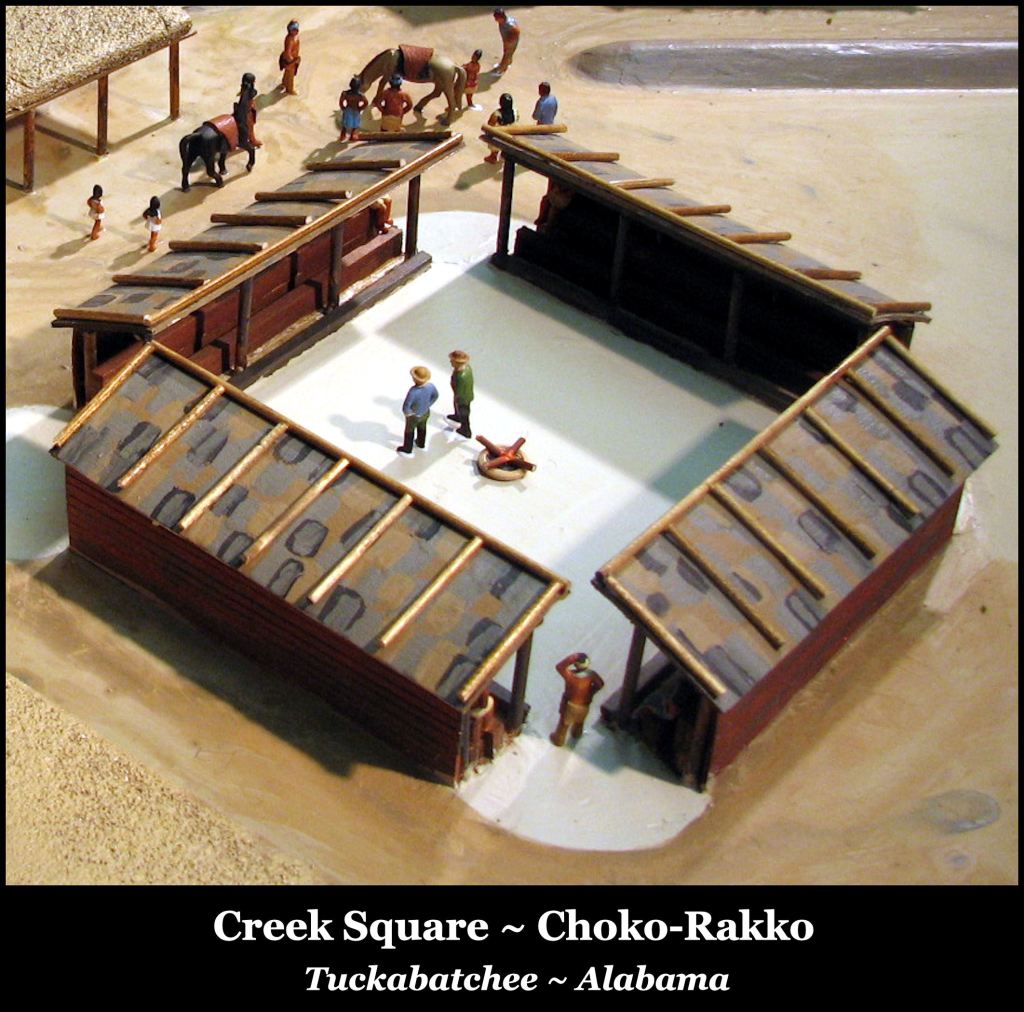
The Muskogee word, Choko-Rakko, means “House-Big” in the Muskogee language. Apparently, the Muskogee speakers borrowed “choko” from the Itsate Creeks, thinking that the word meant “building or house” – not “warm” as in its meaning in Itza Maya. The name strongly suggests that originally the Muskogee Creeks actually constructed a building with roof and walls that kept out undesirable weather. An open air arena with wood benches became practical in the lower elevations and latitudes of Central Alabama.
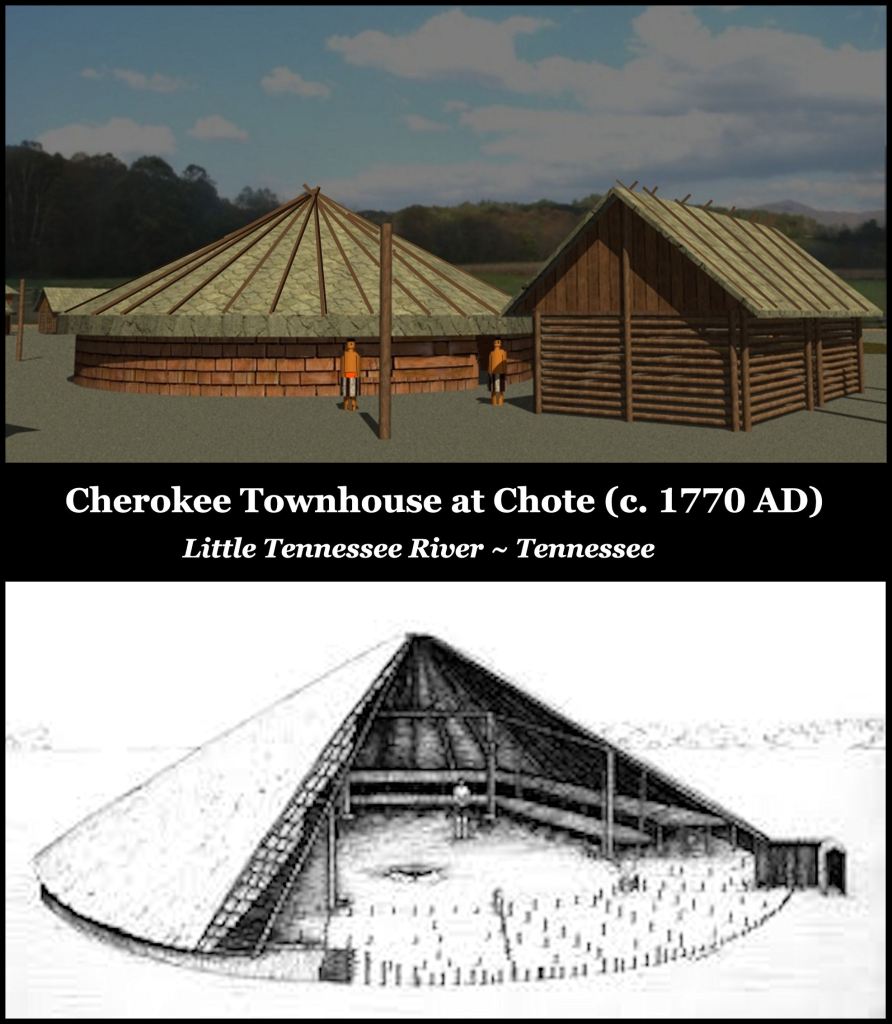
Cherokee Alliance Townhouses could be round or square. It varied with the individual tribal traditions. The Cherokee Tribe was created in 1725 from the alliance of at least 14 tribes, speaking several languages. The construction details of the Cherokee Townhouses were similar to that of the Kansa Council Houses, but they had wooden benches like the Creek Squares.
 The Americas Revealed
Good article Richard. The Kansa Council House’s shape reminds me of pictures from the WPA/TVA photographs I have viewed. There were numerous dig sites around the Southeast. Sorry to say lost to time or under TVA lakes now. A continuation of the elimination of Native American Peoples, culture and heritage that begins with European onslaught and continues still.
LikeLiked by 1 person