Should those Mayas, who are United States citizens, be invited to enroll in Creek, Seminole, Alabama, Miccosukee or Chitimacha tribes . . . alternatively, to form their own federally-recognized tribe?
Miami, Chattahoochee, Tallulah, Tybee (Island), Etowah, Altamaha, Chiaha, Chehaw, Cowee, Alabama, Chickee, Chickamauga, Callimako,Haw, Hatchee, Sautee, Soque, Catawba, Miccosukee, Tama, Tamahiti, Tomahitan, Tamatly, Tamatla and Amichel are Anglicizations of Itza Maya words. Except for Miami, these are river and place names left by Mayas who immigrated to or traded in North America between around 550 AD and 1250 AD. The traders may have come much earlier, because it is quite probable that the attapulgite in Teotihuacan’s murals and stucco came from Georgia. There is no attapulgite in much of Mexico and the nearest source to Teotihuacan is in the Chattahoochee River Basin of Georgia.
More Mayas fled to southern Florida in the 1500s and 1600s, to escape Spanish tyranny then integrated with Creek newcomers in the 1700a, whose ancestors came from southern Mexico much earlier. This hybrid people called themselves Maya, until 1951, when the Bureau of Indian Affairs forced them to change their name to Miccosukee. It is also derived from Itza Maya words, but the current Seminoles in Florida have forgotten that fact.
Miami was the name of the capital of a Maya province that always was located around Lake Okeechobee, Florida. The original indigenous name of Lake Okeechobee was Mayakoa or Mayaca. In the early 1500s, their name was applied by the Spanish to all the indigenous peoples living in the southern tip of Mexico. I will explain later in the article.
by Richard L. Thornton, Architect & City Planner
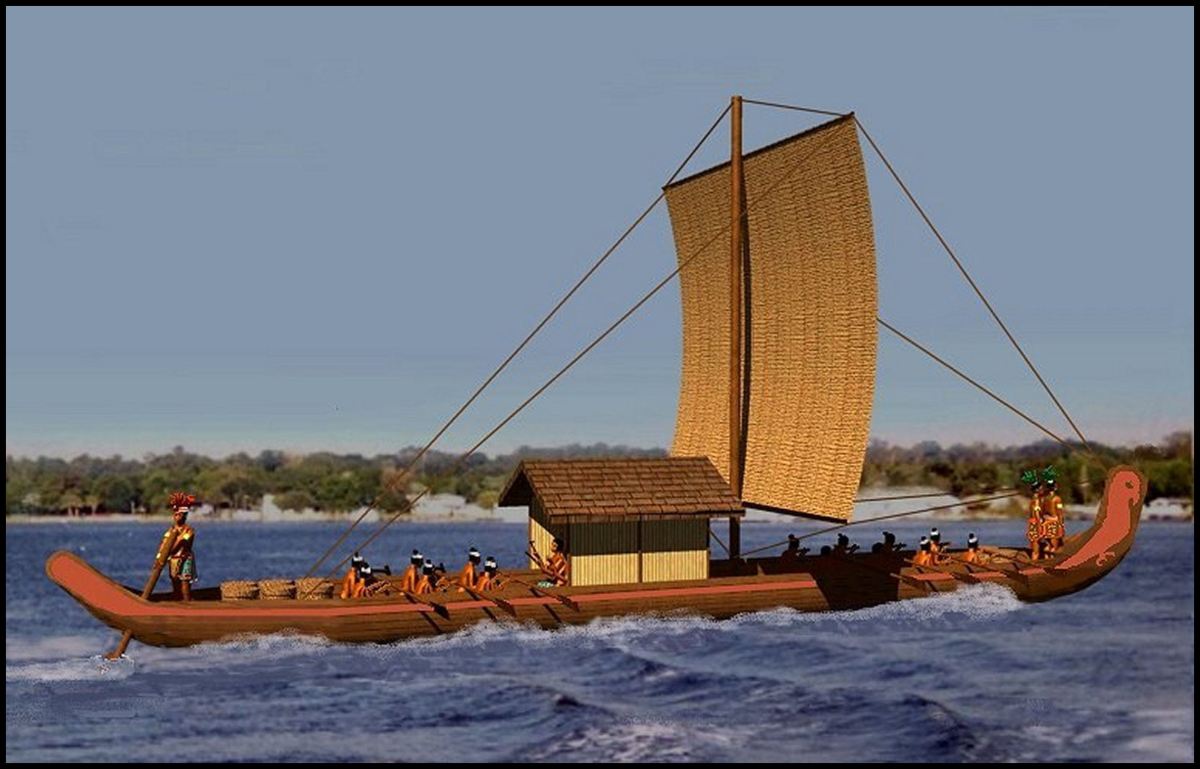
IMAGE ABOVE: In 2006, Florida Naval Historian, Douglas Peck, discovered murals and Maya inscriptions on the coast of Yucatan, which described Chontal Maya sailing ships, large paddle propelled boats, catamarans and canoes. Surprisingly, they were all constructed with wooden planks in a manner identical to the famous vessels of Bronze Age and Iron Age Scandinavia. He hired me to create precise CADD drawings of this Chontal Maya vessels and virtual reality images as the one above. The larger boats were quite capable of rapidly transporting cargo or humans across the Gulf of Mexico.
Kennesaw Maya Heritage Community Project
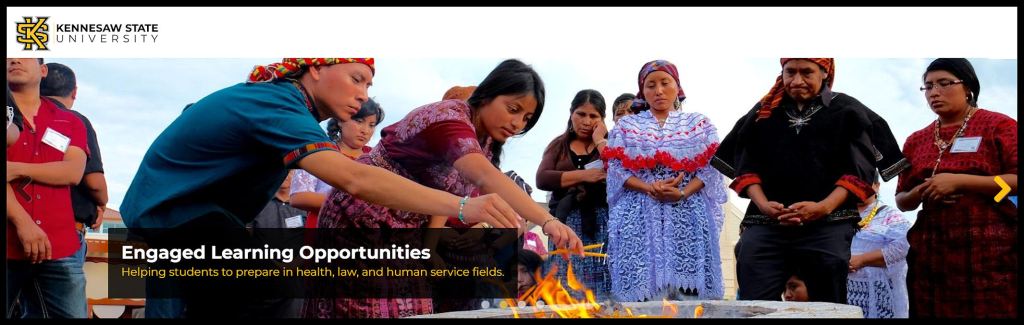
The Kennesaw Maya Heritage Project, founded by Dr. Alan LeBaron at Kennesaw University in North Metro Atlanta, has embarked on a remarkable program to conserve Maya cultural heritage, while integrating them into the mainstream of United States society. At least 100,000 Mayas now live in the Southeastern United States. They are particularly concentrated in the poultry and carpet industry cities of northern Georgia.
In reading essays and comments from readers on the Kennesaw Maya Heritage Project website, it became starkly obvious that the Kennesaw professors have no knowledge of the cultural histories of the Muskogean peoples of the Southeast. One young lady in Georgia wrote that her family always knew they were part Native American, but she was shocked when a DNA test revealed that it was all Maya! The professors had no explanation.
Duh-h-h! Almost all Creek-Seminole descendants in Georgia, South Carolina and southern Florida carry substantial Maya DNA. My mother’s family has no North American Indian DNA. Their Asiatic heritage is entirely from southern Mexico, eastern Peru, Polynesia and the Sami of northern Scandinavia. That lady and her relatives are invited to apply for membership in our Creek tribe.
A couple of years ago, I was buying blocks to build another retaining wall in my terrace garden at Cleveland (GA) Building Supply. The foreman in the storage yard was obviously an Indigenous Latin American. Whether as an architect on a construction site or in such situations, I have always spoken Spanish first to let the person know that I don’t consider them to be servile sub-humans.
The man understood me, but requested that I speak English to him. He said that he was a Maya from Guatemala and his people hated the Spanish. He was raising his children to only speak English and Maya.
I then gave him the shock of his life. He lives near the Chattahoochee River like I do, but was surprised that the river’s current name is derived from the Itza Maya words, Cha’ta Hawche. I told him that they meant “Carved Stone” – “Shallow River”. His eyes lit up as he exclaimed, “They mean the same in my Maya language!”
I was not surprised about my new friend’s attitude about Spanish. I then told him that long ago I had been on a fellowship in Mexico and had also secretly visited FLN (Zapatista) guerilla camps in Chiapas, Quintana Roo and Guatemala on behalf of US Naval Intelligence. I was a Navy Midshipmen at Georgia Tech. Naval Intelligence was trying to discredit war-mongers from getting the United States militarily involved in Central America and Mexico.
My visits proved that the Zapatistas were friends of the American people and should not molested. Today they control most of Chiapas. Their territory is the safest place to visit Mexico. The new president of Mexico is a member of the political party, which is an outgrowth of the Zapatistas.
Everywhere the Mayas gave that same message to me. They despised their Spanish masters and wanted to be friends with Canada and the USA. My Maya guide in Yucatan even offered me a 50% discount, if a took time to help his two teenagers with speaking American-style English.
College students, spending the summer at an FLN camp in then a small Maya fishing village, named Cancun, told me some history left out of our North American history books. Texas and Yucatan seceded from Mexico together as a confederacy! On several occasions in the 1800s, Yucatan sought to be annexed either by the United States or the Confederate States in the Southeast.
There is obviously a critical need for Native American professionals around the United States to open up direct lines of communication to progressive academicians such as Dr. LeBaron. The majority of the current generation of archaeologists, specializing in Native American sites, seemed to be trapped in a fossilized world, focused on potsherds and stone points with English names.
Long ago in a Mexico, gone with the wind
As many readers now know, I was the first recipient of the Barrett Fellowship at Georgia Tech in 1970. Equivalent today to about $8000, the grant enabled me to study on-site all of the major Pre-Columbian ruins in Mexico, plus many more, lesser-known ones.
More than anything else, it was the endorsement of the famous archaeologist, Dr. Arthur Kelly, which gave me this extraordinary opportunity. In February 1969, he had shown me pottery and statuary, unearthed along the Chattahoochee River, which he felt were either made in Mexico or were copies of Mexican ceramics. In August 1970, I observed Chontal Maya artifacts in the Tabasco State Museum, which were very similar.
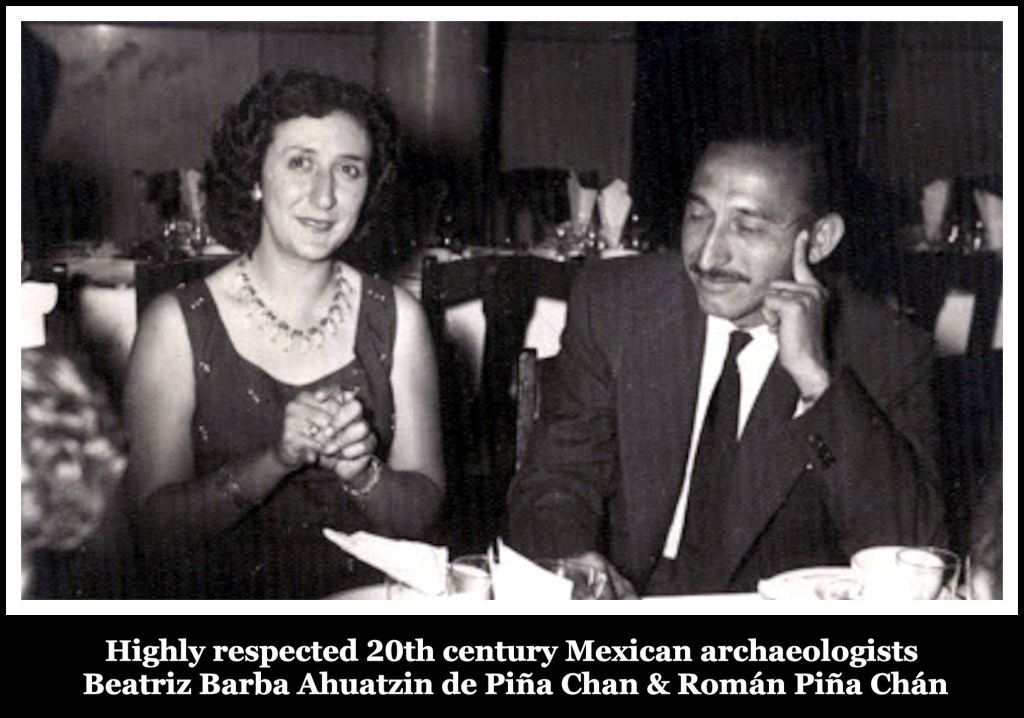
The Mexican Consul in Atlanta was a professional Architect and a graduate of Georgia Tech. He arranged all manner of VIP treatment for me in Mexico, including having two internationally famous archaeologists as my fellowship coordinators, Ignacio Bernal and Román Piña Chán. I knew Bernal for about five minutes. He left our tour of the Museo Nacional de Antropologia as soon as figuring out that my family were not rich, potential donors to archaeological digs. I never saw him again.
In contrast, Román and I had instant rapport. In my first visit, I gave him two books on the Southeastern Indians. He instantly saw strong cultural connections between Moundville, AL and the Toltecs, plus Etowah Mounds with both the Olmec Civilization and the Itza Mayas.
I had three more “talking” lunches with him in his office at the Museo Nacional de Antropologia, plus he and Beatriz took me out to dinner just before my birthday. Three days before his favorite graduate assistant, Alejandra, and I were heading back to our respective universities, we were his guests at an afternoon extravaganza in one of Mexico City’s most plush restaurants . . . overlooking the Paseo de la Reforma.
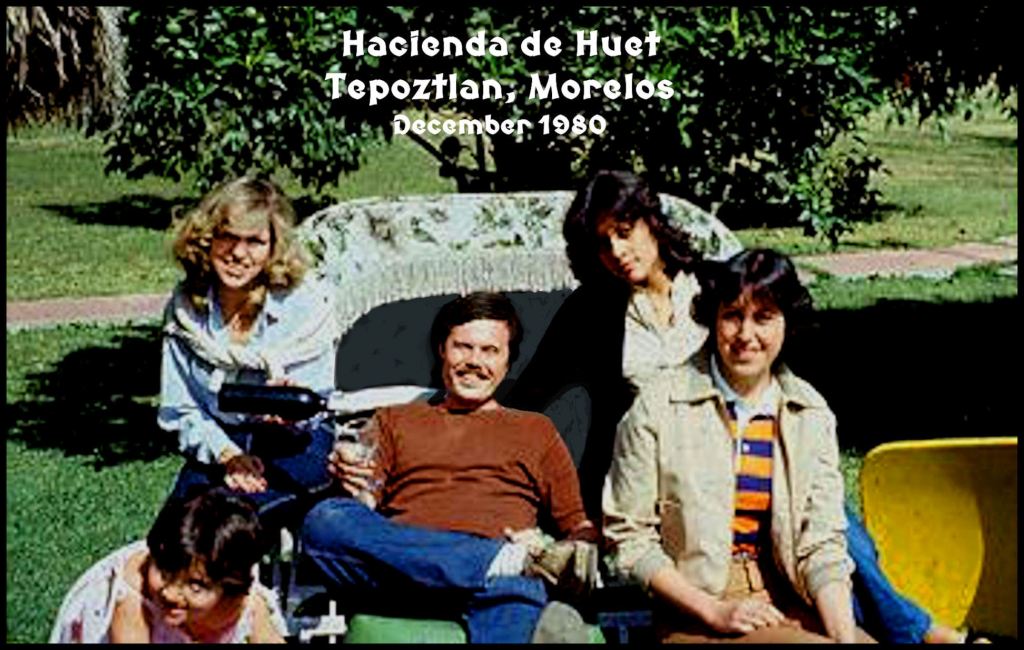
The famous archaeologist was playing matchmaker. LOL There was too little time left in 1970, but during Christmas 1980, we reunited at a hacienda near Tepoztlan, Morelos.
I provide much more information on what I learned from Dr. Piña Chán in other articles on the Mayan-Georgia Connection.
Román Piña Chán was a half-Maya from Campeche. Until a DNA test in 2005, I had no clue that I was part Maya. In fact, because Hollywood then used Italian, Lebanese and Jewish actors to portray American Indians, I assumed that I only had a trace of Native ancestry until then.
I really didn’t look like most Maya tribes, but then when I got up into the Chiapas Highlands, I started seeing Soque and Itza Mayas, who looked just like my grandmother, female cousins and some uncles. Except, we Creeks are much taller, though. That comes from also being descended from a supertall Toltec tribe in the mountains of southwestern Veracruz State . . . the Tekesta.
I really couldn’t “connect” with the Indios of central and western Mexico. However, once I was in southern Mexico, it was like attending a family reunion. Both the Mestezos and full-blood Indios were so hospitable to me. Several free meals . . . mothers would come up to me in stores to introduce their eligible daughters. The Soque owner of a hotel at the Tres Zapotes archaeological zone offered me 400 pesos to go rent his 18-year-old daughter at a local brothel. I declined. He and his wife were highly offended.

The future anthropologist, Ana Rojas . . . my adventure companion in the interior of Campeche. We both had just turned 21 and her father had given her a fancy, white Jeep as a birthday gift. Her father was over half Maya. Initially, he had to pressure her to be my guide in the un-mapped Campeche jungle and Puuc Hills, but soon, she realized that I was not the stereotypical Gringo. We had the romantic experience of a lifetime.

The father of Alfonso Morales was the tour guide for Architect David Schele, Linda Schele and I for our first visit to Palenque, Chiapas. (Yes, THE Linda Schele). In 2012, he stated to the History Channel . . . “That many Mayas immigrated to North America is not a theory, it is a fact. However, we have recently discovered inscriptions at Chichen Itza that describe visits by chiefs from Florida and Georgia to Chichen Itza.” Alfonso tragically died in September 2022, from an infection in his leg, caused by an antibiotic resistant bacteria.
Etymologies
1. The word, Maya – In 1502, as Bartholomew Columbus was sailing off the coast of Yucatan, a large trading canoe approached. Bartholomew Columbus boarded the canoe, and found it was a Maya trading vessel from Yucatán, carrying well-dressed Maya and a rich cargo. The Spaniards looted whatever took their interest from the cargo and seized the elderly captain to serve as an interpreter. The canoe was then allowed to continue on its way.
Within a few years after the kidnapping of the elderly Maya sea captain, the Spanish had decided to label all of the indigenous peoples in the Yucatan Peninsula, Chiapas and Tabasco, as Indios mayas. Over time, the pronunciation evolved to Mä : yä, which should have been spelled in Spanish as Malla. In the meantime, about 90% of the newly minted “Mayas” died from European diseases and Spanish weapons.
Columbus understood that the canoe was from a province that the Spaniards pronounced, Mayam. Remember in Spanish a Y symbolized an English long E (ē) sound, so the Spanish pronunciation was Mä : ē : äm in English phonetics. However, M in Itza, Tamulte and Chontal Maya is approximately a Ma sound, which Europeans usually write as Ma sound.
2. Miami (city and river) – There were provinces at the northern tip of Yucatan and southern tip of Florida, with that name. The mother province was in southern Florida, though. The capital of the Florida Mayam was called Maiami, which means “Lake (people) – place of – principal.” Eastern Creeks also place an “E” sound in front or after an ethnic name to signify a capital.
3. Chattahoochee (river and town) – derived from Itza Maya words, “Cha’ta Hawche” . . . which mean “Carved stone (stela) – Shallow River” or (depending on accented syllable) “Ancient ruins – Shallow River.”
4. Tula (creek, community and former tribe) – Totonac, Itza Maya and Eastern Creek word for town.
5. Tallulah (gorge, river, falls) – derived from Itza Maya word, “Talula” . . . which means “district administrative town with one mound.”
6. Etowah (river and towns in several states) – derived from Itza Maya word, “Etula” . . . which means “principal town or capital.”
7. Tybee Island – derived from Itza Maya word, “taube” . . . which means “salt.”
8. Tama (tribe and creek) – Totonac, Itza Maya and Eastern Creek word for trade.
9. Altamaha (river) – derived from Itza Maya words, “Al Tama Haw” . . . which mean “Place of . . . Trade . . . River.
10. Tamahiti (tribe in Georgia and Virginia) – Itza Maya and Eastern Creek word for “Merchant People.”
11. Tomahitan (tribe) – Anglicization in Virginia of the plural of Tamahiti.
12. Tamatley (community in NC) – Derived from Northern Chontal Maya word, Tamatli . . . means “Trade People.”
13. Tomatla (community in NC) More extreme Anglicization of Tamatli.
14. Chiaha (mountain, river, tribe) – derived from Itza Maya words, “Chia Haw” which mean “Grain Salvia – River.”
15. Chehaw (mountain, river) – more Anglicized version of Chiaha.
16. Cowee (town, creek) – derived from Itza Maya words, “Kaw-I” . . . which mean, “Principal place of Eagle (People).”
17. Alabama (tribe, river, state) – derived from Itza Maya words, “Al I- Baaman” . . . which mean “Principal place of Jaguars.” Jaguars lived west of the Chattahoochee River until the early 1700s.
18. Chickee (creek and community) – derived from Totonac, Itza Maya and Eastern Creek word, “chiki” . . . which means “house.”
19. Chickamauga (two creeks in Georgia) – derived from Itza Maya words, “chiki mako” . . . which mean “house of the king.”
21. Callimako (name of the Tennessee River until 1789) – derived from Campeche Itza Maya words, “calli mako” . . . which mean “house of the king.”
22. Haw (name of a creek and a river, suffix) – Itza Maya word for a large river.
23. Hatchee or Hoochee (creek, river and suffix) – derived from Itza Maya word, “hawche” . . . means a shallow river or large creek.
24. Soque [also Zoque and Sokee] (major tribe in southern Mexico, formerly a powerful, advanced tribe in Northeast Georgia and the current name of a river) – their name in the Mixtec-Zoque language.
25. Sautee (creek and community) – derived from Itza Maya word, Sawte . . . means “Soque People.”
26. Miccosukee (name of town and tribe) – derived from Itza Maya words, “Mako Sokee” (Soque) . . . mean “King of the Soque” or “capital town of the Soque.”
27. Catawba (name of river and tribe) – derived from Itza Maya words, “kataw -pa” . . . mean “crown – place of.”
28. Amichel (original name of region from Pensacola Bay from Apalachicola Bay) – derived from Chontal Maya words, “Am Ixchel” . . . which mean “Place of – the goddess, Ixchel.” There were also two regions in Mexico with this same name. They were Tampico Bay, Tamaulipas and the northern tip of the Yucatan Peninsula.
When Floridians called the Southern Seminole, Mayas
Video: The Secret History of the Miccosukee People
This video will describe the journey of the Soque People from Tabasco State, Mexico to Northeast Georgia . . . and then one large band of Soque from Northeast Georgia to southern Florida. It includes a 1917 newspaper article in Florida, which repeatedly calls the indigenous people of South Florida, Mayas.
 The Americas Revealed
Wow! I am impressed with your knowledge of the different languages. I am sure that knowledge has helped you a great deal with the discoveries you have made. You see links that others don’t between the different indigenous languages used in various places/ countries. I think many aren’t fond of the fact you have brought to light and I am sure you have made enemies along the way because your open mindedness and your perseverance in getting to the bottom of our history. Not taking as a fact what is written in a mere history book but being willing to dedicate your time and effort in exposing the myths we have been taught and the things we haven’t. It takes guts and dedication, I hope you someday write a detailed book on your studies/ findings for future generations!
LikeLiked by 2 people
I certainly agree with the above comment Richard
LikeLiked by 1 person
Here is another surprise for ya since you touched on DNA. A Lucayan / Taino 1,000 DNA from a tooth was found in a cave in the Bahamas, called preachers cave it belong to a sister who is called Atunwa Inaru. Well through GED match comparison guess who are her closest DNA matches are??….. Current living people from the Caribbean but also a Native American. Which I am sure she would match more people here if more were on GED match. That was a surprise I didn’t expect.
LikeLiked by 1 person
Yes! As stated in my previous article, much of the Southeast was occupied by Arawak peoples, including the Taino, until the 1700s. For unknown reasons British historians and then their Gringo heirs decided to erase them.
LikeLiked by 1 person
Great education once more! I’m preparing to conduct a Coastal Georgia tour for a couple in October that will take us from Savannah down to Jekyll possibly St. Mary’s and the things I’ve learned from your blog and books will add more understanding and substance to the outing, Thank you for your continuing work!
LikeLiked by 1 person
Your opening question to this article………..
“Should those Mayas, who are United States citizens, be invited to enroll in Creek, Seminole, Alabama, Miccosukee or Chitimacha tribes . . . alternatively, to form their own federally-recognized tribe?”
Yes and many more who are pre trail of tears (TOT) ancestorial native American’s. Here in Southeast United States, specifically Union County GA, have descendants living owning and occupying land that should be federally recognized by said tribal rights. Our academic and political systems have cloaked the Americana culture into believing native Americans can only be recognized by certain cultural and physical traits. Tribal recognition by the feds is a process that explicitly removes anyone not fitting their prescription. This discriminatory practice removes judgment in sacred, spiritual and historical accounting of that culture. This process currently puts Trackrock in the hands of 11 different Indian counsels non of which are remotely familiar with its history. What then happens to Trackrock? And all the surrounding mounds, pyramids, terracing, burials, artifacts, mines, soapstone bowl and white quartz tool quarries?
There are more than enough residents here in Union county alone to form a proper “federally-recognized tribe”. Problem is getting them to remove the cloak of false information that has been dumped on them for so long so that they can see the truth. Many “classic” native Americans here have been told their ancestors are Cherokee. (probably not) Non “classic” natives or pre trail of tears Americans, what you might call “hill folk”, have been told they are not natives and could not possibly claim any federal recognition. And this all could not be further from the truth.
So yes, the Mayas, Uchee’s, Itstates, and any family that demonstrates ancient American occupation of these lands should be invited and join the proper federally recognized tribe.
The Trackrock site is a mess. And the reason is there is no proper organization who has interest in it. The forest service certainly does not. Federally recognized tribes near this area do not. Most of the local residents don’t care either. Who does care? Those with knowledge of Trackrock ancient history, culture and spiritual significance. My passion is to bring forth the forgotten past and greatness of people who gave us land, culture, knowledge and wisdom to live as we do today. They only way to preserve our true American way of life is to reveal the forgotten history of it.
Most readers here are aware that Creeks are the proper tribal ancestry in Union county. There is not however any local Creek organization (that I am aware of) which the feds could attach recognition. Should one of you brave Creek readers that live in this area come forth, let me know! Research your ancestry. Here in Appalachia regardless of your culture if your family predated TOT chances are you may be Creek.
We must open peoples hearts and minds of what their ancestors gave us. God Speed. Charlie.
LikeLiked by 2 people