
Real Creek Indian history!
by Richard L. Thornton, Architect & City Planner
When doing initial research for the book, the Native American Encyclopedia of Georgia, I noticed a vast area, which included most of Florida, southeast Georgia, southern South Carolina, central Alabama and even some streams in eastern Tennessee, whose place names could not be translated with dictionaries of either the Muskogean or Maya languages. There are really only a handful of geographical place names in the Southeast that were originally Cherokee words. Both in Georgia date from after the Cherokees left.
It took years of acquiring and learning how to use many more dictionaries from the Caribbean Basin and South America, but eventually was able to translate these mysterious words with them. A traumatic era of invasion and chronic war is not mentioned in any archaeology book, but was thoroughly described by English explorer Richard Brigstock in the 1650s. Brigstock spent most of 1653 as a guest of the King of Apalache in his capital here in the Nacoochee Valley.
Because many Colonial Period books have been digitized by the Library of Congress in the past 15 years, I will be feeding interesting stories within those books from time to time. The most detailed information comes from Brigstock because the Apalachete (Northeast Georgia Creeks) were very sophisticated and had people in their government, who were fluent in the major European and Southeastern Indigenous languages. They also had a writing system, but so far, I have only been able to translate a few of their glyphs.
The information given Brigstock by Apalachete scholars matches the archaeological record perfectly. The problem is that the archaeologists, who excavated those sites, couldn’t comprehend a Native America in which peoples traveled and migrated long distances.
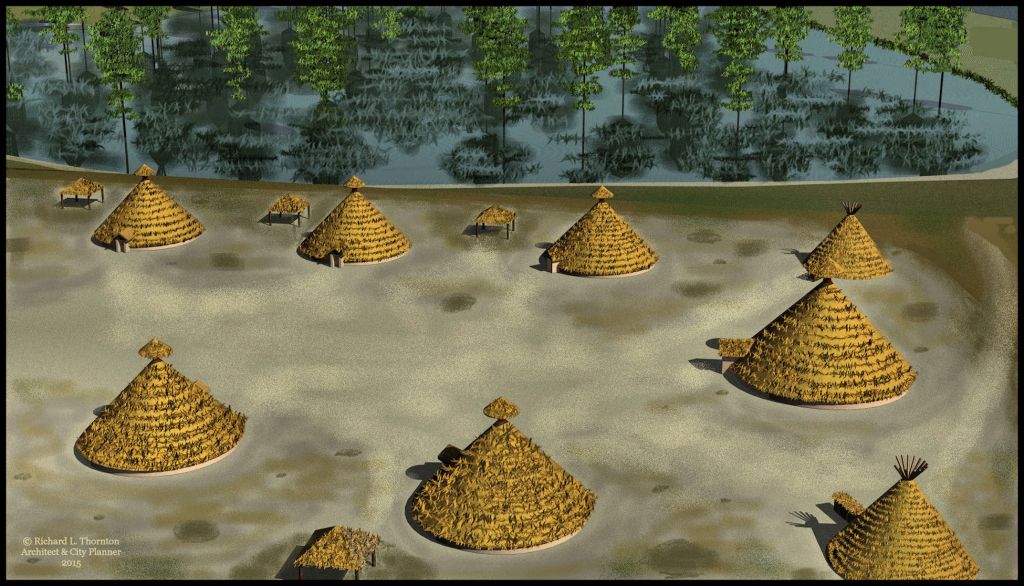
The Toa People from Cuba
Throughout the history of the Apalachete, immigrants had come to what is now Georgia and Florida by sea. Typically, space was found for them to settle, prosper and ultimately assimilate. These multiple layers of new cultural traditions were what made Georgia’s and South Florida’s indigenous civilizations so much more sophisticated than most of North America.
The Toa from Cuba settled on the lower Altamaha River, Brown’s Mount and what became the Ocmulgee Acropolis . . . kicking off the development of a 40 mile long megapolis. They later spread into the area near present-day Six Flags Over Georgia amusement park in South Metro Atlanta, central Alabama near Birmingham and even the first town on Hiwassee Island, Tennessee. Their past presence is remembered today by large boulders carved in the shape of owls and pottery decorated by owl motifs.
By the time the Hernando de Soto’s Expedition arrived on the lower Ocmulgee River, the people of the Province of Toa had fully assimilated to become just a branch of what we call the Creek Indians. The only difference that they spoke a language that mixed northern Arawak with Creek words.

The First Wave of Sea Raiders
The Apalachete traced their heritage to a migration to the Chattahoochee River and mouth of the Savannah River by people from South America (eastern Peru). You can think of the Swift Creek Culture as the beginning of their separate identity. They looked upon the Lower Ocmulgee River, which at that was a long shallow lake as their cultural birthplace.
Around 1150 AD, Native American sea raiders from the Caribbean Basin invaded Florida and Georgia. They wiped out the large towns around Lake Okeechobee and on the headwaters of the St. Johns River in northeast Florida. They did so much damage to what we now call the Ocmulgee Acropolis that the Apalache elite moved the capital northward.
After much bloodshed, the invaders were defeated decisively. They agreed to a treaty in which they would be a vassal of the Apalachete and absorb their cultural practices. Most of the coastal region of Georgia, other than the Savannah Area, became occupied by peoples from the Caribbean Basin or northern South America. Here I insert a section from the book.
The Second War

The second war ended only with an uneasy armistice in which the Sea Raiders kept all of their conquered lands in the Atlantic Coastal Plains of what is now northeast Florida, southeast & south central Georgia and southern South Carolina. In those regions, the cultural traits were typical of South America. They included practices that the Apalachete abhorred such as human sacrifice and the consumption of all first born babies by the household of the provincial king.
The Sea Raiders continued to accept new immigrants from various parts of the Caribbean Basin and South America. The conquered region fragmented into multiple provinces. which had varying relations with their neighbors.
The only exception was the Savannah River Basin, which the Apalachete insisted on retaining, since it was now their only fortified trade outlet to the Atlantic Ocean. From time to time wars flared up because of disputed trade rights between the South American provinces on the Altamaha (called May River here) or with the Apalachete provinces in Northeast Georgia. However, superior agricultural and engineering skills enabled the Apalachete population to grow to a much higher density in later centuries, so that the Sea Raiders were typically outnumbered and defeated if they attempted new invasions.
Tribal bands of Sea Raiders did go around the Kingdom of Apalache and settled in mountain valleys of what is now northwestern North Carolina, Kentucky, Virginia and West Virginia. Their names appear on French maps, but were ignored by British mapmakers and government officials. Their legacies are such place names as Saticoa, Stecoah, Nolochucky and Nantahala. However, this forgotten historical fact explains why people in rural areas of these states are finding that they have substantial Indigenous American heritage, but it is all from tribes that supposedly only lived in South America or the Caribbean Basin.
Now you know!


Thank you Richard for sharing this! These facts have only come to light recently and some aren’t aware of it. There are many similarities in customs, words , word segments, foods in several of the states you mentioned found in Georgia , North Carolina, Tennessee, Alabama and Florida that can also be found in the , Arawaks/Toa/ Taino/ Bohicket/ Cusabo and the Timucuas. To top it off there’s the Batey and the The Sweetwater Creek stela (Stone Petroglyph)Maboya , portrayed a supernatural being known as a Maboya. The Toa Arawaks (Taino in Georgia) believed that there were “demons” who guarded sacred areas and territorial boundaries. In the Caribbean we know that this is what Maboya were often looked at as. The Batey Found In Georgia and the one in Caguana Puerto Rico are almost identical and the stone tablet found in Georgia is identical to one’s found throughout the Caribbean.
https://www.akapasupay.com/blog/tainocherokeeconnection
http://www.hartford-hwp.com/Timucua/
LikeLiked by 1 person