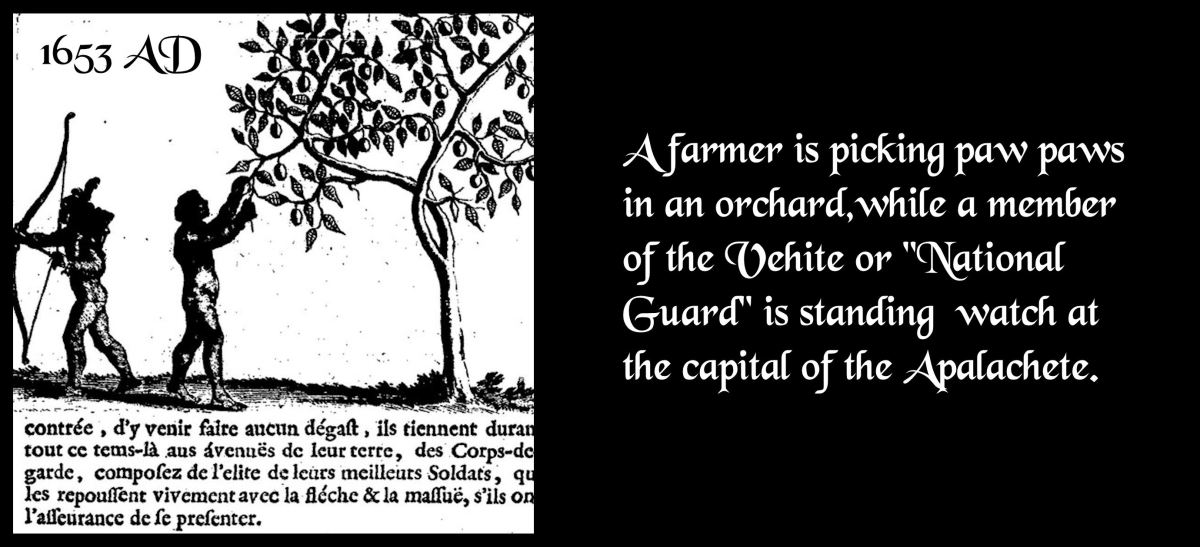
This is a lithograph by Arnout De Leers, based on a sketch by Richard Brigstock, which was included in the book on Apalache by Charles de Rochefort.
Apalachete men averaged about one foot taller than men from northern Europe at that time or about 6′-3″ (190.5 cm). That means that the long bow, carried by a member of the Veheti was about eight feet or (2.4 m) long! Their arrows were made from the stalks of a cultivated strain of light-weight, hollow river cane that was called “arrow cane.” The removable points were either heat-hardened wood or a locally available natural brass.
Elite men wore their hair shoulder-length. As can be seen in the lithograph, commoners typically wore their hair in a bun on the back of their head. The Veheti wore their hair in a bun on top of the head, like a crown. Leaders, priests and elders wore beards. Men, who were veterans of battle, wore mustaches.
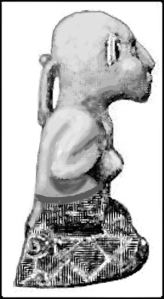
When working, women wore their hair in two buns on the sides of their head. Otherwise, they typically had ponytails or shoulder length hair. The ceramic statue at left from Etula (Etowah Mounds) displays a young woman with Maya features, wearing a typical Apalachete skirt and a pony tail.
During the summer months, commoner men wore simple leather flaps over their private parts. Commoner women only wore mini-skirts, made from a type of linen, woven from mulberry fibers.
During the spring and fall, both commoner men and women wore simple tunics. Members of the middle class and elite wore brightly colored clothing very similar to what is now called by Creeks, the long shirt and the ribbon dress. Cloth was woven from a variety of vegetative fibers. The highest quality cloth was made from a type of cotton, found in the pods of the cottonwood tree.
One of the most most important religious festivals each year was when members of the elite and middle class climbed the ramps of the Temple of Amana (below) and placed their most beautiful clothing on a large stone altar. This clothing was then distributed by the priests to the commoners.

These are some of the hundreds of images that will be presented in a two hour documentary video, which will premier in Sacramento, California during National Native American Heritage Month (November 2023). Needless to say, I have been putting in long hours on it!
 The Americas Revealed
We planted two paw paw 🌳I can’t wait for them to bare fruit. I’ve never tried them but when I saw them in our nursery last year it was the first trees we grabbed.
LikeLiked by 1 person
My understanding is that they take several years to bear fruit, but live a long time and continue bearing for decades.
LikeLike
GGG Amanda Jane Jenkins wore her hair that way and Tunic blouse has always unknowingly been my favorite. My Willis had a huge mustache that I could never figure out- I will check those military rolls again. Marion Frances’s daughter, my grandmother was a complete nut rose opal hound in El Cajon California. Her brother, Nathan Oliver Duncan, married an obvious half-breed from Montana (some of the Duncans landed there), and he had a 4 ft moose head in a tine bedroom library- his son stated on one of the genealogy websites that Nathan was born at the Mesa Grande Reservation- I would not be surprised. My California Grandparents met at a dance at Lakeside. I never could understand all of those bits and pieces until now. I believe Willis F might have gone right back up the Canadian River and landed in Fort Collins where he died of apparent chemical poisoning, and Francis Marion kept going on to Napa, then to El Cajon and Julian California. We lived in Ramona when I was a baby, then in El Cajon my kindergarten thru 2nd grade. I have so many memories. My dad worked at Indian Springs Water Company. Then my father joined the Air Force and was stationed at Jacksonville Air Force Base in Arkansas, where he went on a blind date with my mon, whose family was from Marion and Tuscaloosa. Little did either of them know, but the genes did!
This is why I say that while we may not know the language or clans, many more people than know grew up with a lot of the culture, especially in endogamous communities with multiple GG and GGG grandparents. Along with the other aspects I mentioned, I can hunt, fish, and live outside too. And I know people that while some people might back talk a cop, absolutely do not EVER argue with a Game Warden in Arkansas! Happy Day!
LikeLiked by 1 person