
Now the community of Sautee, GA, Itzate was for many centuries the capital of first the Itsate Creeks then the Apalachete Creeks, who relocated their capital to the Nacoochee Valley in the early 1600s. Spanish maps labeled the town, Apalache. After around 1700, British maps returned the name to its original word, Itaste.
SLIDE SHOW
by Richard L. Thornton, Architect and City Planner
Newcomers arrived in the Nacoochee Valley around 600 AD. They built “medicine capsule” shaped houses and buried their dead near their houses in sarcophagi, constructed of stone slabs. These are traditions, typical of Itza Maya commoners, living in Campeche State, Mexico.

Four of the hundreds of stone sarcophagi unearthed in the Nacoochee Valley
Almost immediately, they began constructing a diamond shaped, earthen pyramid, dedicated to their sun god, on top of Kenimer Hill. The pyramid was created by sculpting the form from the natural terrain. This is an architectural tradition among the Itza and Kekchi Mayas of Chiapas State and the Guatemalan Highlands. Concurrently, the population of that part of MesoAmerica declined by over 50%.
We do not know what styles of pottery were made by the earliest arrivals, because archaeologist Robert Wauchope had to stop work before reaching the initial of the burial mounds on the Eastwood site. Later occupation levels were styles typical of the Creeks Indians ancestors in northern Georgia and Ocmulgee Bottoms.
Itzate (Itsate, Hitchiti) means Itza (Maya People). That was the name of the Native American town, which is now called Sautee Community. Sautee was originally three miles away, but moved to its current location around 1921, when the Nacoochee Academy was constructed.
Archaeologist Robert Wauchope determined that it was the largest and densest occupied village in the valley. It remained the largest town until the early 1790s, when its occupants learned that their land had been given to the Cherokee in a 1784 treaty. It is not known where they migrated to. By that time, though, the Native population of the entire Valley had declined to around 100-120 people.
Three Indian traders were in the valley near the Nacoochee Mound in September 1754, when the Coweta Creek army entered it on their way to burning almost all the Cherokee villages, south of the Snowbird Mountain. The traders noted that they Cowetas massacred and burned Chote (where Helen is today) but did not molest Itzate. Creeks living in Chote fled to Itzate. The Cowetas tried to kill all those residents of Chote, who were not Creek. This is primary evidence that Creeks or mixed-blood Creeks live at Itsate until the 1790s.

Birdseye view, looking south – the white rectangular buildings are warehouses. Anglo-American settlers intentionally placed their public buildings on top of mounds in Itsate. Nacoochee Presbyterian Church sits on the mound in the lower left hand corner. Nacoochee High School was built on the center platform mound.
These drawings are absolutely precise representations of the terrain and natural features. They are a digital terrain model, derived from a U.S. Geological Survey LIDAR scan.
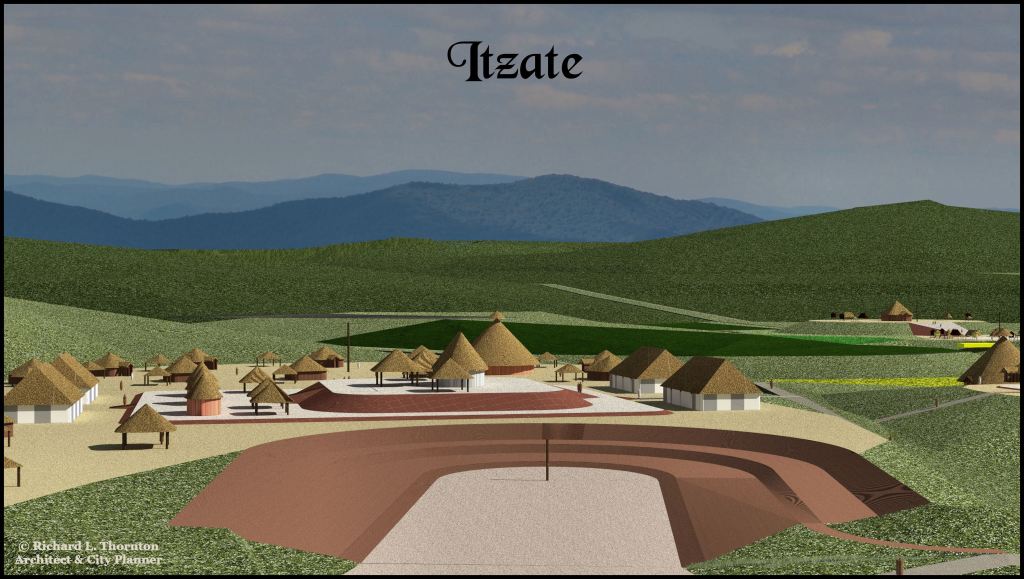
Looking north across the stickball stadium. The terraced seating is still visible on the northern end and young folks play soccer on it now. The seating on the southern end was destroyed by “landscaping improvements” in 2018, implemented by the Sautee Nacoochee Community Association.

Birdseye view, looking northeastward over the massive Kenimer Mound (c. 600 AD)

Birdseye view looking northeastward over the acropolis and toward the Stovall and Lumsden Pyramids. Creek surveyors used triangles to lay out cultivation plots.

View looking eastward toward Lynch Mountain, an extinct, collapsed volcano. Well, we hope it is extinct. It is only about two miles from my house!


Richard, Thank You so much! I finally figured out who two of my lines are by matching the census to the places they lived, all at mound locations. I believe my Duncans and Squires were Shawnee who came to Alabama circa 1800 to 1825. I think the Duncans were Canadian first bc names were Willis Duncan- so many Willis in Canada. Search Sidney Duncan Tuscaloosa to see what I look like —as a trans lawyer!
LikeLiked by 2 people
Richard,
https://www.loc.gov/item/01006586/
See the bottom of Pg. 349 for that description of an “Old Cherokee Fort” you might be looking for!
This is truly fascinating about Itsate as a place.
There is a publication I’ve found on the Encyclopedia of Native Americans of North America claiming that Itzate means Echota? (Those might be fighting words, but it seems they may have been closely located by your account of Chota at Helen, and may have recognition as two actual places)
The Encyclopedia, a publication of the Smithsonian, also has several variants of Cherokee, including Chalaqua as Cherokee, which I found interesting. Chalaqua was more of a Spanish account from what I recall, in and around the same area, quite a bit earlier than 1715 if I recall.
Within the document is a reference of some speculation and suspicion, that even the author of the Encyclopedia alluded some suspicion and speculation, that there was a Jesuit outreach to the Cherokee in 1643 in or near current day Tellico plains, TN as attested by Shea. However, I have yet to find reference, other than this Encyclopedia publication.
https://www.loc.gov/item/15002143/
https://www.newadvent.org/cathen/03646a.htm
So might the Cherokee have made a mad dash in 1643, when much violence was being committed against the Huron, where these band of now vagabonds moved Southward and had little interaction with anyone beside a possible bogus Jesuit in 1643, for roughly 72 years until 1715?
I find that doubtful.
1643 Jesuit interaction now is suspect for first references of the Cherokee in the suspected area prior to 1715 and is around the time the Neutral Nation, and or any remnant Hurons were either killed off by the Iriquois, along with Jesuits with the Huron, or fleeing for their lives in an escape from Canada in 1643, I do not think the Jesuits faired so well in that venture, like pretty much beaten senseless, fingernails removed, hair removed type torture by Iriquois pursuers.
The same publication, part II states Cheroquois was a Huron Chief, however, Samuel de Champlain dedicates an entire portion of his writing to the Cherioquois as a people against the Iriquois, who may have later remained as the Neutral Nation and remnants of an all but forgotten Huron tribe, reverting back to the Chalaquah to remain largely undetected as Huron and Neutral Nations members.
If so, these folks really do have Algonquin identity crisis, and refrained from acknowledgement of Huron heritage for nearly a century probably for shear survival until they could repopulate.
Very Respectfully,
Zac
LikeLiked by 2 people
The inaccurate statements in official documents about Chote and Itsate are due to the provinciality of academicians in Tennessee and North Carolina, the false claim by the Cherokees about occupying “seven states in the Southeast for 10,000 years” and the naivety of Georgia academicians in believing Charles Hudson’s often repeated statement that nothing was known about the Native Americans in Georgia during the 1600s.
There was NEVER a Cherokee town named Itsate in Tennessee. Tennessee scholars, thinking that Tennessee was the center of the world, read multiple accounts by explorers and and traders about the towns of Chote and Itsate being in the same mountain river valley and assumed that these events occurred in Tennessee . . . because there was a Cherokee town named Chote from around 1750 to 1784, However, Georgia’s Chote dates back to around 1000 BC and was occupied until 1822, when its occupants old their land to a real estate speculator from Burke County, NC.
Itstate also dates back to at least 1000 BC or earlier. It became a large town when Mayas began arriving in the Valley around 600 AD. The Creek occupants of Itsate abandoned it around 1790, when they learned that their land was given to the Cherokees. They then moved southward into the lands that were still Creek or else assimilated with white families in northern Georgia.
Being blocked from conventional avenues of setting the records straight, I created this website and am making videos on Youtube – which have far more exposure than any academic publication. Next year I will be creating a series of short videos on such subjects as Chote and Istate.
LikeLike
Making a comment through e-mail is not working, it seems. I’ve sent you two comments this way and they do not figure among other comments at the bottom of the article concerned?
J.-J. Sent using Hushma
LikeLike
Don’t use the “Contact” tab to make a comment. It goes to me directly as email. Only the comment tab produces a published comment.
LikeLike
That blue button there, I tried many times but am not getting anywhere: nothing happens. I must repeat I am new to this kind of communication and I am not on any social media and do not want to be. Sent using Hushma
LikeLike