The two most unusual artifacts that I brought back from Mexico. One is concrete . . . the other is clay.
by Richard Thornton, Architect and City Planner
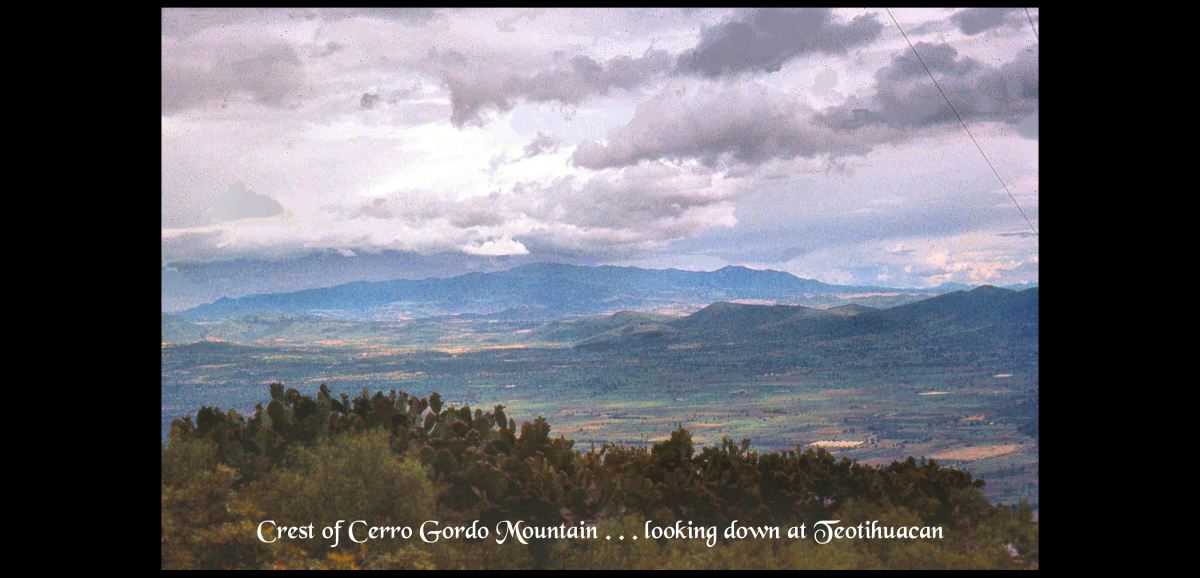
Yes, the bases of those thunderstorm clouds over Mexico City are below me in this photo and they were headed my way. Don’t try this experiment at home, alone. The results can be shocking!

One of the conditions of my sponsorship by the Mexican Department of Cultural Affairs was that I be allowed to collect 50 kg (110 lb.) of artifacts from the surface, outside of lands owned by the federal and state governments, for educational purposes. They were to be individually viewed by Dr. Román Piña Chan and determined to be not essential for understanding the patrimony of the people of Mexico then delivered to the Department of Foreign Relations at Tlatelolco for shipment to Atlanta under diplomatic seal. The box was to be opened in the presence of the Mexican Consul in Atlanta. One exception was that I was allowed to obtain a sample of Mesoamerican concrete from within the El Tajin Archaeological Zone in northern Veracruz, weighing 1 kg or less.
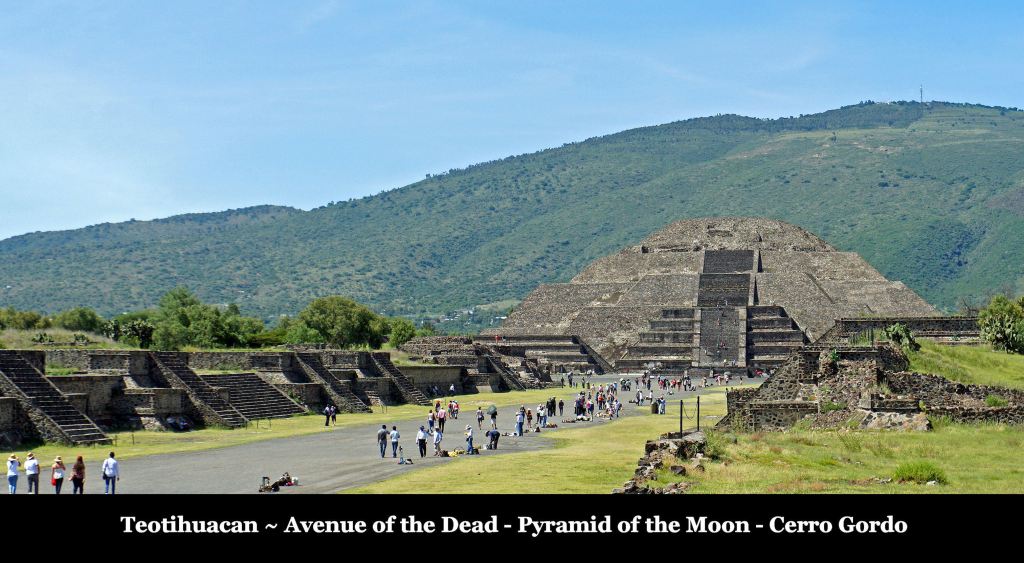
The photo at the top of this article was made from the right edge of the dark area at the top of Cerro Gordo, where you see a radio tower. That’s the regional air traffic control center for the Mexico City air traffic control center.
This trek went up the 10,000 feet tall mountain, the good ole fashion way . . . hoofing it. I didn’t bring my canteen with me, because I crossed the arid 2.2 mile (3.6 km) terrain between the Pyramid of the Moon and Cerro Gordo on a lark, as I stepped off the bus from Mexico City.
Fortunately, after the director of the air traffic control center first pointed a pistol at me, one of the summer college student employees recognized my INAH photo ID and invited me in. The staff allowed me to drink an entire pot of grape KoolAid that was on the stove and gave me one of their sack lunches for nourishment.
I am one of very few North Americans, who have pulled that stunt . . . maybe as few as two. Not many more Mexicans have done it.
(1) The Mysterious Clay Figurine
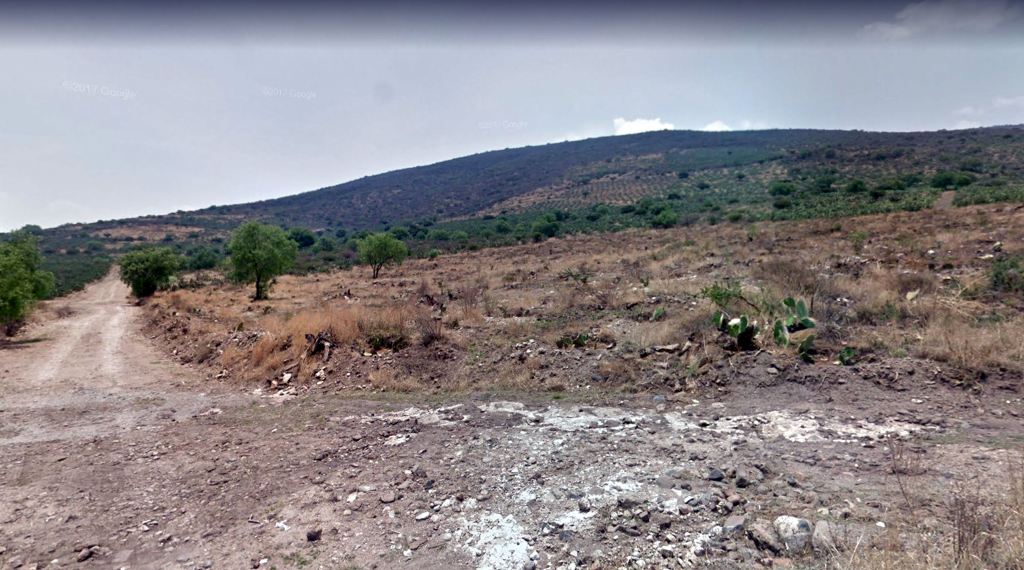
This is the approximate location where I picked up the partial figurine, discussed below.
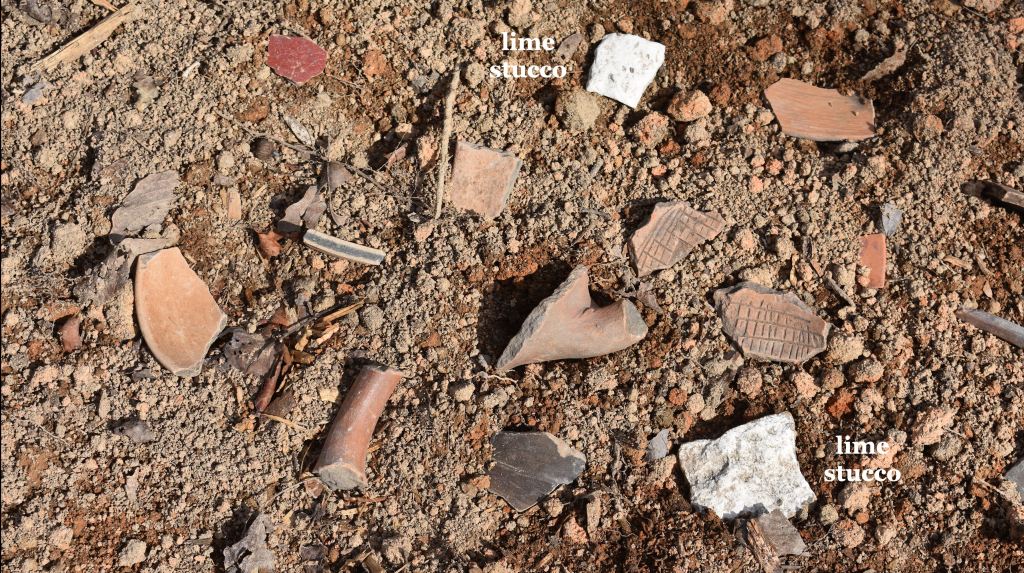
This is the appearance of the soil near where I found the figurine
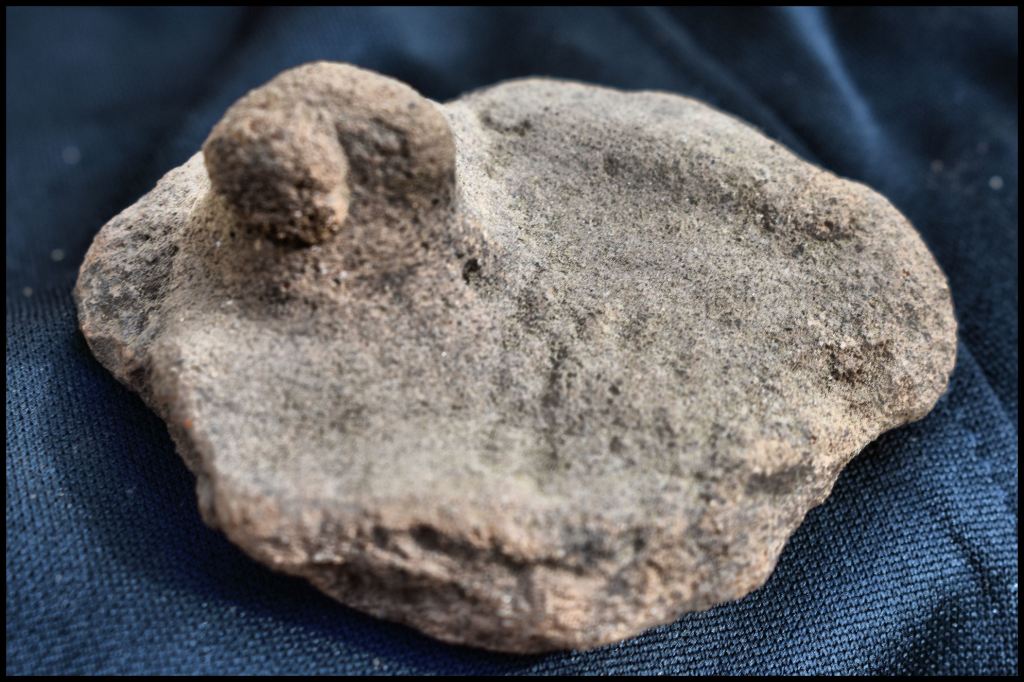
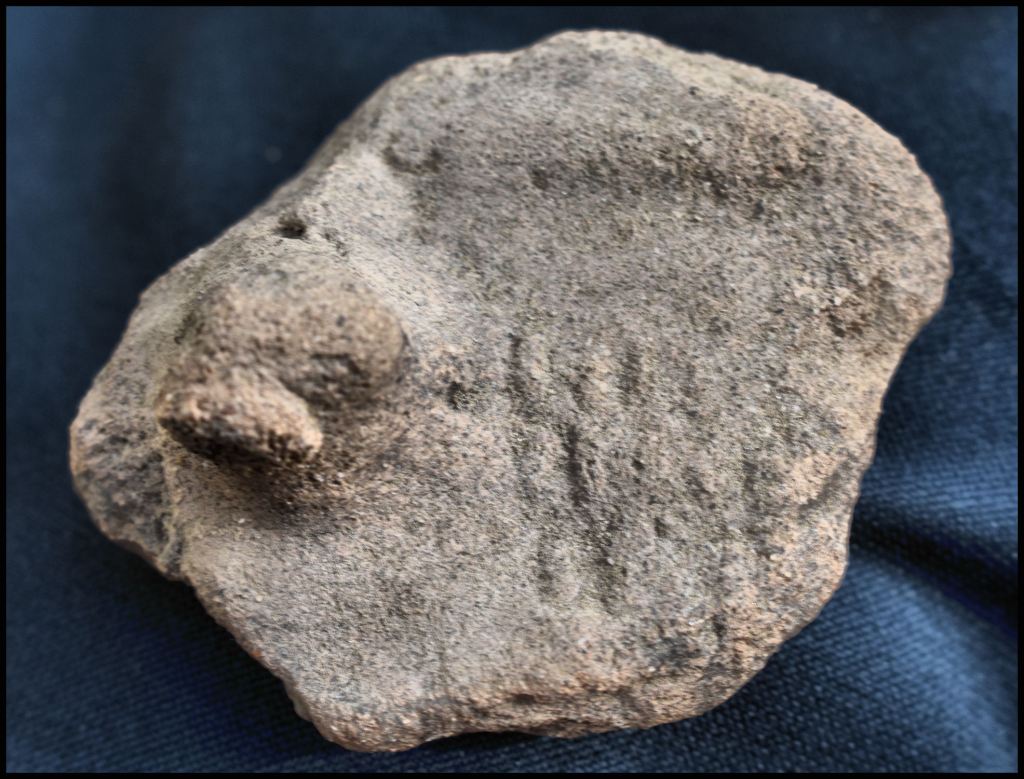
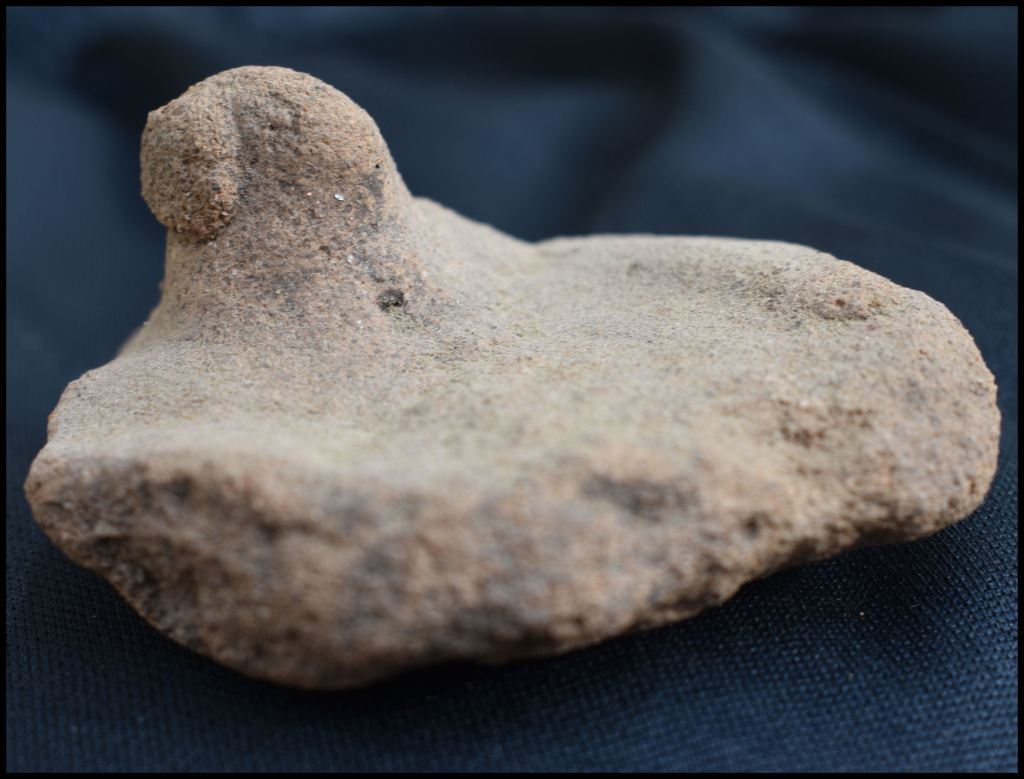
What appeared to be a hard lump of clay was stuck to a large potsherd that I picked up about half way between the Pyramid of the Moon and Cerro Gordo. When cleaning up the artifacts back at the Soto house the next day in Colonia Nueva Santa Maria, I was shocked to see that within the soil casing was a section of a poorly fired figurine. The artifact was a maximum of 62 mm (2.44 in) in diameter. I couldn’t figure it out, so took it in with me at my next appointment at the Museo Nacional de Antropologia.
Dr. Piña Chan was also puzzled by it and so put in a device for magnifying and photographing details on small artifacts. It is an unidentified creature, crouched like a jaguar, eating a human! Notice the spinal in hip bones in the photos below. However, jaguars don’t have big ears like this creature. In fact, no indigenous predator in the Americas has ears like this creature. He finally decided that it was a Spanish Mastiff War Dog, eating an Indian . . . or an extraterrestrial monster eating a human. The head and oversized ears really don’t look like a dog, however. After photographing all sides of the artifact, he let me keep it.
_
_
_
(2) Discovery of a 1200 year old mural at El Tajin
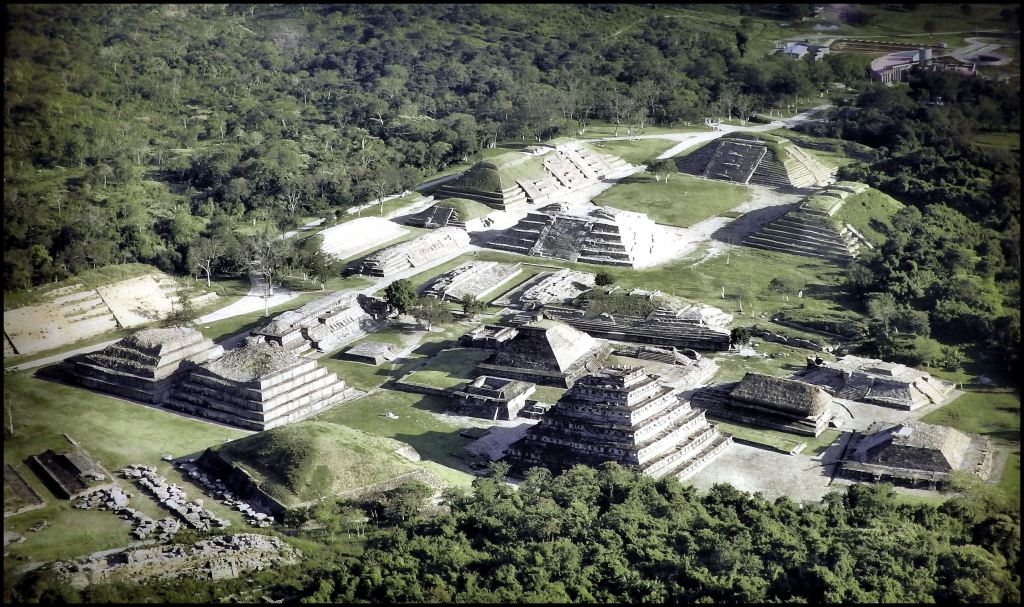
El Tajin was the last archaeological zone that I visited before heading back to Atlanta. The location was northern Veracruz State near the oil fields of Poza Rica. It was the capital of the Totonac Nation from around 600 AD to 1200 AD . . . when the city was sacked by Chichimec barbarians. There are many Totonac core words in the Creek languages and on the lower Southeast’s landscape, but I didn’t know that at the time.
The Totonacs were the only people in the Americas, who discovered how to make Portland cement . . . concrete. They did this about the same time that the Romans made that discovery. At El Tajin are several multi-story buildings with poured-in-place concrete walls and floors.
Dr. Piña Chan gave me a letter, authorizing me to remove a kilogram sample of concrete from an unrestored building ruin . . . so I wouldn’t have any problems with the staff or Mexican soldiers, who patrol the fringes of all major archaeological zones in Mexico.
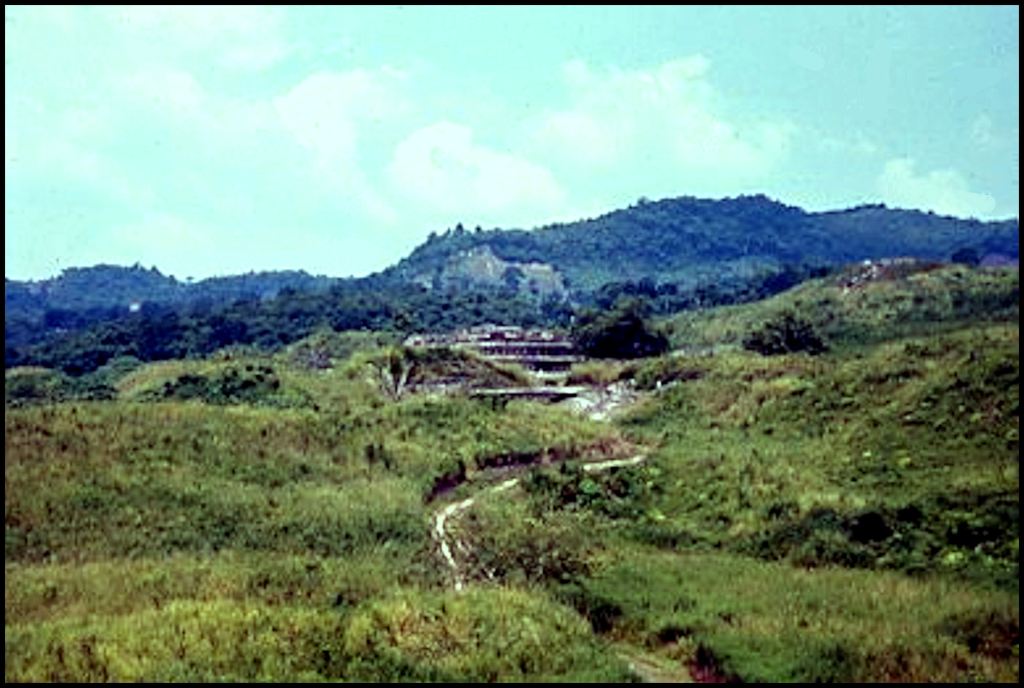
This is the area of the archaeological zone, where I obtained a concrete sample.
I found a chunk of concrete that had broken off a fallen concrete wall on the right of this photo. You can see a rectangular white shape on the lower right corner of this color slide. When I got back to the Soto’s house the next day and washed it, I was astounded to see that the other side was a section of a mural in almost perfect condition.
Just think, it had been laying on the floor of the jungle for many centuries. There had to be Georgia attapulgite in the stucco. Of course, I wouldn’t know about attapulgite until 2012.
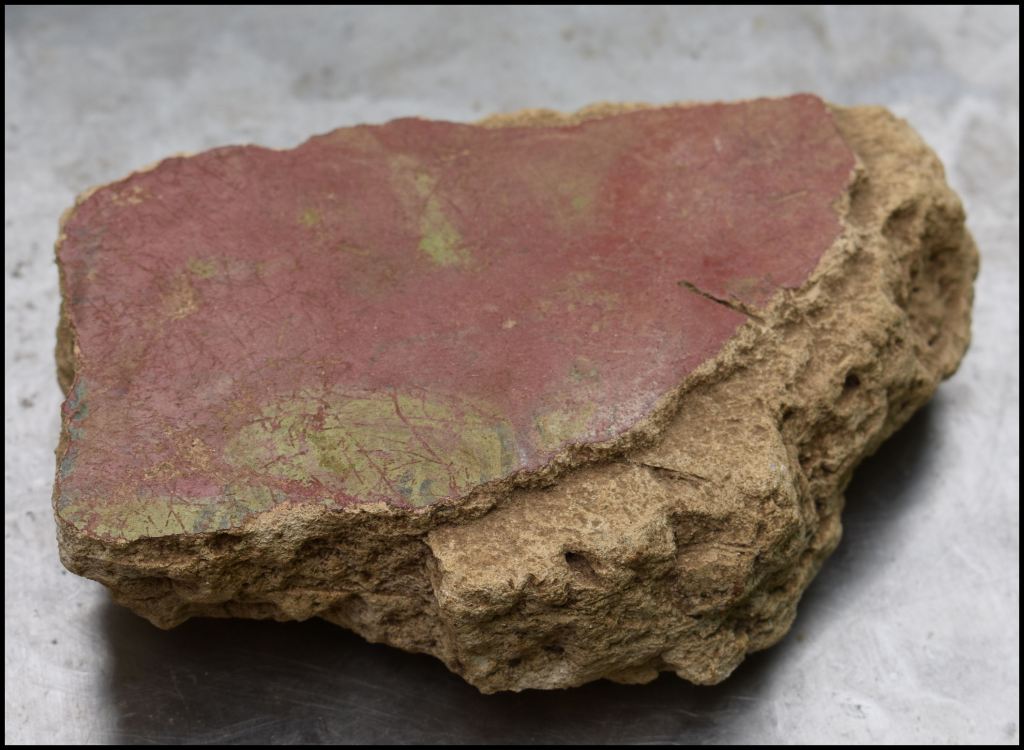
This piece of the mural is 136 mm (5.35 in) long and 96 mm (3.78 in) wide. It weighs .74 kg (1.64 lb). Even today the red stucco is hard as a rock. I don’t know of any modern stucco material that would be in such extraordinary condition after laying for many centuries on damp, acidic tropical soil.
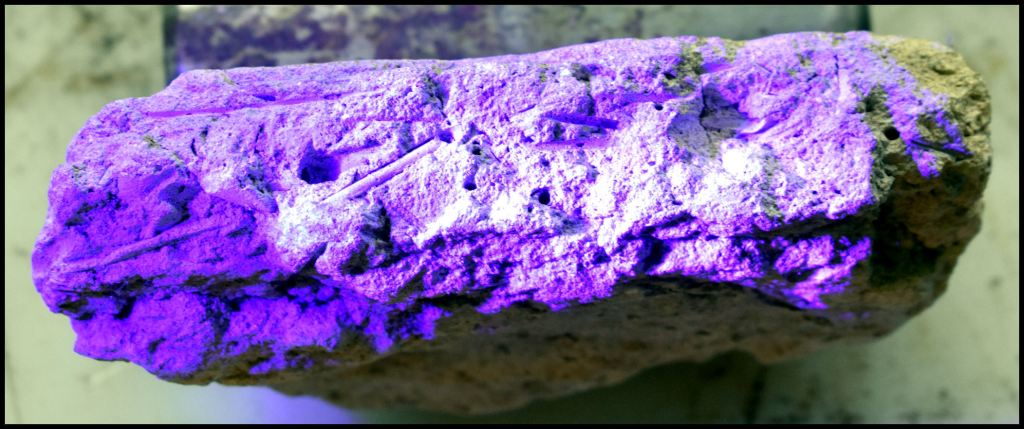
I illuminated the profile of the concrete with intense ultraviolet light. This makes the particles of calcium carbonate from hydrated, powdered limestone and crushed seashells stand out. Note the stems of straw preserved in the concrete. The chemically active volcanic clay was concentrated on the inner and outer edges of the concrete.
The aftermath
Upon taking my 50 kg of artifacts to be examined by Dr. Piña Chan, I was shocked to learn that he had been fired by the new president, Luis Echeveria, during the month that I was in southern Mexico. The kind-hearted archaeologist had plenty of time on his hand to share with me and his graduate assistant, Alejandra. He was packing up his belongings when I came in with the box.
When no employees were around, he told me that Echeveria had long carried a grudge him because he had attended a memorial service for the 224 Mexican college students killed in the Tlatelolco and Polytecnico massacres in 1968. As Mexico’s Attorney General, Echeveria had orchestrated the massacres, just prior to the Olympics.
Dr. Piña Chan spent very little time looking over the hundreds of potsherds, obsidian blades and simple bowls in my collection. He was flabbergasted by the piece of the mural. Like a good little architect, I had measured the whole concrete slab. He said it would be the largest intact mural ever found in Veracruz State.
There was a political problem, though. Dr. Piña Chan was no longer Curator of the museum. His boss and friend Ignacio Bernal, Director of INAH had allowed him to hang around a few weeks to finish up any projects and move his belongings on a temporary consulting contract, until it was time for the students to go back to their universities. The mural WAS significant patrimony, but he couldn’t give me a waiver.
Here is what Dr. Piña Chan decided to do. Alejandra was the graduate assistant, who prepared my revised course syllabus and travel itinerary. She was from a wealthy family, a graduate of the University of Texas and was always being picked up for lunch by very wealthy men, driving Mercedes, Porches or Cadillacs. I never made an effort to know her, assuming that she was out of my league.
Alejandra was still employed by the museum and INAH until Friday of that week. He told us to take a staff car first thing in the morning and drive the 270 km (168 miles) to El Tajin, photograph the wall slab, get a larger sample of the mural then come straight back. He would have the paperwork ready for her to sign upon her return, giving her full credit for discovering the mural. He was classifying my chunk of concrete as being a small sample from the mural slab discovered by Alejandra. That stunt insured Alejandra being hired by INAH the next summer as an entry-level archaeologist . . .not just a post-graduate student in archaeology.
The mural that “we” discovered is now on display. I am no sure if it is in the national museum or the one at El Tajin. Just look for a huge mural with a burgundy colored frame.
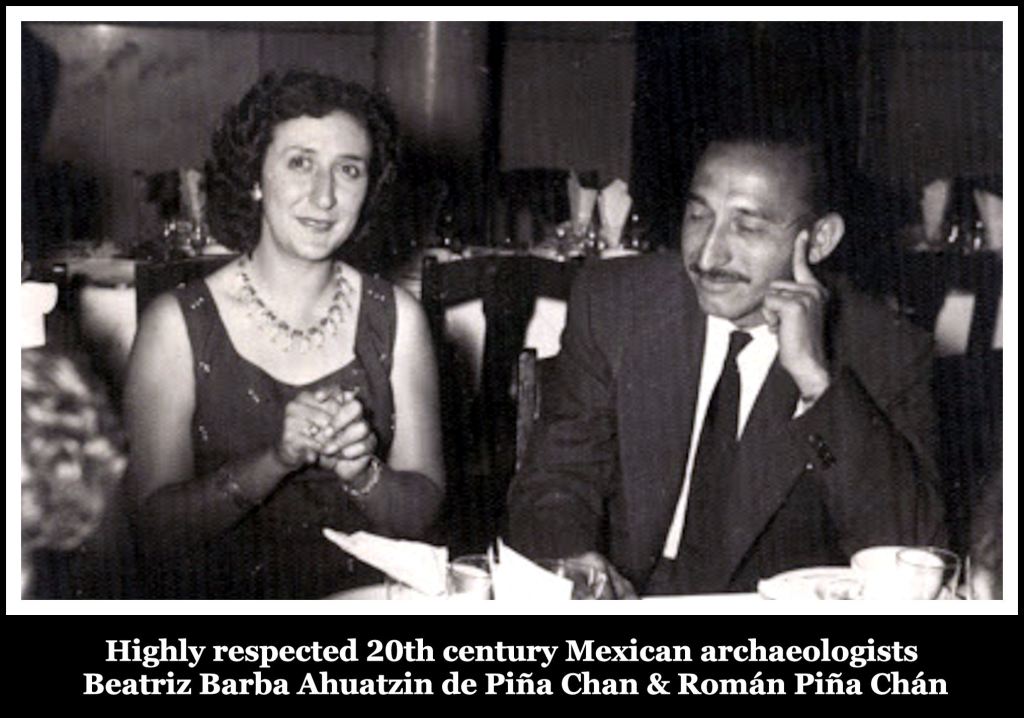
On Saturday, Román and Beatrix Piña Chan took Alejandra and I as their guests to a posh restaurant overlooking the Paseo de la Reforma. We were the beneficiaries of Román’s remaining VIP entertainment budget. Back then Mexicans ate their main meal at around 2 PM.
Beatrix left after the main meal, but Román was playing matchmaker, so plied us with the best possible wines for the remainder of the afternoon and early evening. He was an extraordinary man . . . brilliant . . . a little eccentric, because he was always asking himself questions . . . but extremely kind to all people, regardless of their socio-economic status.
I had to leave for Atlanta on Tuesday, so did not have the opportunity to carry on a private conversation with Alexandra until December 1980. She unknowingly walked across my camera’s viewfinder, when I was about to take this photo in Tepoztlán, Morelos.

_
_
_
 The Americas Revealed
Thoroughly fascinating! And I would love to reblog this, wholly intact, if that is okay?
LikeLiked by 1 person
Thank you! You are welcome to reblog anything on here.
LikeLiked by 1 person
Beautiful! I know you have posted several articles I am interested in learning about (now that I’m retiring). Thank you!
LikeLike
Good stuff, Richard! Amazing insights into worlds we have little knowledge of … and I don’t mean the artifacts. They’re pretty amazing too.
LikeLiked by 1 person
From what I was taught, a balam/jaguar will attack a person only if the person is a demoniac. A demoniac is a witch who does human sacrifice and/or cannibalism (skinwalkers are a good example). Jaguar will jump at a human if startled but to escape. Most cats just run, but Balam is assured of his holiness as one born of the Sun by the will of Old-Father. It’s to frighten fools into awe and humility.
You had a very interesting adventure at Teotihuacan and my respect to the good doctor. To buck the PRI Dr. Piña Chan was true to his machismo and an example to anyone who calls himself a man. We bear our scars with pride and our women call them beauty marks.
May Balam bring joy to your dreams. niio
LikeLiked by 1 person
Richard,
That figure you collected looks almost more like a 3D map if you look at it straight on from the photographs.
The split in the El Gordo mountain towers above the other mountain and small hillsides near where Teotihuacan might have been located, with what appears to be a cave carved at the bottom of a split mountain side (El Gordo) and another mountain off on the distance with possible scale caves in a secondary mountainside as well.
Maybe it is a small landscape mural instead of a jaguar or dog eating a human, or perhaps it is also duplicative in a representation of folklore to describe the landscape, such as a volcano devouring the landscape, being equivalent to a jaguar or dog devouring human flesh?
I wonder if it was a planned celestial modeled guide for placement or construction of great importance? I would think if someone trekked all that way up the mountain to place that there, there would be some value in its placement where you found it.
That shaped top of El Gordo (or the dog’s had is pretty interesting and unique when you see there is a split in El Gordo from some of your aerial and early geospatial photographs.
It also resembles something riding on a cloud from the side as well, which may also convey a volcanic ash event
Just some thoughts. Geographically, it may represent what a stone artisan viewed and carved from a mountain top, and may have additionally infused some license of folklore for iconic imagery of the landscape.
Very Respectfully
Zac
LikeLiked by 1 person
One of the earliest religions in Mexico involved a myth of jaguars devouring humans and then having children, who were half jaguar and half human. However, jaguars do not have floppy ears like some dog breeds. That is definitely a human skeleton. You can see the human pelvic bones on the far end. They are faint on the photo, but quite visible with a magnifying glass. Thousands of children were killed and eaten by the occupants of the town on top of Cerro Gordo.
LikeLike
Fascinating artifacts and incredible discoveries! It’s amazing to see these unique pieces of history.
LikeLiked by 1 person