
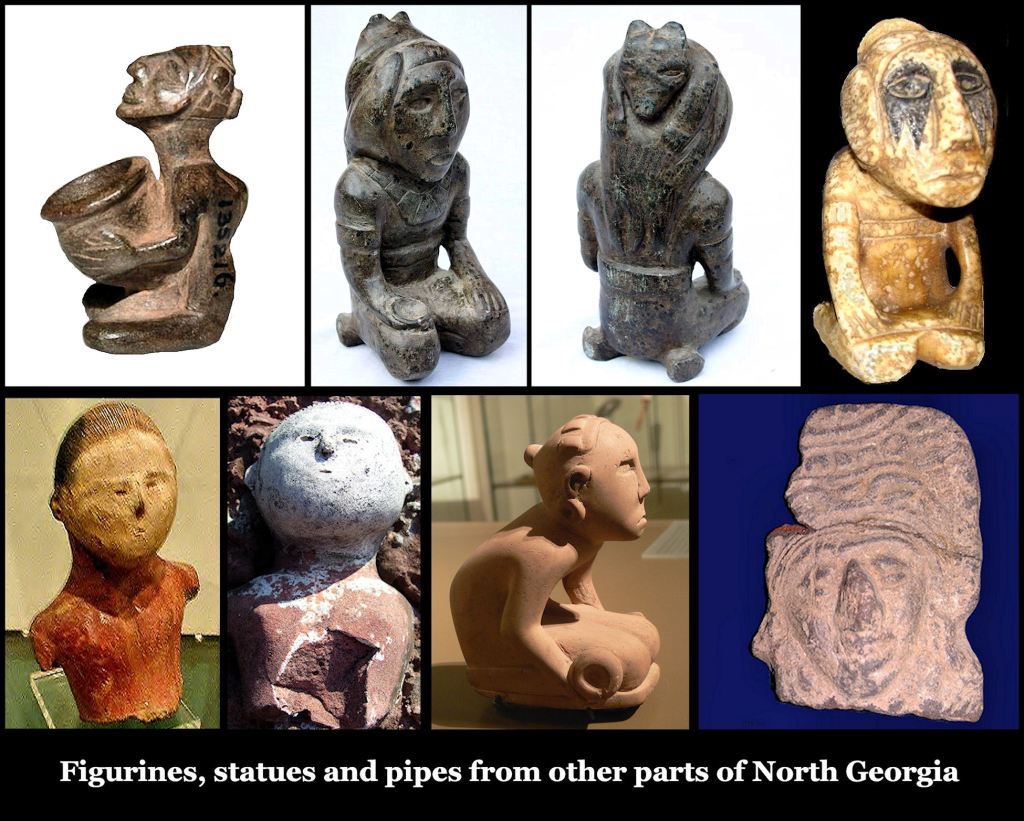
They reflect the various Mesoamerican peoples, who later merged to form the Creek Confederacy, Seminole Confederacy and Miccosukee Tribe. Chickasaw architectural traditions are derived from those of early Campeche Maya immigrants, who were absorbed by proto-Chickasaws. These figurines above were found near the Soque River in Habersham County, Georgia. They portray ancestors of the Federally-recognized Seminole and Miccosukee Peoples, now living in Florida and Oklahoma.
by Richard L. Thornton, Architect & City Planner
The Secret History of the Southeastern Indigenous Peoples – Part Four
The ivory-colored, ceramic figurines above were made from Ball Clay, a primary kaolin that is a gray color before firing. The pink porcelain figurines are made from a black clay which occurs in a 4-6 inch band within the red clay of Northeast and North Central Georgia. It was probably produced by the impact of a large asteroid or perhaps, the eruption of a large caldera volcano.
The Sokee and Miccosukee
At the time that Charleston was founded in 1671, the Sokee were described as the largest, most powerful and most advanced tribe in South Carolina . . . and the culturally most advanced, north of Mexico.. South Carolina originally included most of what is now the State of Georgia. The Sokee-Miccosukee Migration Legend specifically states that their ancestors were the progenitors of a great civilization, which preceded the Maya Civilization. That is true. Gringo archeologists incorrectly called it the Olmec Civilization.
This legend also states that they are the descendants of people, who were ravaged by Mexica (Aztec) raiders, who ate their children. Other Sokee (Soque) bands fled into the mountains of Chiapas State, Mexico, where they are known as Zoque or Soque today.
The story says that they were the last members of the future Creek Confederacy to arrive in the Southeast. Earlier immigrants from Mesoamerica had intermarried with the Uchee and Chickasaw then absorbed many of their cultural traditions. The Sokee adapted to the local cultures and began obtaining more protein from hunting game and fishing, rather than depending on plants. As a result, they became taller and stronger .
Many Soque intermarried with Europeans. Mixed-heritage descendants have spread all over the nation, but most live in either northern Georgia, east-central Alabama or northern Florida.
In 1818, when the heart of the Sokee Homeland was ceded to United States to become Habersham County, Georgia, several Sokee bands first moved to South Georgia then to northern Florida and then to southern Florida. In the late 1800s and early 1900s, they lived between the Everglades and Palm Beach, FL. They now are concentrated in the Big Cypress Swamp, about 70 miles west of Miami.
Apparently, my Native ancestors spoke a dialect of Itsate-Creek similar to Miccosukee. When scanning a Miccosukee glossary, I recognized several words that were taught me by my great-uncles or Uncle Hal that are quite different in the Muskogee-Creek dictionary. I also know some Itza Maya and recognized words in Miccosukee that are exactly the same in Itza.
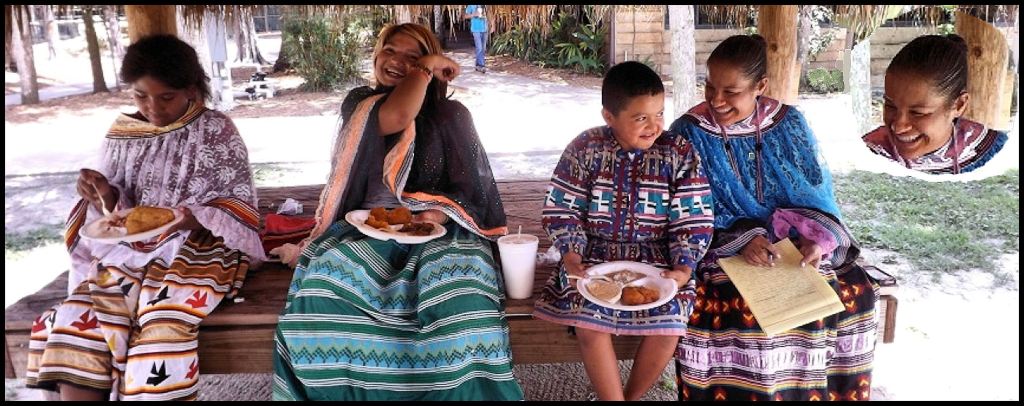
The Sokee usually have larger noses and broader heads than Itza Mayas and Itsate Creeks. The woman on the right also has some Parakusate heritage. Her skull extends backward over the neck like many people in Europe and Peru with Parakusate heritage. The Parakusate’s DNA has been traced to southeastern Ukraine.
A large body of full blooded Sokee moved to southern Florida, where they intermarried with a smaller band of their cousins, the Mayas, who had fled Yucatan to escape persecution from the Spanish. Yes, the plot of the movie, “Apocalyto,” is based on fact . . . but the movie’s writers didn’t know it. They came to call themselves Mayas and were called Mayas by southern Floridians.
In 1950, the South Florida “Mayas” first sought to become a Federally recognized tribe by that name, rather than being grouped with the new Seminole Tribe of Florida. The language that they spoke was so close to several Western Maya dialects that they can carry on conversations with each other. The South Florida Mayas were refused by the Bureau of Indian Affairs, because it might encourage Mayas from Mexico to immigrate to the United States.
Most of the Florida Mayas eventually opted to be in the federally-recognized Seminole Tribe of Florida as was the case of a great-uncle of mine, living in Florida. One band eventually re-petitioned to be recognized under the tribal name of Miccosukee, which was the Anglicized Creek name of their principal village. The real name was Mako Soke in their own language. The words mean, “King of the Sokee”
Seven decades later there are several million Mayas and Soque from Mesoamerica living in the Southeastern United States. LOL
The figurines above
Figurine 1 - This is the head of a Sokee (aka Zoque or Soque) leader. His ornate turban is very similar to statues of Zoque-Soque kings in southern Mexico.
Figurine 2 – This is probably a very tall, Parakusate or “egghead”. English explorer, Richard Brigstock (1653), said that the ruling elite of the nearby Apalachete were Parakusate They were the same people as the Paracus eggheads, who once lived on Nazca Plain in Peru. Archaeologists Robert Wauchope and Joseph Caldwell excavated a very large Parakusate town on the Upper Etowah River in the Allatoona Mounds about 10 miles upstream from Etowah Mounds. They were probably the founded of Etula (Etowah Mounds).
Figurine 3 – This is probably a Sokee or Apalachete man.
Figurine 4 - This is an Itza Maya (Itsate Creek) leader or priest. Itsate Creeks have square heads, protruding chins and pronounced cheek bones, plus much smaller noses and ears. The ears typically do not have lobes.
Figurine 5 - This is a Chickasaw man. Chickasaws have “long” skulls, plus ears and noses, smaller than the Sokee.
Figurine 6 – This is probably an Itza Maya (Itsate Creek) woman.
The Itsate Creeks Today
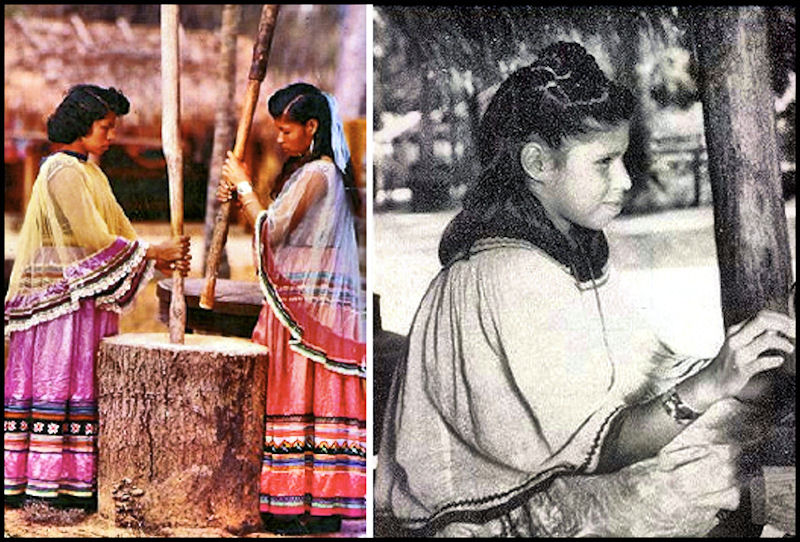
These are photographs of young Itsate (Hitchiti) Seminole women that were taken, when my family went on Florida vacations from Waycross, GA. Note that these ladies, like Eastern Creeks in Georgia, do not have ear lobes.
Some large Georgia statues


–
Life is stranger than fiction

This lovely Itza Maya teacher was my assigned companion at a FLN (now Zapatista) guerilla training camp in eastern Chiapas State. She is admonishing me to let her put on lipstick and a prettier dress, before taking a photo to show my friends in Atlanta. It is likely that many of the Native women, who early European explorers saw in the future state of Georgia, looked very similar to her.
You see . . . one of many misperceptions about the Southeast’s past is that when Georgia was founded in 1733, it was occupied by Muscogee Creeks. Actually, most of the future territory of the State of Georgia was occupied by Itsate speaking Creeks. The Muskogee-speaking tribes were indigenous to the North Carolina Mountains .
At both FLN camps, I was assigned an English-speaking college student or recent graduate as a 24-7 companion. I was posing as a college student reporter with the Great Speckled Bird hippie newspaper, but actually was quite sympathetic to their cause. My final reports were objective like a good newspaper article, not propaganda.
You would have thought that the situation of us coming from two different worlds to be suddenly paired, would have been painfully awkward, but it wasn’t. At the time, I didn’t understand why, but it was like we came from the came cultural heritage. We had almost identical personalities and values. It seemed bizarre, but she seemed like a intelligent lady that I met at a family reunion, who was distant enough a cousin to be legal. I really had much more in common with her than any of the Gringas that I have met in the past 20 years.
Like most Mayas, I met then and now here in North Georgia, she hated the Spanish language and Spanish cultural traditions. They dream of the day when Mayas only speak Maya and English . . . a little French is okay, I guess. She had given herself the alternate English name of Natalie . . . after actress Natalie Wood.
Alas, though Natalie’s job was teaching teenagers English, world geography and democracy, she was still a soldier at war with the government of Mexico. It would be impossible for us to communicate long distance . . . even with conventional mail. By the way, her side won. The Zapatistas control most of the State of Chiapas and are participating in the current government of Mexico.
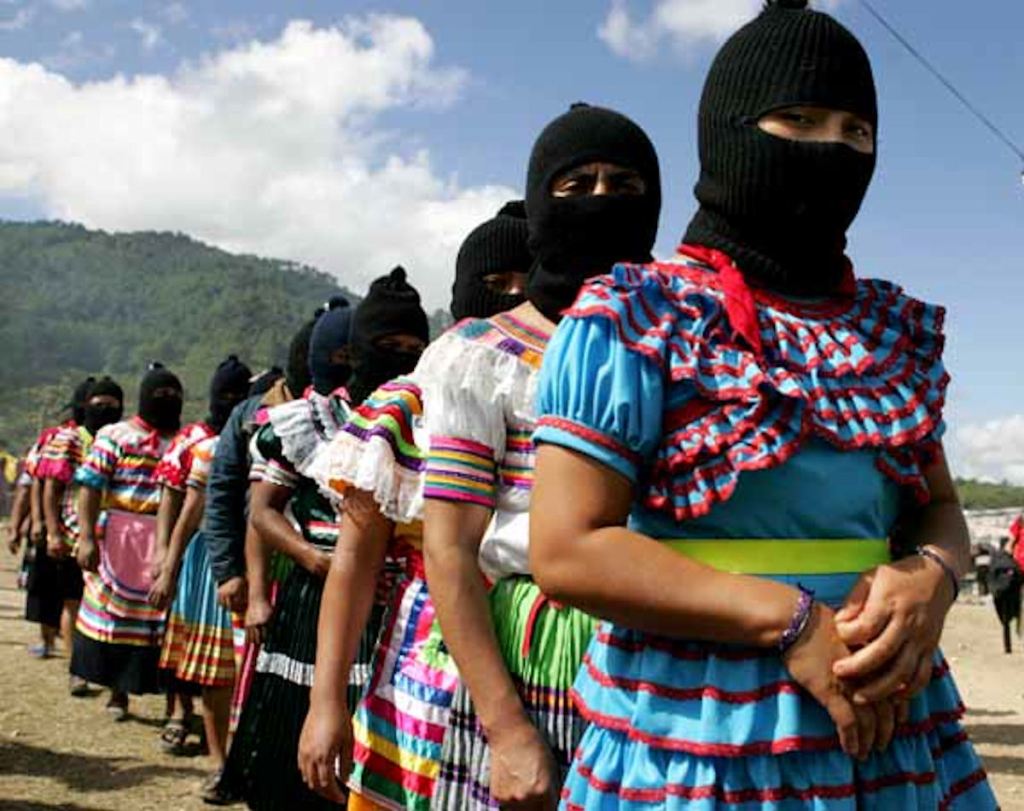
Female Zapatistas, but not Itza Mayas
While traveling through Mexico, I found that I could not “connect” with the Indios of Central Mexico. They often looked at me like I was not human.
As soon as I hit southern Mexico, everything changed. Both the Indios and the Mestizos were extremely friendly. Several total strangers invited me to dine with their families. Mothers would approach me with their eligible daughters. The Rojas Family in Campeche, who were about 1/4th Maya, blatantly encouraged their 21 year old daughter and I have have a close relationship. They treated me like a son.
I had no clue at the time that I had substantial Native ancestry, because in that era Hollywood used actors from the eastern Mediterranean Basin to portray Native Americans. I would not know until 2005 that all of my Native American ancestry was from southern Mexico and eastern Peru. So . . . I really was “family” in southern Mexico.

The Tamulte Maya of Tabasco are the only tribe in Mexico, who eat grits, hushpuppies and corn-on-the-cob. They are also the only tribe that celebrates the Green Corn Festival and the New Year’s Day on the Summer Solstice. They can carry on conversations with the Miccosukee and Itsate Seminole. Yes, of course, they dance the “Stomp Dance.”
All “Americans” do NOT have the same body chemistry!
Itza Maya, Campeche Maya and Itsate (Eastern Creeks) women have physiques different than women of many Native American tribes in North America and Central America . . . and very different than European women. The Itza Maya, Kekchee Maya, Tamulte Maya and Eastern Creek women tend to be around 5′-6″ (157 cm) to 5’8″ (173 cm). Unlike most Native American women, very few ever have problem with obesity, alcoholism or diabetes. They tend to kept gracile figures their entire lives, without worrying about what they eat.
Well, there are two major exceptions. Itsate (Eastern) Creeks are highly sensitive to wheat products and food preservatives. Whole wheat bread does not usually have as toxic an impact, but that is not always certain. It is common for Eastern Creek women to have their gall bladders removed by age 30, if they have been eating a typical Gringo diet. I strongly suspect that their cousins in Southern Mexico have the same problem.
The toxic effect is accumulative. If they do not go back to a traditional Creek diet of unprocessed foods, no preservative chemicals and minimal wheat, their colon may atrophy and removal of most of the colon may be required. A 21 year old lady in our tribe was forced to have half her colon removed, because of the damage done by a modern American diet!
The impact of a modern diet on Eastern Creek men is not as rough on the gall bladder and colon, but our entire digestive system may become enflamed. My personal problem with this issue was greatly enhanced by being almost killed by poisoned tea three decades ago, plus at least seven years prior to that of exposure to arsenic. I carry a nylon mesh inside my abdomen.
My belly had swollen up like a balloon, even though I didn’t drink beer and exercised regularly. An internist said that is was all water, not fat . . . swelling up the cells of internal organs and tissues as if I had been stung by a giant wasp.
The only way I have found to start flattening my “beer” belly is to eliminate food preservatives and wheat products as much as possible. That means avoidance of restaurants and processed foods.
I am daily consuming tropical fruits, typical of southern Mexico, plus eating stone ground whole kernel grits and stone ground corn meal bread as much as possible. Supermarket cereals, flour, grits and corn meal now contain large quantities of fungicides these days! My main sources of carbohydrates at supper time are brown rice and sweet potatoes. Slowly, but surely the organs are shrinking.
Now you know!
 The Americas Revealed
This is very interesting Richard. I was intrigued by those which didn’t have ear lobes.
LikeLiked by 1 person
Being a professional archaeologist in another part of the world, I thought that you would find the photos interesting. I don’t have ear lobes either. Since I don’t wear ear rings, that is not a problem. LOL
LikeLiked by 1 person