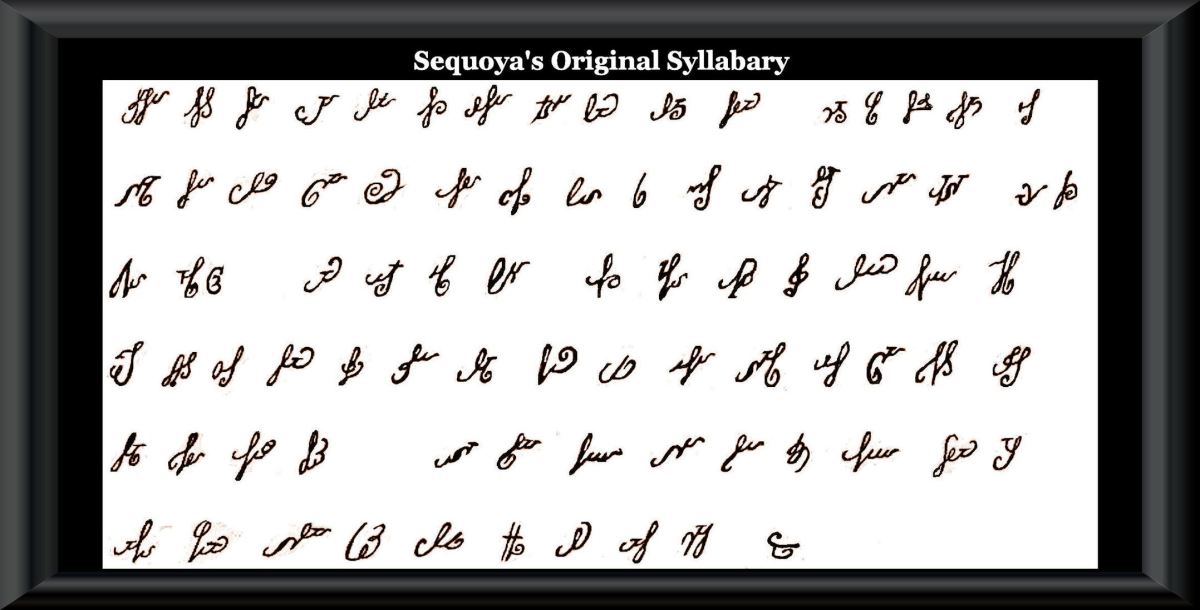
Sequoyah Syllabary introduced – c. 1820
Current Cherokee Syllabary introduced – 1827
The Cherokee Syllabary used nowadays was developed by Cherokee leader, Charles Hicks . . . a white missionary, the Rev. Samuel Worcester . . . and Cherokee Phoenix editor, Elias Boudinot, in 1826 – after Sequoyah had moved out west. Worcester continued to make modifications to the symbols until his death in 1859. However, throughout the 1800s and up until the late 20th century, the contemporary syllabary was called “the Hicks Syllabary.”
Hicks wrote in 1826 that Worcester, Boudinot and John Ross were grossly ignorant of real Cherokee history. The articles that Worcester secretly wrote in the Cherokee Phoenix Newspaper on Cherokee history are almost consistently fictional propaganda aimed at wealthy New England donors to the missionaries and tribal government. Even though the Cherokee language version of the Phoenix was free for tribal members, so few Cherokees read it that the newspaper soon shifted to only publishing English language editions. Yet today, academicians cite the Phoenix as a factual source for scholarly articles.
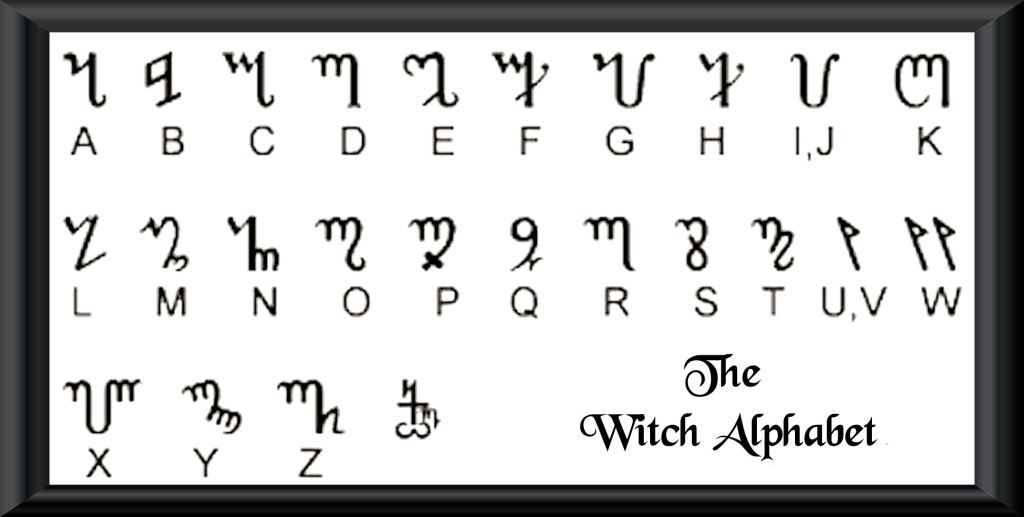
Worcester was the actual author of most articles in the Cherokee Phoenix, but always used Boudinot’s name in the byline. Boudinot ran the printing press. In initial experiments, the two found it impossible to achieve legible printing with Sequoyah’s symbols. Also, all of the missionaries in the Cherokee Nation were concerned that Sequoyah’s symbols strongly resembled the “Witch Alphabet” used by alchemists and occultists. Indeed, some of the symbols are identical.
–
North Carolina Cherokees bitterly opposed the creation of a new writing system, because it would hinder communications with whites and to them, appeared to be the “work of the devil.” Sequoyah and his first wife were abducted and brought to the North Carolina Mountains, where they were sentenced to be tortured to death for practicing witchcraft. They were subjected to excruciating pain over several days, until rescued, near death, by a troop of Georgia Cherokee Light Horse Police, led by John Ridge, Jr.
Sequoyah’s wife died soon after, while Sequoyah was left maimed and disfigured for life. He and his sons moved to the Cherokee band in Arkansas. The man, who you see in paintings of him is not him.
Hicks, however, gave full credit to Sequoyah for coming up with the idea of using a syllabary rather than a European-type alphabet in his manuscript, “History of the Cherokee People.” It was also Hicks idea to have a silver medal struck in Sequoyah’s honor, but the medal, plus all mentions of him in Hicks’ book, call him George Gist.
In later years, the myths were created that Sequoyah was lame from falling out of a tree as a teenager and that he fought in the Battle of Horseshoe Bend on behalf of Andy Jackson, when he was in his late 50s. Sequoyah did fight with the Chickamauga Cherokees as a young man . . . undoubtedly like his comrades, Charles Hicks and Major Ridge, killing quite few white settlers.
The Secret History of the Southeastern Indigenous Peoples – Part Five
by Richard L. Thornton, Architect & City Planner

Interestingly enough, there is no mention of Nancy Ward in Hicks’ History of the Cherokee People even though, they were both born in Georgia, about 20 miles apart. The Battle of Taliwa, which in modern myths, she supposedly fought in, never occurred, and there was never a Creek town named, Taliwa, anywhere.
The Creek-Cherokee War ended in the autumn of 1754, after an army from Coweta captured and burned all Cherokee villages, south of the Snowbird Mountains. The destroyed villages are noted on John Mitchell’s 1755 Map of North America. The Cowetas executed 32 Cherokee chiefs then forced the Cherokees to sign a peace treaty on the 40th anniversary of the murder in their sleep of 32 Creek chiefs at the Uchee village of Tugaloo.
Nancy was definitely a real person, who was greatly admired by Native Americans and white settlers in Northeast Georgia. She is mentioned frequently in late 18th and early 19th century Georgia newspapers. The details of her real life can be found in “The History of Franklin County, Georgia.“ She was born in Chote, which was the name of Helen, GA from around 1000 AD to 1822 AD. She was of mixed Jewish and Southern Mesoamerican heritage. The mythical Nancy was created by a man in Tennessee via publishing of a dime novel, four years after her death.
At about the age of 16, she moved in with Irish immigrant, Bryan Ward, who was a member of the Georgia Rangers at Fort James on the Savannah River, plus traded with Native Americans in northern Georgia. He was not licensed to trade with Cherokees in present-day North Carolina and Tennessee. They later lived together in the southern (Creek) part of what is now Stephens County, GA.
Bryan formally married a white woman after the American Revolution. Nancy moved by herself to the Cherokee Territory on the Ocoee River in 1795, but returned to NE Georgia often to visit with family and friends. Her children from several relationships in Georgia, stayed in Northeast Georgia, where their descendants live today.
An eyewitness to the syllabary’s introduction
While writing my Thesis for Georgia State University, I worked full time for the Atlanta Planning Department, whose offices were adjacent to the campus. It was a lucky decision, because I was the only person in the planning department, who could prepare architectural and urban design drawings. The earlier people, hired as Urban Designers, were Liberal Arts graduates, who knew nothing about Urban Design. LOL My projects there were the Midtown Atlanta Urban Design Plan and conceptual design for the Atlantic Station Development. (Yes, really!)
Shortly after receiving my Masters Degree in Urban Planning from Georgia State, I was hired by James Wright Associates in Atlanta to be their Director of Urban Design and Physical Planning. My initial job with the firm was to provide land use planning assistance to federally-recognized tribal reservations around the United States . . . a project funded by the American Indian Housing Council. After completing those assignments, I prepared the first Comprehensive Plans for Auburn, AL, Opelika, AL and Charleston, SC. I was subsequently hired by the City of Asheville, NC to plan and lead its Downtown Revitalization Program. That turned out pretty well.

My first client was the Eastern Band of Cherokee Indians! Houses, built by the Qualla Housing Authority were washing off the sides of mountains! The commercial part of Cherokee, NC looked like a county fair . . . well, more like an Appalachian flea market.
At almost the same time that I arrived at Qualla, two Cherokee teachers from the Oklahoma arrived to teach the North Carolina Cherokees how to write with the Hicks Syllabary. About that same time, they changed the name to the Sequoyah Syllabary, even though Sequoyah probably never saw the Hicks Syllabary and wouldn’t have understood the meanings of the symbols, if he did.
The State of North Carolina paid for the two teachers, because they thought it would be good for tourism, if the North Carolina Cherokees wrote with an exotic writing system. The Cherokee Syllabary had never been used in North Carolina, prior to then.
Oh! Did I mention that upon entering the tribal offices I was handed a brochure, which described the official history of the North Carolina Cherokees? It said that the Cherokees originally lived far to the north, but arrived in the Southern Mountains in the late 1600s. Western North Carolina was almost uninhabited, because of a terrible plague. The brochure emphasized that the Cherokees did not build any of the mounds in the Southeast.

Reconstructed office of the Cherokee Phoenix Newspaper
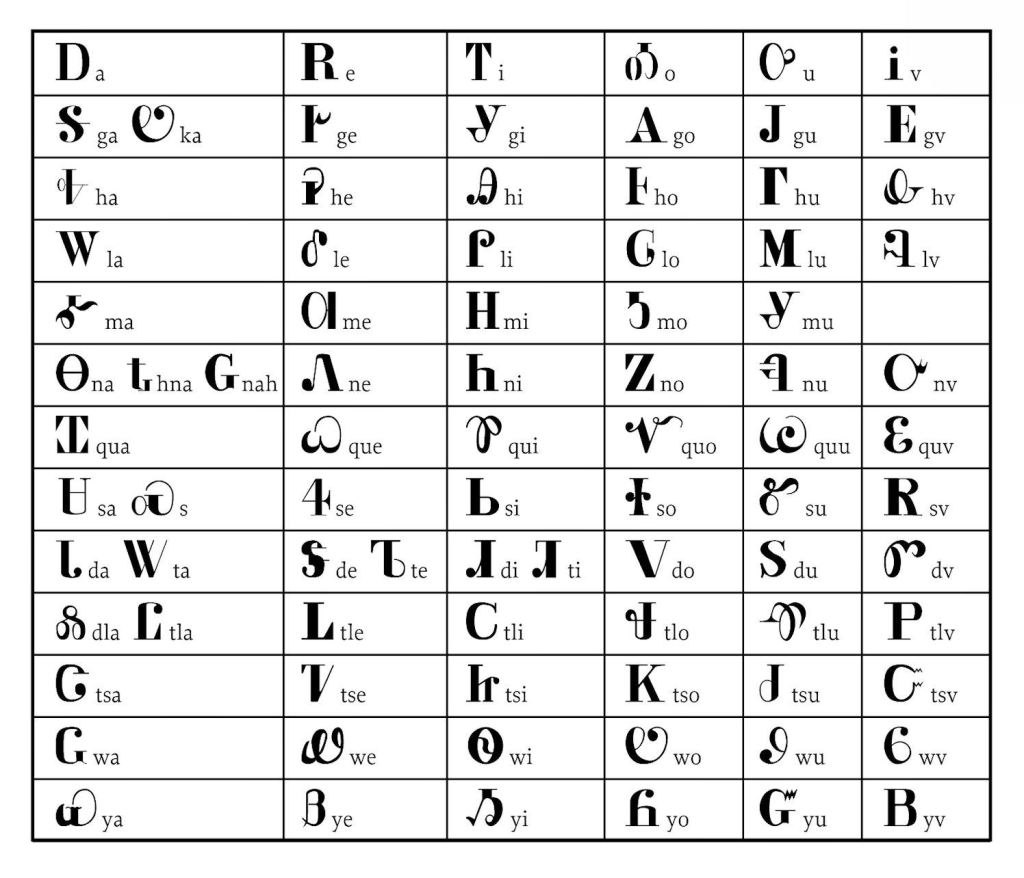
The contemporary Cherokee Syllabary
Below is the Cherokee Syllabary, used today, but even it is a little different than the version utilized by the Cherokee Phoenix Newspaper. You can see that most glyphs are entirely different than what George Gist created. Most of the symbols on Sequoyah’s original syllabary can be found as alphabetic letters in the Late Medieval scripts, used by the Christian Anatolians, Armenians and Circassians. As I have said before, a significant portion of what you read about Southeastern Native American history in Wikipedia and even, books written by academicians, is modern mythology!
–
Now you know!
–
FOOTNOTE: Charles Renatus Hicks functioned as the real leader of the Cherokee Nation from 1817 till his death from diabetes in January 1827. He wrote the Cherokee Constitution. He had one of the largest personal libraries in the United States. It was he who invited in the missionaries to educate the Cherokees. He was a close friend of Creek Mikko William McIntosh and deeply grieved McIntosh’s “mob” execution in 1825.
Hicks chose the site of the Cherokee capital at the location of where the Kansa People first lived, when they moved from near Guntersville, Alabama to NW Georgia. He prepared the capital’s town plan and supervised the surveys of the lots, plus the construction of the public buildings. Hicks also gave the capital its name, Echote. Echote is an Itza Maya word, meaning, “Principal town of the Cho People.” A dialect of Itza would have been spoken in the part of NE Georgia where Hicks grew up. The Cho Mayas still live in Tabasco State, Mexico.
Yet, Hicks’ name is barely mentioned in the New Echota Museum in Georgia and Museum of the Cherokee Indian in North Carolina.
 The Americas Revealed
Thank you, Richard, for once again so carefully challenging long-standing myths and bringing truth and clarity to the history of Southeastern Native peoples.
LikeLiked by 1 person