
The founding of New France and first contact with the Cherokee in what is now Quebec . . . Why thousands of French Protestants immigrated to British colonies in North America and some Cherokee descendants carry substantial Nahua DNA from northern Mexico.
The Forgotten Native American history of the Southeastern United States – Part 15
by Richard L. Thornton, Architect & City Planner
Soon after establishing a trading post and headquarters in Quebec, Samuel de Champlain made contact with several tribes, who 43 years later would migrate southward into what is now the United States and play significant roles in the British North American colonies. One reads anthropology texts, published in the United States, however, and observe academicians either labeling these tribes as “of mysterious origins” or in the case of the Cherokee, creating fairytale histories that don’t jive with Colonial Era maps and eyewitness accounts.
The omission of Canadian history from United States history texts continues to this day. It is inexplicable and very embarrassing. Our educational system is producing generation after generation of citizens, who are largely ignorant of the history and indigenous peoples of our good neighbor to the north.
- My year-long high school World Geography course spent a one hour class on Canada.*
- My three World History courses at Georgia Tech possibly spent 20 minutes on Canada. My six quarters of World Architectural History at Georgia Tech . . . a far more detailed cultural history than the Freshman World History courses, discussed three Canadian structures . . . igloos, the Canadian National Railways Tower in Toronto and Habitat 67 in Montreal. I still have the textbook!
- My four postgraduate courses at Georgia State University in Urban History allotted about 15 minutes to Quebec and Montreal . . . two world class cities, noted for their cultural sophistication and livability.
*Lest you think I lived in Podunkville, Jawja . . . My alma mater was the No. 1 rated public high school in Georgia – academically. My senior class produced the Star Student for the State of Georgia. Eighty-five percent of our senior class went on to college. I also played on an undefeated football team in which almost half of the first string players were also honor graduates. .

Habitat 57 was designed by Architect Moshe Safdie in conjunction with the 1967 Worlds Fair.
The French Colonial Archives
There is absolutely no excuse for academicians in the United States ignoring the detailed information on Native America in the French Colonial Archives. The original documents are maintained in the Downtown Toronto Research Library. Copies of both the English translations and the original French documents are accessible online. The English translations have been held by the Library of Congress for over a century. All of the detailed maps, showing locations of individual Indigenous tribes in specific time periods by Jacques Le Moyne, Jean Baptiste Franqueline and Guillaume De L’Isle are available at both libraries and online.
During the 20th century and continuing into the 21st century, an inaccurate orthodoxy has developed, because academicians completely ignored the reports of Samuel Champlain and Stephen Brulé in the early 1600s . . . the explorations of René-Robert Cavelier, Sieur de La Salle . . . and then the numerous French civil engineers & Royal Marines, who mapped the rivers of Southeastern North America in the late 1600s.
Differences between original French books and English translations: There are slight differences between the French language and English translations of these books. French authors consistently called the Cherokees either Charioqui or Charoqui. The translators of these books into English used the Iroquois name for the Cherokees – Charioquois. You must use the Iroquois version as a search word.
Also . . . Samuel Champlain clearly described the Charioqui as a distinct ethnic group that was a vassal of the Tianontateca that was a vassal of the Huron. The Charioqui and Tinontateca were immigrant tribes, who did not own the land, where they lived. Apparently, they were allotted a specific territory, where they could hunt and fish. In contrast, the English translations describe the Charioqui and Tianotateca as being bands or divisions within the Huron Tribe. Typically, the translators wrote Charioquois (Huron). This translation error set the stage for decades of “kornfuzed” anthropological texts.

Habitation du Quebec – founded by Samuel Champlain in 1608. It was essentially a fortified trading post, which became the starting point for the City of Quebec. Painting by William Harvey Sadd.
Samuel de Champlain (1667-1635)
Today, he is honored as the father of Nouvelle-France (New France) and by extension, Canada. One finds his place name and statues throughout eastern Canada, in particular, Quebec. He stands unique among “founding fathers” in the Americas, because he was not only an explorer and colonial administrator, was also a cartographer, diplomat, chronicler, linguist and military commander. He lived with several tribes to learn their languages and customs.
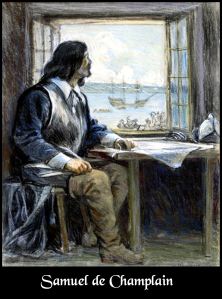
Monsieur Champlain was certainly not the first Frenchman to explore and map any part of Canada, but he played a key role in the founding of its first permanent settlements. These settlements will be described in the next article. He also produced the first reasonably accurate maps of eastern Canada. They provide the names of several Native American tribes, which were later pushed southward into land, claimed by the British crown.
He was born in either Brouage or La Rochelle, seaports on the Atlantic Coast of France, to a fairly prosperous middle-class family of mariners, navigators and merchants. However, extraordinary his achievements on behalf of the Kingdom of France, he could never “officially” be an officer in the French Navy or Army . . . the Royal Governor of Nouvelle France . . . because of France’s rigid feudal system. That would only end with the sting of the guillotine, almost two centuries later.
He was definitely baptized a Roman Catholic, but as an adult, was based in the city of La Rochelle, a French Protestant stronghold. However, his closest friend in New France was his Roman Catholic priest-confessor. That is not all of the story, however. Almost all French Catholics were baptized with the first name of a saint. It was common for French Protestants to take the name of a prominent person in the Hebrew Torah (Christian Old Testament). So, they typically had names like Adam, Samuel, David, Benjamin, Abraham, etc.
Furthermore, all of his expeditions to the New World included a sizable percentage of Protestants.* Several of his close relatives, even uncles, were Protestants. His royal sponsor, King Henry IV, was originally commander of the French Protestant army, but converted to Catholicism to bring peace to a bleeding France. However, under his reign, Protestants and Jews had the same civil rights as Catholics. Perhaps his parents did not know who was going to win the French Religious Wars and so “placed bets” on both sides.
Until 1633, when French Protestants were permanently banned from settling in France’s North American colonies, Protestant leaders hoped to transport Protestants and Jews, living in regions of France, which were particularly hostile to them across the Atlantic, where they would settle the interior of the Southeast, the Mississippi River Basin and what is now Canada. After 1633, they were forced to secretly flee to Switzerland, Germany, the Netherlands or Great Britain then obtain passage to a British, Dutch or Swedish colony in North America.
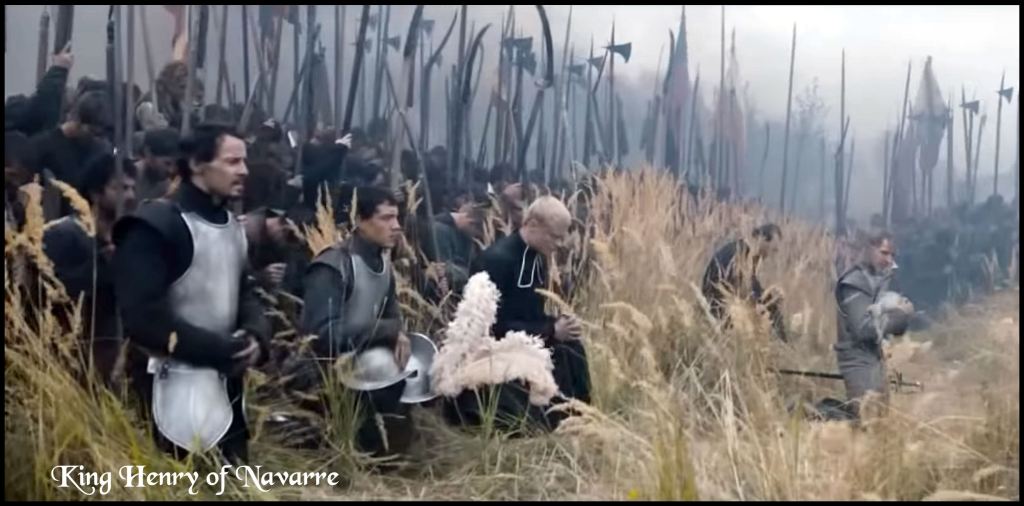
King Henry of Navarre, leading the French Protestant army in the Lord’s Prayer, prior to defeating the much larger Catholic League army (France & Spain) in the outskirts of Paris. This victory made him de facto, King of France. He led his triumphant army into Paris, but there was no bloodshed. The predominantly Catholic residents of Paris were terrified of the Protestants, because they had repeatedly defeated much larger, better equipped Catholic armies. Nevertheless, King Henry decided to be baptized a Roman Catholic in order to end the bloodshed. The Roman Catholic clergy and residents of Paris would never accept a Protestant king.
His Edict of Nantes in 1598 gave substantial civil rights to mainstream Calvinist and Lutheran Protestants (not Anabaptists) and substantially ended the French Religious Wars. The revocation of the Edict of Nantes in 1685 made Protestantism illegal and quickly forced over 200,000 more middle class French subjects to flee their homeland. This revocation by King Louis XIV also provoked extreme hostility in Great Britain . . . and a series of wars, which ultimately caused France to lose all of its colonies in North America, 79 years later.
Champlain sought to learn to fight with the firearms of his time, because each ship had to defend itself against enemy borders, in the naval tactics of that era. He acquired military skills, while serving with the army of King Henry IV during the later stages of France’s Religious Wars in Brittany from 1594 or 1595 to 1598. His rank initially was a quartermaster responsible for the feeding and care of horses. He was not “officially” an officer, but had the authority of a colonel or sea captain.
Many of the founders of the French Protestantism were lower and middle tier nobility from regions of France that had originally been Arian Christians in the Late Roman Era and Albigensians in the Medieval Period. They hated the Inquisition, but also accepted feudalism as the norm.
While King of Navarre, a Basque kingdom in what is now SW France, King Henry developed a means to reward middle class soldiers of special talent and bypass feudalism. They were given specific “job assignments” with the full power of the Crown behind them, but were not awarded officer’s titles. Champlain quickly rose in King Henry’s respect. Thus, for most of his time in New France, Champlain had all the powers of a Royal Governor or Viceroy, but not the title.
Our next article in The Americas Revealed will provide a chronological overview of Champlain’s achievements in New France. The discussion will also include several of my architectural renderings from the book, Earthfast.
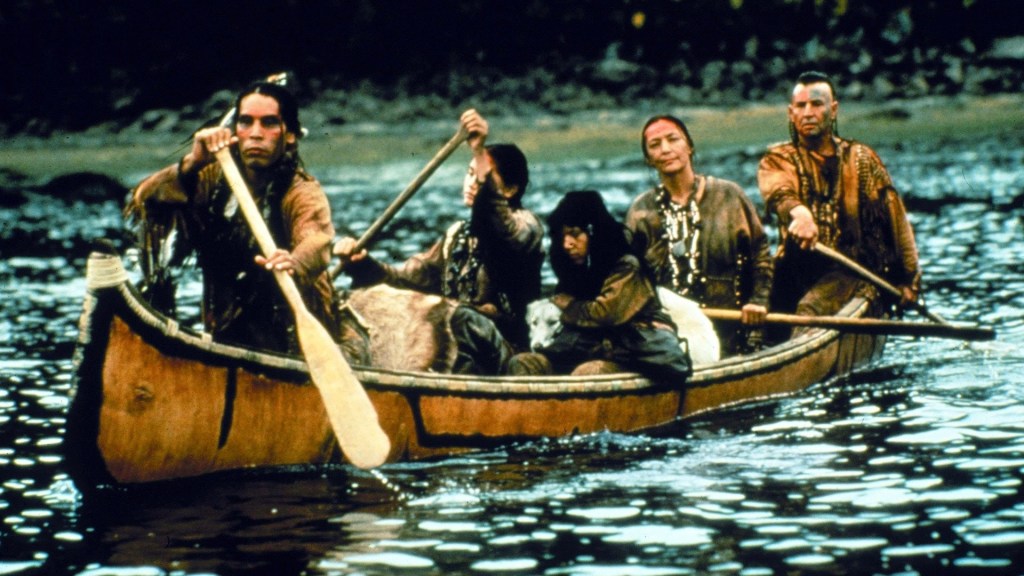
In this article we will focus on the indigenous peoples, who were living along the Saint Lawrence River Basin between Quebec Cité and Lake Erie in 1600 AD. In the mid-1600s, many of these peoples were forced southward by the Iroquois Confederacy. They include the Wyandot, Erie, Cherokee, Ojibwe, Potawatomi, Tionontati, Cat (Chat), Neutral, Attignawantan and Wenrohronon (Wenro). Iroquois raids combined with Rickohocken slave raids caused the Tamahiti (Itsate Creeks) to abandon western Virginia and return to Georgia.
The Charioqui (Cherokee) and Tionontati are mentioned several times in the memoirs of Champlain and Brulé. The Charioqui were vassals of the Tionontati, who were vassals of the Hurons. They spoke languages very different than that spoken by the Hurons. Champlain claims to have given them their official name. One is never told, what they called themselves. ”Chario” is the Aquitaine-French dialect word for a chariot or two-wheeled cart. “Qui” is the Gaelic and Algonquian suffix for “tribe or people.”
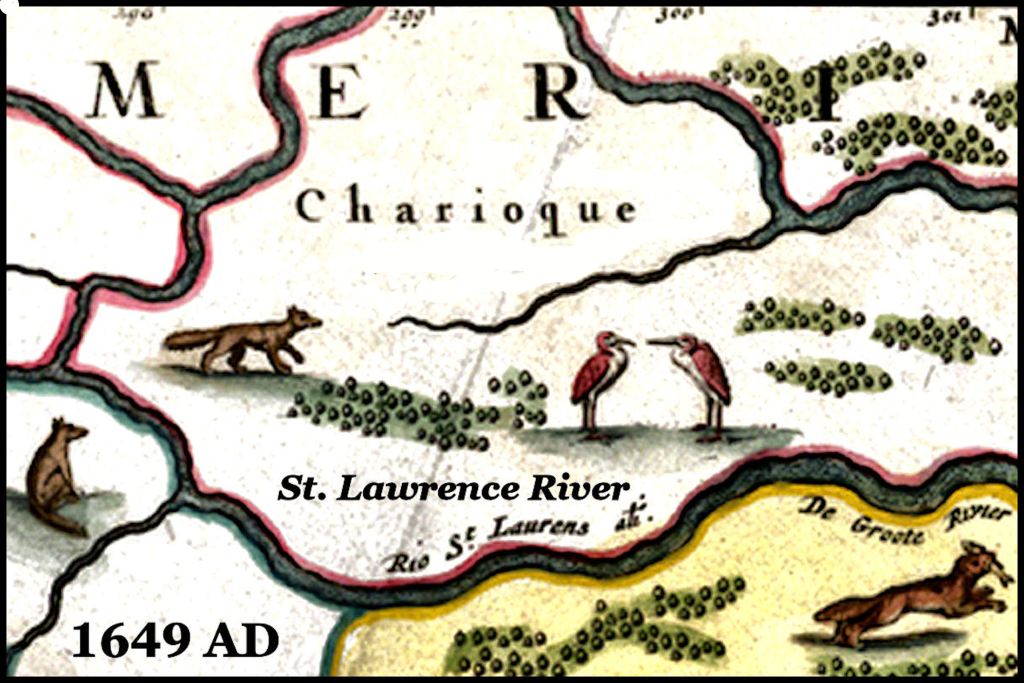
Champlain stated that the Charioqui long ago lived on the Atlantic Coast along with the Potawatomi, Ojibwe and Otawa. In more recent times, that had lived at the great falls, upstream from Montreal. There they portaged freight canoes around the falls with two-wheeled carts, until driven away by the Mohawks, a division of the Iroquois Confederacy. They now portaged canoes at the falls on the St. Lawrence River near Lake Erie.
The Cherokee are the only Indigenous American people, known to have built and utilized wheeled carts at the time of Renaissance Period contact with European nations. They may have learned this skill from Early Medieval Period Scandinavians, who harvested timber or created settlements on Canada’s Atlantic Coast
Champlain’s statements match perfectly with The History of the Cherokee People by Cherokee Principal Chief Charles Hicks (1826). He said that the Cherokee lived far to the north until driven south by the Iroquois. They arrived in the southern mountains (SW Virginia) about the time that Charleston, SC was founded (1670). One small band settled at that time near the source of the Tuckasegee River, which is in North Carolina, near its border with South Carolina.
The Hurons, Tionontati and Cherokee were catastrophically defeated by the Iroquois Confederacy in 1649. The survivors began migrating southward and westward in 1650.

The Wendat (Huron) Confederacy
Most of the tribes, listed above, were allies or vassals of the Wendats, which the French called Hurons. They did not speak the same languages. In fact, they probably spoke significantly different languages than their descendants speak today, because massive deaths from Iroquois attacks and European diseases forced the remnants to band with people, speaking different languages.
Champlain’s success in befriending the smaller tribes on the upper St. Lawrence River was partially because almost simultaneous with his establishment of a large trading post at Quebec Cité, the local tribes came under attack from the imperialistic Iroquois Confederacy. In 1603, Champlain had formed an alliance against the Iroquois, but he decided that the French would not trade firearms to them.
The Indigenous peoples in the St. Lawrence River Basin provided the French with valuable furs, while the Iroquois interfered with that trade. The first battle between the Iroquois and the French-Huron alliance occurred in 1609. The French-Huron Alliance won the battle decisively.
The continued survival of these tribes became dependent on French military assistance. In fact, the only reliable image of Champlain is a self-portrait, which he included in a drawing below of a combined force of Wendats and French militia defeating the Iroquois. Only the Frenchmen were using firearms.

The situation was to change radically, about the time that Champlain died in 1635. Champlain had extensive combat experience in both the New World and France. He was replaced by wussy nobles, who knew absolutely nothing about Native American-style warfare.
Nieuw Amsterdam was founded in 1613 and began trading with the Iroquois Confederacy the following year. Within 20 years, the majority of Iroquois warriors had obtained firearms from the Dutch, whereas only a few Christianized chiefs had firearms in Quebec. The Iroquois began committing genocide in Quebec after Champlain died.
The nobleman, Charles Jacques Huault de Montmagny, became the governor of New France after Charles Champlain died. Being a commoner, Champlain could never be a governor. De Montmagny successfully negotiated a treaty with the Iroquois in 1645 . . . which stopped the carnage for a while.
As soon as De Montmagny was replaced in 1648 by Louis d’Ailleboust de Coulonge, another nobleman, the Iroquois Confederacy broke its treaty and began to ravage Quebec. They also began attacking French settlements and farmsteads. De Coulonge abrupt reversed the policy of not selling firearms to Native Americans, but it was too little, too late.
The French government didn’t begin to have enough muskets to arm all of the warriors in the Huron Confederacy. Those, who did receive firearms, had no time to develop their marksmanship skills or even knowledge of how to maintain a firearm. Villages of the Huron Confederacy were massacred, one after another, leaving much of the region south and west of Ville-Marie (Montreal) depopulated.
By the end of 1650, the surviving Hurons, Potawatomi, Ojibwe, Otawa, Erie, Chat and Neutral villages had fled westward, while the Tionontati and Charioqui had fled southward into what was then southwestern Virginia, but is now southern West Virginia. That is where the Tionontati are shown to be living on Jean Baptiste Franqueline’s 1684 Map of North America and Guillaume De L’Isle’s 1700 Map of Mexico and La Florida.

Tionontati men in the early 1800s
The forgotten Tionontati or Tionontateca
Up until the early 1700s, the Tionontati also lived in the upper tip of the Shenandoah Valley, between present-day Winchester, VA and Harpers Ferry. Both branches were known for the high quality, “sweet tropical” tobacco. They were also known to the French as the Petun Indians. Petun is an eastern South American word for tobacco.
When I first saw their name, I immediately recognized it as being Nahua . . . from northern or central Mexico. The first spelling adds the Eastern Creek-Itza Maya suffix for “people or tribe”. “Teca” is the Nahua suffix for “people or tribe.” Tiononta means, “God-Silent” (or Deaf). There was temple dedicated to Teononta in Tlatilolco . . . eventually one of the three Mexica (Aztec) capital cities.
Several people of Cherokee descent have mentioned to me that their only Native American DNA was found by a genetics lab to be from northern Mexico. That was the homeland of the Nahua-speaking Chichimeca. The Chichimeca tribes invaded Central Mexico in the period from 1000 AD to 1200 AD.
I have also heard some Cherokee descendants mention that according to their oral traditions, one of the branches of the Cherokees came from Mexico. This suggests that in the late 1600s, the Tionontati become members of an expanded Cherokee Alliance in northeastern Tennessee and southwestern Virginia.
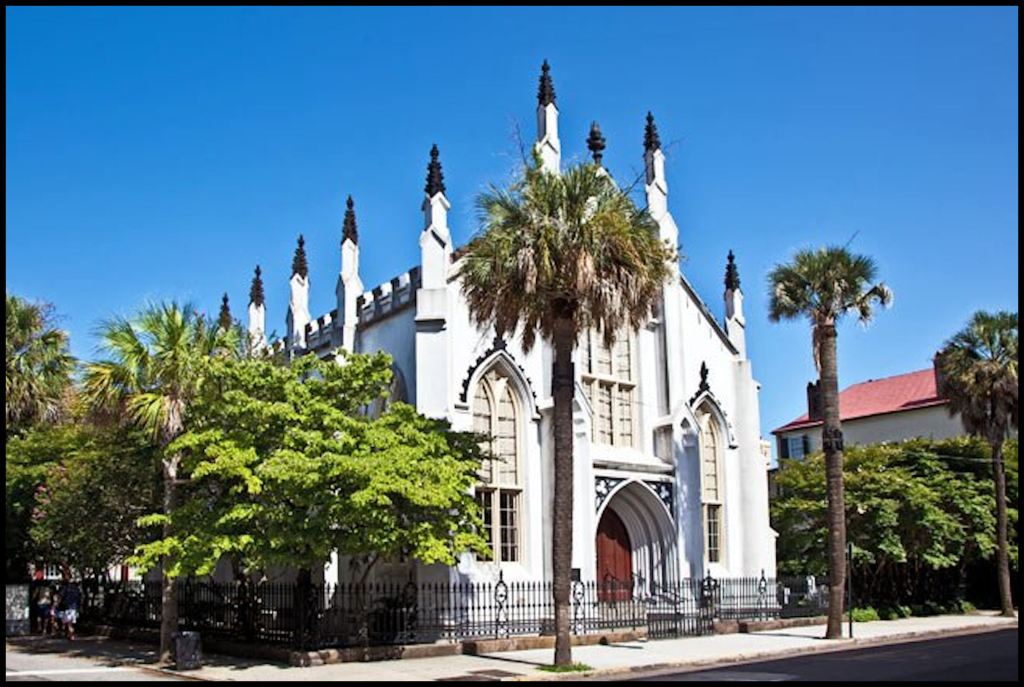
The historic French Huguenot Church in Charleston, South Carolina
The religious situation today in France
When we reconnected in 2020, Vivi related to me some interesting speculations. Both she and her daughter’s family are now members of the French Protestant Church, which is different than the more conservative French Huguenot Church. It is modeled after evangelical Methodist churches in Wales and is the fastest growing Christian denomination in Europe.
Vivi thinks that had not France killed or driven out over 500,000 of its best educated and most industrious citizens, plus blocked French Protestants from emigrating to Canada, history would have been very different. Most of North America would be speaking French today. In the 1600s France would have quickly evolved into a democratic, constitutional monarchy as the Netherlands did. There would not have been a French Revolution or Napoleonic Wars. The close allies of France, Great Britain, Netherlands, Germany and Sweden would have dominated the world.
Many of the most prominent leaders of the new American Republic had significant French Huguenot ancestry. They included Col.. Samuel Kercheval, Col. Francis Marion, Capt. John Morel, Capt. John Sevier, David Crockett, Benjamin Franklin, John Adams, John Hancock, Thomas Jefferson, Paul Revere, and George Washington.
Now you know
 The Americas Revealed
So much we are not supposed to know…
LikeLike
Kerimeo Ahau has many YouTube videos on the Huguenots as Moors and blacks that came to US with Sephardic Jews in 1500s before Jamestown and Plymouth Rock, and that those people you listed at the end of this article were not really Caucasians! Are you familiar with Ahau’s work?
LikeLike
Yes, he constantly uses my copyrighted VR images without permission and in some videos makes people think that I endorsed his beliefs. . I am unable to find out his real name. Ahau is the Itza Maya word for “lord” or “noble.” Kerimeo seems to be an African word.
LikeLike
I haven’t watched every video, but haven’t heard your name come up. He has the old books and documents right on screen. I’ve certainly never heard any of that historical info!So, what about those famous people not being Caucasian?
LikeLike
Typo- Kirimeo
LikeLike