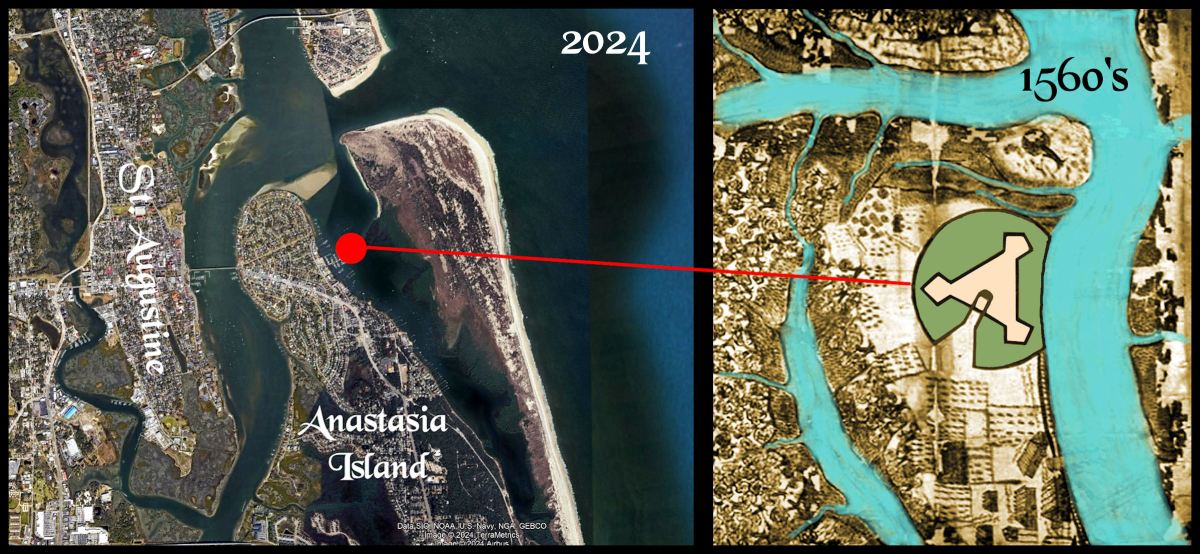
St. Augustine, Florida
It was the first fortification, built by Spain in the State of Florida.
by Richard L. Thornton, Architect & City Planner
As can be seen in comparing the two maps, St. Augustine Bay has been changed radically by two centuries of dredging by the US. Army Corps of Engineers. Note the difference in color between the harbor excavated on the northern end of Anastasia Island, where the fort was and the remainder of the bay. Even today, most of the bay is impassible to large ships.
It is a similar situation, 21 miles farther north on the St. Johns River. When the United States acquired Florida from Spain in 1821, only small canoes could pass through the entrance to the St. Johns River. In fact, during the 1770s, Indian trader and explorer, James Adair stated that he and his Creek Indian friend had to get out of their canoe and walk it through the mouth of the river.
The St. Johns River thus was impassible to sea-going vessels with keels until 1860! Thus, the placement of Fort Caroline on the St. Johns River by the Jacksonville Chamber of Commerce was always comparable to the parable of “the Emperor, who had no clothes.”
Nevertheless, because of ocean currents, St. Augustine was a perfect location for a “Coast Guard station” and ship repair yard. In late August of 1565, Spanish Admiral Pedro Menendez found that his larger warships could not enter St. Augustine Bay, but the cargo galleons could reach the northern end of Anastasia Island. Here the Spanish began construction of an earthen infantry fort, named Fort Anastasia, and docks, where ships could unload cargo.
A company of approximately 80-120 soldiers were stationed at Fort Anastasia. It was they who executed Captain Jean Ribault and a large party of survivors of the storm-ravaged French fleet.
The surviving Frenchmen greatly outnumbered the Anastasia Island garrison. They were hungry, but could easily overwhelmed individual Spanish patrols exploring the island. With the weapons captured from these patrols, they could have easily wiped out the rest of the occupants of the fort, which was still under construction.
Instead, they assumed that since France was not at war with Spain and they surrendered peacefully , they would be treated decently, fed and then returned to France. That didn’t happen.
 The Americas Revealed
Fascinating learning once more, Richard and hadn’t realized the butchering of those Frenchmen was all the more tragic on the face of everything. I’ve always been haunted by it and one wonders what the story was of the musicians they let live or where they made off to and did their children “tell the tale” or did it simply fade from their heritage!
LikeLike