
The Easter Bunny, Easter Egg hunts, Easter bonnets, Easter parades and even Christian Sunrise Services date back to the Bronze Age or probably even the Neolithic Period.
It gets even more surprising! Both the Swedish goddess of love & fertility, Easter, and the Itza Maya goddess of love & fertility, Ixcher, were portrayed holding their pet rabbit in their arms. I know all this because I didn’t throw away a telegram from Swedish Crown Prince, Karl Gustaf, thinking to be a hoax. Oh did I mention that the first TV program that I watched in Sweden was a one-hour special on Georgia?
by Richard L. Thornton, Architect and City Planner
Strangers from academia always demand that I cite my sources, when writing orthodoxy-shattering articles. So, here we go.

I worked in the brown brick building – Landskrona Stadsarkitektkontoret
I did not apply for the job in Sweden. At the time, the United States did not have diplomatic relations with Sweden, so to apply for a job there, was unthinkable. In late 1970, the U.S. Navy informed me that it did not plan to put me on active duty after graduation from Georgia Tech, unless I wanted to sign a 10-year contract to become a career Intelligence Officer . . . so I was looking for an employer.
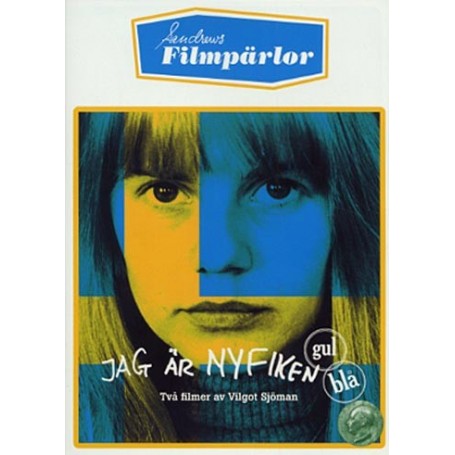
In February 1972, I received a telegram, claiming to be from Swedish Crown Prince Karl Gustaf. It invited me to participate in a “technical exchange program.” I assumed that it was a hoax from a gal, who liked to play practical jokes. We had gone to a movie theater in Buckhead, back in December to see the X-rated Swedish movie, “I Am Curious, Yellow.”
There was no such thing as the internet, so I went to the Georgia Tech library to find out who this man was. He was heir to the Swedish Crown, an officer in the Royal Swedish Navy and sat on the Swedish National Security Council. There was no way in Hades that he would know who I was.
Playing along with the practical joke. I telegrammed back, “Yes, American women are too cold.” but thinking the prospect of working in Sweden highly unlikely, I did not think much about the probable hoax, until out of the blue, I was offered a job in Landskrona, Sweden six weeks later.
I did not know why I was going to Landskrona until over the Atlantic Ocean in a British Airways 747 . . . in a scene straight from the beginnings of Mission Impossible TV shows and movies. Also invited to Landskrona was the son of the Commanding General of the Italian Air Force. We became close friends.
In addition, I was put in touch with a first cousin of my Creek Indian mother, who was married to the Commanding Admiral of the West German Navy. All my other contacts were with out-of-uniform personnel from the Swedish and Danish Royal navies. There were no communications with United States military personnel, while I was in Europe. Presumably, this is so the US Department of Defense would have “plausible deniability” . . . as they often say in such low profile activities.
Prince Karl Gustaf would become king a year later. However, the extremist faction in Olav Palme’s socialist government was friendly with the Soviet Union and the Swedish equivalent of the FBI was thoroughly infiltrated with Soviet KGB moles. They succeeded in pushing a bill through the Riksdag (Parliament) that removed King Karl Gustaf from the Swedish National Security Council.

Learning Scandinavian history
On my fourth night in Sweden, I was the guest of a City Council member and his family for dinner and to watch the color (then a big deal) premier of a new prime time series on Swedish TV, “Life in the USA.” Unbeknownst to all of us ahead of time, the one hour program was on the State of Georgia and at the end, predicted that Jimmy Carter would someday be President of the United States.
The City Council member liked me so much that he arranged for the municipal government to buy a TV for my apartment. He told me that it would be a good way for me to learn how to speak Swedish and also learn about real Swedish culture . . . not what President Nixon was telling Americans.
I learned about the origin of our Eastern traditions the good ole fashion way . . . by being assigned to an apartment on Easter Street in Landskrona, Sweden . . . plus having a brainy, patriotic law student at Lund University being assigned as my official Swedish girlfriend . . . yes, really. Britt was also president of the university division of the pro-NATO, anti-Communist Center Political Party. She later served in the Riksdag.
At lunchtime, on my fifth day of work, I was seated on the fountain in front of the old Landskrona Rådhus (City Hall) . . . eating a korv (Danish hot dog) and pomme frits (French fries) . . . introspectively pondering the fact that seven days earlier, I had been graduating from Georgia Tech and now was in a whole different world.
My peace was startled, when a classic, statuesque Swedish flicka appeared before me as if in a vision and announced, “Hey Richard, I’m Britt. I’m your official Swedish girlfriend.” At this point, I was convinced that I had been killed by a crashing satellite and now was in Heaven.

Britt explained that there were many female Soviet KGB spies in southern Sweden and the Copenhagen, Denmark region. They were natural blondes from Karelia, Russian-occupied Finland or Estonia, who had been taught Swedish, but in a disco or night club, I would not be able to tell that they spoke Swedish with an accent. Initially, she viewed herself as a tour guide and dating service . . . making sure that I only played with “good, democratic Swedish girls . . . no Communists!”
+
That is how I met Agnetha Fältskog two weeks later . . . before she was the blonde A in ABBA. In our first conversation over a restaurant table, Agnetha confided that her dream was to move to the United States and sing on Broadway. The Fates had something else in store for her! By mid-summer, though, Britt and I were in a dating relationship.
In an earlier article this past winter, I described how my entire high school and college education on Canada consisted of one class hour in high school and part of a class hour in college-level architectural history. It was the same with Scandinavia. I knew virtually nothing about Sweden until I was living there.
You see . . . of course, the internet did not exist, but also, TV programming at that time was almost entirely for entertainment. PBS had just been created, but was not yet producing documentaries. Sophisticated TV documentaries would not be commonplace until the mid-1980s. The first National Geographic TV special was broadcast seven years before my journey, but still was just an annual event.
My boss, Stadsarkitekt Gunnar Lydh, quickly realized that I knew virtually nothing about Swedish history or even, its architectural history, so enrolled me to audit several classes at Lund University. Lund has duplicate curricula in Swedish and English.
You see, the pedestrian village that I was to design was in the midst of 8,000 years of Swedish history . . . including pond-bottom burials like the ones at Windover Pond, Florida. . . burial mounds, petroglyphs and stone circles, like the ones near my current residence in Northeast Georgia, plus medieval farmhouses, a Viking port and Scandinavia’s oldest existing church, from around 900 AD.
I had many, many questions for Britt as a result being exposed to Swedish cultural history. She was delighted to answer them or find a Lund University professor, who could. In a subsequent article, I am going to blow you away with the linguistic mysteries . . . archaic Scandinavian words in Southeastern indigenous languages.
Okay, so now you know my sources! I am not a dilettante, suddenly promoting some poppycock idea out of thin air . . . as Georgia archaeologists liked to say 12 years ago.
From the dawn of Nordic history
The class on Bronze Age history was especially fascinating to me. It was barely mentioned in Gringo textbooks back then, but Landskrona was ground-center for the Nordic Bronze Age Civilization. “Nordic” is the correct term, because Germanic peoples had not migrated into Scandinavia at that time. The Germanic peoples introduced the Iron Age around 500 BC, but also intermarried with the Eurasian locals . . . absorbing most of their religious traditions and symbols.
I quickly noticed several Bronze Age religious practices, probably dating back to the Neolithic Period in Sweden, which we in Americas assume to be Christian traditions from the heart of Europe. This was particularly true for Christmas and Easter. Here are their real origins.

Easter
Easter (Öester in Swedish or Øesther in Gamla Norsk) was the Scandinavian Iron Age goddess of fertility. During this time the Angles, Jutes and Danes were living in southern Scandinavia. The name evolved from the Persian-Babylonian goddess of fertility, Astarte . . . or its Hebrew version, Esther.
When the Angles, Jutes, Norse and Danes migrated to Britain, they carried the worship of Easter with them. Her worship was focused on the period of the Spring Equinox to May 1st (May Day). The Christian celebration of Christ’s Crucifixion, Resurrection and Ascent into Heaven (Pentecost) coincided with that season of pagan worship. Evidently, the newcomers to Britain continued to call that season Easter, even after converted to Christianity.

Sunrise Service
This tradition has disappeared from Roman Catholic liturgy, but in the United States many Protestant church congregations hold outdoor, hillside services at sunrise of Easter Sunday. This is straight from Nordic paganism.
On the morning of the Spring Equinox, all of the people, unless invalid, would climb up to mountaintop or hilltop shrines in order to watch the sun rise. The shrines were typically composed of fieldstone circles or ovals.
Until the 20th century ancient stone circles or ovals could also be found on the mountain tops of Metro Atlanta, including Stone Mountain. Native Americans also journeyed up to such shrines to observe sunrises and sunsets on certain significant days of the year.
Easter egg hunt
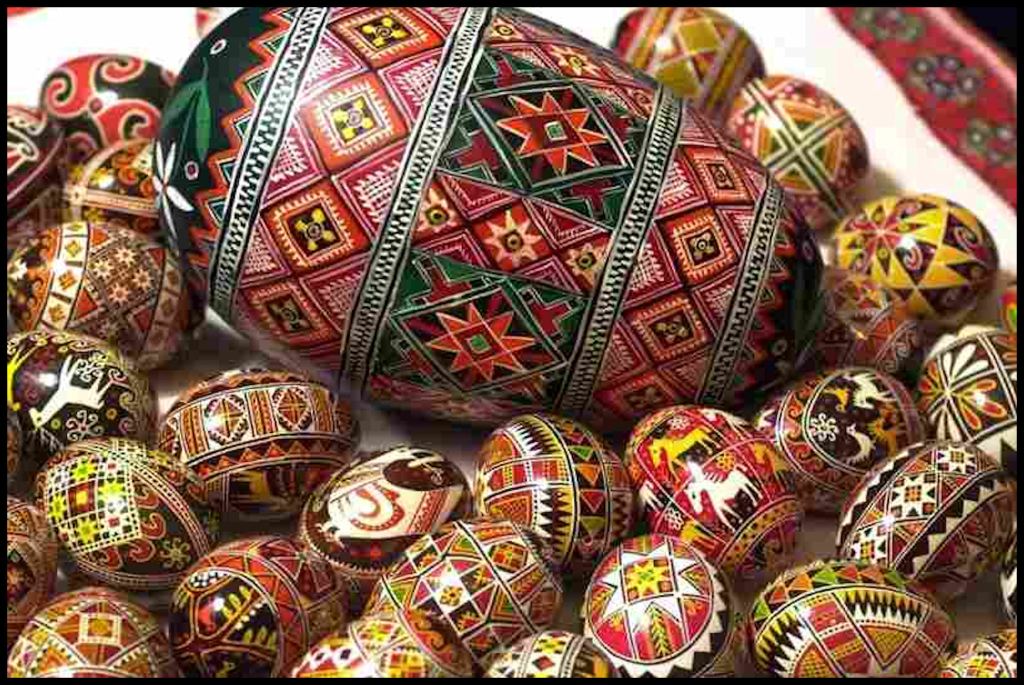
After the Sunrise Service, young brides would fan out across the countryside, looking for birds eggs. If they found an egg, it meant that the goddess Easter would make her pregnant in the coming year.
Now, I have noticed that several English-language references link Easter eggs to the end of Lent, since supposedly Roman Catholics were not allowed to eat eggs during Lent. Not so, in ancient times the young Nordic women painted ornate designs on eggs as votive offerings to the goddess, Easter.
The Rus (Swedish name of Vikings) carried the tradition to the Slavic countries. The women of Norse and Danish Vikings carried the tradition to Britain. The decoration of eggs at Easter reached its highest state of art among the Eastern Slavs. Possibly, that tradition during Christian times worked its way westward into the heart of Europe.
Easter Bunny
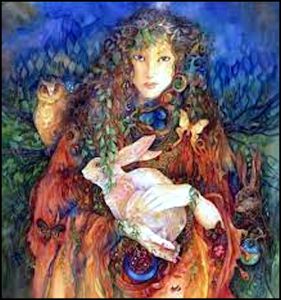
The goddess Easter was believed to have pet rabbits. Unmarried maidens in Sweden would search for bunny rabbits on the Spring Equinox and then until May Day. If she found one in a nest, it was a sign that Easter was sending her romance and a potential husband in the near future.
Here is where it gets really weird. The Swedish fertility goddess was named Easter. The Itza Maya fertility goddess was named Ixcher. Not only are the Swedish and Itza Maya names for their Goddess of Love and Fertility similar, but both goddesses were portrayed, holding their pet rabbit! Think that there might have been a close encounter of a third kind?

Easter Bonnet and Easter Parade

During the pagan Easter festivities, single women would promote their availability by wearing ornate flower and vine garlands on their heads and clothing with flower motifs. The symbolism is obvious.
As stated earlier, the Rus from Sweden founded a kingdom in what is now Ukraine. This Nordic tradition is the origin of the traditional women’s costume of Ukraine today.
Both around the time of the Spring Equinox and around the beginning of May, there were coming of age rituals, dances and literal parades in which the young ladies would advertise their availability for courtship and marriage, while wearing their Easter bonnets and new Easter dresses.
Coming up next . . . the Swedish word for their nation, Sverige, contains two ancient Indo-European words, which can be found in Native American place names throughout the Southeastern United States.

 The Americas Revealed
As always, almost too fantastic to be true! Note: Ester is Hadassah ( myrtle) in Hebrew. Or Ester is from Hebrew word s t r root ( hidden) or Hester. She was hiding her identity,or from Persian word Ishtar…
LikeLiked by 1 person
Yes, it is a lot for NE Georgians to handle. When I first moved a here a Habersham matron stopped by and saw a large framed print of Landskrona in the 1500s on the wall. I told her the same story. Then she saw a photo of our goats on the wall and I told her about the cheese creamery As parting she said, “Please don’t tell people that you worked in Sweden, had a Swedish girlfriend and formerly owned a famous goat cheese creamery. People here will think you are crazy. I had to show her a letter from Britt, signed “your Swedish girlfriend” - an award given to our cheese creamery and hand-signed by Chef Julia Child and then posted an NBC TV program about our cheese creamery. LOL The witch ran away.
LikeLike
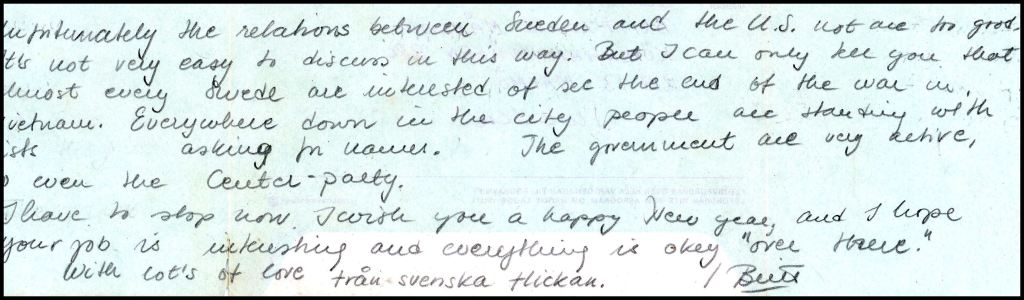
I google searched the picture of “Britt”. I’m guessing this was a representative image?
Always interested in your work. Thanks.
LikeLiked by 1 person
I have added a section of one of Britt’s letters to me that mentions the Viet Nam War and her Center Party. You can analyze it to determine if was the typical syntax and vocabulary of a Swedish law student in December of 1972.
LikeLike