
In 1776, Creek and Uchee farmsteads, along with their European and African neighbors on the frontiers of Georgia, South Carolina and North Carolina, were ravaged without warning or provocation by Native American allies of the British. Although initially inclined to remain neutral, the Eastern Creeks had no choice, but to become loyal allies of the Patriots.
“Mahala” means “teacher” in the Itsate-Creek and Muskogee-Creek languages. For the next four generations, a particularly bright young girl in the family would be singled out and given the Creek name of Mahala and the English name of Ruby. They lived near where Wahachee Creek joined the Broad River in present-day Elbert County, GA. It was a scattered settlement, inhabited by the farms of Creek Indians, Uchee Indians, Free African-Americans, Mixed-bloods and White frontiersmen.
by Richard L. Thornton, Architect & City Planner
Note: Mahala Bone’s 3D models were created with a Revopoint 3D laser scanner, Bricscad architectural software and the Artlantis Virtual Reality program from Paris, France. Using this state-of-art technology, I am am creating extremely realistic 3D models of how peoples of the Americas lived in the past.

Forgotten coincidences of history
This Mahala’s family were neighbors of and friends with a White family from North Carolina, named Hart. Nancy Hart was to achieve fame as a Patriot heroine in the American Revolution.
Also, living nearby was the Ward family. In order to have good relations with his Native American trading partners, Bryan Ward had married a 16 year old mixed Jewish-Spanish-Creek Indian girl from the Nacoochee Valley that he named Nancy.
Yep! The real Nancy Ward was not an ethnic Cherokee and she lived in Georgia until the mid-1790s. That’s when the Harts also moved westward to settle on virgin land. Most of Nancy Ward’s real descendants still live in Georgia.

Jack Bone, Benjamin Hart and Bryan Ward were part-time Georgia Rangers, based at nearby Fort James, which overlooked the confluence of the Savannah and Broad Rivers.
In 1732, the new Province of Georgia was granted by King George II the Savannah River and all lands westward. However, South Carolina continued to claim was is now Middle Georgia and North Georgia until 1793. South Carolina did not make that claim a fait accompli by establishing settlements, counties and courthouses.
In contrast, three years after Savannah was founded in 1733, Gen. James Edward Oglethorpe went 126 miles upstream and founded Augusta as an inland trading center. Any South Carolinian, wishing to trade with Indians on the west of the Savannah River were required to purchase a license. Most opted to move to the Georgia side of the river.

Multi-cultural settlements on the Georgia frontier
From Savannah’s founding in 1733, provincial and Creek leaders had encouraged the intermarriage of their peoples to cement good political and commercial relations. There were several Creek and Uchee villages in the territory ceded to the British Crown, including next door to Savannah, up until the 1755 Smallpox Epidemic. The biracial offspring tended to settle in frontier regions that had been recently ceded by the Creek Confederacy to the British Crown.
Twenty percent of the population of South Carolina was composed of enslaved Native Americans. In 1752, King George II issued a proclamation, which banned all enslavement of Indigenous Americans and freed all existing Native American slaves. Georgia did not have slavery at the time, but was about to legalize slavery of Africans only.
Virginia and the two Carolinas responded almost immediately to King George’s decree by defining a slave as being African, if they had as much as 1/64th African heritage. It had been standard procedure, especially in South Carolina to crossbreed Native and African slaves.
The more attractive Mustee (mixed-blood) women were raped or kept as concubines by their white masters. By the mid-1750s, this led to a large segment of the Southern colonies’ populations of people, who looked Indian or mixed white and Indian, but who actually also had some African ancestry.
Those freed Native American slaves, who could, fled to the Appalachian Foothills frontier or better still, to the frontier of Georgia to put distance between themselves and plantations. Slave catchers were seizing Native Americans and claiming that they were part African then filing fraudulent papers in court in order to sell them back to planters.
My family’s experience reflects those insecure times. A recently freed South Carolina Creek, named Mary, was freed by her masters in Fredericksville, Virginia. She soon married a man from Scotland names William Bone. They first settled in her former village in the Piedmont near Chester, South Carolina, but found it highly prudent to move 120 miles westward and across the Savannah River to the safety of Georgia. There is no genetic evidence of her being part African, but that didn’t matter to the slave catchers.
My grandfather Obie’s Native American heritage was Peedee-Creek from the Wataree River Basin in northeastern South Carolina. His Pee Dee ancestors also moved to Creek territory in northeast Georgia, in the 1750s and intermarried with Scottish settlers.
At this time, Uchees and Muskogee-speaking Creeks still lived in the region near present-day Brevard, Hendersonville, Etowah, Rosman and Old Fort, North Carolina. All of the Native American place names in that part of North Carolina are Muskogee-Creek words. Like their brethren in Georgia, they initially tried to remain neutral, but after being attacked by the Cherokees, most survivors moved southward to Georgia.
Cherokees and Tories ambush a wagon train in the Piedmont region of South Carolina
The Firestorm
South Carolina and North Carolina sent representatives to the first Continental Congress in June 1774. Georgia did not. Georgia was also the only province where Stamp Act stamps were ever actually sold. As a result, Georgia did not initially receive punitive treatment by the British government, which was especially severe in Massachusetts. Georgia’s Royal Governor, James Wright, was extremely popular. When most leaders of the colony did decide to join the Patriot cause, they first invited Wright to remain as the fledgling state’s first governor!
The diverse families living on the extreme northern frontier of Georgia, which then was between Augusta and Tallulah River, had virtually no contact with British officials or soldiers . . . not a great deal more with the representatives of the Crown in Savannah.
Technically, the region from the Broad River northward to the Tallulah River was Creek and Chickasaw territory. The Chickasaws in North Georgia were members of the Creek Confederacy. However, it was so thinly populated by the property owners that they welcomed remnant tribes from South Carolina, mixed-bloods, friendly whites and even a colony of refugees from Mallorca and Cabrera in the Balearic Islands off the coast of Spain.
The Georgia Provincial Rangers maintained law and order in the region, but the hardworking farmers rarely needed to be chastised. Undoubtedly, they ignored the events happening in New England. That’s assuming that they even heard of such revolutionary sparks as the Battle of Concord Bridge or the Battle of Bunker Hill.
Unbeknown to most frontier families, was the secret plot being hatched by British Army agents. They offered the Cherokees relief from their debts with traders, plus munitions and trade goods, if the Cherokees would massacre Patriot families on the frontier. They were to be paid for all scalps. Actually, there were very few families on the frontier vocally supporting the Revolution. Most families were indifferent to either side’s calls for support and generally apolitical.
Families, openly sympathetic to the British Crown, were supposed to be secretly warned about a pending Cherokee attack. Many were not. Of course, none of the Native American families were warned either. The Tories were supposed to erect “Passover Poles” to assure protection. These were de-barked saplings, flying white flags.
When the massacre along the frontier began in June 1776, most Cherokees attacked any farm they encountered, which didn't have a Passover Pole, because how were the Redcoats going to determine if a scalp was Patriot or Neutral? The Creek farms were virtually identical to those of white families. Unless they put up a ferocious defense, they shared the fate of their white neighbors.
According to The Early History of Franklin County, Georgia, the real Nancy Ward did hear about the pending Cherokee attack through her kin in the Nacoochee Valley, who traded with the Cherokees. She persuaded Northeast Georgia Native Americans not to join the hostile Cherokees and when possible to militarily block any raids into Georgia. She continued to work for good relations among North Georgia’s diverse population until moving to the Ocoee River Valley in Tennessee during the mid-1790s.

William Bartram at the Creek town of Tuckabatchee in 1776. This is a detail of a large model, built by the author for the Muscogee-Creek Nation. Tuckabatchee’s leaders decided to side with the Patriots. As a result, they were attacked by Upper Creeks, allied with the British. In 1776, Tuckabatchee moved back to its original location, where Six Flags Over Georgia is now situated. Mixed-blood Creek Rangers from Northeast Georgia were dispatched to the new location, in order to protect their ally.
Because local Creeks and Uchees sided with their white neighbors, apparently the only deaths in Georgia were a few individuals, unfortunately traveling alone in unsettled areas. The Cherokees tried to kill botanist and explorer, William Bartram, but he made it to Creek side of the Tallulah River in the nick of time. A Cherokee war party was right behind him. He was protected by his Creek friends during the rest of his journey to the Atlantic Coast.
Again, according to Georgia newspapers of the era and The Early History of Franklin County, Georgia, Nancy Ward was considered a true heroine. She frequently returned to her homeland in Northeast Georgia to visit with kin and friends after moving to Tennessee. Her visits were announced in the Northeast Georgia newspapers, treating her as an important dignitary. However, the “Nancy Ward” portrayed in Cherokee literature and plays, is for the most part, fictional. That character was based on a dime novel, published in Tennessee, four years after her death.
For example: Nancy never fought in any battle, nor did she marry a Cherokee man, named Kingfisher. He died in the Battle of Etowah Cliffs in 1793, in which most of the Cherokees were killed. There was no Battle of Taliwa and no Creek town named Taliwa. The Cherokees catastrophically lost the 40-year long war with the Creeks. Nancy Ward was not a Great Leader of the Cherokees. Even, when she lived among them, she was virtually unknown. She is not even mentioned by Principal Chief Charles Hicks in his History of the Cherokee People (1826).

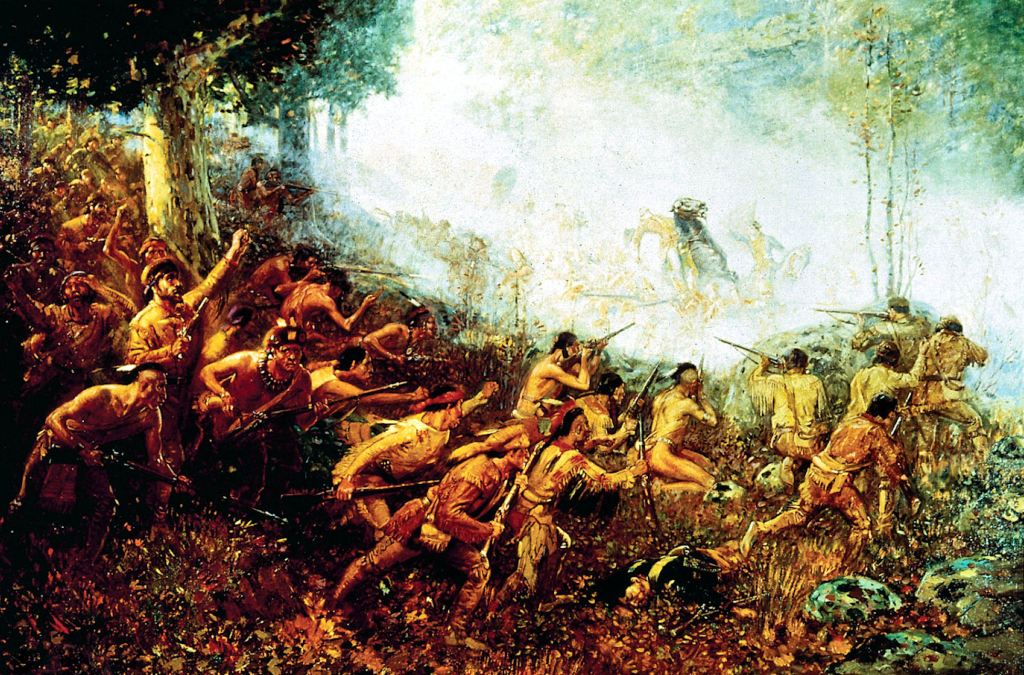
Battle of Kettle Creek – February 14, 1779 – Painting by Jeff Trexler
Revenge on the Cherokees and 18 years of guerilla warfare
Both the Georgia Rangers and the leaders of the Eastern Creeks had sworn allegiance to King George III. However, the treachery of the British Army dispatching the Cherokees to massacre apolitical civilians instantly changed Northern Georgia and the South Carolina Upcountry into a hornets nest.
Three Patriot armies were raised in the autumn of 1776 to invade the North Carolina Mountains and carry out, essentially, what was ethnic cleansing. All buildings and stored food were burned. It was quite common for any Cherokee, regardless of age or gender to be shot on sight. Some Cherokee villages had refused to attack the settlers, but they shared the same fate as the hostile villages.
Mahala Bone’s and Nancy Ward’s husbands served as scouts for the army coming from South Carolina. After the Cherokee Tribe surrendered and signed a peace treaty with the Continental Congress. The men of Wahachee helped build a line of log forts along the Tallulah River to guard against renegade Cherokee bands then served in their garrisons. The Wards moved permanently to a location near the Tallulah River, now called Ward’s Creek. The locations of these forts are still in a natural state. They would make fascinating archaeological digs.
For the next three years the Georgia frontier only knew intermittent attacks on travelers by small bands of Cherokee renegades, but experienced extreme hardship because of the lack of commerce with Great Britain and other colonies. They had grown accustomed to trading their agricultural products for British cloth, cooking pots, spices, sugar, tools, knives, muskets, lead balls and gunpowder. The women had to learn how to spin threads and weave cloth. Their home-made cloths were quite crude at first. LOL
Then Lord Cornwallis sailed south in late 1778 with a large army to force the southern colonies back into the British sheep pen. Savannah and Charleston were quickly captured. Tory militia and cavalry units were raised to assist the Redcoats in the suppression of the interior. By February 1779, Augusta was captured. Georgia ceased to have a functioning Patriot government.
Most of the men in the Tallulah River forts were ordered southward to serve in a Georgia Militia being organized by Major Elijah Clarke. A large Loyalist army column was marching north to the Georgia-North Carolina line in order to revert Georgia back to the status of a colony.
The Patriots initially were going to make a stand at Fort James, on the north side of the Broad River. However, when reinforcements arrived at the same time that they learned that the British troops were bogged down in a swampy area to the south, they decided to attack on St. Valentine’s Day. It was an overwhelming victory for the Patriots. The British temporarily abandoned Augusta, but later returned, after Charleston, SC was captured.
Using Augusta as a base, Tory horsemen and Upper Creeks from what is now Alabama raided the Georgia and South Carolina Uplands. They almost always tried to kill the males on farms and sometimes killed or abducted the females.
After the British surrender at Yorktown, peace negotiations began. Initially, British delegates insisted that Georgia and Florida remain British colonies. On May 8,m 1781, the Spanish, now allies of the Patriots, captured the British fort at Pensacola, FL. Soon all of Florida fell to either Spanish or Georgia troops.
On June 5, 1781 Georgia Patriot troops recaptured Augusta, then pushed the Redcoats southward to the outskirts of Savannah. British negotiators agreed to let Georgia be part of the new United States, while Florida was given to Spain.

Battle of Long Swamp Creek – October 23, 1783
Last battle of the American Revolution
When Augusta fell, the most notorious Tory cavalry unit, commanded by Lt. Col. Thomas Waters escaped northward and established a base on Long Swamp Creek near the Etowah River. Nearby was a village containing about 50 Cherokee renegades, led by Sour Mush, who had been expelled from the Cherokee Nation. The location is now in Pickens County, GA.
Battle of Long Swamp Creek: On October 22, 1783, the last battle of the American Revolution occurred at Sour Mush’s hamlet and then moved to the camp of Waters Rangers. Colonel Andrew Pickens and Major Elijah Clark led about 400 Georgia & South Carolina Mounted Rifle militiamen, plus Georgia Creek scouts, such as my gggg-grandfather, attacked Sour Mush’s village in search of Waters Rangers. A few rangers were in the village. Several were killed or wounded while attempting to escape. The wounded were all executed by the militiamen.
Sour Mush quickly surrendered, told Pickens where the Tory Rangers were camped. Folk histories state that almost all of the Waters Rangers were killed. In fact, most of the rangers escaped, while Sour Mush was cleverly delaying Pickens order to attack the Tory camp.
The surviving Tories had nowhere to go, since the war was lost. They settled on the headwaters of the Etowah and Amicalola Rivers with their Indian wives. Several of the Tory family names can be seen on roads in northern Dawson and western Lumpkin Counties to this day.
One of Thomas Waters’ mixed-blood sons settled in a cove near Amicalola Falls, where I formerly lived. In fact, my cabin was on Waters Road. The opening scenes of the premier of “America Unearthed” on the History Channel were of show host, Scott Wolter, driving on the graveled portion of Waters Road!

Waters Road in January 2014
Bloodshed did not end with the signing of a peace treaty with Great Britain in December 1783. Alexander McGillivray was a half-blood Tory, who maneuvered himself into being Principal Chief of the Creek Confederacy during the American Revolution. He moved the Creek Capital from Georgia to Pensacola, FL and knew NOTHING about such traditional Creek sacred sites as Ocmulgee Mounds in Central Georgia, plus the Nacoochee Valley and Yamakora Shrine in Northeast Georgia.
After Great Britain signed the peace treaty, McGillivray began dispatching large war parties of Upper Creeks to attack Georgia Creeks AND their white neighbors in Northeast Georgia. Native Americans and European-Americans fought together to drive off Native American raiders. They soon built palisaded forts, where I all families could take refuge during raids.
At this point Northeast Georgia and western South Carolina Creeks began seeing themselves as a separate tribe. They cut their ties with the Creek Confederacy. Many of the full bloods eventually moved to Florida and joined the Seminole Alliance. There were old photos in my grandmother Ruby’s (Mahala V) office desk, which showed her family and Florida Seminoles socializing in traditional Seminole/Creek clothing.

With Revolutionary War veterans pouring into Georgia to accept free land, the major Upper Creek raids became suicide missions and petered out. The Creek Confederacy was officially at peace with the United States. However, until around 1794 small bands of Upper Creeks from what is now Alabama would travel long distances to murder individual white, Creek and Uchee families in eastern Georgia, who lived on isolated farmsteads. During that period, Mahala Bone and her offspring stayed armed 24/7, never knowing when they might have be fighting for their lives.
Now you know!
 The Americas Revealed
WOW This is a heartfelt post Richard. Thanks for sharing us with your GGGG Grandmother.
LikeLike
Hi Richard
I just ran across this article.
https://taskandpurpose.com/news/army-civil-war-medals/
2 of the Yankee soldiers that participated in the Great Locomotive Chase from Marrietta to Chattanooga are being awarded the Congressional Medal of Honor 162 years later.
I remember you writing about this raid before. The General is still in Kennesaw on display, I have seen it a couple of times,it’s a beautiful machine well worth seeing.
Have a wonderful 4th and God bless America.
LikeLiked by 1 person
Yes, in the years immediately after I moved back to Georgia from Virginia, I did a lot of planning and architectural work in Kennesaw and Smyrna . . . including the restoration of several buildings near the Locomotive Museum.
LikeLike