
Architecture of the North American Frontier Series
by Richard L. Thornton, Architect & City Planner
Many readers will recognize the image above as an iconic scene in the magnificent 1992 movie, “The Last of the Mohicans.” A British officer had arrived at a village in the northern frontier of the Province of New York to recruit militia to fight an invading French army from Quebec. The year is 1757.
This movie, like most historical epics, portrayed all of the British colonists on the frontier living in log cabins. In fact, log construction was a very new concept for British colonists in 1757, primarily utilized by immigrants from Ulster, Ireland in the southern Shenandoah Valley of Virginia.
Western New York, western Pennsylvania and what is now the state of West Virginia were claimed by France and occupied by its Native American allies. No British settlers lived there until after the French and Indian War . . . and even then, at great peril for several decades. Log construction never caught on in Nouvelle France and coastal regions of the British Colonies. The oldest surviving log house in New York State was built in 1771.
The scene at the top of the article will be burned into my brain as long as I live. I watched this movie for the first time during mid-December 1992 at a theater in Fairfax County, VA . . . accompanied by my French soulmate and her daughter. She was a direct descendant of a soldier in the invading French army!
The opening scene of the movie, a deer hunt, looked like the steep portions of my former farm in the North Carolina Mountains, but really could have been anywhere in the Southern Appalachians. The arrival of Natty Bumppo (Daniel Day-Lewis) at a pioneer log cabin was at dusk, so I did not pay much to the details. The movie then shifted to the dark interior of the cabin, when the family and their guests were eating supper. One could barely make out the interior details of the cabin.

However, I almost fell out of my theater seat, when the scene at the top of the page appeared. It was obviously the high mountain meadow, where I grazed my goats and sheep in the summer after the valley pastures had dried. There was a massive wild apple tree (on the left of the video frame) where we gathered bushels of apples to make cider each October from 1977 to 1987.
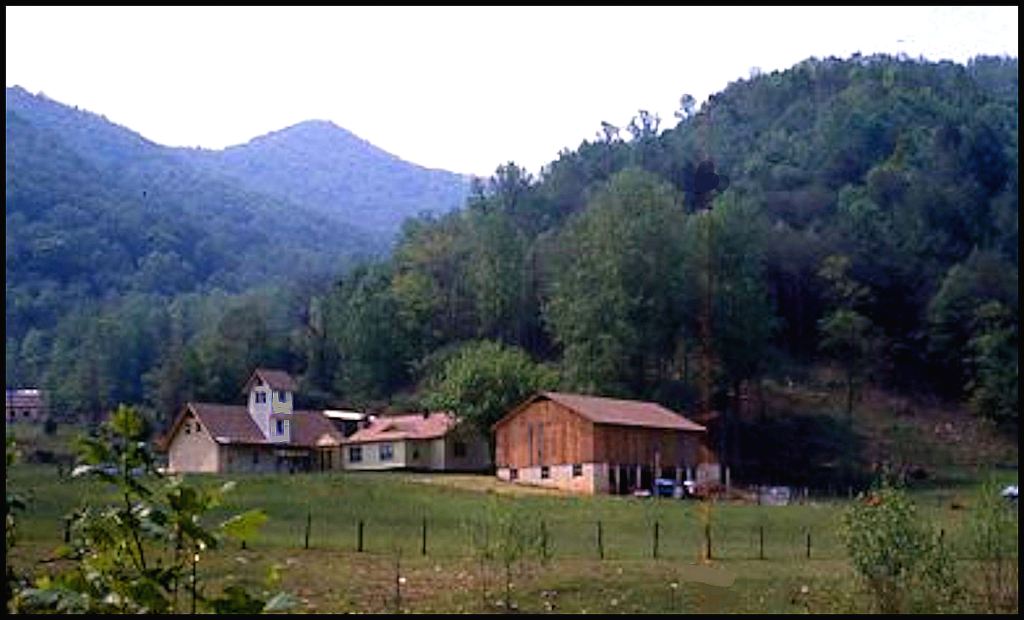
The deer hunt scene was on the steep mountain behind my farm building complex. The pioneer cabin, pioneer village and massacre scenes were filmed in Wolfpen Gap, directly behind the tower. The tall mountain in the background is Courthouse Knob.
The cabin was real. After becoming the first Director of the Asheville-Buncombe County Historic Preservation Commission, I determined that it was one of the oldest man-made structures in the Asheville area . . . dating from somewhere between 1795 and 1820. Alas, the film crew of “The Last of the Mohicans” burned it down to recreate the scene of an “Indian Massacre.” It was yet another vestige of America’s past that is now gone forever.
American log structures that long predate Columbus

Vestiges of the oldest known log architecture in North America were found by archaeologists Lewis Lawson and Arthur Kelly in 1956, underneath Mound C at Etowah Mounds in Cartersville, GA. This temple contained the famous Etowah marble statues and dated to around 990 AD. The indigenous peoples of southern Mexico were building log temples at least 3,000 years ago!
Clearing up the folklore about log houses
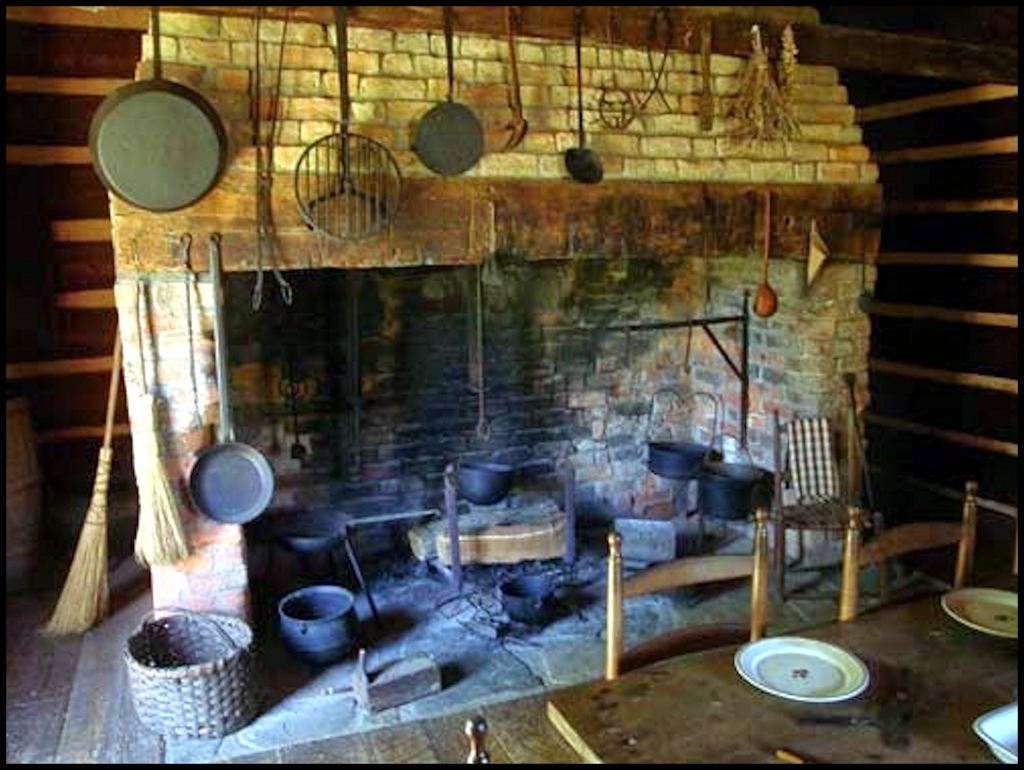
During the coming months, readers will be seeing many log structures. However, I wanted to clear up three myths that are maintained by many references, novels and textbooks. You will be seeing other types of architecture for several weeks before you see log houses again.
Myth 1 – Indigenous Americans did not build log structures until they had obtained iron and steel tools from European traders.
False! The ancestors of the Creek and Alabama Peoples brought with them an ancient architectural tradition from southern Mexico, which constructed temples and communal buildings with vertical log walls, set in trenches, filled with dense clay. The peoples of the Northwest Pacific Coast and the Maori of New Zealand also had a tradition of building temples and prominent houses with vertical logs. It is not known, when their tradition began.
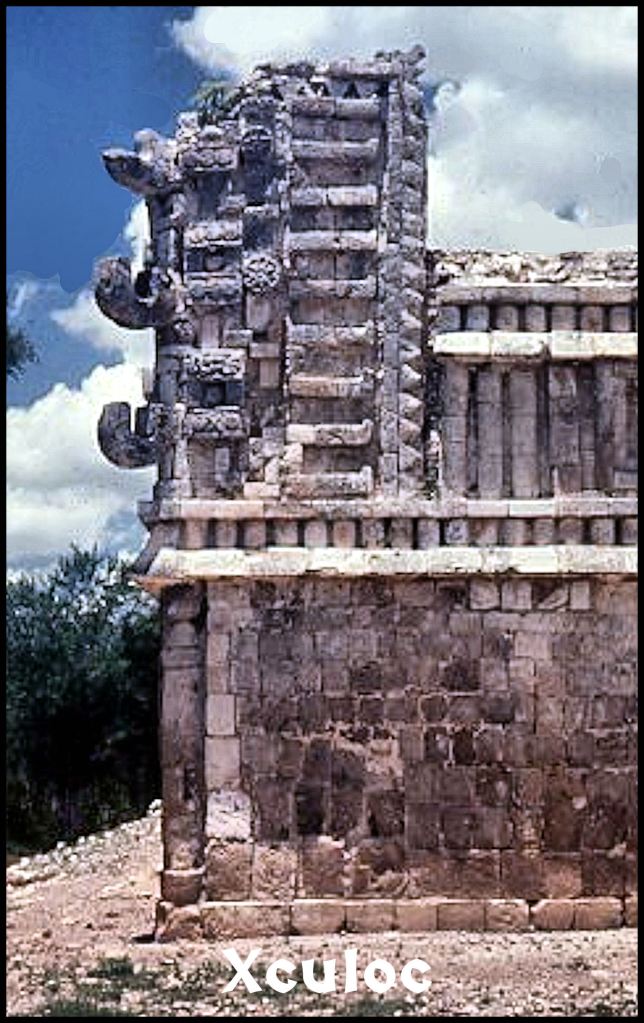
All of the log temples and houses in Veracruz, Tabasco, Chiapas and Campeche long ago turned into humus, but their appearance has been preserved by ancient stone architecture. This is a detail on what essentially was the “city hall” of Xculoc in central Campeche. The town has been continuously occupied for at least 4,000 years. Note the vertical and horizonal logs in this limestone facade composition.
As was discussed in the introductory article of this series, some branches of the Creeks and Uchees learned how to construct wooden sided, timber-framed buildings in the early 1600s . . . maybe even before Europeans arrived. By the mid-1700s, horizontally lain, log houses predominated Creek and Uchee architecture in South Carolina and Georgia. The leaders coated their log houses with clay stucco to make them look like traditional Creek houses.
By 1776, when William Bartram traveled through the Creek Nation, almost all Creek houses were of horizontal log construction. These houses differed little than the log houses that increasingly characterized the European frontier farmsteads.

Cherokee village of Chote in 1763
When Lt. Henry Timberlake visited the Overhill Cherokees in present-day Tennessee during 1763, he found that the residential architecture varied from village to village. During the winter months most Cherokee lived in round or sometimes rectangular shingled or wattle-and-daub houses. During the warmer months, they lived in log houses that had no chinking between the logs.
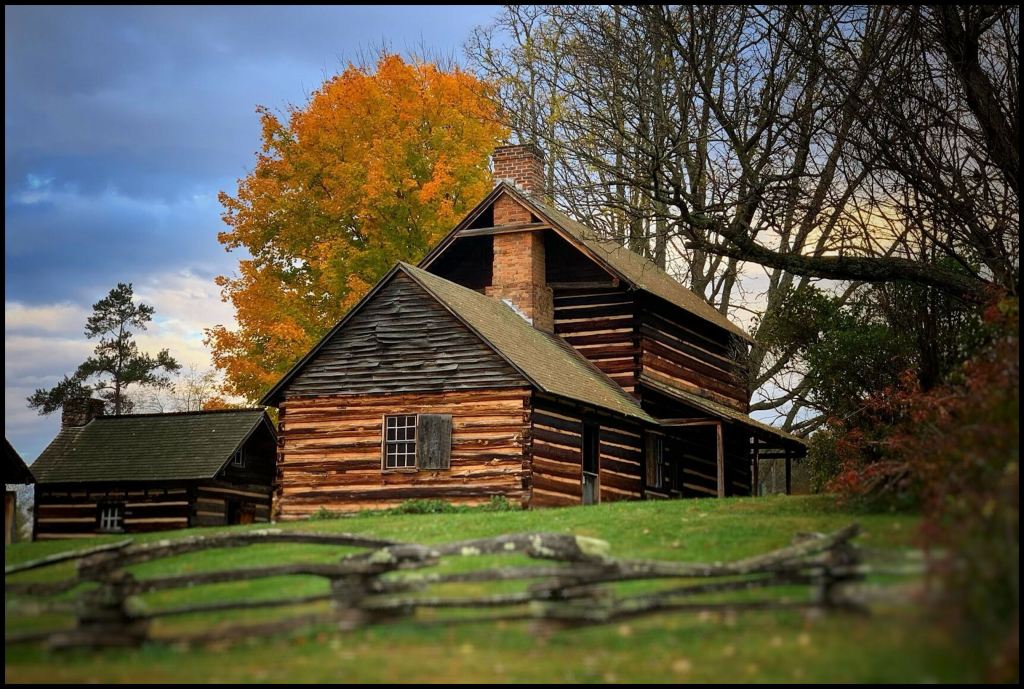
A 1792 log house about two miles southwest of my former farm in the Reems Creek Valley of North Carolina. It was built by an Ulster Scots family from Virginia. Although, seeming quite old, most of the building materials that you see date from their 1960s restoration. The Ulster Scots introduced log architecture across the entire continent of North America.
Myth 2 – European colonists began living in log houses as soon as Jamestown was founded.
No! Log buildings were either non-existent or rare in the British colonies until the end of the French and Indian War (1763), when large numbers of families began moving much deeper into the interior of North America. At this time, most roads consisted of one lane dirt trails with very few bridges. Transportation of European-style building materials from coastal ports was difficult and costly. This forced pioneers to resort to the use of available local materials . . . namely logs, clay mortar and fieldstones.

Log house, built by Finnish immigrants to Nya Sverige in 1638
European log architecture was introduced to North American by the founding of Nya Sverige (New Sweden) in 1638. Much of Sweden did not have a significant log building tradition, but Finland, then a province of the Kingdom of Sweden, did. A significant percentage of the settlers were Markfinns (Forest Finns) who were highly skilled in the construction of log houses.
A knowledge of log construction techniques spread slowing inland and southward from the Delaware River Valley, where Nya Sverige was located. Nya Sverige was conquered by soldiers from the Netherlands in 1655.
The Dutch did not seem very interested in log houses. New Amsterdam was captured by the British in 1664. This victory enabled an unobstructed flow of travelers, wagons and ships between the British North American Colonies. However, it would eventually be catastrophic for Swedish and Finnish families. When William Penn founded Pennsylvania in 1682, he claimed the lands of former New Sweden, because the charter from King Charles II gave them to him. The Nordic families were scattered to the winds . . . taking their knowledge of log architecture with them.
Both France and Great Britain claimed what is now western New York, western Pennsylvania and the State of West Virginia. For most of the time, the region was dominated by Native allies of the French, but not colonized by France. Because of a series of wars between Great Britain and France, there was relatively little settlement in the region by the British.
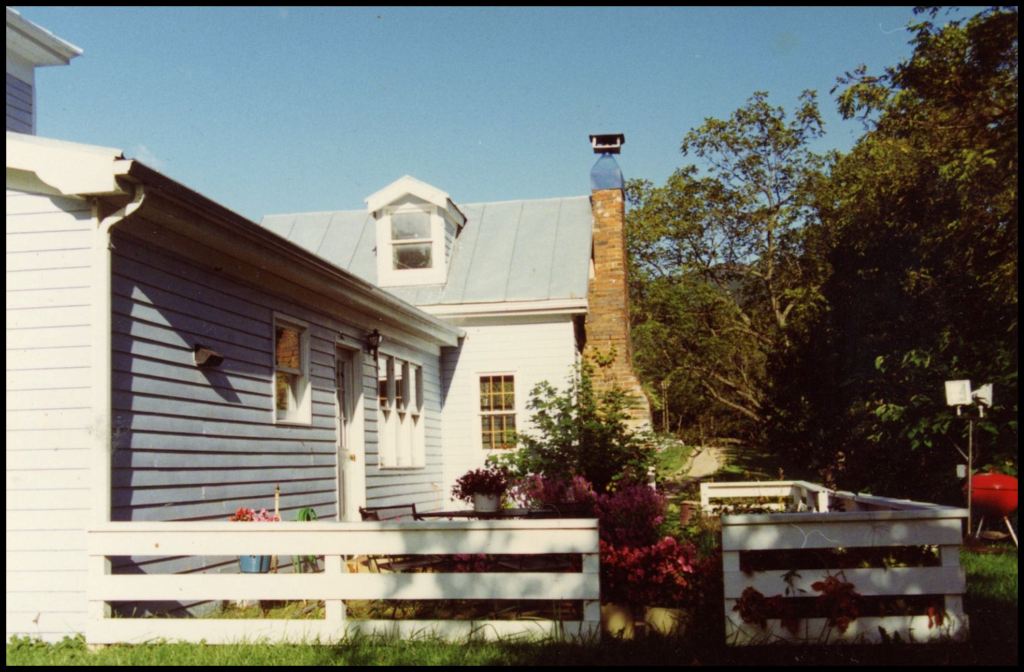
Colonel John Tipton built a small timber-frame cottage to live in, prior to constructing the main house on our future farm. It then became a summer kitchen. I connected the two structures together and converted the summer kitchen into an architecture office. I then built a traditional Colonial kitchen garden, framed by the old kitchen and new kitchen.
Tom’s Brook Plantation, a planned estate/farm subdivision in the Shenandoah Valley, was founded in 1738. My former farm was the western tip of the subdivided tract. From studying old maps and land plats, I got the impression that most property owners built small timber frame cottages to live in until the main house could be constructed, not log cabins. The original cottage then became the summer kitchen. That was the situation on my farm. I linked the summer kitchen with the main house to create a modern 25 feet long kitchen and breakfast room.
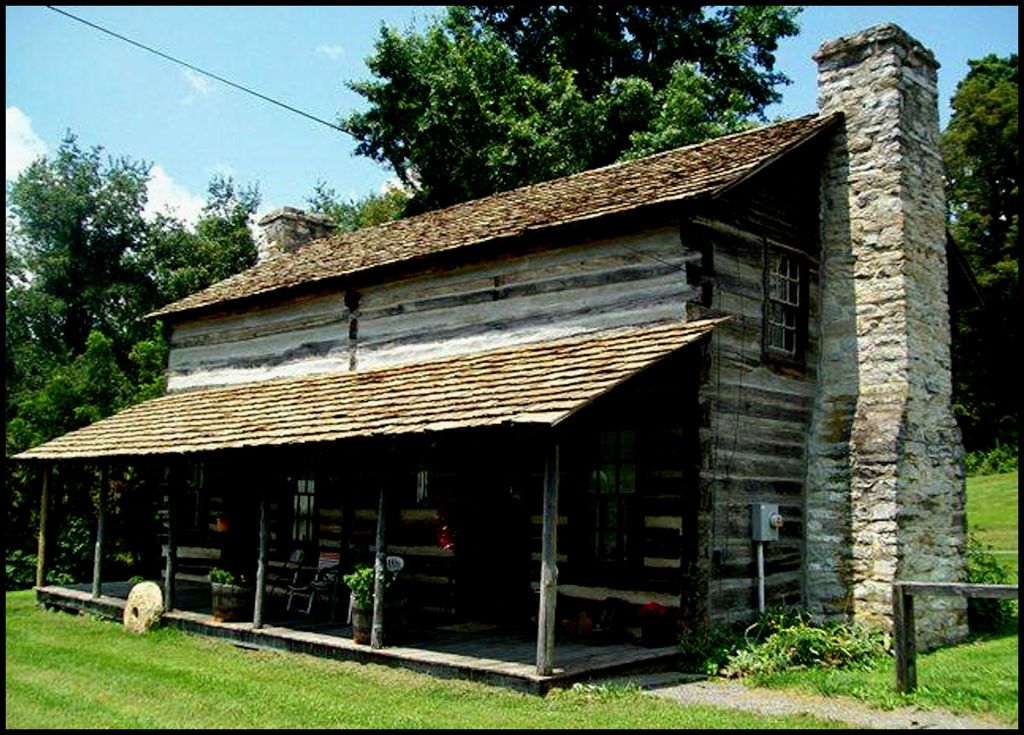
Some substantial log houses were built in the Shenandoah Valley of Virginia, prior to the American Revolution. Very few remain. Above is the Bundy house, which was constructed in 1769. The oldest surviving log house in Virginia was built in 1744. That’s 27 years older than the oldest surviving log house in New York State.
Myth Three – The scale of a building, constructed with logs, was limited to a small single story cabin, due to the scarcity of nails and bolts for creating large roof trusses.
False! Carpenters in the 17th, 18th and early 19th centuries did not use nails to join structural wood timbers. They morticed and pegged the joints. The structural frame of my two-story 3,400 sq. ft. timber-frame house contained NO nails.
When I first moved to North Carolina, I also assumed that all historic log houses were relatively small, crude one room structures. Then in 1982, my job assignment in Asheville City Hall shifted from planning Downtown Asheville’s future to preserving the entire county’s past. I quickly discovered that the earliest log structures in the Southern Highlands were finely crafted, two story or “Cape Cod Style” houses.
However, culturally and economically, the more mountainous sections of western North Carolina declined in the 1800s and early 1900s. Each generation of rural folk built smaller and cruder log houses. The newest log cabins were the ones most likely to decay into ruins after a few decades.
The Carson House – Marion, NC

The Carsons were an Ulster-Scots family, who moved from the Southern Shenandoah Valley to the Blue Ridge Foothills of western North Carolina, shortly before the American Revolution. They initially constructed a small large cabin. In 1784, they constructed this finely-crafted, Virginia-style log house. The wood lap siding was added by a later generation.
Next time in The Americas Revealed
The Western Mayas of Tabasco State, Mexico developed a sophisticated type of prefabricated house, whose modular walls were woven like a basket. Its technology was adopted by the Totonacs and still utilized today in northern Veracruz State, but is no longer built in Southern Mexico.
This house-style was carried to what is now Georgia over a thousand years ago and became the architectural trademark of planned Creek towns. The Itza Maya name for this type of house has now entered the English language.


I can attest to the similarity between Upstate Carolina, North Georgia, and New York’s Hudson Valley having spent my last 20 Years in Manhattan and Rhinebeck, NY. These landscapes are in part why I’m looking to retire near my undergraduate alma mater, Clemson. btw, Richard, I did get permission to walk the Chaugatown site.
LikeLiked by 1 person
The film Last of the Mohicans is one of my favourite films Richard, but then of course I wasn’t taking much notice of the houses at the time. Your explanation with regards to the different styles of the time is very interesting.
LikeLiked by 1 person
Just think Rita, if you like “Last of the Mohicans” then you have seen where I hiked and herded my goats and sheep, many a time. Now we need a good movie, filmed in Crete so I can see where you and your partner live.
LikeLiked by 1 person
O.K. I will look for one.
LikeLiked by 1 person