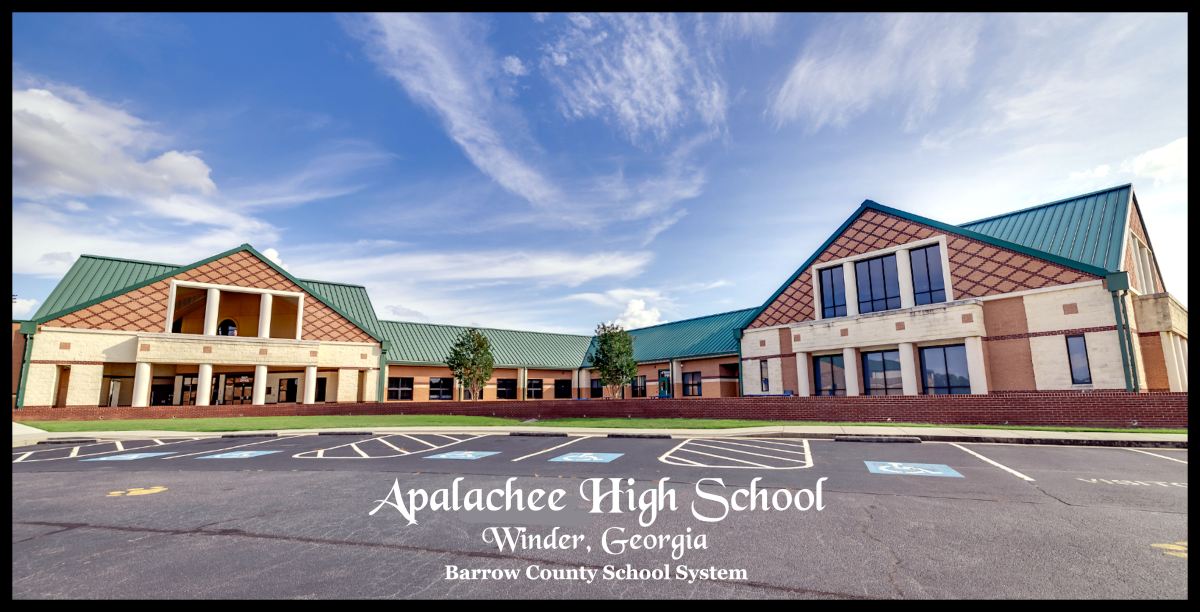
The REAL Apalachee Indians were in Northeast Georgia, not northwestern Florida. They were the immediate ancestors of the Muskogee-Creek Confederacy. Along with their neighbors and allies the Itsate and Soque, they were the most advanced indigenous people, north of central Mexico!
The architecture of this outstanding academic high school today reflects that proud heritage of the people of Barrow County. The Apalachee River flows out of Barrow to join the Oconee River.
by Richard L. Thornton, Architect & City Planner
As our hearts, prayers and drum beats go out to the victims, victims’ families and Apalachee High School community, we would like to correct some statements being made by national media reporters and Atlanta newscasters. General ignorance of the rich and ancient Native American history of Georgia is worsening, because of the state’s rapid population growth. There is also the continuing myth that the people of Barrow County were doing “something wrong” that brought about this tragedy.
The people of Barrow County have a special place in my heart. The Barrow County Historical Society is the ONLY organization in Georgia that has ever let me personally present my archaeological discoveries and historical research. The only way that I have been able to reach my neighbors has been through national and international media . . . four national TV programs and 40 videos, with more to come! Stores where I live in Habersham and White Counties refuse to sell my tourist guidebooks and references, because I am not a member of the “right” political party.
Rightwing extremists blocked the broadcast of the December 21, 2012 premier of “America Unearthed” in most of northern Georgia. The program had absolutely nothing to do with partisan politics, but did radically challenge the version of Native American history, being taught in the official Georgia history textbook. Most Georgians did not see the program until 2018, when the Travel Channel purchased it and began broadcasting it repeatedly on its regular line up.
Some of the leaders of Barrow County did get to see the premier in 2012, then invited me to speak. I was shocked by the size of the crowd that packed into the auditorium. From the questions asked by those attending, it was obvious that the vast majority of people in Barrow County were proud of its ancient heritage, but were trying to create a better future for all its citizens. It is a progressive, prosperous community, which has no place for violence, ethnic hatred or censorship of new ideas.
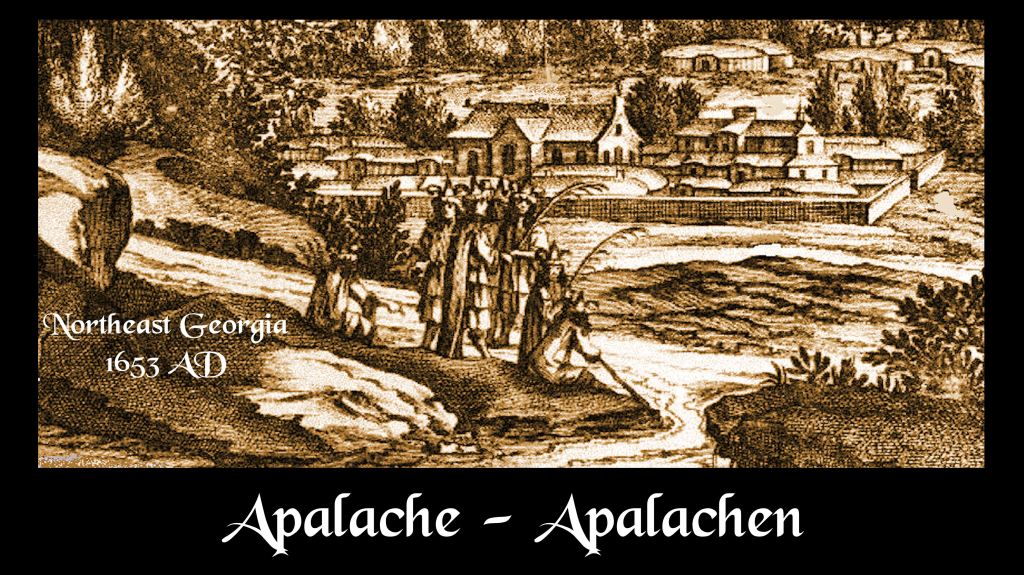
Engraving for 1653 AD book on what is now Georgia by Arnout Leers of Rotterdam, Netherland
Apalache is the Anglicization of the Panoan (Peruvian) words, “A Parashe” – which mean either “From the ocean – descendants of” or “From the Upper Amazon Basin – descendants of” . . . depending on the accent marks on “para.” After bands of Panoans immigrated from eastern Peru to Georgia in the period around 100-200 AD, they mixed with the Uchee to create the “Swift Creek Culture”. These people later mixed with Chickasaw and Southern Mesoamerican immigrants from Mexico to create the “Southern Appalachian Ceremonial Culture” – ultimately known as the “Kingdom of Apalache.” Like most Georgia Creeks, I personally carry the DNA of all of these peoples.
Apalachen is the plural of Apalache. Until the mid-1800s, the term Appalachian only applied to the mountains of northern Georgia, but in the decades since the meaning has been gradually expanded to mean all of the mountains in Eastern North America.
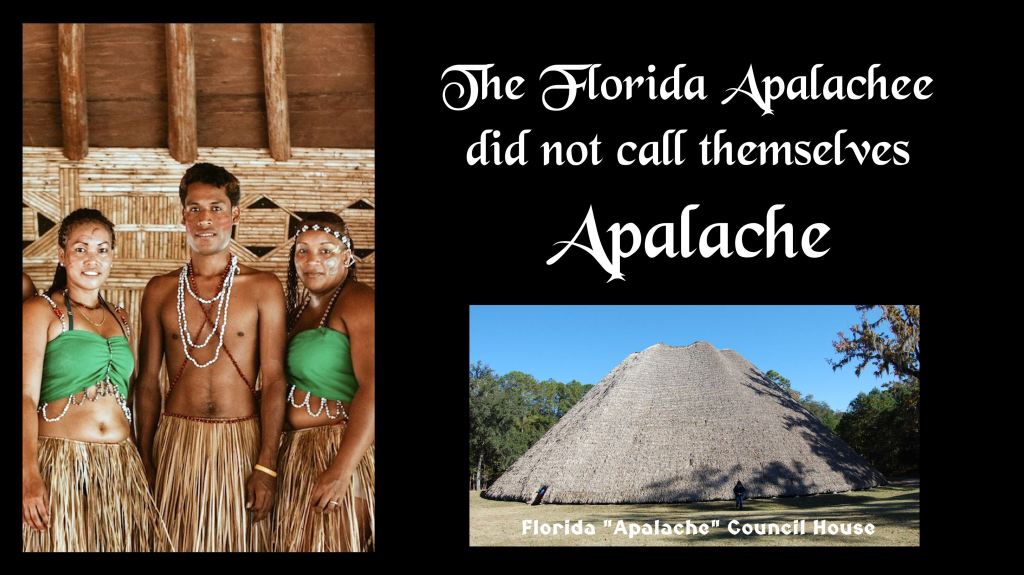
Because there was an Apalache trading village among the indigenous people of Northwestern Florida, named Apalachen, the leaders of the Hernando de Soto Expedition mistakenly named all of those people, Apalaches. The Florida Apalachee were actually Arawak immigrants from northern Peru and the Amazon Basin.
When Savannah was founded in 1733, the Creek Indians called themselves Apalache, Apalachete, Apalachikora or Palache. Since the Spanish had called the Natives in the Florida Panhandle, Apalache, for two centuries, this was confusing to British colonists. Eventually, in the late 1740s, the Creeks changed their official name to Maskoki (Mixed People), which was Anglicized to Muskogee.
Now you know!
 The Americas Revealed
WOW! What a grand history lesson!
LikeLiked by 1 person
My God. When are we going to ban assault rifles??? Who was the lunatic responsible for allowing them onto the open market is what I want to know. Hang ’em High.
I found the map you will go to by clicking on below link to “Legacy of Texas” website. They have huge numbers of old maps showing lands of tribal lands. Thought you guys might find it interesting per the Apalache…
https://www.legacyoftexas.com/product/a-new-and-accurate-map-of-louisiana-with-parts-of-florida-and-canada
LikeLiked by 1 person
The Apalache from Florida gave up trying to tell people their real names and so began using the name given them. So the Apalache in Texas are not the real Apalache. The Apalachicola are the real Apalache as are all Creeks and Seminoles.
LikeLiked by 2 people
I studied the many maps over the period of 200 years…they ebb and flow and one wonders is the information simply incorrect or based on migration
LikeLiked by 1 person
Hi Richard, I find this post most interesting but have a job keeping track of the tribes. However, I feel you must be very proud of your Heritage.
LikeLiked by 1 person
That’s right! I am mixed heritage trash! However, my two largest gene pools are Viking and Maya. That ain’t shabby.
LikeLiked by 1 person