
by Richard L. Thornton, Architect & City Planner
Daring reporters and videographers are making their way into the devastation within the Southern Appalachian Mountains by catastrophic floods to document a surrealistic landscape of shredded roads, power lines, aqueducts, sewer lines . . . even entire communities that until this weekend interconnected a thriving region.
The extreme damage covers 28,000 square miles of South Carolina, North Carolina and eastern Tennessee . . . with the central mountains of North Carolina bearing the most damage. Even though the Northeast Georgia Mountains were hit with the same apocalyptic rainfall and winds, their volcanic geology, much higher annual precipitation and different approach to road building seem to have protected that region from serious, long term damage.
Unfortunately, I must add that the severity of Asheville’s flooding is also due to a laissez-faire attitude toward storm water runoff and construction in flood prone areas. Vast areas of the city’s and county’s flood plains are filled with commercial development . . . something not allowed in North Georgia. You see, once upon a time, I was the Senior Architect-Planner for the City of Asheville then practiced architecture in the Asheville area for five years.
We still do not know the full tally of human lives and devastated communities along the path of Hurricane Helene in Florida, Georgia, South Carolina, Georgia, Tennessee, Virginia and Kentucky. Rescue crews everywhere are overwhelmed by the scale of the damage and by impassible roads. In Florida and Georgia the problem is primarily fallen trees and power lines. The saturated ground is causing more trees to fall . . . in at least one case, killing a rescuer.
In the mountains of South Carolina, North Carolina and Tennessee, however, those trees and power lines are just the beginning of the obstacles. Dams have failed. Many bridges have collapsed, even on interstate highways. Sections of state and federal highways have been washed down the sides of mountains. Mud slides and boulders block other sections of highways. The boldest of the initial explorers are finding entire communities washed away or groups of houses covered by mudslides with the occupants still inside.
I have noticed one thing that the TV reporters and newscasters don’t seem to understand yet. It is vastly more expensive to build or reconstruct infrastructure in mountainous regions. Aside from the civil engineering obstacles, the much colder climate of the Southern Appalachians requires much higher quality infrastructure components than in southern Louisiana and Mississippi, where Hurricane Katrina struck. The ultimate reconstruction cost of Hurricane Helene is going to dwarf that of Katrina.
There are three components to architectural and civil engineering design in the Southern Highlands that are not considered in the Gulf Coast Region . . . long term ground freezing, sudden temperature swings and extremely rapid runoff rates for storm water.
While I was living and practicing architecture in the Asheville, NC area, we regularly placed water and sewer lines at least three feet underground on the north (shaded) sides of mountains and two feet underground on the sunny sides. That was necessary. On the morning of January 15, 1985, I was stunned to see the thermometer outside our kitchen window in the Reems Creek Valley at – 25° F (-31.7° C.) It stayed below 0° F. for a week. Such temperatures also require much more potent insulation and heating systems than in New Orleans.
Rapid temperature changes put severe stress on power/telephone/internet lines, the steel structures of bridges and on highway paving. Only the highest quality steel, electrical cables and paving materials can be used in regions of high temperature swings. In the 31 hours prior to Christmas Even 2022, the thermometer at my cottage in the crest of Alec Mountain in Northeast Georgia dropped from 72° F (22.2 C.) to -1° F. (- 18.3 C.) !
The Gulf Coastal Region is prone to flooding because the landscape is pancake flat and the water has nowhere to go. In the mountains, we have another problem . . . the water wants to go somewhere else too fast. As long as you keep the water away from the building and parking lots that you are designing, it can quickly become someone else’s problem. I didn’t worry when our county received a Flash Flood Warning, because I live 200 feet above the valley floor.
All of the many rivers that begin in the Georgia Mountains soon reach reservoirs, operated by the US Army Corps of Engineers or the Georgia Power Company. Therefore, the feds and state government make architects and engineers in the Georgia portion of the Southern Highlands design landscaping and structures to retain storm waters, so they will be somebody else’s problem at a slower rate. At least for the past sixty years, commercial building construction in North Georgia’s river flood plains has been forbidden.
In addition to being the original urban designer and director of the Downtown Asheville Revitalization Program, I was the land use planner for Central Asheville. I was instructed NOT to require developers to install storm water retention structures and to continue to show commercial development permissible in all the flood plains of the French Broad and Swannanoa Rivers. We did have a 35 feet setback from the river banks.. The Buncombe County, NC Planning Commission allowed developers to construct buildings up to the very banks of the Swannanoa River, but not the French Broad River, but they still could develop flood plains with very few restrictions. These policies would have been unthinkable in North Georgia at the time.
Now you know!
Post-script
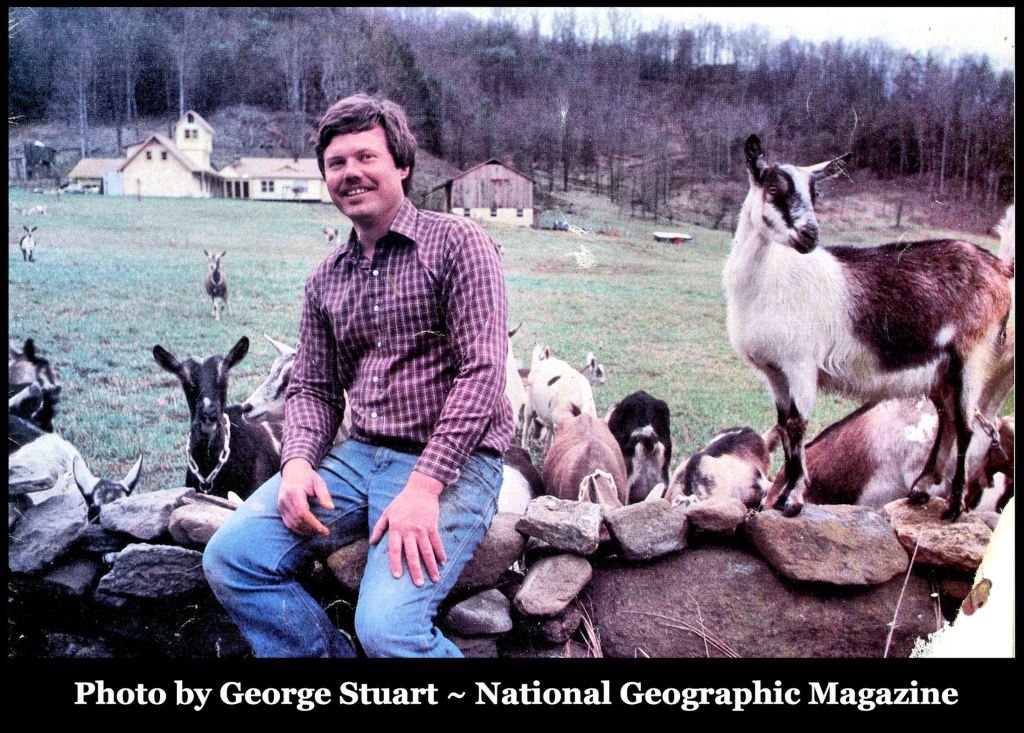
This photo was made for National Geographic almost exactly 40 years ago, when I had started the nation’s second licensed goat cheese creamery . . . still at that time the only one outside of California. I was looking across narrow Blackberry Inn Road, beyond which was a natural buffer required by the State of North Carolina for trout streams then sparkling Reems Creek.
I would not be smiling this morning. I am told that the view today would be a ravine and a ruptured aqueduct, which until this past Friday supplied potable water for most of northern Buncombe County, NC. The flood waters destroyed part of the stone wall, but this section still survives today.
 The Americas Revealed
Fascinating, inspiring. Same time disheartening and tragic. Appreciate the enlightening article all of the same and I know that you’re feeling the weight of what you know here about everything that has occurred and for all of the loss out there. My heart goes out.
LikeLiked by 2 people
Such devastating losses and who knows for how long they’ll continue. It’s a heartbreaking lesson too late for the learning, especially at a time when the costs to replace this vital infrastructure is going to be through the roof. Oh, Richard.
LikeLiked by 1 person
One of my cousins who lives in Asheville is missing, and all of the other cousins on that side of the family have been communicating back and forth all day trying to reach him or find him. He’s been added to an official missing persons list, but of course, he may be okay and just not able to communicate with anyone. I was at a funeral this afternoon in Sautee, and afterwards, many people were talking about relatives in Western North Carolina and the devastation there. Someone mentioned a factory that was not evacuated, and all the workers are trapped inside. There’s no telling how many people have perished and how many more will die before rescuers can get to them. This is beyond tragic.
LikeLiked by 1 person
How absolutely horrible. Praying for all of them.
LikeLiked by 2 people
Very sorry to hear that. I had a bad feeling, when I heard about the many mudslides and rock slides that many people were missing. As you probably know,. western North Carolina contains a lot of people, who live on remote one lane dirt roads, isolated from neighbors or telephone lines.
LikeLiked by 1 person
here in greenville, we got bad winds, no power since saturday morning, duke energy said maybe FRIDAY to get power back.
I am throwing out what remains in the fridge, it wont last
LikeLiked by 1 person
Can you get to a store to buy ice. I once was without power for 2 1/2 weeks at my cabin near Amicalola Falls. I kept my food in ice chests. Didn’t lose anything.
LikeLike
no, since it aint summer, what ice there was is gone. Plus, since we have no power, gas stations are closed for almost a 10 mile radius.
they did remove the tree that was on the power line in front of the complex, but the lines are still down and it needs a new pole and maybe a new transformer
LikeLiked by 1 person
Very interesting insights, Richard. Thank you! We have some young family members trapped in their homes in Spruce Pine. At least they have a roof and some food for now… but No water, no power, no end in sight… I did see a piece about some people with mules volunteering to pack food and supplies in… Looks like the new wild west for a whole lot of people.
LikeLiked by 1 person
Yes, it is a terrible situation. There might be over a hundred houses in WNC and the South Carolina mountains, that are still covered in mud or rocks from land slides. It is impossible for rescuers to reach them, because the roads are washed out and there is no location for a helicopter to land.
LikeLike