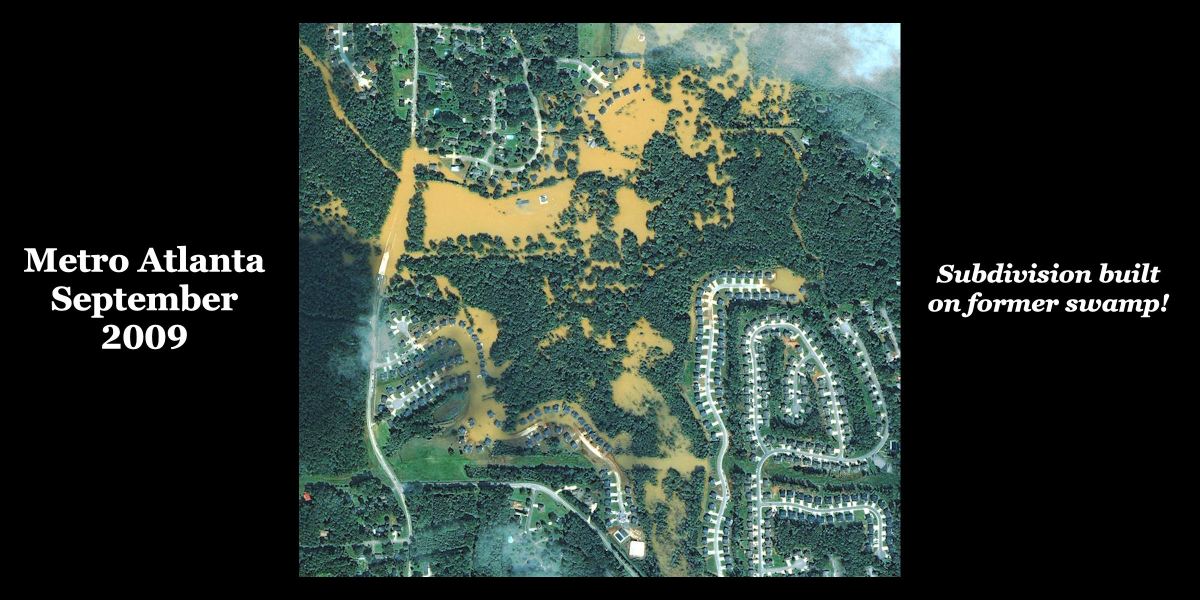
When developers build houses in a drained swamp!
Part Two of an award-winning series that originally appeared in the Architecture Column of the Examiner in September 2010.
by Richard L. Thornton, Architect & City Planner
Very few of the millions of people, who have moved to Florida in the past five decades are aware that approximately 80% of the commercial and residential development in the lower 2/3 of the state has been on drained swampland!
In 1992, Hurricane Andrew leveled thousands of acres of inadequately constructed houses in South Florida that were built on drained swamps. This trauma permanently changed land use policies and building codes in that part of state, but the rest of Florida keeps on doing business as usual.
Someday in the future, a major hurricane out of the Gulf of Mexico will strike the Gulf Coast of Florida head on. Here, public officials not only allow dense construction on swampland and at the edges of beaches, but also on islands in the ocean. This monster will do even more damage than Andrew. Whether or not Florida will be able to return to its former arrogance over nature is questionable.
Types of flood damage
One of the primary reasons that it is so difficult to measure the exact financial impact of flooding is that there are so many types of flood damage. Many of these types of property loss are not covered either by conventional property owner’s insurance, tenant insurance or Federal flood insurance. (See the previous article in series for the discussion of Federal flood insurance.)
Government agencies tend to monitor more closely the impact of regional catastrophic disasters than list every single event of water damaging a building or structure. Therefore, unless the flooding of individual properties is covered by the news media, they often go unnoticed by the records keepers. The types of flood damage include:
1. Failure of building mechanical systems – When a hotwater heater, water pipe or sewage pipe bursts, the water/effluent may flood a building and do extensive damage. Commercial property insurance will generally cover this damage. Many homeowner’s insurance policies will not cover this damage, unless the bursting pipe(s) were proved to be caused by the negligence or intentional sabotage of persons not living in the house. Repairs to damage from such events can even make the house a total loss. The intentional open of faucets and stopping of drains is a favorite form of sabotage by organized crime.
2. Failure of containment structures – Dams and canal walls may fail due to improper design, exceptional rain falls or ice dams. (See riverine flooding, below.) When that happens, torrents of water may be released on areas that are above known flood hazard zones. The results may be equally catastrophic (or more so) than conventional flooding. Several hundred deaths resulted from the failures of levees and canal walls during and after Hurricane Katrina. (See series Examiner series on New Orleans and Hurricane Katrina.)
North America’s worst flooding disaster caused by a collapsed dam, occurred on May 31, 1889. The South Fork Dam, owned by a group of millionaires that included Andrew Carnegie, failed after a particularly severe rainy spell. A wall of water and debris at least 40 feet high swept through the Johnstown Valley for at least 25 miles, destroying everything in its path. At least 2,209 people were killed. Several hundred bodies were never found.
The statistics of the destructive wall of water are staggering. Twenty billion tons or 4.8 billion gallons of water swept through the City of Johnstown. This is the equivalent of all the water pouring over Niagara Falls for 36 minutes. Even though many people died, hundreds surveyed by clinging to rafts of debris in the water as the deluge rolled on. Many of the floating houses were rammed against a railroad bridge, where the friction caused them to catch on fire!
The Johnstown flood was the first natural disaster to be served by the newly formed American Red Cross. The philanthropic activities of the Red Cross set a precedent in the United States that would occur again and again in future natural disasters.
Litigation after the Johnstown Flood also eventually changed the American legal system. The Pennsylvania courts found in favor of the defendants, when the victims of the dam’s failure sued the millionaires in the South Fork Fishing and Hunting Club. The disaster was ruled to be “an act of God” even though the design of the dam was clearly faulty. Indignation around the country caused sweeping changes in the legal definition of liability, whereupon in the future, corporate owners were held responsible for the negligence of employees, contractors and consultants.
3. Damage from fire-fighting activities – Large volumes of water are typically used by firefighters to extinguish a fire, or prevent it from spreading to other structures. It is quite common for this water to flow into neighboring structures, particularly if they are apartments or condominiums. Particularly, if the water freezes afterward, the water damage can be almost as severe as fire damage. The contents of adjacent structures are not turned to ashes, but they are total losses from water absorption. There is significant variation in the insurance coverage of such damage. Compensation from water damage may often come from legal suits between insurance companies.
4. Damage from sub-surface drainage – This category is defined as damage from a rise in the water table in the soil. The ground water may come from precipitation events long distances away, and not be the direct result of storms in the vicinity of the structure. The most common example of this type of damage is a flooded basement. However, living spaces and sometimes, even entire buildings can be damaged by water that came from under the ground.
Regions with porous soils or limestone rock strata, underlain by dense sandstone strata are the most common locations. Limestone strata typically look like Swiss cheese in section. Through the eons acidic water has created underground caves and reservoirs. When these cavities fill with water, any additional water is forced upward. The cause of the problem is that dense strata of rock block the natural downward percolation of groundwater. Water saturates the sub-soil and then has no place to go but up, or even above the ground. This problem can also occur when other types of rock underlay porous soils.
It happened to me in the Shenandoah Valley! This type of damage is a common surprise of families, who buy un-restored Colonial Period, houses in calciferous regions western New York, western Pennsylvania, western Maryland and the Shenandoah Valley of Virginia and West Virginia. During the early 1700s frontiersmen were subject to frequent attacks from Indian tribes located elsewhere. The most likely time to be attacked was early in the morning when the drowsy families were walking outside to fetch water from a spring or use the privy. Therefore, settlers learned to build their houses over springs.
In the 2 ½ centuries since that dangerous era, the water tables of most regions have generally subsided, causing small springs to dry up. Occasionally, heavy snow melts or major storms will raise the water table sufficiently to cause the springs to flow again. Shocked modern homeowners soon discover their basements flooded with cold spring water!
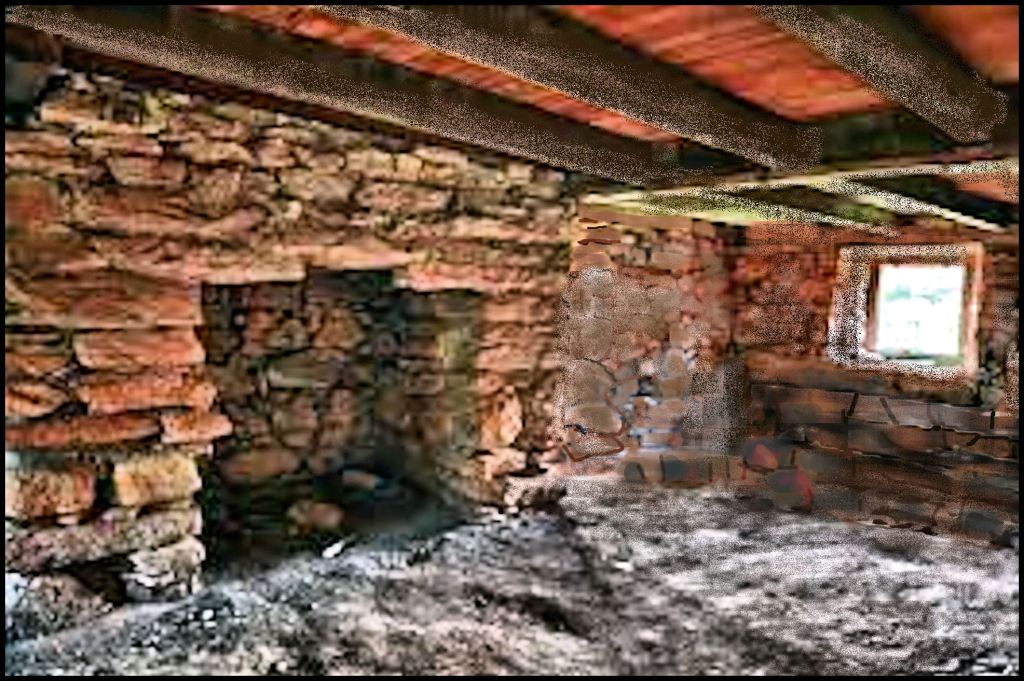
After suddenly learning that my house was originally a frontier fort, built by George Washington in 1754 over a spring, I had to cut a hole in the floor of the basement, formerly the kitchen of the fort, then construct a catchment basin and install an automatic sump pump. That worked fine unless the electric power went off. I then had to use a gasoline-operated pump to drain the whole basement!
Probably the most notorious example of groundwater damage occurred in a region underlain by granite bedrock about ten years ago. Gwinnett County, GA, a suburb of Atlanta, was one of the fastest growing counties in the nation. A political change in the county commission caused several politically appointed administrators to be fired, which was followed by the resignation of many long term building inspection department employees.
The new administration filled the department with employees from other regions and even nations, who had little knowledge of the geology or climatic history of the county. Simultaneously, there was a long term drought that lowered the water table.
A developer, who had recently moved to the Atlanta Area from another state, bought a tract of land for a upper middle income subdivision.
Even though in the past, much of the land in this tract had been a seasonal wetland, it was NOT included in the FEMA Flood Hazard Map for Gwinnett County. Seasonal wetlands form in the Southern Piedmont in the spring when groundwater from the Blue Ridge and Appalachian Mountains raises the water table at some locations above the soil surface. At the time, the maps were drawn by major national engineering firms, contracted by the Corps of Engineers the land had been covered with woods. Therefore, the surface conditions were not visible in aerial photographs. Long time residents of the county knew about these wetlands and therefore did not develop them.
The drought eventually ended in Georgia. In the meantime, the developer had constructed and sold 132 homes in the seasonal wetland to unsuspecting families. When the seasonal wetlands appeared the next spring, most of the homeowners found their houses sitting in water, even though there had been no exceptionally heavy rains.
Property insurance companies did not cover any of the damage since it was classified as flooding. The homeowners sued the developer, but he quickly declared bankruptcy. Most of the homeowners were not able to pay the cost repairing their homes and/or raising the entire building sites above seasonal flood levels, and therefore were foreclosed upon. It is not likely that the +/- $40 million in property losses in that subdivision were recorded in Georgia’s total that year for flood damage.
In Part 3 we will continue with the description of the types of flood damage that may occur to property. You will be surprised at how many ways water can destroy buildings and take human lives.

