The region is about to be hit by a massive wave of business, personal and possibly even local government bankruptcies.
Final article in a series on the Hurricane Helene Catastrophe
FEMA estimates that only ½% of the building owner flood victims in Western North Carolina had flood insurance. This is an especially catastrophic situation for Asheville and Buncombe County< NC because much of their commercial development in the past 35 years has been in flood hazard zones! They soon will be hit with a staggering shortfall in 2024 Property Tax and Sales Tax revenues.
Local sales taxes are the second largest county-levied revenue stream in North Carolina and are shared with local municipalities. They comprise on average 12 percent of total county revenues. Property tax revenues are due by January 5, 2025, before 5% penalty fees are added.
FEMA’s long-term assistance to “regular folks” consist of low interest loans for new buildings, whose occupied spaces are constructed above the 100-year flood level. FEMA is forbidden from providing financial assistance to the reconstruction of commercial buildings, whose occupied levels are below the 100-year flood level.
How can homeowners pay back loans for grossly inflated construction costs, when they don’t have a job? It is impossible for a modern “box” retail store to thrive, when placed on 12-14 feet high structural steel stilts.
The Catch 22? A few weeks before Hurricane Helene, the Republican-controlled North Carolina General Assembly passed a law that prohibited local governments from regulating development in flood hazard zones and on steep slopes.
There is another problem. Most of the residential flood victims inside the Asheville flood hazard zones were renters. Residential renters receive no-long term assistance from FEMA, other than transportation costs to another part of the nation.
Western North Carolina lost most of its industrial economic base between 1980 and 1992. That has been replaced by a more fragile economy based on retirees, tourism and casino gambling. Most highways serving major tourist attractions in WNC will be closed during the peak leaf color and Christmas seasons.
Ingles Markets, Inc. is western North Carolinas largest employer, but its continued existence is in question. Unfortunately, it constructed its new corporate headquarters campus inside a flood hazard zone and parked all of its fleet of tractor trailer trucks on the edge of the bank of the Swannanoa River just prior to the hurricane’s arrival. Ingle’s only warehouses for a four state region are in this campus. They were severely damaged and over 50 employees from the night shift are missing. The company recently constructed one of the largest refrigerated warehouses, but as a cost-cutting measure did not purchase any emergency generators. The company did not have any emergency operating plan.
Many of the new retail stores, warehouses, distributers, restaurants and motels serving the tourist industry were severely damage by Hurricane Helene. This means that a large number of hourly workers in the region, will be unemployed for many months, even if their residences were not destroyed by flooding or landslides.
by Richard L. Thornton, Architect & City Planner
The author prepared the highly successful Downtown Asheville Revitalization Plan and then coordinated municipal support for the initial 64 private sector projects in Central Asheville. Simultaneously, he designed the now famous plazas around Pack Square in Asheville. He next got the Asheville-Buncombe County Historic Resources Commission going. Afterward, he practiced architecture in the Asheville Area for five years, before moving to Virginia.

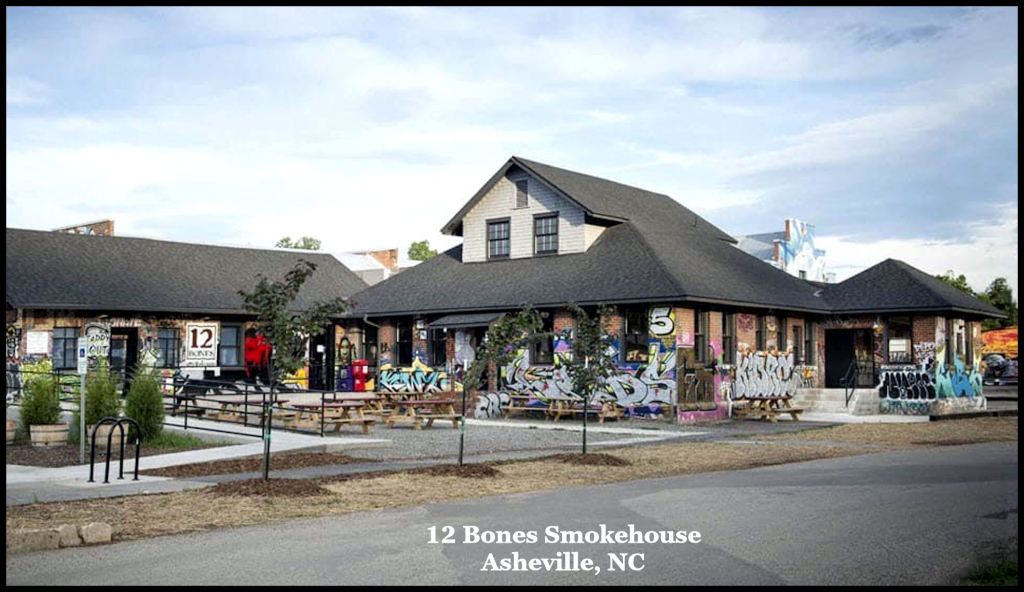
The 12 Bones Smokehouse Restaurant was located in the district that had been unoccupied since the 1916 Flood.
President Barrack Obama and Asheville – A Metaphor
The Restaurant Owner: On Monday morning, following the hurricane, NBC Today conducted simultaneous interviews with former President Barrack Obama, the owner of the 12 Bones Smokehouse in the now devastated River Arts District and Mayor. The owner of the restaurant stated that he didn’t have flood insurance and that it would be many months before the flagship restaurant of his small chain would be open. He said that they did have a new branch restaurant in Downtown Asheville. It would reopen as soon as it had running water, electricity, telephone and internet service.
The Mayor: NBC News then interviewed Mayor Esther Manheimer of Asheville. She first stated that none of the public water systems in Buncombe County were operating. None of the thousands of rural residents had water, unless they owned generators. Almost all electrical power in the county was out.
Manheimer stated that the entire Asheville Water System from the reservoir dam in the mountains to the aqueduct to the distribution pipes were severely damaged. She said that it would take several weeks for all damage to the system to be identified and many, many months to repair it.
Asheville’s sewer system was also severely damaged. Long sections of trunk sewers had been washed into the French Broad River. Most pumping stations required complete replacement. Water service could not be turned on until the sewer system was repaired. She said that it might be several months before electricity and telephone service was available to the district, where “12 Bones Smokehouse” was locate. In a final note of grim news, Manheimer added that it would be next spring or early summer before all of the interstates and expressways, linking Asheville to the rest of the world, would be open to traffic.
The Former President: Barrack Obama stated that Asheville was one of his favorite cities and that 12 Bones Smokehouse made the best barbecue in the world. He assured the owner of 12 Bones that FEMA would get him running and open as soon as possible.
The Obamas in the past had even considered buying a vacation home in the Asheville Area. That part is true, but what FEMA can do for this owner is very limited.
Probably, Barrack Obama didn’t realize that the restaurant was located in a designated flood hazard zone next to a mountain river highly prone to flash flooding. If the regulations adopted by Congress are obeyed, about all FEMA can do directly for the restaurant owner is offer a low interest loan for the business to relocated to a building above the 100-year flood hazard zone.
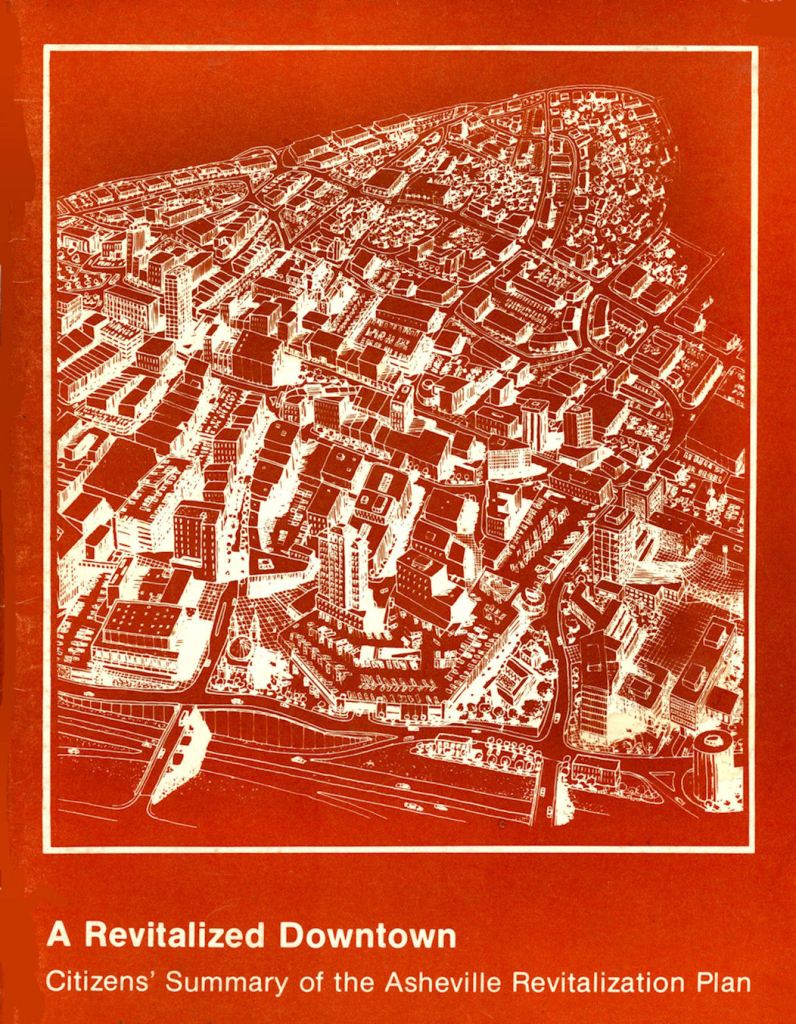
After preparing the Revitalization and Urban Design Plans, I produced a heavily illustrated booklet in simple English so the citizens of Asheville could understand the urban design concepts that I learned while working in Sweden then traveling around Europe.
Historical Anecdote: After the Pack Square Plans were completed in Asheville, I sent a proposal to City Manager Ken Michelove to carry out a planning-urban design study of the turn-of-the century buildings along the river that is now called “The River Arts District.” It had been a ghost town since the 1916 flood. No building or occupancy permits were issued there.
What I proposed was to create something akin to the “Old West towns” that tourist visit in California, which also used for filming movies, TV programs and TV advertisements. None of the buildings are permanent occupied, but look like they are. I also proposed a Green Belt Park along the French Broad River with large spaces for outdoor festivals and parking.
Michelove wrote back in red ink at the bottom, “What is this crap?”
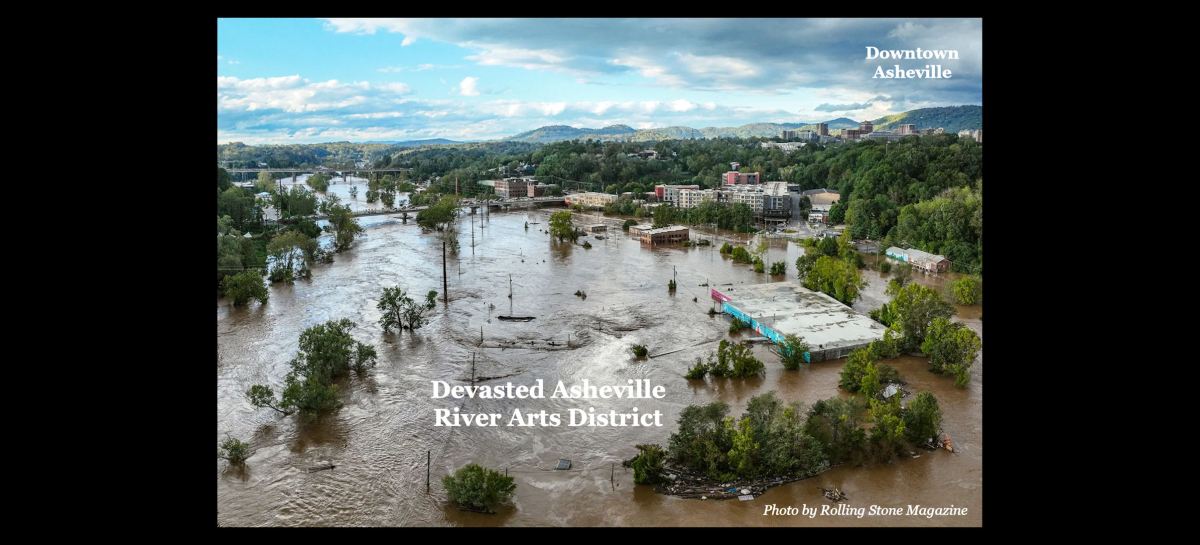
Apparently, someone dusted off the proposal after we moved away from Asheville, but took it a step further by putting restaurants, art studios, night clubs with live music and apartments in the old buildings in the flood plain. As you can see in the photo at the top, most of those businesses are now bits of scrap, floating down the Tennessee River between Knoxville and Chattanooga.

Asheville City Hall
Asheville the Great Sodom: When I lived there, it was a place that many young, college-educated, outdoorsy couples moved to in order to live with nature and start new businesses. My former wife and I were one of those couples. We were the pioneers, who saved downtown Asheville, but eventually learned that it was a lousy place to be an entrepreneur, unless your parents were filthy rich, so most of us moved to greener pastures. My architecture income tripled and our goat cheese creamery became nationally famous, after I moved to northern Virginia.
Asheville elected a lesbian mayor, who encouraged the hiring of her kindred souls into government agencies. Then . . . the Asheville Area was the only section of the Southern Highlands, which didn’t flip to being all Republican in the late 1990s. Asheville had always been tolerant of eccentric people and so did not openly harass LGBTQ immigrants.
The city’s relatively small group of LGBTQ residents began calling Asheville, the Gay Capital of America, to attract more of their persuasion. The reality is that gay males make up 0.7 percent and lesbians make up 1.1 percent of households in Asheville. That is not a very high figure, compared with other regions of the nation. The LGBTQ community has definitely added to the cultural vitality of the region, despite their modest numbers. Demographic reality is not considered, when rightwing extremist politics are a concern.

Blue Ridge Gay Pride Parade in Asheville
Photo by The Asheville Citizen
Many of the folks in the remainder of the Southern Highlands now believe that Asheville is composed of nothing, but sexual predators and “perverts.” In their mind, God destroyed Asheville because it wickedness, but Satan destroyed Florida and Texas to persecute the good Christians there. If the extremists among them had their way, the remainder of the Asheville Area would be depopulated and bulldozed.
It sounds ludicrous, but it is true. After Susan, my longtime friend with benefits in National Security, “raised cane,” the U.S. Justice Department became serious about investigating the corrupt district attorneys, state cops and local cops in this region. They had committed a legion of federal and state crimes against me in their zeal to “find something to charge me with.”
The sources of all the problems were found to be some nutcase Georgia Bureau of Investigation agents and a delusional deputy in the Lumpkin County Sheriff’s Department, who said, “We know that he is a pervert, because he used to live in Asheville.”
When they learned through illegal wiretapping that I was to receive an honor at the National Trust for Historic Preservation annual meeting, the Lumpkin County Sheriff’s Department called the Savannah City Police and described me as one of the most dangerous criminals in Georgia. These men, clearly needing to be in a mental hospital, did the same thing again, when I bought a house in Northeast Georgia.
The District Attorney and Habersham Sheriff’s Department then took their crazy pills and elevated me to being the most dangerous person in America, because I had lived in Asheville. I was investigated for every unsolved heinous crime in North Georgia, since I graduated from high school. They went to night, dreaming of the glory they would receive on national television when they locked me up. My oh my!
Whatever your opinion of the City of Asheville, a large chunk of your taxes are being pumped into the Florida Gulf Coast, southern Georgia, western North Carolina and eastern Tennessee to rebuild after Hurricane Helene. Current estimates are that over a billion dollars will required to repair the devastated dams, roads, railroads, water lines, sewer lines, storm sewers, electric lines, telephone lines, bridges, cellular towers and parking lots in western North Carolina alone. That achievement will just mark the beginning of that beautiful region’s recovery.


Oh, me, oh my, Richard. I have an analgous stories, about Chatham County government and the retroactive insurance requirements for building on flood plains. Not to bore you, but I can appreciate how the County’s nit-picky harassment of individuals resisting local Powers That Be in the internal GroupF**ck of local government. When I worked in Columbus, they referred to the “State of Chatham”. I have since learned why.
LikeLiked by 1 person
That is very surprising, because outsiders think of Savannah as being very progressive and tolerant. I guess police state government can be found in many areas . . . but seems now to cover the whole state of Florida . . . which increasingly resembles Germany in the 1930s.
LikeLiked by 1 person
I didn’t live back then, but I’m reading now a book that belonged to my Grandfather, Olaf, who emigrated to the US in 1908, then married my Grandmother Kate, who was born in Dahlonega, GA. Pa probably acquired the book after it was published in English in about 1953. Peter Moen’s Diary. Amazing story about his incarceration in an Oslo site taken over by the Nazis during the Gestapo’s occupation of Norway. The “Westphalen” hit a mine off the coast of Sweden in 1944 and sank. Moen had pricked out his diary with a pin used for his blackout curtain on prison toilet paper, then shoved it in rolls down the ventilator grate. He had confided about his diary to a few people onboard, and one survivor of the sinking ship told Moen’s story to Oslo police. After the war, they broke up the floor and found Moen’sdiary intact.
LikeLiked by 1 person
Jag forstor Norska en lite gran.
LikeLiked by 1 person
About Savannah . . . Savannah is the latest Go Too city along the Eastern Seaboard for Urban Yankee Escapees and Sun Followers. As in Asheville, local government dances to the rhythm of Yankee money and Debt Obligation Bonds to finance extensive “infrastructure improvements”.
The sales pitch does not reflect day-to-day life on the streets.
LikeLike
The trouble with Asheville is that their bonds went to pay for important items like tearing down the Vance Monument RATHER than fixing their water, sewer and storm drainage systems. Uncle Sam is going to pay for work now. The Vance Monument honored Zeb Vance for pulling North Carolina out of dire poverty AFTER the Civil War. It was not a Civil War monument.
LikeLiked by 1 person
I follow Christ Jesus and I do not beleive God sent those hurricanes to anywhere to punish anyone. That’s a horrible thing to say and think. And I’m hearbroken and sad that our government is helping other countries and people in the world but not helping its own citizens.
LikeLike
I forgot to subscribe to replies.
LikeLike
What are you talking about? As of Monday October 20, 2024, the federal government had already spent over $45 million in the region impacted by Hurricane Helen and has over 3,400 FEMA, law enforcement and active duty military personnel working in western North Carolina alone. That dollar figure does not include what has been spent by state governments, local governments and foundations.
LikeLiked by 1 person
This is good to know. Thanks for clarifying.
LikeLiked by 1 person