The Peopling of Eastern North America Series
by Richard L. Thornton, Architect & City Planner
The only way of being assured of learning an accurate description of Maya Cultural History is to attend university-level anthropology classes in Mexico or Guatemala.
I learned about the Mayas the good ole fashion way. All of my Mama’s and biological father’s Native American DNA came from southern Mexico. My fellowship advisor in Mexico was 1/2 Campeche Maya. My girlfriend in Campeche was 1/4 Maya. Later on, my French soulmate was 1/4 Tamulte Maya. Her grandmother was from Tabasco.

This photo of Dr, Piña Chan was made about a year before his death and 30 years after he was my fellowship coordinator. The famous 2000 year old figurine in the center of this photo was on a wooden shelf immediately to the right of the entrance door of his private office. I will never forget the first time I walked into his office in complete awe. Internationally famous Pre-Columbian art was casually scattered around his office as if they were family photos.
Before discussing migration of peoples
The next article in this series will discuss the evidence for Mesoamerican Indigenous Peoples migrating into Eastern North America. You will be shocked how early this occurred and from which direction they came from.
However, there is so much misinformation being repeated replicated in North American TV documentaries on Mesoamerican civilizations, I thought it would be appropriate to provide a chronological catechism, before diving into information that is available on the internet from some universities in the United States or other nations, but not in North American anthropology and architecture texts.
On December 21, 2011, I published an introductory article in the National Examiner on the Track Rock Terrace Complex in hope of creating work for archaeologists. It was the Great Recession and at least 85% of them were unemployed. Some of my closest friends in Virginia had been nationally famous archaeologists.
Instead of asking me questions, a clique of “Old Guard” archaeologists in Georgia and Florida turned on me like trapped, wounded dogs in a dogfight pen . . . when falsely promised future work by Boss Hogs. Meanwhile, their profession collapsed so completely that both archaeological associations in Georgia ceased to have functioning websites for the next six years,
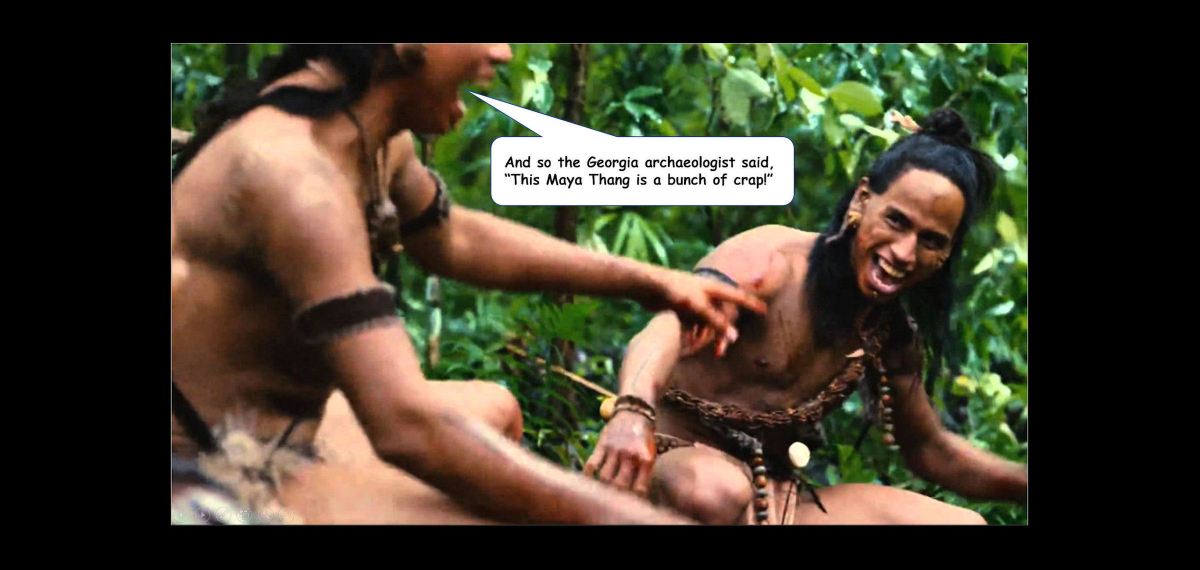
In 2012, I was absolutely appalled at how little the Georgia Council of Professional Archaeologists knew about the cultural history of the Creek and Maya People. In early March 2012, the President of that organization kicked off the “The Maya Myth-Busting In the Mountains” campaign with a speech to the Georgia Trail of Tears Association with the statement at this top of this article. At that point, most of the Creeks walked out and permanently left TOTA.
Those few Georgia archaeologists, who had actually worked some summer in Mexico or Central obvious knew little about Maya cultural history . . . only the style names and approximate dates of the artifacts that they happened to unearth. They did not even know there are 44 “Maya” tribes with distinct languages, plus that those in Tabasco and Chiapas can carry on conversations with Florida Seminoles and Miccosukees! Unfortunately, their ignorance has cost the people of Union County, GA millions of dollars in tourism revenue.
What particularly intrigued me was the archaeologist, who the personnel at the Chattahoochee National Forest hired as their archaeologist-spokesman, Johannes Loubser. Neither Loubser nor the U.S. Forest Service knew that Chattahoochee (Cha’ta Hawche) were Highland Maya words meaning “Carved Stone – Shallow River.” I will be showing you that carved stone in a future article.
Loubser was promoted by the US Forest Service as an archaeologist with decades of experience and internationally respected expert on rock art. Yet, on the few occasions, when he was paid to interpret petroglyphs in Georgia and North Carolina, he didn’t have a clue what he was looking at. He interpreted the Track Rock Petroglyphs as being “graffiti carved by bored Cherokee hunters.” Only problem is that Track Rock was in Creek territory until 1785 and unlike him, I can translate every symbol. It is a writing system, but we won’t tell you more until next time.
Loubser is the one, who told an assembled group of Southeastern tribal members that I was a racist white man, who was trying to steal the Cherokees’ and Creeks’ heritage . . . and they believed the lie. He told them that I had never been in Mexico and had never met a Maya Indian. If I had not been homeless and penniless at the time, I would have immediate filed a $5 million dollar Professional Liable suit against and easily won.
So, I decided to do some research. There was really nothing to back up his broad claims made to reporters in his United States, so I decided to google an inquiry about his background in Afrikaans – the Dutch dialect in South Africa. What I discovered turned out to be a metaphor for the whole problem with current profession of anthropology in the United States.
For most of his adult life in South Africa, Loubser was a soldier for the Apartheid government in its unsuccessful war with the African National Congress. After retiring from the S. A. Army, he entered a university, where he studied for five years. His South African biography lists five archaeological sites, where he participated in student field trips or worked as a student laborer. His American bio infers that he was the professional archaeologist in charge at these digs. During this period, he was also an intelligence asset of the National Security Agency and the CIA, who apparently paid for him to attend international conferences in order to gather intelligence. Well, at least the Afrikaans bio proudly lists those agencies as his sponsors.
Shortly, after Loubser was awarded a Doctorate in Anthropology, the Apartheid Regime collapsed. Having a price on his head for something in the past, Loubser was given political asylum in the United States in 1991. He immediately began working full time in the National Security Agency offices in Augusta, GA and Atlanta. In 2000, he was “hired” by the US Forest Service to study the Track Rock Petroglyphs, but was still considered an employee of the NSA and for many years to come. As of 2012, Loubser had never been in Mexico or worked on an ancestral Creek town site.
This most ironic part of this story is that I totaled up Loubser’s professional experiences at the bottom of the South African biography. NOT counting any of my extended trips to Mexico, as a professional Architect, I have been involved in at least three times as many archaeological sites as him. In addition, National Park Service archaeologists worked for two years on my farm in the Shenandoah Valley. Also, my position as Principal Planner of Cobb County, GA included administration of all contracts for archaeological projects, funded by the county.
Over and over again, if you dig behind the scenes on contemporary archaeological orthodoxies in the Eastern United States, you often find immense piles of caca de toro. So much for the profession’s frequent mantras of “pseudo-archaeology.”
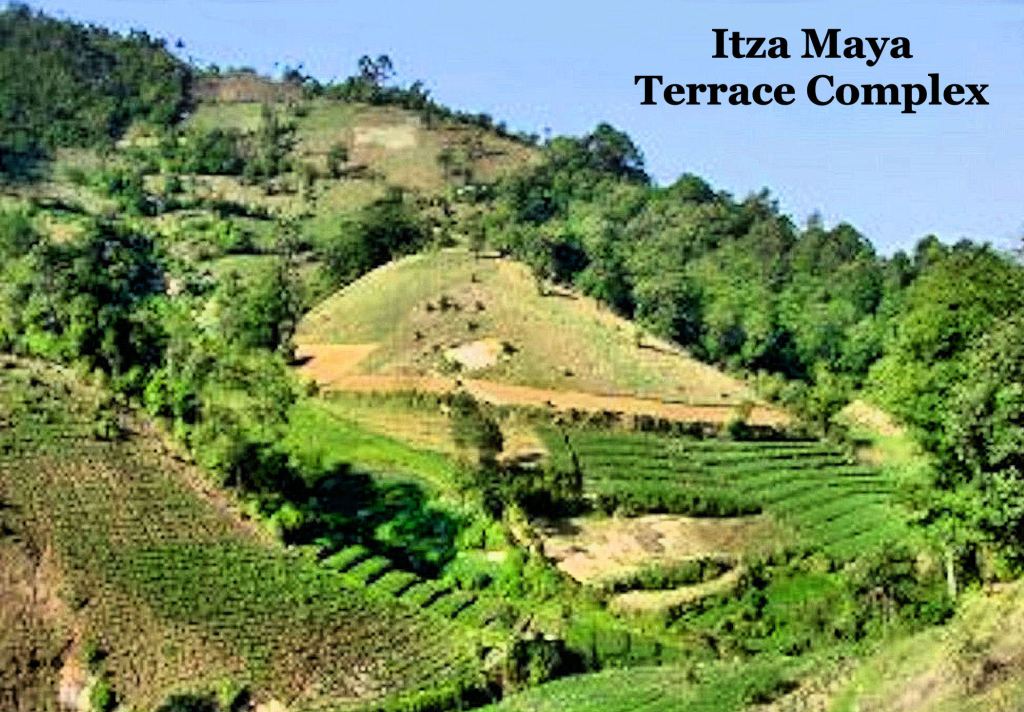
Forty years later, I would stumble upon an almost identical terrace complex at Track Rock Gap, GA
Fake names!
The Olmec People had nothing to do with the Olmec Civilization. They were Nahua invaders, who entered Tabasco around 1000-1100 AD. In fact, their tradition of eating humans as a protein supplement is probably what drove many of the ancestors of the Creek Indians out of Mexico.
The false name was coined by Mathew Stirling of the Smithsonian Institute, who vacationed where Mexican archaeologists had been working for three decades. He paid professional photographers to photograph him next to stone monuments, unearthed by Mexican archaeologists. Upon returning home, Stirling wrote a poplar article on what he had seen, which made readers think that he had discovered a new civilization and excavated those monuments.
The real founders of this civilization
The Zoque (aka Soque & Sokee) claim to have founded the “Olmec” Civilization. In all spellings, the word is pronounced, Jzhō : kĕ. According to their migration legend, the highly advanced Soque People of Northeast Georgia are one in the same as those in Mexico. many later migrated to South Florida, where they called themselves Mayas, until forced to change their name by the BIA in 1951.
The same phonetic syllables were the Norse name for the Sea Sami of northern Scandinavia – Sjøke. The Sea Sami were Eurasians, who built large whale hunting boats, which were capable of sailing across ocean waters. It is now believed by European archaeologists that they taught the Germanic Scandinavian newcomers how to build seaworthy boats.
The real Mayas
Only one tribe called itself a name similar to Maya until the Spanish Conquest of Central America . . . and they did not probably arrive in Yucatan from southern Florida until around 1000 AD or later. Their original capital on Lake Okeechobee, FL was called Maiami, which means, “Capital of the Lake People,” Miami, Florida’s name is derived from that word. Their large capital city in Yucatan State had the same name, but is known today by its Spanish name, Mayapan. A Spanish “y” has the same sound as a “long i” in English.

This is a color slide, taken with a tripod and timer, of Ana Rojas and I dancing to a boombox playing “Creedence Clearwater Revival.” We were spending our first night together in a Maya hut near the ancient Maya city of Labna in mid-August 1970. At the time, Ana was a rising senior at the University of Campeche in Highschool History Education. Inspired by our romantic journey by Jeep through the then tierra incognita of eastern Campeche, she eventually earned a PhD in Cultural Anthropology, specializing in Maya Music and Dances.
Chronological Surprises!
The oldest known burial mounds in the Americas, probably the world, are on the campus of Louisiana State University in Baton Rouge. Construction of these mounds began around 11,000 years ago.
- The oldest known large communities in the Americas were found by my late friend, archaeologist Bill Gardner, in the Shenandoah Valley of Virginia. The communities were founded as early as 9500 BC and contained up to 1000 residents.
- The oldest known copper artifacts in the world were found in the Great Lake Basin of the USA and Canada. They are about 9,500 years old!
- The oldest known pottery in the Americas was found in the Amazon Basin in Brazil and dates from around 6,500 BC.
- The oldest known large scale public works project in the Americas is found in Savannah, GA, The Bilbo Mound, Canal, Port and platform village date from about 3,545 BC.
- The oldest known pottery and mounds containing pottery, north of the Amazon Basin, were found near Augusta, GA and date from around 3,500 BC.
- The oldest stonehenges in Canada are 500 years older than the earliest stonehenges in the British Isles. They date from around 3500 BC.
- The oldest large town in North America is now called Poverty Point, LA. Construction began around 1700 BC . . . about 800 years before any significant mounds or earthworks were constructed in Mexico. Poverty Point was abandoned around 1100 BC . . . the approximate time when villages began to grow in the future locations of the “Olmec” and Maya Civilizations.
- The “Olmec” and “Maya” civilizations began at the same time, around 900-800 BC. Both textbooks and TV documentaries continue to tell people that the Maya civilization suddenly appeared, after the Olmec Civilization disappeared.
- Pottery making did not begin in southern Mexico until around 900 BC. This is also the earliest date of their ceremonial mounds. They did not build stone veneered pyramids like the Mayas did.
- The “Olmec” civilization did not suddenly disappear around 500 BC. Some of their largest cities were abandoned at this time, because they were environmentally unsustainable. Other large towns were continually occupied until around 1500 AD, when the Spanish introduced a catastrophic small pox plague into the Caribbean Basin, Gulf of Mexico Basin and Mesoamerica.
- Most of the advanced cultural achievements ascribed to the Olmec Civilization by TV documentaries actually occurred several centuries AFTER the program just told you when the civilization died. This later period is called the Epi-Olmec Culture.
- The Maya Civilization did not suddenly disappear around 900 AD. Many large cities in the Lowlands were abandoned about that time, but the population increased in northern Campeche State, Yucatan State and Quintana Roo State. There are smaller Maya towns in central and northern Campeche State, which have been continuously occupied to this day.
The Truth is out there somewhere, but rarely on television documentaries!


I don’t come out and call it a lie. No, not at all. It’s all about the programming. The truth, they don’t want us to know.
LikeLiked by 1 person