
Beginning what is called the Late Archaic Period in Eastern North America and the Late Neolithic Period in Europe, various peoples were constructing underground chambers as gateways to the Underworld. The dead were worshipped for awhile then the structures were covered with dirt.
The burial mounds, constructed between around 1200 BC to 500 BC in southern Sweden, Denmark, the coast of Massachusetts, upper Ohio River Basin and in northern Georgia were identical.
Also, the stone implements and cord-marked, beaker-shaped pottery of southern Sweden, Denmark, southern Ireland and Georgia were very similar in this period. Denmark and Sweden had to import all of their bronze implements, so they were primarily utilized by the elite.
The Kialegi Tribal Town, a division of the Muscogee Creek Nation, has the exact name as the tribe that gave County Kerry, Ireland its name. The Kialegi formerly lived in North Georgia. There are many petroglyphic boulders in North Georgia, which are identical to those in County Kerry! In fact, the Muscogee word for “tribe” is the same as the Gaelic word for tribe.
Both the custom of building burial mounds and knowledge of how to make pottery did not arrive to southern Mexico until around 900 BC.
The Peopling of Eastern North America
by Richard L. Thornton, Architect & City Planner
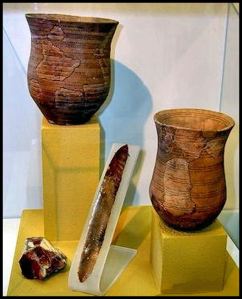
Probably all archaeologists and anthropology students in the Southeastern United States would assume that this museum exhibit portrayed Deptford Culture artifacts from somewhere in northern or central Georgia. Scandinavian archaeologists would assume that the exhibit was from a museum in Denmark or southern Sweden. Actually, it is from a museum in southwestern Ireland! In all three regions such artifacts date from the same general time period.

A large mound near Britt’s apartment in Malmo, Sweden
En svensk sommar (One Swedish summer)
On the morning after June 3, 1972 when I graduated from Georgia Tech, I flew across the Atlantic to start (officially for the next 20 years) a technical exchange position at the Landskrona City Architect’s Office.
On June 7, my boss Stadsarkitekt Gunnar Lyhd showed me my project site on Ven Island in the Öresund Channel. Nearby were boulders containing petroglyphs identical to Creek and Uchee sacred symbols, plus some petroglyphs that I had seen in the Georgia Mountains. For the next four decades, I would be “bothered” by that experience and later that summer . . . by seeing Sami shell gorgets like the ones Creek Indians wore, in a museum in Kiruna, Lapland . . . but never gave it deep thought until the 21st century.
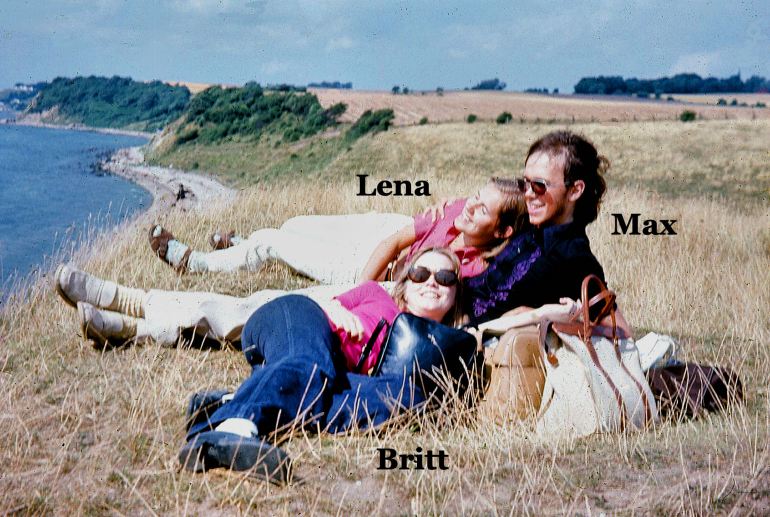
On June 9, while I was eating a lunch of korvar (sausages) and pommes frites (French fries) on the edge of a fountain in front of the Rådhus (City Hall) a statuesque, classic Swedish flicka walked up to me and smiled. She said, “Hey Richard. My name is Britt. I am going to be your official Swedish girlfriend.”
Britt was a law student at Lund University and President of the College Division of the Center Political Party. She had been asked by the Swedish Royal Navy to be my tour guide and dating service. Swedish Naval Intelligence was concerned that I would be easily fooled by blond Soviet spy girls, who lurked in the discos and bars of southern Sweden and nearby Copenhagen, Denmark.
I asked Britt about the Bronze Age petroglyphs and stone ruins that I had seen on Ven Island. She confessed that she had been a nerd in high school and college, thus knew practically nothing about them. We agreed to meet up the next morning (Saturday) and tour the Landskrona History Museum.
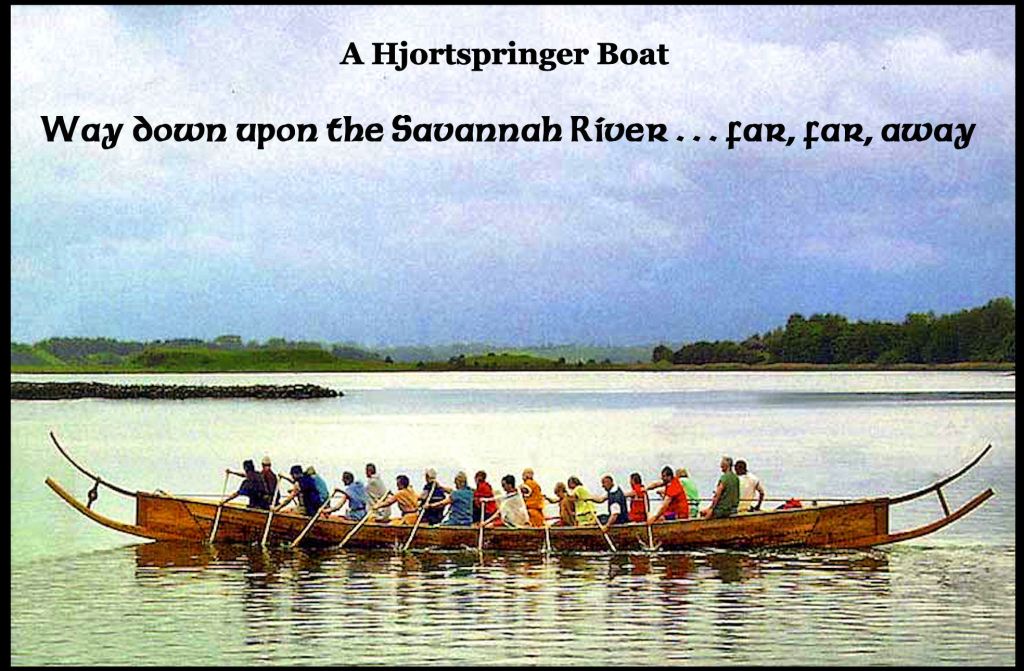
At the museum, I beheld a restored hjartspringerbåt, a Scandinavian Bronze Age rowing boat, which eventually evolved into the Viking långbåt (longboat). Not in a million years, would have dreamed that 45 years and 7 months later, would I see that same boat, plus Swedish Bronze Age petroglyphs, engraved on a petroglyph rock in a museum, overlooking the Tugaloo River in extreme Northeast Georgia. The Tugaloo is a tributary of the Savannah River.
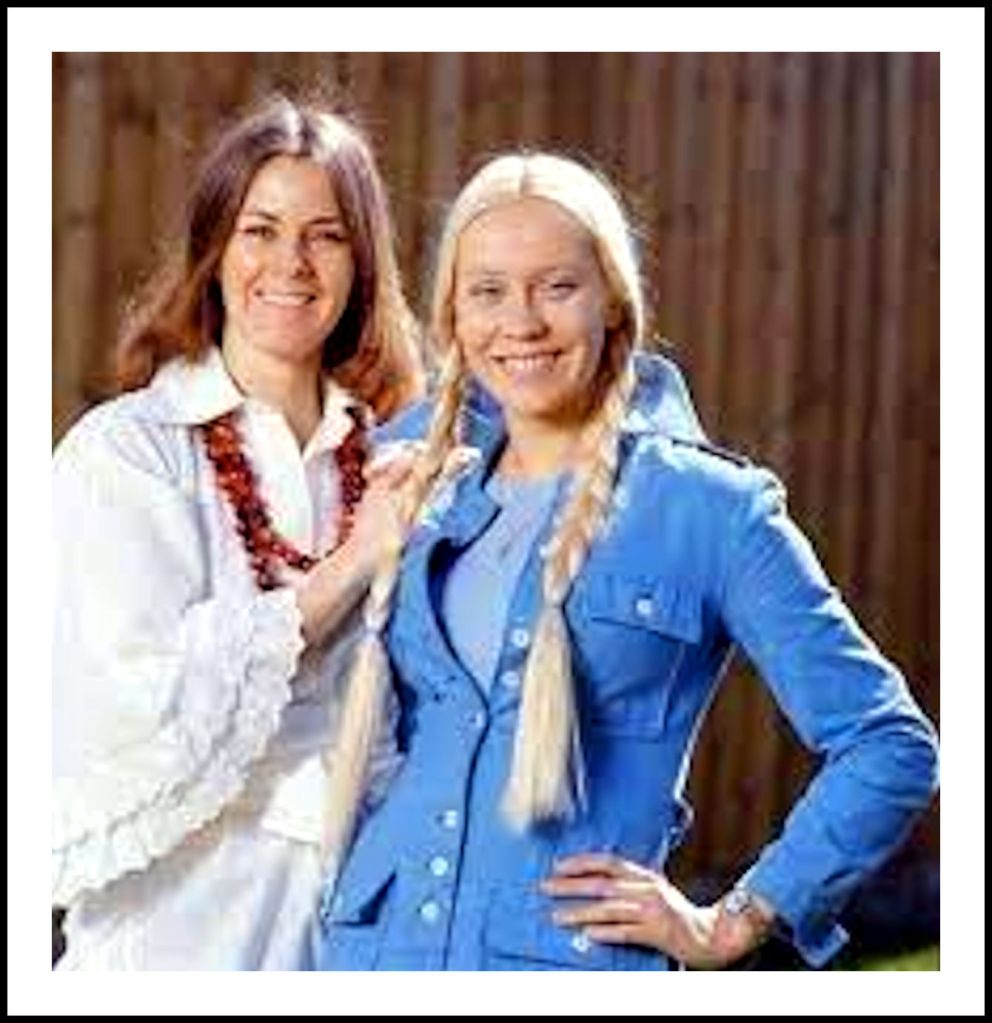
Anni-Fried and Agnetha, before they were famous
Initially, Britt thought that she would not be attracted to American men, so introduced me to young Swedish women, who were “safe.” They included a buck-toothed, pig-tailed Agnetha Fältskog, who two years later would become the blonde A in ABBA. She had a beautiful voice and at that time dreamed of moving to the USA to sing on Broadway.
By early July, Britt had warmed up to me. We began traveling around southern Sweden and Denmark on weekends visiting museums, Bronze Age mounds and Viking Age sites. My employer enrolled me in some all-day classes at Lund University, one of which was on the Late Neolithic, Copper and Bronze Ages.
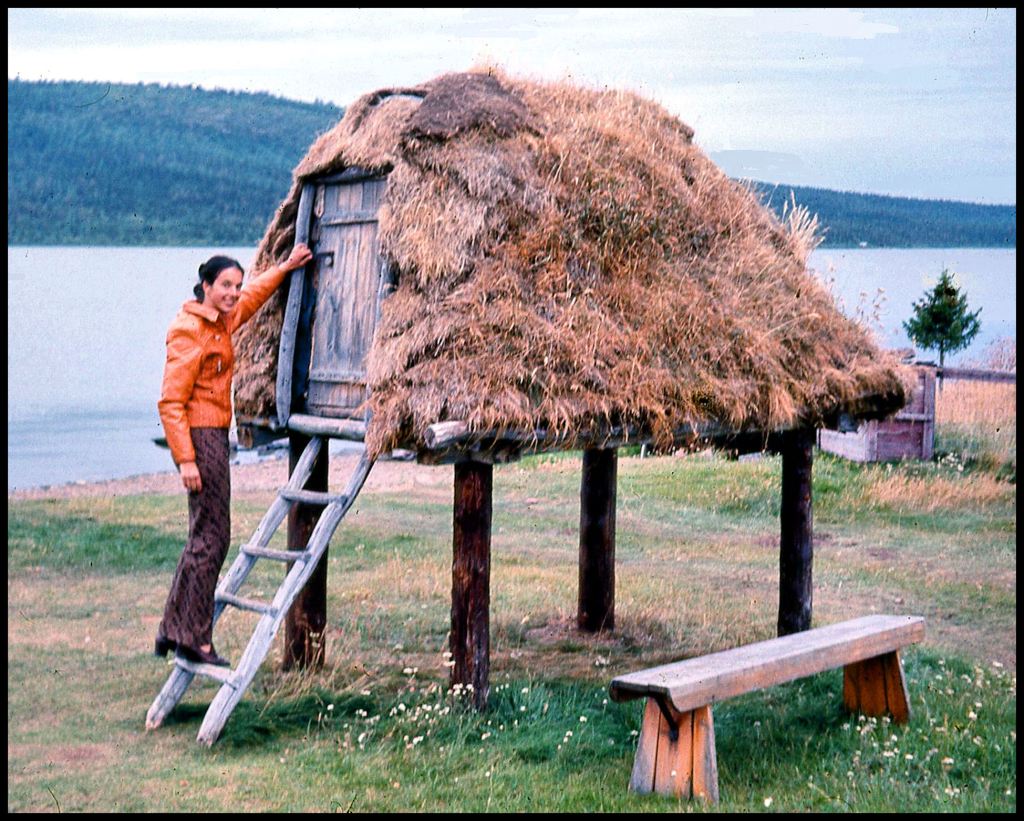
Color slide of Joana by Richard Thornton at Jukkasjärvi, Lapland – August 20, 1972. It was already sleeting and snowing that far north of the Arctic Circle. The Sami must store their deceased loved ones in above ground houses like this one, if they die during the many months when the ground is frozen. The bodies are typically buried in May. This type of shed was also used for storing reindeer meat and fish during the winter months.
In mid-August, I was assigned to pose as a boyfriend/bodyguard for a female biologist, working north of the Arctic Circle. She was descended from a Sami tribe that migrated to the Alps in the Roman Period, but now lived in Salzburg. Most Scandinavians assumed that I was Sami.
After rendezvousing with Joana in Kiruna, we wandered about the Arctic regions of Sweden, Finland and Norway . . . taking samples of the fallout from Soviet nuclear tests. Then I traveled the entire length of Norway on the way home. Afterward, Britt and I continued to explore southern Scandinavia until late September, when it was time for me to head to other parts of Europe.

Thus, I learned about the Scandinavian Bronze Age the good ole fashion way, by taking an 8-hour class on the subject then accompanying a beautiful Viking shield maiden around southern Sweden and Denmark. However, I did not give much thought to those experiences and color slides until 2017, when I beheld a hjartspringerbåt at a museum in Toccoa, Georgia!

Painting from National Geographic Magazine
It was not just in Ireland
National Geo Article: The September 2024 issue of this famous magazine contained a very interesting article, which traced the origin of most of the Halloween traditions in Europe and the Americas to the Bronze Age in Ireland. It is quite interesting and well worth the read.
Southwestern Ireland contains significant gold and copper deposits. One of the earliest copper mines in Western Europe, located in Lough Leane, Killarney, Co. Kerry. The copper workings date back to between 2,400 and 2,000 BC. That’s recent history compared to the world’s oldest copper mines in the Great Lakes Region of North America, which began around 9,500 years ago.
The Wicklow Mountains and the Mournes region of Ireland contain placer deposits of almost pure tin. Mix copper and tin together and you get a much stronger metal, bronze. Thus, the people of Ireland had the raw materials to make practical bronze implements and the gold to trade for fancier bronze containers and art from elsewhere in Europe. The bronze artifacts in Irish burial mounds have survived the eons and thus can tell us much about the origins of traditions, associated with Halloween today.
However, the authors of this article in National Geo are wrong in assuming that such traditions only were practiced in Ireland. Simultaneously, peoples in southern Sweden and Denmark, plus eastern North America were constructing underground log temples and tombs, albeit without the rich depositories of bronze art and implements. Those in North America worked raw copper and gold, but apparently did not know how to make bronze. Those in southern Scandinavia did not have copper, tin or gold deposits. The Swedes did not discover the vast copper deposits in the northern lands of the Sami until the late Medieval Period.

Swedish Bronze Age petroglyphs, about seven miles from my house
Petroglyphic evidence: The Track Rock petroglyphs in the North-Central Georgia Mountains are identical to the oldest know petroglyphs in Scandinavia, which are found on the Baltic Coast near Nykōping, Sweden, which date from about 2000 BC. The Nykōping petroglyphs include the earliest known examples of the earliest Maya glyphs and numerical symbols. (yes, really!) The Maya Migration Legend says that they originated in a frigid land of ice and snow, where they were persecuted by giants. (Remember the Nordic Ice Giants and Trolls?) The ancestors of the Mayas migrated southward along the eastern edge of North America until they reached a land, where it never snowed.
All of the petroglyphs in the Upper Etowah River Basin of Georgia are identical to those County Kerry Ireland. Both regions have rich deposits of gold. Kerry is the Anglicization of an Archaic Gaelic proper noun, Ciar-rai-ghe, which is pronounced “Kē : r(r)ä : g(k)ē: and means “Dark-skinned Tribe – People.” The heavily rolled R(r) of most Creek tribes, was typically written as an “L” by English and French speakers.
Most of the petroglyphs in the Upper Chattahoochee Basin, Soque River Basin and Upper Savannah River Basin of Northeast Georgia are identical to those in Early Bronze Age Sweden. Some boulders also contain symbols from Late Bronze Age Sweden, Denmark and southern Norway.
I will discuss the petroglyphs in more detail, within later articles. Below is a link to the online version of the National Geo article:
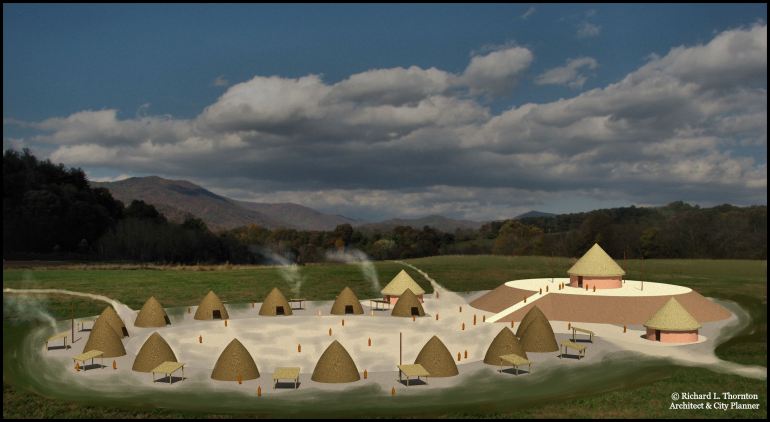
The Robertstown Mound
The Deptford Culture in Georgia
This Late Archaic-Early Woodland Period culture gets its name from a mound on the eastern edge of Downtown Savannah, which was excavated by archaeologists Arthur Kelly, Joseph Caldwell and Antonio Waring. The largest Deptford Culture mounds are the gold-bearing regions of northern Georgia, however.
Very few Deptford Mounds have been radiocarbon dated. Their initial construction has been presumed by archaeologists to have been in the range of 1200-1000 BC. Around 1200 BC, a tsunami or hurricane completely inundated Denmark and the coastal plains of Skåne Province, where Landskrona is located. The Deptford Culture evolved into other cultures around 500-400 BC, but the later cultures continued its burial traditions.
Archaeologist Robert Wauchope excavated one of the largest Deptford Culture mounds in 1939. It and a burial mound were located on the west side of GA Hwy. 75, near its intersection with GA. Hwy. 255 in Robertstown, GA (immediately north of Helen). The highways crossed the western edge of a large town, which was almost continuously occupied until 1821. The last known name of the town was Cho’i-te, an Itza Maya word.
Wauchope excavated artifacts that could have easily been on exhibit at the Landskrona or County Kerry Museums. Scandinavians primarily used stone and wood tools until the Iron Age. Unfortunately, the only knowledge that we have of them are a few sketches and the verbal descriptions in a technical book that Wauchope published in 1966. No one seems to know what happened to the thousands of artifacts that he unearthed in North Georgia during 1939 and 1940.
In 1995, Georgia archaeologists rammed through a law that restricted access to the state’s archaeological site registry to self-styled professional archaeologists. Formerly, local and regional planning offices had access to this critical document, which they reviewed prior to approving proposed real estate developments. Archaeology is NOT a licensed profession.
The perpetuators of this stupid law thought they were creating jobs for themselves. What instead they caused was a continuing massacre of official archaeological sites by local governments and private developers in most of the state. Few people know where these sites are. If a sympathetic local official does find out the presence of an official site, it is too late for anybody to prevent its destruction. Involvement of archeological consulting firms is only mandatory in state and federal funded projects. Even then, sub-contractors will do things like excavate mounds then sell the “top soil” to the GA DOT.
A few years ago, the City of Helen, GA leveled the mounds, containing ancient burials, in Robertstown to create a gravel parking lot for people, tubing down the Chattahoochee River. A slew of federal and state laws were violated, but very few people to this day even know that they destroyed 3,000+ year old mounds. Even they did, there is no one in much of the state, enforcing those laws. The number of actively practicing, professional archaeologists has collapsed to a handful of people in Georgia.

Stairwell passage to underground tomb at Palenque – Temple of the Inscriptions

Sarcophagus of King Pakal – Temple of the Inscriptions – Palenque, Chiapas
Continuance of the underground burial tomb tradition
With the notable exception of the Roman catacombs, construction of log-or-stone walled underground burial chambers pretty much ended during the Iron Age in Europe and the Middle East. The tradition continued in several parts of the Americas until the arrival of European invaders in the 1500s. However, the Mexica (Aztecs) and builders of Cahokia Mounds often placed numerous sacrificial victims under the foundations of temples.
The earthen pyramids of Alabama, Georgia, Tennessee, North Carolina and South Carolina typically were erected over the tomb of a founder or an important leader. This also the custom of the Mayas.

This photograph was taken by Dr. Arthur Kelly the day in August 1956, when an archaeological team led by Dr. Lewis Larson discovered the famous male and female marble statues underneath Mound C at Etowah Mounds National Landmark.
Larson’s team were removing soil from around the stone walls of a rectangular temple, when they discovered loose soil underneath it, which belonged to an older wood-framed temple. That temple was built around an even older, log-walled chamber like those found in Neolithic and Early Bronze Age Scandinavia.
The weight of dirt added on top of the decomposed wood chamber caused its roof to collapse, which knocked the famous statues off of an altar. The archaeologists were shocked to discover the bones of four humans intentionally scattered in disarray on the floor of the temple chamber. There was no obvious reason why this was done.

In the mid-1990s, the Etowah Mounds Museum was remodeled under the supervision of a team of University of Georgia anthropology professors. Some were simultaneously “consultants’ for entities that wanted to build a Cherokee gambling casino near the museum. The findings of the big state-funded excavation of Etowah Mounds in the mid-1950s were greatly distorted in the “renovated” museum.
Visitors were told that no one had ever lived at the site before around 1000 AD, when locals began to congregate there. They then learn that there were three occupations until 1585 AD. They were not told that the largest mound looked very different in 1817, when first viewed by a scientist from Yale University. It has been severely altered by amateur art collectors and Union soldiers! Native American invaders (aka Cherokees) supposedly attacked the town in 1585 AD and eventually burned it to the ground. In haste, the marble statues were dropped in a shallow log tomb and chipped each other in the fall. Cherokees continued to live on the site until 1838.
Thereafter, both Georgia anthropology students and visitors to Etowah Mounds were told that Doctors Kelly and Larson never produced a report on their archaeological dig. That’s a bald face lie like the one about the statues being buried at the top of the mound. There were several occupations of the site prior to 1000 AD, while Apalachete-Creek elite lived there from around 1585 until around 1700 AD. The town was abandoned because of horrific smallpox plague. The first Cherokees arrived at the Etowah River around 1795, but never lived anywhere near the mounds.
The Etowah Mounds Museum is now closed while a team of Creeks from Oklahoma and Gen-X’ers from Georgia remove all artifacts that came from burial mounds and then come up with a new version of the museum. It is very likely that no one involved ever met Dr. Kelly and Dr. Larson or are aware that they actually did publish a report. I feel extremely blessed that as a Georgia Tech architecture student, I got to spend an afternoon with Kelly and Larson, touring the site . . . before it was repeatedly altered by people with a political agenda.
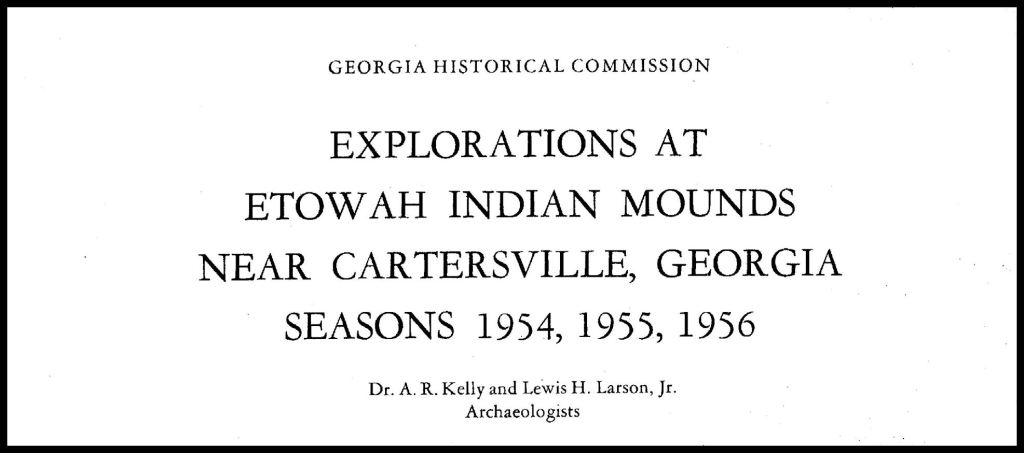
For stubborn archaeology truthers out there, I have good news! I have a copy of the Etowah Mounds Archaeological Report and Dr. Kelly gave me another copy to give to Dr. Román Piña Chan at the Museo Nacional de Antropologia de Mexico. You’re not getting my copy, but you can fly down to Mexico City and read the other one at the museum’s library.
The truth is out there somewhere and in Mexico City!
 The Americas Revealed
In 1972, I was in my second year of college, in North Carolina. This regional history connects with my personal and family history. There has been a lot of mixing and melding going on, and it continues today. Glad you are striving to connect some dots . . .
LikeLiked by 1 person
Comment forwarded from J. M. – You may know there is a place up here in New England called ‘America’s Stonehenge’. It is a little complex of stone structures. The biggest of these I think has an area with a kind of gutter than is paved over with flat stones. It is kind of set into a hill, so I imagine it was to keep the floor dry.
Anyway, way back when, not long after I had noted this little sort of gutter feature in this stone complex, I was on vacation in Ireland. In a place called the Dingle Peninsula we stopped off at a stone complex that was in some old woman’s backyard. She charged people one euro to get in. It had a sign that it was some kind of European Cultural Heritage Site or something.
As we were looking around, I came across the exact same covered over stone gutter as I had just seen in NH a few weeks before.
LikeLike