It was at a time when the dream of an egalitarian republic seemed lost!
Veterans Day ~ 2024
by Richard L. Thornton, Architect & City Planner
Georgia was the first and only state, declared to be “pacified” by the British government. Redcoat victories and occupation troops had forced it back to the status of a submissive colony. Most of Georgia’s Continental Line and State Militia had been killed or captured, when the British seized Savannah, GA on December 29, 1778 and Charleston, SC on May 12, 1780.
The majority of the residents of Georgia had been pressured to take the oath of allegiance to King George III in order to conduct their business, farm their lands or even stay in their homes. Continued resistance to the overwhelming wealth and power of the British aristocracy seemed futile. With a price on their heads, members of the Provisional State Government scattered to hiding places in the Northeast Georgia Mountains, where they were given sanctuary by the Pro-Patriot Creek, Uchee and Soque Indians living there.
During 1779 and early 1780 a new Georgia Militia had been recruited by Major Elijah Clarke. It had won a few battles, but by September 1780, Clarke had led his men out of Georgia to a remote section of North Carolina. Their continued presence in Georgia seemed hopeless.
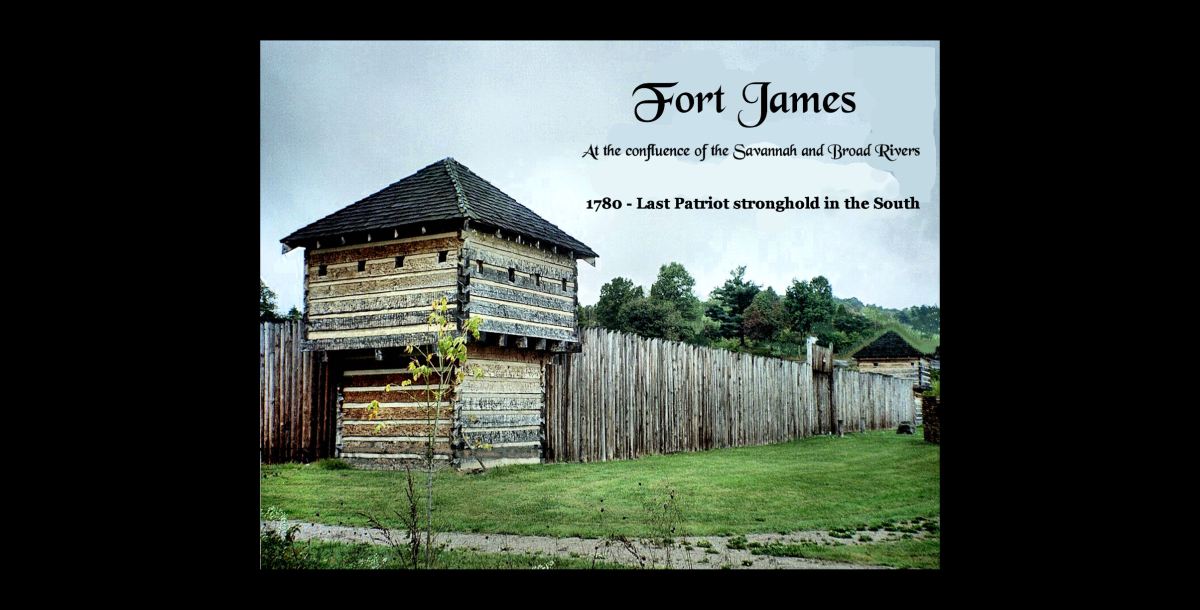
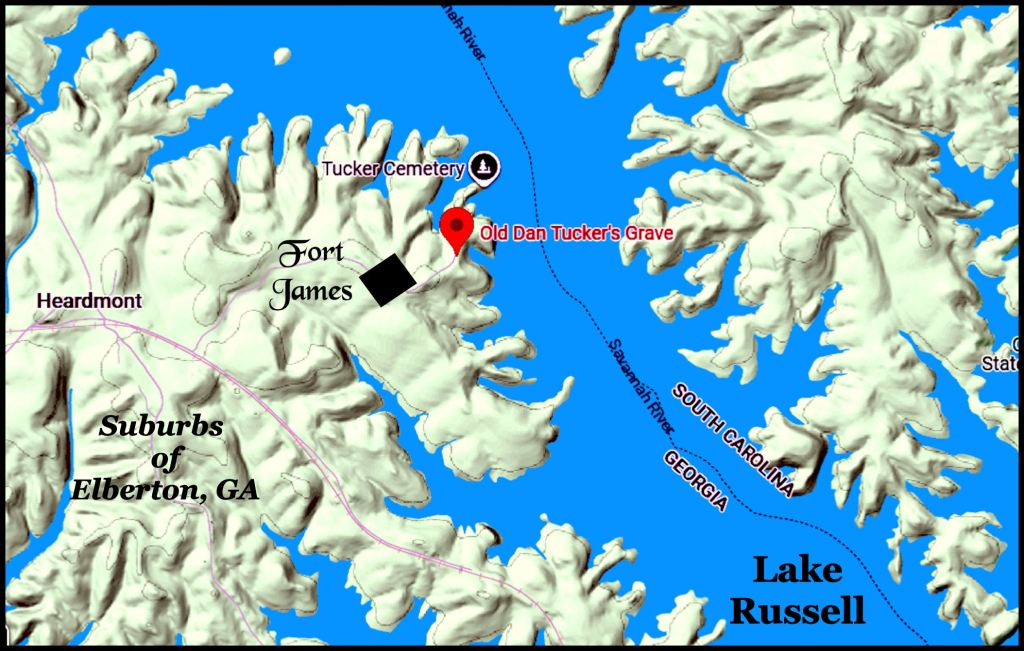
All that remained of the Free State of Georgia was a narrow band of land that stretched from the Pro-Patriot Creek town of Tuckabatchee* on the Chattahoochee River . . . where Six Flags Over Georgia is now located . . . to Fort James on the Savannah River . . . then northward 50 miles (80 km) to Fort Clarke along the Tallulah River, which marked the boundary between the Creek and Cherokee Nations.
This seemingly doomed territory was guarded by an informal alliance between a couple hundred pro-Patriot Creeks, Mixed-Bloods and Anglo-Americans. They were untrained frontiersmen, still loyal to the dream of a new kind of republic . . . an egalitarian society. For almost two years, there was no state government in Georgia to at least give these men (and one famous woman) the legitimacy of a uniformed militia. Under European rules of war, the British could have hung or shot them without a trial, after they were captured. That was often the fate of prisoners, if the Tories won a battle.
* The original site of Tuckabatchee had been on the Chattahoochee River, where Six Flags Over Georgia is now. During the 1700s, a colony on the Tallapoosa River in present-day Alabama had grown to become the main town. On the outbreak of the American Revolution, Tuckabatchee became allied with the Patriots, but was dangerously close to the Upper Creek towns, allied with the British. Therefore, in 1776, Tuckabatchee moved back to the Chattahoochee River to be near other pro-Patriot towns.
Crackers – Illegal immigration from South Carolina!
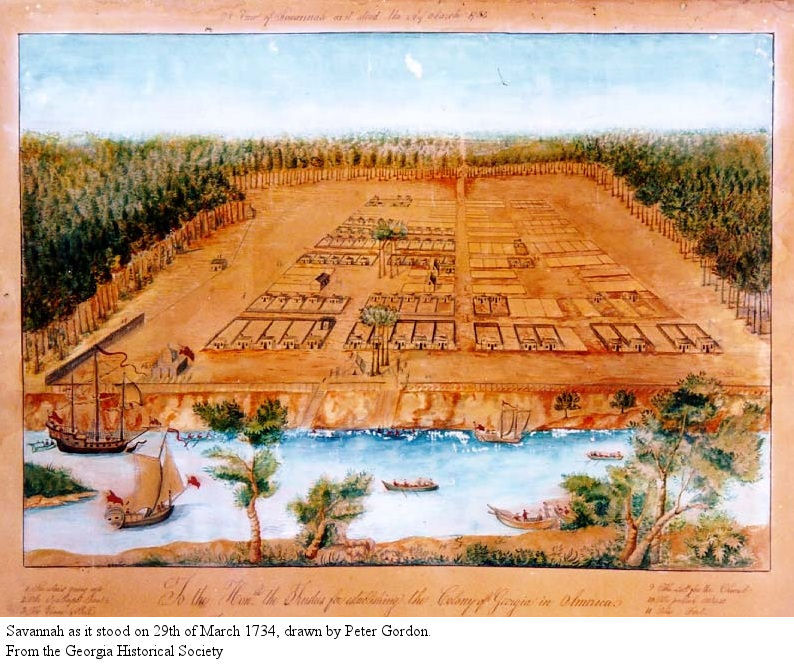
General James Edward Oglethorpe, Supervising Trustee of the Province of Georgia, is considered one of the pioneers of modern city planning. His work in Georgia is studied by architecture and planning students around the world. His plans of Savannah are even studied by high school Civics students in Sweden.
One of Oglethorpe’s many innovations was a terminal for processing all ship’s crews, passengers and potential immigrants, plus any animals aboard the ships. Before being allowed to walk the streets of Savannah, all humans were interviewed by an official and inspected by a doctor. All animals were inspected on board ships for any signs of disease. Those that seemed to be healthy were allow to embark, but were kept in quarantine pens for several weeks, so that provincial officials were certain that they would not introduce a disease into the colony.
This system worked well until the chaos of the French and Indian War and an incompetent Royal Navy Captain, named John Reynolds, turned Royal Governor. Legally emancipated and escaped indentured servants in the Carolinas learned of a place on the Savannah River, 76 miles (122 km) north of Augusta, where the water of the Savannah River was usually shallow enough to be traversed by wagons and livestock. There were no law enforcement officers north of Augusta. Georgia owned a narrow strip adjacent to the river.
Beyond the provincial corridor was a thinly populated territory of the Creek Confederacy, where many non-British or mixed blood families had lived long before the arrival of the British. Illegal immigrants began pouring across what is now called Colonists Crossing. They committed unpunished crimes and introduced diseases to the region.
The Creek Capital, Koweta, was located 205 miles ( 330 km) to the southwest. Its leaders were getting increasingly angry over the presence of lawless squatters on their land. The squatters had brought sick livestock with them, which almost overnight exterminated the Woodland Bison and Elk herds. Many deer and Creek-owned cattle were also dying.
Henry Ellis, the new Royal Governor of Georgia in 1756, was Anglo-Irish. He called the squatters, Crackers . . . a term used by the Anglo-Irish for Gaelic Irish. The Irish word craic is pronounced like “crack” and is a slang term that means a good time, fun or casual, friendly conversation. The pejorative label, Georgia Crackers, stuck.
One of Ellis’s first acts was to sign a new peace treaty with the Creek Confederacy, whereby the British promised to stop the flow of squatters. Ellis dispatched a troop of Redcoat Dragoons to guard the Colonist Crossing.
Then in 1757, the Cherokees suddenly went on the warpath and were massacring farmsteads on the Carolina frontiers. The Koweta Creeks had thoroughly crushed the Cherokees in 1754, ending the 40 year-long Creek-Cherokee War.* Thirty-two Cherokee chief had been executed by the Kowetas. All Cherokee villages, south of the Snowbird Mountains had been burned. The Cherokees would not dare attack Georgia, as long as the Creeks were its allies.
Governor Ellis created the Georgia Rangers to bring law and order to the frontier, plus protect it from Cherokee attacks. They would be patrolling both British and Creek-owned lands. Most of the Rangers were either recent Irish immigrants or mixed-blood Creeks. This is when my mother’s Creek ancestors settled near the campground, where the Redcoat Dragoons had been stationed. Some of the Creek men became Rangers Soon, that lookout point became a fort, named Fort James.
*There are several state historic markers in northern Georgia, which describe several different ways that the Cherokees “captured all of North Georgia.” They are all pure late 20th century fiction! There were very few ethnic Cherokees living in Georgia until after 1784. That’s when Georgia secretly gave them the Creek and Chickasaw lands in what is now northwest Georgia. Creek farmsteads and villages, plus those of the Chickasaws and Uchees in their confederacy, continued to occupy lands as far north as Yonah Mountain until 1818.
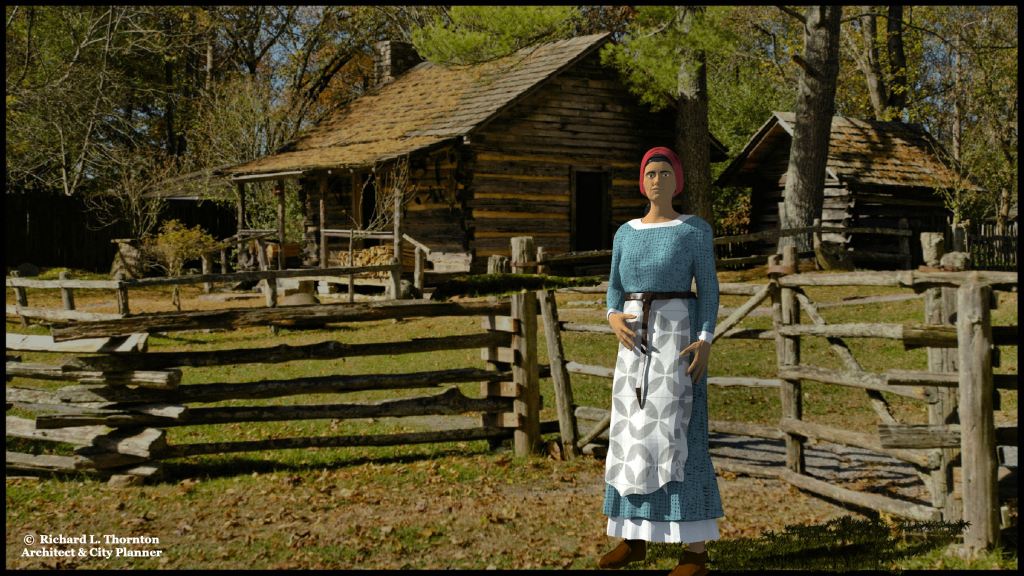
My gggg-grandmother Mahala, Creek-Uchee wife of Sgt. Jack Bone, a scout with the Georgia Rangers. Four more generations of Bones would name one daughter, Mahala, which means “teacher.” The last Mahala was my grandmother. The famous leader of the Creek Mounted Rifles in Oklahoma, Tiger Bone, was a descendant of this Mahala.
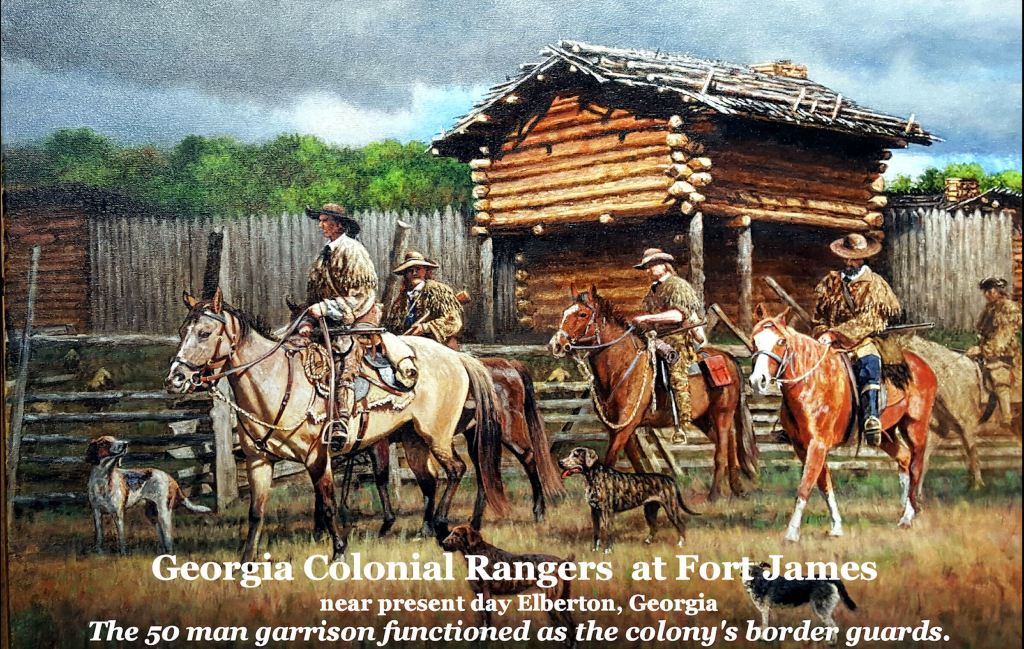
Fort James
A description Fort James was written by explorer William Bartram in the spring of 1776. Bartram stated that it was located on the point of land lying between the Savannah and Broad rivers, about equally distant from each of the streams and from the point of their union. When it was the last bastion held by Patriots, during the darkest days of the Revolution, it was renamed Freemen’s Fort.
The stockade was an acre in extent, with ‘salient bastions at each angle, mounted with a blockhouse, where are some swivel guns, one story higher than the curtains which are pierced with loopholes, breast high, and defended by small arms.”
At the time of Bartram’s visit the place was garrisoned by fifty Georgia Rangers, well mounted and armed. Located as it was upon an eminence, it commanded the two rivers, as well as a considerable scope of the surrounding country.
Royal Governor James Wright was so popular in Georgia that he was invited to remain in Savannah as chief administrator of the State of Georgia, when the American Revolution broke out in 1775. He declined the offer.
During the first year of the American Revolution, the Georgia Rangers were loyal to Governor Wright, but fought the Cherokees, when they attacked the South Carolina frontier without warning in 1776. The Rangers then furnished Creek scouts, including my ancestors, to guide the Continental Army’s march into the North Carolina Mountains to neutralize the majority of Cherokees. The Georgia Rangers were outraged when they learned that the British Army had bribed the Cherokees to attack the frontier. Almost all of the Rangers changed sides at that point.
Georgia was the first and only state, declared to be “pacified” by British government back to the status of a submissive colony. Most of its Continental Line and State Militia had been killed or captured, when the British seized Savannah, GA on December 29, 1778 and Charleston, SC on May 12, 1780.
The majority of the residents of Georgia had been pressured to take the oath of allegiance to King George III in order to conduct their business, farm their lands or even stay in their homes. With a price on their heads, members of the Provisional State Government scattered to hiding places in the Northeast Georgia Mountains, where they were given sanctuary by the Pro-Patriot Creek towns there.
During 1779 and early 1780 a new Georgia Militia had been recruited by Major Elijah Clarke. The new militia, had won a few battles, but by September 1780, Clarke led his men out of Georgia to a remote section of North Carolina. The British assumed that all of Georgia and most of South Carolina were “pacified,” so were sending Cornwallis’s army north to help crush George Washington’s army.
All that remained of the Free State of Georgia was a narrow band of land that stretched from the Pro-Patriot Creek town of Tuckabatchee* on the Chattahoochee River, where Six Flags Over Georgia is now located to Fort Clarke on the Savannah River then northward 50 miles (80 km) to a line of Patriot blockhouses along the Tallulah River, which marked the boundary between the Creek and Cherokee Nations. It was guarded by informal alliance between pro-Patriot Creeks, Mixed-Bloods and Anglo-Americans, loyal to the ideal of a new, egalitarian nation.
*The original site of Tuckabatchee had been on the Chattahoochee River. During the 1700s, a colony on the Tallapoosa River in present-day Alabama had grown to become the main town. On the outbreak of the American Revolution, Tuckabatchee became allied with the Patriots, but was dangerously close to the Upper Creek towns, allied with the British. Therefore, in 1776, Tuckabatchee moved back to the Chattahoochee River to be near other pro-Patriot towns.
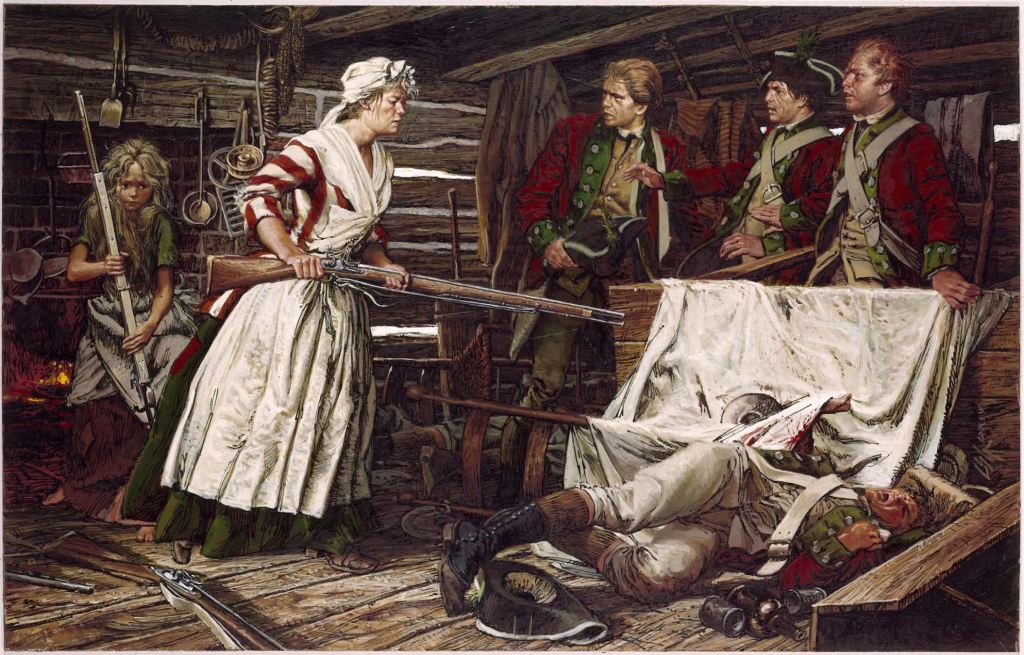
Nancy Hart the War Woman
Around 1770, Benjamin and Nancy Hart moved from the Yadkin River Valley in North Carolina to the growing mixed-ethnic community near Fort James. Benjamin became Georgia Rangers. When the allegiance of the Rangers shifted the Patriot Cause, Benjamin became a Lieutenant in the Georgia Militia, under the command of Major Elijah Clarke. You will read in most reference articles that Nancy’s Creek Indian neighbors called Nancy . . . War Woman. Those Creek neighbors were my ancestors!
The British made one concerted attempt to capture what was now Freeman’s Fort in February 1779. At first Major Clarke planned to make a last stand there, but then sent word to other Patriot Militia units to converge on a large Loyalist Militia army heading north to occupy the promontory above Colonists Crossing.
Somewhere between 340 and 450 Patriot militiamen from Georgia and South Carolina essentially surrounded 600-700 Tory militiamen near Kettle Creek in Wilkes County, GA. The battle turned into something a rout after the Tory commander was mortally wounded by a band of Patriot militia, who became lost then stumbled into the heart of the Tory camp. It was the FIRST Patriot victory in Georgia. Benjamin Hart was definitely there. Tradition has it that Nancy was also there.
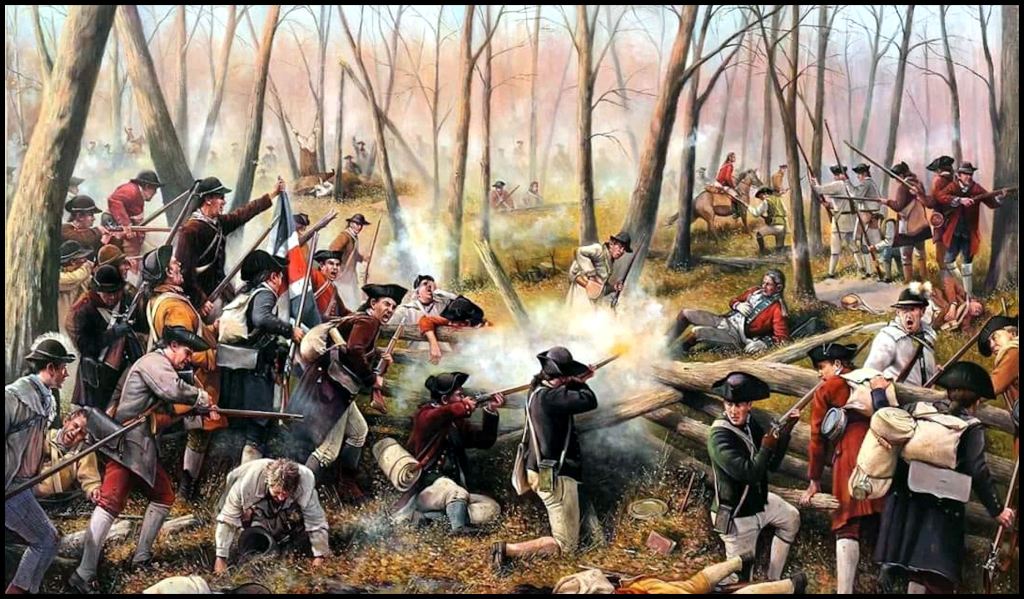
Battle of Kettle Creek
Nancy Hart had many adventures, while serving as a spy for the Patriots. However, she is best known for a battle fought inside her own home. In was during the darkest hours of the Revolution, when Clarke’s men, including Benjamin Clarke, had left the fledgling state. Bands of Tory Militiamen were ranging the entire countryside, even the former free zone, hunting down the last few Patriot militiamen in the state. A haughty six-man Tory patrol entered Nancy’s house, looking for a Patriot militiaman, running for his life.
The haughty Tories shot Nancy’s prized gobbler turkey and ordered to her to cook him. They demanded something to drink so she filled them full of wine. While they were becoming intoxicated, she handed their loaded muskets to her daughter through a window. She ended up shooting two of the Tories and with the help of neighbors, hanging the other four. A railroad construction crew discovered the six buried skeletons in 1911.
The small log cabin on the Hart Historic Site today is inaccurate. It was built by Civilian Conservation Corps members during the 1930s. The Harts were a prominent, affluent family with eight children. Their log house would have looked like the large, two-story, log houses that I worked on as an Architect in the Shenandoah Valley. These were featured in an earlier article during 2024.
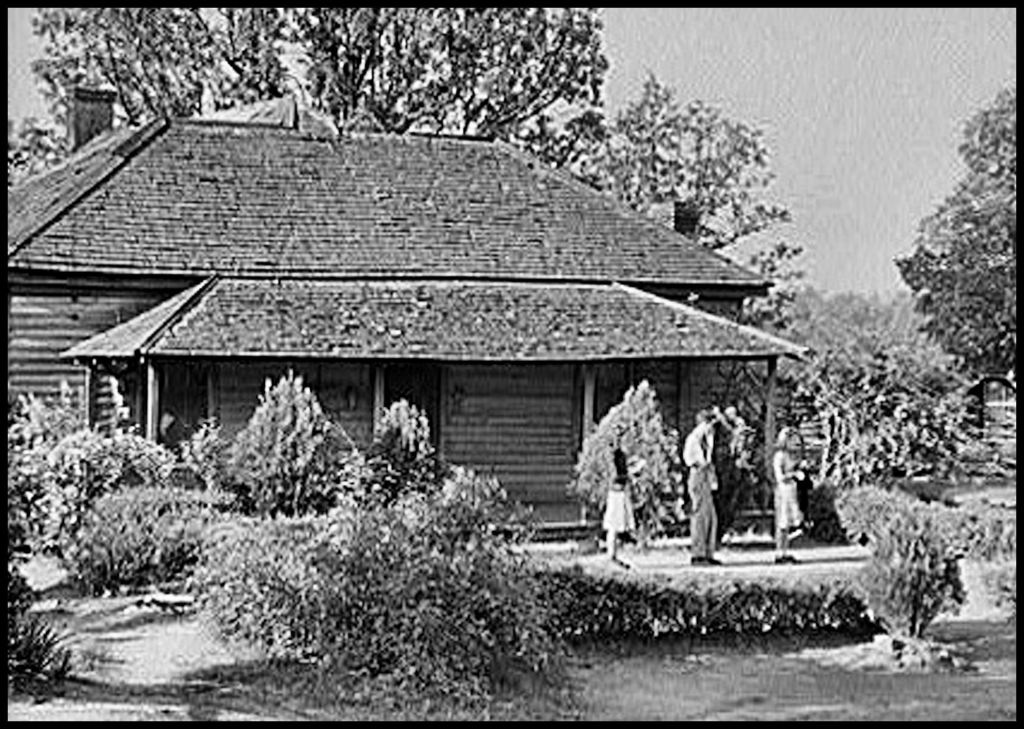
A farmhouse in Dewey Rose, GA where we often held family reunions, which also celebrated the Green Corn Festival. We stopped having this beloved Creek Indian tradition, when my grandmother’s generation died out. Everyone was scattered to the winds.
Only land owners could vote
Why would the few remaining Patriot militiamen continue to fight the British and Tory troops without any pay or outside support for two years? With the British offering amnesty to most rebels, who voluntarily surrendered outside of battlegrounds, it seems quite illogical.
Since the 1990s, it has been popular for revisionist historians to claim that the American Revolution really wasn’t a revolution, but merely a war of independence. Yes, it was a revolution! The British Isles were ruled by a wealthy aristocracy getting wealthier. England, Wales, Scotland and Ireland were composed primarily of arrogant landlords and barely getting-by renters, who could not participate in any elections.
Only owners of substantial tracks of land or large urban houses could vote in Great Britain. The same laws applied to the British North American colonies, but the difference was that it was quite realistic for most white men to buy a tract of land somewhere. These land men standing in the northern edge of Georgia were fighting for land they and owned and the right to be full citizens!
It is interesting that the people of South Carolina and Georgia were rather indifferent to the growing calls for change until 1773. That year, the British government banned the importation of yaupon tea from the American colonies, heavily taxed the yaupon tea shipped from southern colonies to northern ones and gave preference to Asian tea, imported by the East India Tea Company. Until that time, the only tea most Englishmen knew, came from the Carolinas and Georgia.
It was no accident that the East Indian Tea Company was owned by King George III and the highest-ranking nobility of Great Britain. Those parliamentary laws effectively killed the formerly booming indigenous tea industry in the British Colonies and it never came back.
Southerners quickly realized that increasingly in the future, their economic condition would be at the whim of a handful of ultra-wealthy families in England, who controlled Parliament and the courts. Of course, such a thing would be unthinkable now in the United States, wouldn’t it? These brave patriots were willing to put their lives on the line and fight to the last man so their children would not have to live in a world controlled by a few rich familes.
In 1789, Georgia became the first state to remove land ownership for the right of free male citizens to vote. In 1798, Georgia became the first state to remove the payment of a poll tax for the right of free males to vote. At that time, Native Americans and mixed bloods living outside of tribal boundaries were considered full citizens. Throughout the Colonial Period, the provincial government had encouraged the intermarriage of whites and Creeks, so mixed blood offspring were quite common.
By autumn of 1781, the Continental Line and state militias had driven the British troops out of all of their forts. Lord Cornwallis had surrendered an entire army at Yorktown, VA. British occupation was confined to pretty much, just the provincial capitals of New Bern, NC, Charleston, SC, Savannah, GA and St. Augustine, FL. The 13 rebelling colonies had defeated the most powerful army in the world.
Unfortunately, the Upper Creek and Alabama Creek allies of the British continued to attack both white and Eastern Creek farmsteads in Northeast Georgia until 1794. There were no significant cultural differences between the descendants of the Kingdom of Apalache and Pro-Independence Europeans. Both peoples considered themselves to be Christians. Eastern Creek communities invited educated European families to live among them and also to intermarry with their offspring. Many Creek families, such as my mother’s family continued to quietly practice traditions such as the Green Corn Festival until the late 20th century, but we no longer had any political ties to the Creek Confederacy. A little-known fact is that more Creeks stayed in Georgia than were forcibly removed first to Alabama and then to Oklahoma. This dichotomy was created by divided loyalties of the Revolutionary War era.
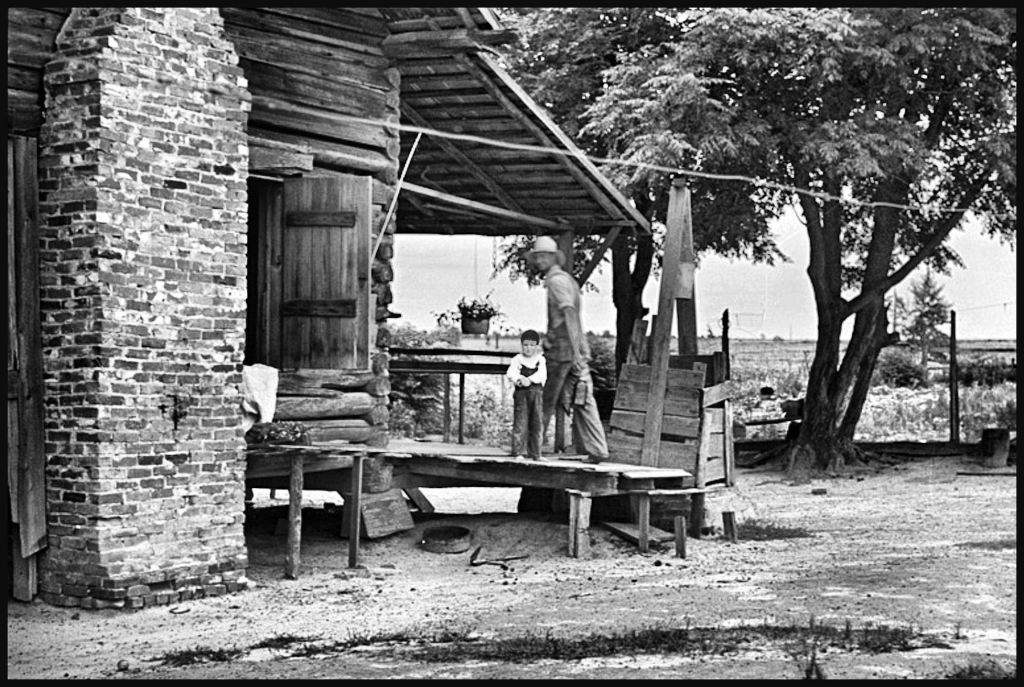
Mid-20th century photo of one of the Bone family farmhouses. Many of my relatives still used old fashion wells with buckets, plus kept their chickens under the house, when I was growing up. The little boy might be me, since I had a broader head than most of my mother’s family. The photo was in a album that my mother kept in the 1950s.
Old Dan Tucker
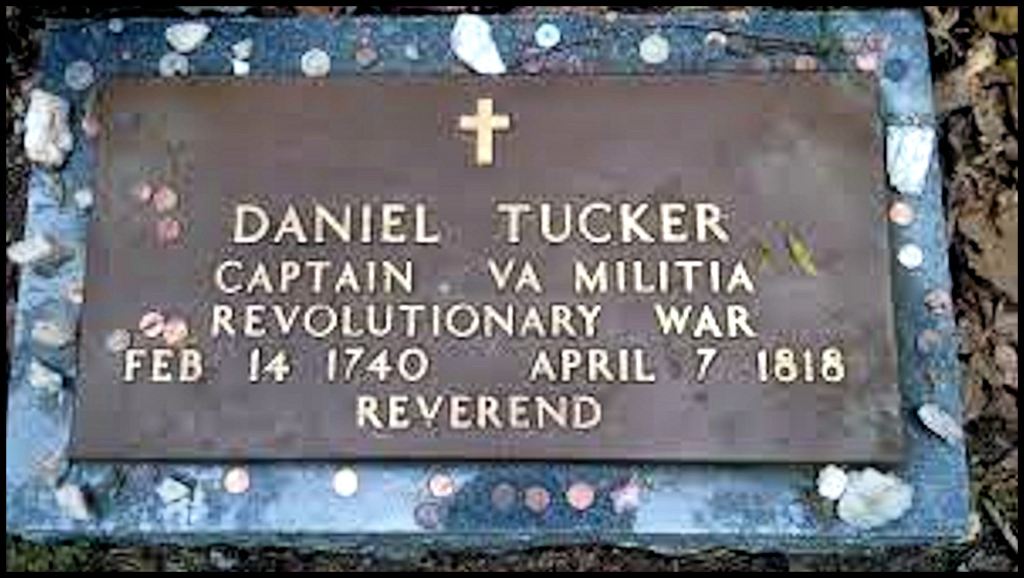
Most everyone has heard the folk song, “Old Dan Tucker.” He was a real person, but not some sort of scoundrel as the song would have you believe. He owned a plantation near the site of Fort James and was also a Baptist preacher. You can visit his grave and the site of his house in Elbert County, GA near the site of Fort James.
At the close of the Revolution, the state of Georgia began offering free farmland and/or house lots to all veterans and widows of veterans. Thousands of Virgnia veterans moved to the region near old Fort James. One of those Virginia veterans was Captain Daniel Tucker!
Now you know!
+

