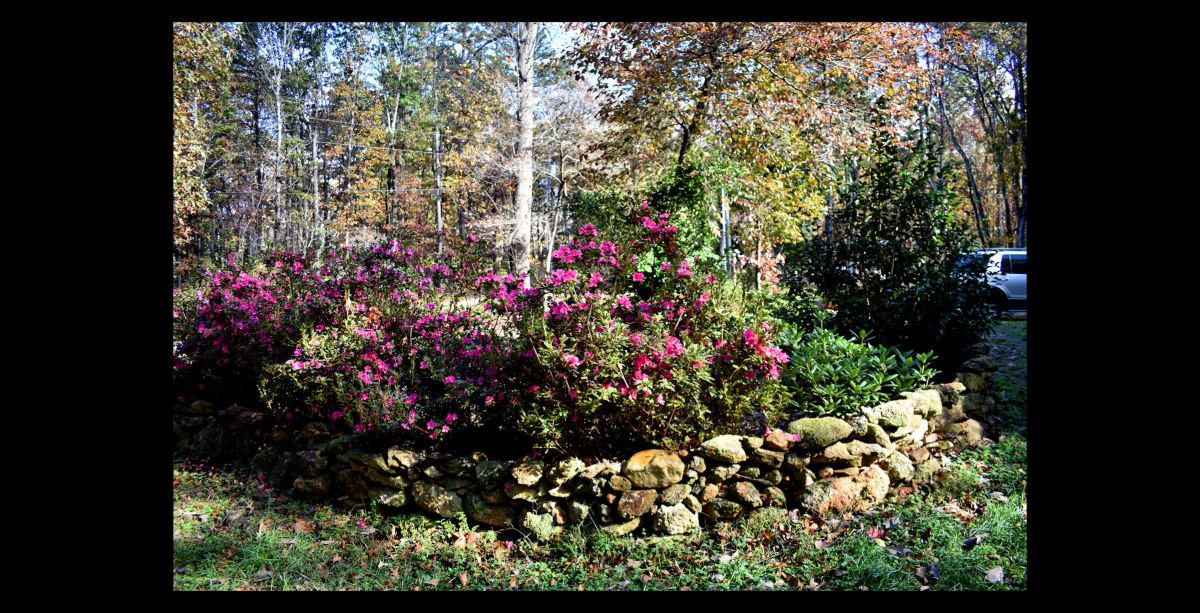
There is definitely a radical change in the climate from western Maryland to northern Georgia, In just three decades the growing season in the Southern Appalachians has lengthened about three months! I am still harvesting Roma tomatoes, Fordhook lima beans, rosemary, sage, basil and turnip greens from my garden! We have not had a “killing frost” this autumn and none is forecast for the remainder of November!
by Richard L. Thornton, Architect & City Planner
Image Above: Both photos of the azaleas were taken on November 15, 2024. These azalea shrubs are about 7-8 feet tall. The camellia tree on the right is about 12 feet all.

These azalea shrubs are about five feet tall.
The media continues to give undue attention to ignoramuses, who claim that climate change is a a delusion of wussy Libruls. Unlike them, I am a real farmer from a family, whose Native American ancestors were farming in southern Mexico thousands of years ago. In fact, one year I was named U. S. Soil & Conservation Service Farmer of the Year, and had my photo on the cover of several farming and rural life magazines. I am going to give you some examples how the climate has changed in the Southern Highlands.
- In 1567 AD, the Juan Pardo Expedition arrived at the edge of the Blue Ridge Mountains in northwestern South Carolina to find all the trails in the mountains were blocked by heavy snow. They could not pass into the mountains until late March 1568.
- The traditional Creek Indian name for the mountains in northern Georgia and northwestern South Carolina is “The Snowy Mountains.” Until the early 1800s, during the winter months, moist air from the Gulf of Mexico collided over the Snowy Mountains with Jet Stream air from Canada, which caused constant frequent heavy snow storms.

The Battle of Toms Brook . . . between Brig. Gen. George Armstrong Custer, USA and Maj. General Tom Rosser, CSA was fought on my former farm in the Shenandoah Valley on October 9, 1864. The ground was frozen and it was snow flurrying. This year the trees and grass were green at that farm on October 9.

Our farm on October 9, 1991 ~ The trees are just beginning to change color after a frost
- On both my farm near Asheville and in the Shenandoah Valley the first “killing frost” occurred around October 7th each year. The Virginia farm was 1750 feet lower in elevation. However, in 1985 (North Carolina farm) our last spring frost was on June 6th. We had snow flurries that day. The first killing frost that fall was on September 6th. On January 15, 1985, the temperature dropped to -25 F. and stayed around 0 F. for about a week.
- When I was attending Enota Elementary in Gainesville, GA (Blue Ridge Mountain Foothills) we had several snows each winter, deep enough for sledding, plus building snowmen and snow forts. In March 1961, we had 4-6″ snows every Wednesday.
- Both at the North Carolina and Virginia farms, the ground generally froze in early November and thawed in late March or early April. There was sufficient snow on the pastures during the winter for me to go cross country skiing in the pastures most days. On November 3, 1987, we had 12″ of snow on the Shenandoah Valley farm.

Christmas Day 1979 – This was our first Christmas at the old North Carolina mountain farm. I had expanded the living room to include the former area of the front porch, but had not started the major construction project of adding a two story wing to the house and building a large two-story barn.
The last White Christmas in the Georgia Mountains was in 2010, when I was living in a Chicken House. The Track Rock area received 10″ of snow that Christmas Day. On both the North Carolina and Virginia farms we had a white Christmas every year. Since I moved to this mountain crest home in Northeast Georgia in 2018, there have been no White Christmases here, in the Asheville Area or in the Shenandoah Valley.

Vivi, my French Soulmate, dressed as Santa’s Little Helper at my Shenandoah farm on December 19, 1990. It snowed again on Christmas Day and on New Years Eve. This photo captured a magic day in both our lives. I thought I would never see her again, after driving off from my friends’ home in Alexandria, VA on Dec. 16. She had been through a horrible experience in Harvey Weinstein’s office at Miramax Studios in Los Angeles on Dec. 18th. On the flight back to Paris, she decided to quit the movie and music industries, then stop by to visit my farm. She had never been on a farm nor seen dogs outdoors, who were not on leashes. I had just baptized her, when she slipped into the Santa’s Helper outfit then stepped outside to start her new life, living with nature.

This is typically what the pastures at my Shenandoah Valley farm looked like from Christmas to late February. They were ideal for cross country skiing. On March 15, 1993, we had 37 inches of snow! We were completely snowed in for two weeks. I had to ski to Bakers General Store a mile away, just to get the items for meals that were not in our freezer.

After I moved to the cabin near Dahlonega, GA in 2012, I initially was able to cross country ski once or twice a year, but then the climate accelerated its warming trend. The last time that I have been able to ski in North Georgia was during one day in the winter of 2016. Now the Shenandoah Valley receives less snow than Gainesville, GA did, when I was young.
Perhaps the best indicator of how radically the climate has changed can be found in the booklet issued by the Agricultural Extension Office in Shenandoah County, VA. The one that I obtained in 1987 stated, “Shenandoah County is the driest county, east of the Mississippi River. It receives most of its precipitation in the form of snow or sleet in the winter. Summers are exceeding dry. Farmers must plan for feeding hay to livestock in July and early August.”
The current booklet reads, “Shenandoah County is the driest county, east of the Mississippi River. It receives most of its precipitation in the winter, spring and summer. July is the wettest month of the year. In recent years far less snow has fallen than the 22″ average over the weather records time period.”
The times are indeed a-changing!
 The Americas Revealed
The times certainly are changing Richard. Here in Crete we had the hottest summer known even the Greek people themselves were complaining as the temperature on the mainland reached 40 deg. It’s only just begun to cool down so of course I am wondering if we are going to have a bad winter. Even so, the English weather is even colder during the winter and not really all that warm in the summer. Also here in Crete we only get snow on the mountains. Have a good weekend.
LikeLiked by 1 person
Well, I learn something every day. I had no idea that it snowed anywhere in Crete. I also had no idea that any island in the Mediterranean Sea reached 40 C.
LikeLiked by 1 person
Here in the NC piedmont, I am enjoying spring flowers, azaleas, my elephant ears, cosmos, cornflower and more. The Google search led me to your article, published yesterday. I’ve lived in this house 24 years and in NC all of my 56 years and this is a first for me. Waiting for the daffodils to pop up any day now.
LikeLiked by 1 person
Yes, my elephant ears are still growing, too!
LikeLike